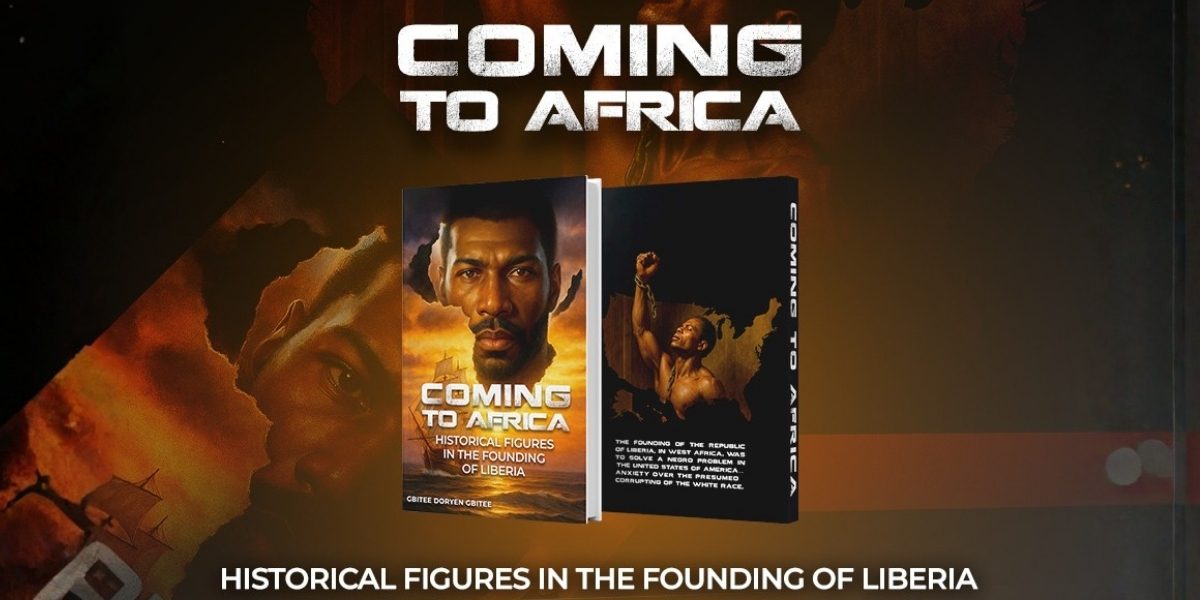

History is often told in terms of institutions, policies, and dates. But the deeper truth of history always revolves around humans. It is shaped by people who make difficult choices in uncertain times and take steps that can alter the fate of multiple generations. In Coming to Africa: Historical Figures in the Founding of Liberia, Gbitee Doryen Gbitee invites readers to revisit one of the most complex chapters in Black Atlantic history through the human lens.
Gbitee takes a unique approach when talking about Liberia and its history. Rather than presenting its foundation as a political project or a colonial scheme, he stresses that it was a convergence of longings, fears, ideals, and contradictions carried by individuals. He effectively portrays the hopes of freed Black Americans who were seeking dignity and autonomy at a time of high politics and racial discrimination.
What makes Coming to Africa especially compelling is its insistence on complexity. Gbitee does not give in to the urge to write plainly about heroes and villains. Instead, he shows how the same movement could be seen as containing both emancipatory potential and coercive logic. The Back-to-Africa idea provided some Black Americans with a chance to imagine political self-rule for the first time, even as it emerged from a society unwilling to accept them as equals, where deep racial divides and systemic oppression shaped the context in which these ideas were born and spread.
Gbitee’s background as a former production and circulation manager of a leading newspaper in Liberia is evident in his writing. He has worked with editors in the newsroom to produce objective news articles. His goal was to strive for balanced and factual news stories. Currently, he is a history student and researcher, deeply committed to uncovering diverse perspectives and exploring untold narratives. As a result, he has used thorough and careful research techniques in his book to trace how merchants, missionaries, politicians, and African leaders became participants in a shared, if uneven, historical moment that shaped Liberia’s development.
Another important point this book covers is the repositioning of Liberia within global history. Liberia is often treated as a marginal or exceptional case of African and American history. Gbitee works to challenge that framing by showing that Liberia’s story may reflect the larger questions about freedom, race, migration, nationalism, and belonging, which continue to resonate in contemporary global struggles. The founding of Liberia may reflect the unresolved contradictions of the 19th-century Atlantic world, where competing ideologies of freedom and Power were in constant conflict. As a result, the book has significant contemporary relevance. Gbitee writes with clarity and restraint, allowing the truth of the history to be clearly set forth. His prose is measured, accessible, and grounded in evidence, ensuring that readers can engage with complex ideas in a straightforward manner. The book’s 115 pages are not filled with jargon. In contrast, they offer valuable insight to the readers, prompting reflection on both past and present struggles. Each chapter builds patiently toward a more layered understanding of what it meant and still may mean to imagine a Black republic in a world structured by empire and inequality.
In doing so, Coming to Africa has become more than a book that offers a look into Liberia’s formation. It is a valuable depiction of how nations are born from the hopes and compromises of ordinary people, realizing when the time is right and taking action.
Moreover, Coming to Africa stands as an important contribution to African, African American, and diaspora studies. For readers who are keen to learn about the origins of Liberia and the transatlantic forces that shaped it, Coming to Africa: Historical Figures in the Founding of Liberia is an essential and informative read.