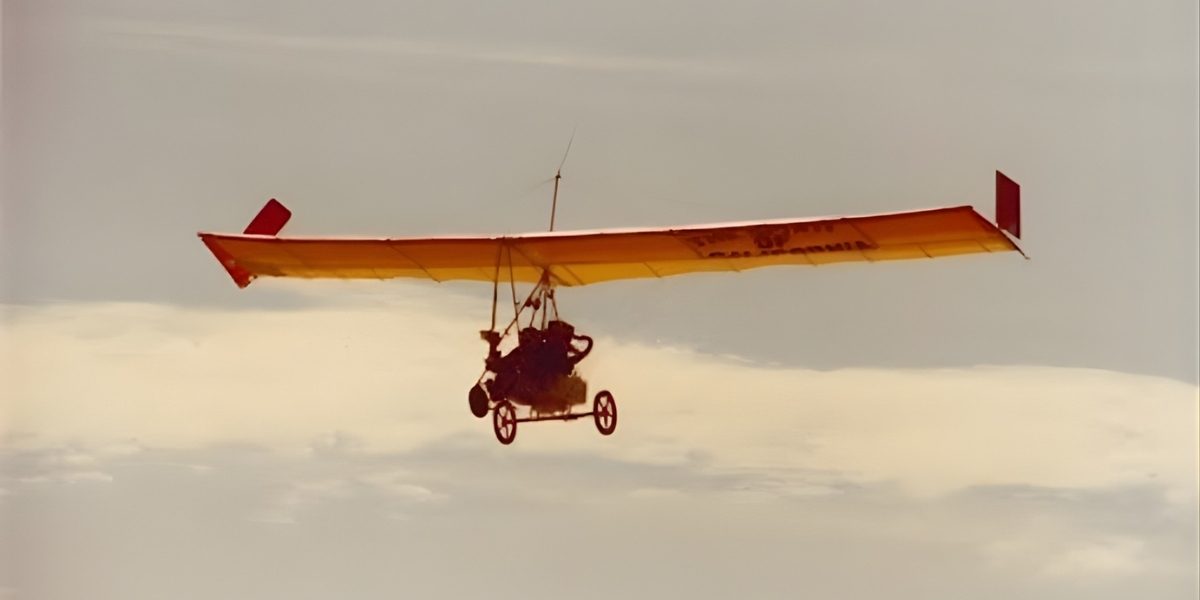

By: Eagle Sarmont
As told to Suheer Baig by Eagle Sarmont
The customs inspector looked at my motorized hang glider like I’d just landed a UFO on his runway. “You flew this here? From New York?”
“Not all the way,” I said. “Just up the Hudson, past Albany, over Lake Champlain. Then I called ahead to cross into Canada.”
“Called ahead.” He repeated it like I’d said something in Martian.
It was 1980. I was 28, and I’d spent months modifying a hang glider to carry enough fuel to fly from New York to Paris, island-hopping across the North Atlantic a couple of hundred miles at a time. The first few days had been perfect. I’d landed on golf courses where groundskeepers gave me gas and ladies gave me sandwiches. I’d flown with eagles, watched my shadow race across treetops at 70 miles per hour.
Then I crossed an invisible line, and everything changed.
When 45 Miles Per Hour Becomes an Invasion
The border between the United States and Canada is 5,525 miles long. From the air, you can’t see it. There’s no fence, no wall, no change in the color of the trees. But the moment I landed in Baie-Comeau, Quebec, that invisible line became very real.
Two Royal Canadian Mounted Police officers showed up with an Immigration officer who looked at my tiny fabric-and-aluminum hang glider and accused me of being a one-man invasion force. I had the phone number of the customs agent who’d cleared me to enter. It took three calls and a lot of badge numbers before they believed I wasn’t smuggling contraband.
Even after they confirmed I’d entered legally, the Immigration officer kept insisting I was a threat. The RCMP officers eventually had to escort him out of the room.
I sat there thinking: I almost started an international incident with a motorized kite.
The next morning, a Ministry of Transportation official from Ottawa showed up. He took one look at my American-made emergency gear and said, “We do not allow that here.”
I pointed at the Cessna on the runway. “That’s American.” “That’s different.”
A Boeing 737 was landing at that exact moment. I couldn’t help myself. “What about that one?”
The reporters who’d gathered loved it. The inspector did not. But the absurdity was impossible to ignore: every airplane at that airport was American-made except for one De Havilland Beaver sitting on blocks without wheels or an engine. The rule wasn’t about safety. It was about something else entirely.
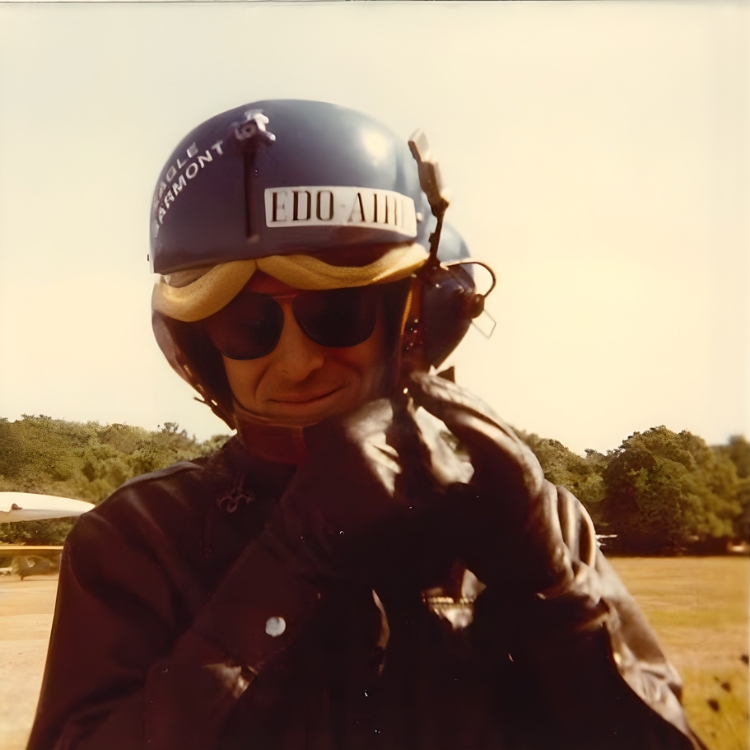
Photo Courtesy: Eagle Sarmont
The Rules We Invent
I spent years as an aerospace engineer working on F-18s and inventing concepts for reusable rockets that eventually became the backbone of the commercial space industry. All that technical knowledge didn’t help me understand why an inspector would reject safety equipment simply because it was made on the wrong side of a line.
The answer has nothing to do with logic. Borders exist because we’re scared of the other, of losing what we have, of change. The officials enforcing those borders are carrying their own fears, too. Scared of making the wrong call, scared of their bosses, scared of the person who doesn’t fit neatly into the boxes on their forms.
My hang glider didn’t fit in any box.
Trying Again
I tried again in my 50s, after my wife died and I needed to find out if I could still feel joy. This time I made it, flew across the United States in an ultralight, took a cruise ship to Iceland, flew around that land of fire and ice, took a ferry to Denmark, and flew from Denmark to Paris.
But this time I had papers. Registration, an airworthiness certificate, and an N-number on my tail identifying me as American. That created its own problems.
In Denmark, I needed a local inspector to approve my aircraft. My pilot friend Ella knew the guy. “He is a bit of, how you say, butt head,” she warned. When he showed up with flowers for Ella, his smile disappeared the moment he saw me.
“I do not inspect microlights,” he announced.
“It’s a homebuilt aircraft with an American airworthiness certificate,” Ella said calmly.
What followed was spectacular. The inspector’s face went red, his hands clenched and unclenched. Ella, never one to back down, threatened to invite me to stay at her house and “have sex with him all day long and all night long until he leaves” if the inspector didn’t approve my plane. He finally stamped my paperwork, beaten.
Later, Ella explained: the inspector had been her childhood friend, the boy she’d loved. But his grandfather was a Nazi who’d poisoned his son, who’d poisoned his grandson. “From generation to generation, the disease gets passed on,” she said quietly.
That’s when I understood something I’d missed the first time. The people enforcing borders aren’t just following rules. They’re carrying wounds, fears, histories they can’t escape. Just like the rest of us.
What the Air Shows You
Here’s what you learn when you fly a hang glider across a continent: the world doesn’t actually have borders. We drew them. We decided that this side of the river is ours and that side is theirs, and made rules about who can cross where and when.
From a mile up, with nothing between you and the ground except air and a seatbelt, all of that looks small. Not unimportant, just small. The rivers flow where they want. The birds fly where they want. The wind blows where it wants. Only humans insist on dividing it all up.
I’m not arguing for the elimination of borders or customs. I’m not naive about security. But the next time you’re stuck in an airport security line or angry at an official who treats you like a threat simply because you came from somewhere else, remember: the lines on the map are inventions. Rivers, mountains, the curve of the earth, those don’t care about our rules.
And sometimes, if you’re lucky enough to see the world from above, you realize we’re all just tiny specks on a giant ball hurtling through space. The things that divide us are only as real as we decide to make them.
The View That Matters
People ask what I learned from trying to fly to Paris twice. The first time, I learned that bureaucrats will stop you even when you’ve followed all their rules, because some rules are really about power. The second time, I learned that borders are enforced by humans carrying baggage, and sometimes the only way through is with humor, patience, and a friend willing to embarrass an inspector into doing his job.
But the real lesson came from the flying itself. Up there, you see the truth: we’re supposed to be free. Free to fly wherever the wind takes us, to land wherever we want, to be welcomed with gas and sandwiches instead of suspicion.
That’s the world I saw from my hang glider. That’s the world I’m still trying to live in. And every time I see a plane overhead now, I think: I wonder if that pilot knows they’re free up there? I wonder if they can see the invisible lines dissolving beneath them?
I hope so. Because that view—that’s the one that matters.
Eagle Sarmont is a retired aerospace engineer who invented concepts that became the foundation for modern reusable rockets. His memoir “New York to Paris” explores flying, loss, and what lies beyond. He still believes in the freedom of flight, even when the bureaucrats say no.
Suheer Baig is a developmental editor and writer who works with authors to shape compelling narratives across business, memoir, feature journalism, and fiction.
Disclaimer: The views expressed in this article are those of the author and do not necessarily reflect the views or policies of any organization or entity. The content is intended for informational purposes only and should not be interpreted as an endorsement of any political, legal, or social stance. The article is a personal reflection on the author’s experiences and opinions.