
K-12 school districts across the country are under increasing pressure to expand facilities to accommodate growing enrollment, evolving educational programs, and aging infrastructure. Whether adding new classrooms, expanding career and technical education (CTE) spaces, or modernizing outdated buildings, school expansions are complex construction projects that require careful planning and execution.
One of the critical early decisions a school district makes is selecting the right project delivery method. The chosen delivery approach directly affects project schedule, budget certainty, risk allocation, collaboration, and overall success.
This guide explains common construction project delivery methods used for K-12 school expansions and provides a framework to help districts determine which approach aligns with their goals, constraints, and community expectations.
Why Project Delivery Method Matters for School Expansions
School expansions differ from many other building projects. Districts must balance construction activity with ongoing school operations, student safety, fixed funding sources, and immovable academic calendars. A poorly chosen delivery method can lead to:
- Schedule delays that disrupt school years
- Cost overruns that strain bond or taxpayer funding
- Change orders driven by design gaps
- Increased administrative burden on school staff
Selecting the right construction project delivery method helps school leaders manage these risks while delivering high-quality learning environments efficiently.
Common Project Delivery Methods Used in K-12 Construction
The most widely used project delivery methods for school expansions include:
- Design-Bid-Build
- Design-Build
- Construction Manager at Risk (CMAR)
Each method has advantages and limitations depending on project complexity, schedule constraints, and risk tolerance.
Design-Bid-Build: The Traditional Approach
How Design-Bid-Build Works
Design-Bid-Build is a traditional construction process used in public school construction. Under this model:
- The school district hires a designer (architect/engineer)
- The design is completed in full
- The project is competitively bid
- A construction firm is selected
- Construction begins
The designer and contractor operate under separate contracts, and the district coordinates between them.
Advantages for School Districts
- Familiar and widely understood procurement method
- Clear separation between design and construction
- Competitive bidding may appear cost-effective initially
Limitations for K-12 Expansions
While common, Design-Bid-Build presents challenges for school expansion projects:
- Longer timelines due to sequential phases
- Limited contractor input during design
- Higher risk of change orders
- Budget uncertainty if bids exceed estimates
For school expansions that must align with enrollment growth or fixed funding cycles, these limitations can be significant.
Design-Build: An Integrated Project Delivery Method
What Is Design-Build Construction?
In design-build construction, the school district enters into a single design-build contract with a design-build construction company responsible for both design and construction.
Instead of working in silos, the design-build team collaborates from the earliest planning stages, aligning educational goals, budget, and schedule.
Why Design-Build Works Well for School Expansions
Design-build has become one of the fastest-growing construction project delivery methods in K-12 construction due to its integrated nature.
- Faster Project Delivery
Because design and construction phases can overlap, the design-build process shortens overall schedules. Early site work, procurement, and permitting can begin before final construction documents are complete.
For school expansions tied to academic calendars, this time savings can be critical.
- Early Cost Certainty with Maximum Price
Many design-build construction projects incorporate a Maximum Price early in the process. This allows districts to establish budget certainty sooner and avoid bid-day surprises.
Early pricing is especially valuable for bond-funded school expansion projects.
- Single Point of Accountability
With one contract and one responsible entity, design-build simplifies communication and accountability. This reduces administrative strain on district staff and minimizes disputes between designers and contractors.
- Reduced Change Orders
Integrated collaboration between design and construction teams helps identify constructability issues early, significantly reducing change orders during construction.
- Enhanced Collaboration
Design-build promotes transparency and collaboration among educators, administrators, designers, and builders, resulting in facilities that better support educational outcomes.
Construction Manager at Risk (CMAR)
How CMAR Works
In CMAR, the school district hires a construction manager early in the design phase. The CMAR provides cost estimating and constructability input, then serves as the general contractor during construction, often with a maximum price.
Advantages of CMAR
- Early contractor involvement
- Budget input during design
- Familiar structure for many public agencies
Limitations for School Expansions
- Multiple contracts still exist
- Risk allocation is more complex
- Collaboration may be less integrated than design-build
While CMAR can work well for some projects, it may not deliver the same level of speed and integration as design-build contracting.
Comparing Project Delivery Methods for K-12 School Expansions
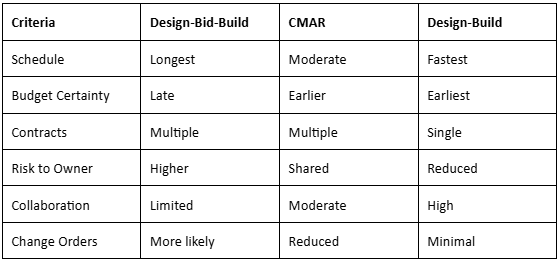
Key Factors to Consider When Selecting a Delivery Method
1. Schedule Constraints
If a school expansion must be completed before a specific academic year, design-build construction offers the greatest schedule flexibility.
2. Funding Structure
Bond-funded or grant-funded projects benefit from early cost certainty provided by design-build contracting and GMP structures.
3. Project Complexity
Projects involving occupied campuses, phased construction, or specialized spaces (labs, CTE facilities, secure entrances) often perform better under integrated delivery models.
4. Internal Resources
Districts with limited in-house construction management capacity often prefer delivery methods that reduce coordination complexity.
5. Risk Tolerance
Design-build shifts much of the risk related to cost, schedule, and coordination away from the school district and onto the design-build construction firm.
Why Many School Districts Are Choosing Design-Build
Across the design and construction industry, school districts are increasingly selecting design-build for expansions due to:
- Predictable outcomes
- Faster delivery
- Improved collaboration
- Reduced administrative burden
- Better alignment with educational goals
These benefits are particularly important as districts respond to enrollment growth, aging facilities, and evolving instructional needs.
Understanding the Evolution of Design-Build in Education
Design-build has a long history in commercial and public-sector construction. Over time, legislative changes and successful outcomes have made it more accessible to school districts nationwide.
To learn how this delivery method evolved and why it continues to gain traction, explore
The History of Design-Build.
How Performance Services Supports K-12 School Expansions
Performance Services specializes in design-build construction projects for K-12 school districts, higher education institutions, and municipalities. By providing integrated design and construction services, Performance Services helps schools:
- Deliver expansions faster
- Maintain budget control
- Minimize disruption to students and staff
- Reduce project risk
Through collaborative planning, construction management expertise, and established delivery strategies, Performance Services supports districts from concept through completion.
Final Thoughts: Making the Right Choice for Your School Expansion
Selecting the ideal project delivery method is one of the important decisions in any K-12 school expansion project. While traditional approaches still have a place, the growing complexity and urgency of school construction make integrated delivery methods increasingly attractive.
By evaluating schedule, budget, risk, and internal resources, school leaders can choose a delivery approach that aligns with their district’s goals and community expectations.
For many districts, design-build construction provides a path to delivering high-quality educational facilities on time and on budget, with confidence.