

For many ambitious marketing professionals, especially in competitive hubs like New York, there comes a moment when raw talent and hard work alone are no longer enough. You hit a ceiling, feeling stuck while the industry accelerates around you, unsure of the next strategic move to break through. While ambition is the engine of any successful marketing career, it’s strategic guidance that separates the good marketers from the great ones. This is where mentorship becomes a critical tool for advancement.
Unfortunately, many professionals are navigating this challenge alone. Recent reports highlight a significant mentorship gap for the current generation of workers, with a majority of Gen-Z workers lacking access to these opportunities. This makes proactively searching for a mentor more critical than ever for anyone serious about their professional development.
Key Takeaways
- Clearly distinguish between a mentor, a coach, and a consultant to find the right fit for your specific needs.
- Define your long-term career goals before seeking a mentor to ensure you find an expert with relevant experience.
- Effective mentorships are structured relationships with clear expectations, regular meetings, and proactive effort from the mentee.
- For specialized fields like SEO, consider structured group mentorship programs for access to advanced, proven tactics.
Understanding the Different Types of Professional Guidance
Before you can find a mentor, it’s essential to understand what a mentor is and how the role differs from other forms of professional support. Many people use the terms mentor, coach, and consultant interchangeably, but they serve distinct purposes. Choosing the right type of guidance is the first step toward achieving your career goals.
What Is the Difference Between a Mentor, a Coach, and a Consultant?
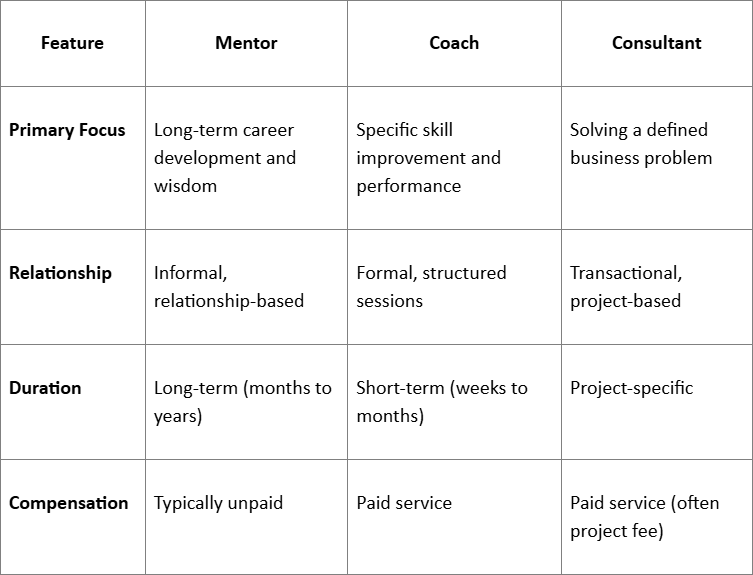
A mentor is a long-term, relationship-driven guide who shares wisdom and experience to foster your overall professional and personal growth. This relationship is built on trust and mutual respect, often developing organically. A coach, on the other hand, is a short-term, performance-driven professional focused on helping you develop a specific skill or overcome a particular challenge. Finally, a consultant is a task-oriented expert hired to solve a specific business problem with a defined deliverable and timeline.
A Side-By-Side Comparison
To clarify these roles, here is a simple breakdown of their key differences:
A Step-By-Step Guide to Finding Your Ideal Mentor
Once you’re clear on the type of guidance you need, the search can begin. Finding the right person is a proactive process that requires thoughtful preparation and strategic outreach.
Step 1: Define What You Want to Achieve
The most successful mentorships start with clarity on the part of the mentee. Before you identify potential candidates, you must first identify your own needs and aspirations. Ask yourself specific questions to create a clear picture of your career goals: What specific skills, like data analysis or team leadership, do I need to develop? What role do I want to hold in five or 10 years? What industry challenges, such as the rise of AI in marketing, do I need to understand better? Your answers will help you pinpoint the type of expert who can provide the most relevant advice.
Step 2: Identify and Research Potential Mentors
With your goals defined, start looking for professionals who have already achieved what you aspire to. Your first stop should be your existing network. Look to senior colleagues, former managers, and connections on LinkedIn. Don’t limit your search to your immediate circle; expand your view to include speakers at industry conferences, webinar hosts, and leaders within professional groups like the American Marketing Association. Thoroughly research each potential mentor to understand their career journey, accomplishments, and areas of expertise.
Step 3: Craft a Respectful and Compelling Outreach Message
The manner of asking is just as important as who you ask. A generic, demanding message is likely to be ignored. Instead, your outreach should be personal, respectful, and make it easy for them to say yes. Below is a basic guide to making that happen:
- Lead with a specific compliment. Show you’ve done your homework. Mention a specific project, article, or talk of theirs that resonated with you and explain why.
- Briefly introduce yourself. State your current role, your connection to their field, and what you admire about their career path. Keep it concise.
- State your intention clearly. Explain that you are seeking mentorship to grow in a specific area and why you believe their particular experience would be invaluable to your journey.
- Make a clear, low-commitment ask. Instead of the intimidating question, Will you be my mentor?, suggest a brief 15-minute virtual coffee. Frame it as an opportunity to ask for their perspective on a specific challenge you’re facing. This respects their time and significantly lowers the barrier to entry.
- Express gratitude. Thank them for their time and consideration, regardless of whether they accept your request. Professional courtesy is always appreciated.
How to Structure a Productive and Lasting Mentorship
Making the initial connection is only the beginning. The real value of mentorship comes from nurturing the relationship over time. This responsibility falls primarily on the mentee.
Setting Clear Expectations From Day One
Once a potential mentor agrees to connect, you must drive the relationship forward. The first meeting is critical for setting expectations. Use this time to discuss your long-term goals and align on how the mentorship will work. Propose a potential meeting cadence, such as a 45-minute call once a month, and ask about their preferred communication style for brief questions between sessions. This professional approach shows that you respect their time and are serious about the commitment.
Driving Value in Every Interaction
To ensure your mentor’s time is used effectively, always come to meetings prepared. Create a brief agenda with updates on your progress, specific challenges you’re facing, and targeted questions. This structure ensures you both get the most out of every conversation. Remember, productive mentorships yield tangible results. According to research, 70% of businesses reported an increase in productivity due to mentoring, demonstrating the powerful impact of structured guidance.
Gaining an Edge in Highly Specialized Fields
While traditional one-on-one mentorship is powerful, some technical disciplines require a more structured approach. In highly specialized fields like search engine optimization (SEO), where algorithms and tactics change rapidly, structured, results-driven mentorship programs are essential for gaining advanced tactics and insider knowledge. Modern group-based SEO mentor programs, like the Black Ops SEO Mentorship, offer actionable insights, proven strategies, and a community of support to accelerate one’s mastery and achieve page 1 rankings. An expert seo mentor can provide a curriculum that a traditional mentor may not have the time to develop, giving you a distinct competitive advantage.
Your Career Advancement Is a Proactive Pursuit
Ultimately, finding a mentor is not a passive wish but an active strategy for career advancement. It requires self-reflection to define your goals, strategic outreach to connect with the right experts, and consistent effort to build a productive relationship. The benefits are well-documented and profound. Research shows that those with mentors are promoted five times more than those without.
Furthermore, the positive effects extend beyond personal achievement. Companies with strong mentoring cultures see increased retention, innovation, and employee engagement. By taking the initiative to find a mentor, you are not just investing in your own success; you are adopting a practice that strengthens the entire professional landscape. The first step, from defining your goals to sending that first outreach email, is one you can take today.
Frequently Asked Questions (FAQ)
How much time should a mentorship take?
A typical mentorship involves meeting once or twice a month for 30-60 minutes, with occasional brief email or message exchanges in between. The key is consistency and quality of interaction, not a massive time commitment from either party.
Can you have more than one mentor at a time?
Absolutely. It can be highly beneficial to have multiple mentors who offer different perspectives or expertise. For example, you might have one mentor who guides you on leadership skills and another who specializes in a technical area like data analytics or marketing automation.
What should you do if a mentorship isn’t working out?
If the relationship isn’t providing the value you anticipated, it’s important to address it respectfully. Thank the mentor for their time and guidance, explain that your professional needs have shifted, and professionally conclude the formal arrangement. Honesty and gratitude ensure you can part on good terms.