
By: AR MEDIA
What if the world’s chaos could be summed up in a simple ratio?
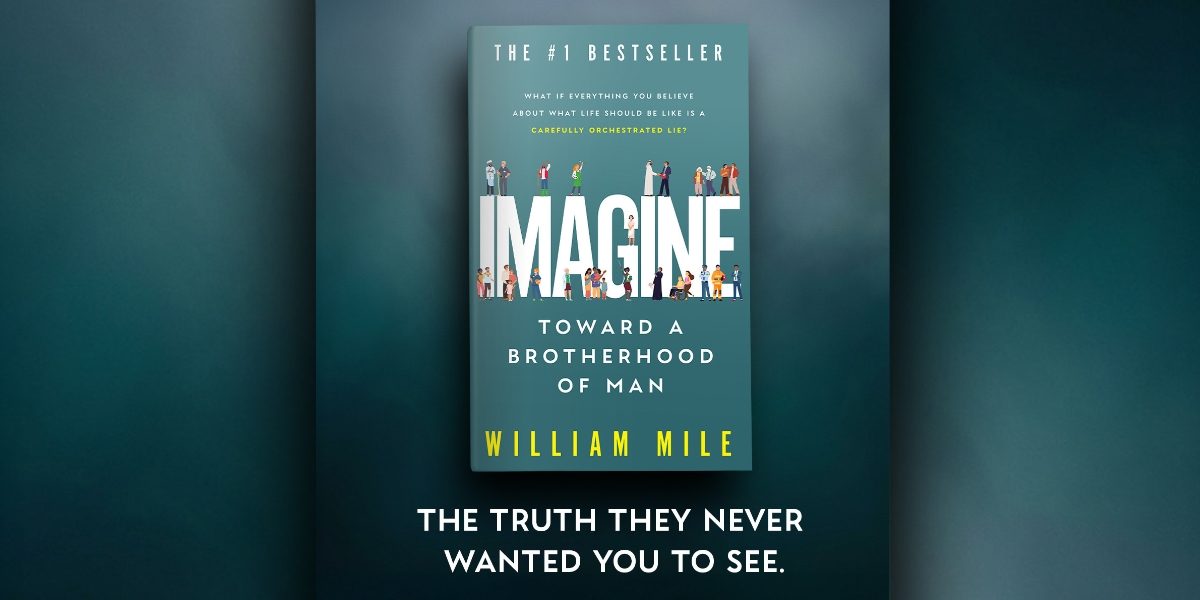
In Imagine: Toward a Brotherhood of Man, William Mile proposes what he calls the 8:2 theory: out of every ten people, eight are fundamentally “brothers” open to God’s love and capable of growth, and two are “evil people with successful actions” who thrive on confusion, division, and harm. It’s a bold, almost startlingly simple lens on good and evil, part spiritual manifesto, part social theory, part practical handbook for living with purpose in a broken world.
Rather than a dense academic treatise, Mile offers a short, highly accessible book that reads like equal parts sermon, pep talk, and kitchen-table conversation. The tone is plainspoken and direct, and the stakes, in his view, could not be higher.
The 8:2 Theory in Plain Language
Mile begins with a familiar picture: a classroom of thirty kids, many of whom are decent, imperfect but generally trying, and a smaller handful who seem bent on disruption, cruelty, or control. From that everyday observation, he builds his central claim: across humanity, roughly eight out of ten people are 8s, those who, however flawed, are reachable by God’s “transformative power” and capable of living ethically, while two out of ten are 2s, driven by a darker source, “born with innate behavioral habits” that consistently produce harm.
The twist is that Mile’s 8s aren’t limited by any of the usual labels. The brotherhood includes every race, ethnicity, nation, political system, religion, age, social class, and walk of life.
If you’re open to what he calls a “good source,” God by any name, and willing to keep growing, you’re in the 8s. If you consistently serve chaos, cruelty, and manipulation and find joy in others’ suffering, you fall into the 2s.
This framework allows him to do something refreshingly countercultural: shift blame away from “those people,” other religions, other parties, other nations, and onto a small, stubborn minority he believes has been quietly steering history toward disaster. The majority of us, he insists, are not the problem. Our problem is that we’ve been fighting each other instead of recognizing who’s actually pulling the strings.
It’s a sweeping claim, but it has an undeniable intuitive appeal. Many people have had the experience of sensing that some individuals seem wired for kindness and growth, while others seem almost addicted to damage.
Evil, Demystified, and Made Uncomfortably Close
One of the book’s strengths is its treatment of evil, which is serious and clear. This is not the vague “toxic people” language of pop psychology, nor the purely structural evil of social theory. Mile means something sharper.
His “evil 2s” are the kind of people who engineer genocides, design torture regimes, weaponize ideology, or incite mass violence for power and profit. He points to history, World War II and the Holocaust, inquisitions, authoritarian regimes that erased intellectuals and artists, as moments when 2s nearly reshaped the planet in their own image.
But he’s careful to say 2s aren’t just dictators and generals. They can be bosses, neighbors, even family members, anywhere power, deception, and a lack of conscience converge. They lie easily, avoid responsibility, and, in his telling, sometimes laugh at the suffering they cause. By giving this group a name and a pattern, Mile hopes to strip away some of their mystique: “Shining a spotlight on evil reveals it,” he writes, “so we can plainly know it when it shows up.”
Importantly, 8s are not painted as pure. They can do significant harm, too, out of ignorance, confusion, fear, or misguided “greater good” thinking. The difference, for Mile, is that 8s are ultimately reachable: they regret, repent, learn, and change. 2s do not.
That sharp binary may be a provocative aspect of the book, and also where readers will likely have the strongest reactions, positive or hesitant. On the one hand, there’s relief in the idea that humanity is salvageable and fundamentally aligned with goodness. On the other hand, it raises hard questions: Are some people truly beyond transformation? What happens if we start labeling real individuals in our lives as “2s”?
Mile doesn’t encourage paranoid witch-hunts for villains. The emphasis is always on strengthening the 8s’ unity, sobriety, and sense of purpose, so that evilhas fewer openings.
Work, Sobriety, and “Surthriving”: A Practical Path for 8s
Where many spiritual books stop at big ideas, Imagine gets surprisingly concrete. The central chapters read like a compact field manual for living as a strong 8 in a confusing age.
Mile’s core advice is disarmingly simple: stay clear-headed, develop yourself, find meaningful work, and teach the next generation.
For readers adrift in a world of algorithmic distraction and political fatigue, there’s something grounding about this emphasis on simple disciplines: sleep, sobriety, study, and service as key acts of resistance against chaos.
A Wide-Open God and a Big-Tent Brotherhood
An engaging passage is in the chapter “On God,” in which Mile shares his own journey: baptized and churched, then led, through a long, stubborn personal struggle, to explore wisdom from Christianity, Hinduism, Judaism, Islam, Buddhism, meditation, and beyond. He describes himself now as an “educationalist,” committed to studying broadly and drawing his own conclusions rather than confining himself to any single tradition’s brand.
Crucially, the 8:2 theory doesn’t ask anyone to change religions. It doesn’t say, “my path instead of yours”; it says, “If you’re sincerely seeking the good, you’re already part of the brotherhood.” His call is less conversion and more détente: Christians, Jews, Muslims, Hindus, “spiritual but not religious, ”stop treating each other as the problem. The real danger, he insists, is the small minority that manipulates those divisions for its own ends.
In a time when faith communities are as divided as politics, the call for interreligious humility stands out. It offers people of conviction a way to hold their beliefs firmly while still recognizing the sincerity and dignity of others on different paths.
Readers whose theology emphasizes universal redemption may bristle at the suggestion that 2s are nearly unreachable, but Mile does repeatedly affirm that God still loves them and desires their return. The emphasis, though, stays firmly on strengthening the 8s’ unity rather than speculating about the inner life of the 2s.
Imagining an 8:2 World
What would it look like, Mile asks, if enough people embraced this framework?
He doesn’t promise utopia, but he does imagine a world in which purposeful work is re-honored as the “forgotten spiritual path”; faith and science are allies, not enemies; religious and cultural battles calm down because the “real enemy” is more clearly understood; and evil finds fewer cracks to exploit.
He’s honest about the effort involved. There’s no quick fix, no secret hack. It’s “step by step,” a slow transformation out of what he provocatively calls an age-long “dark age” of confusion into something more aligned with God’s intention.
A Brief Book with Big Ambitions
Ultimately, Imagine: Toward a Brotherhood of Man is exactly what its subtitle promises: an invitation to build a world in which most of us recognize our shared allegiance to goodness, and stop letting a small, destructive minority set the tone.
It is hopeful without being naive, spiritual without being sectarian, and challenging without being crushing. Mile writes as someone who has wrestled for decades with questions of God, work, and human nature, and has distilled what he’s found into a lean, usable framework.
For readers who sense that “this can’t be as good as we get,” who are hungry for belonging and purpose but wary of rigid dogma, this little book offers a surprisingly spacious vision: You are not alone. You are not powerless. And if you’re willing to become a stronger 8, clear-headed, working, learning, and refusing to demonize your fellow 8s, you might just help tilt the ratio toward a better world.
Get your copy of Imagine: Toward a Brotherhood of Man by William Mile and explore a vision for a more connected world.
Disclosure: This editorial review was prepared by AR MEDIA.