

By: Polina Semina. FinTech Project Manager.
Abstract
This article analyzes the impact of process innovations in management on the efficiency of companies in the financial technology (FinTech) sector. Key areas of operational optimization—automation, data analytics, and digital transformation—are examined as tools for improving business profitability and resilience. Based on data from McKinsey, Deloitte, and Statista, it is shown that companies that systematically implement process innovations demonstrate up to 35% higher operating margins and up to 40% shorter product implementation cycles compared to traditional financial institutions.
Introduction
The modern FinTech industry has radically transformed global finance by integrating technology, analytics, and customer-centric approaches. According to McKinsey (2024), the total revenue of the global FinTech market has exceeded $340 billion, with an average annual growth rate of 17%. However, behind this rapid expansion lies a key factor—operational efficiency. Without a well-structured system of business processes, digital expansion can lead not to development but to chaos, increased costs, and regulatory risks.
In an unstable economic environment, FinTech companies face intensifying competition, stricter data security requirements, and growing customer expectations regarding service speed and quality. Therefore, operational efficiency becomes not just a tool for optimization but a foundation for long-term business resilience and scalability.
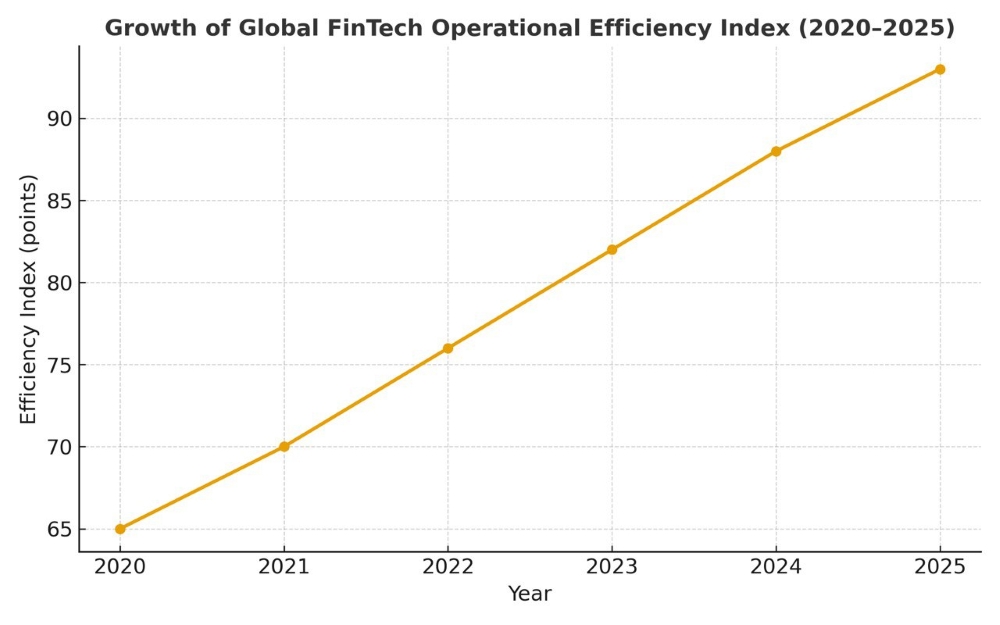
Photo Courtesy: Polina Semina (Global FinTech Operational Efficiency Index, 2020–2025)
Process Innovations and Digital Transformation
Process innovations are not merely the implementation of technologies but a complete rethinking of the company’s workflow structure. According to Deloitte (2023), 63% of FinTech companies have already implemented AI-based systems to optimize internal processes, risk management, and data analytics.
Robotic Process Automation (RPA) is used in more than 70% of digital banks, accelerating credit checks, compliance, and client onboarding. According to PwC (2024), automated management systems allow FinTech companies to process 60% more transactions without increasing staff size.
Digital transformation shifts the business model from the category of “cost reduction” to the category of “value creation.” The main goal is to increase the accuracy, transparency, and speed of decisions while maintaining process controllability.
Materials and Research Methods
The study uses comparative data from McKinsey, Deloitte, and Statista covering the years 2020–2025. Key efficiency metrics were examined: cost-to-income ratio (CIR), return on assets (ROA), level of automation, and employee productivity.
According to the summarized results:
- Client request response time decreases by 30–40%;
- Operating costs decrease by 20–35%;
- Compliance accuracy increases by 25%;
- Employee productivity increases by up to 45% when automated task distribution is implemented.
These data demonstrate a direct relationship between process innovations and the growth of a company’s financial efficiency.
Results and Discussion
Figure 1 shows the growth of the global operational efficiency index of FinTech companies from 2020 to 2025. During this period, the integration of automation, artificial intelligence, and digital systems led to a significant improvement in profitability and stability metrics.
The effect is especially pronounced in companies where innovations are implemented systematically—not as temporary projects but as part of strategic management. Such organizations show, on average, 35% higher operating margins, implement new products 40% faster, and demonstrate resilience to market fluctuations.
In addition, the development of FinTech stimulates the transformation of the financial sector as a whole: traditional banks actively adopt technological solutions, create their own startup hubs and innovation laboratories.
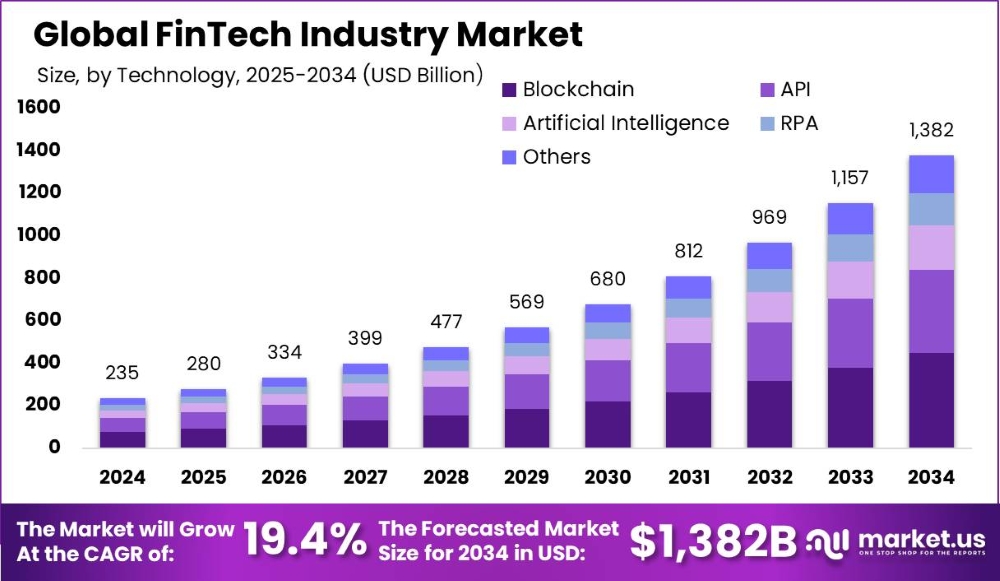
Photo Courtesy: market.us
In recent years, the FinTech sector has become one of the most dynamic platforms for the implementation of innovative managerial solutions. Companies strive not only to increase operational efficiency but to build holistic digital ecosystems in which every process is measurable, scalable, and controllable in real time. This is reflected in the growth of the global operational efficiency index, which, according to Deloitte and PwC, increased by almost 40% over the period from 2020 to 2025.
One of the key factors of transformation is the integration of artificial intelligence and machine learning technologies into business processes. More than 60% of FinTech companies already use AI tools for data analysis, forecasting customer behavior, and automating operational decisions. Such digital transformation makes it possible not only to reduce costs but also to build more resilient risk management models.
Another important area is the development of a culture of continuous improvement. In modern FinTech companies, operational efficiency is viewed not as a one-time goal but as a constant process of adaptation. The use of Agile and Lean principles helps form flexible management structures in which decisions are made based on data and real-time feedback.
In addition, increasing attention is being paid to the human factor. The efficiency of digital systems directly depends on the qualifications of personnel and their ability to manage change. Companies invest in training programs, digital simulators, and corporate universities that allow employees to develop skills in strategic analysis and technological thinking.
Overall, it can be noted that the sustainable growth of the FinTech industry is determined by the synergy of technologies, competent management, and the high adaptability of corporate structures. Companies that have managed to combine these three areas not only increase efficiency but also form new standards of doing business at the global level.
Conclusion
Operational efficiency is becoming the main competitive advantage in the FinTech market. Process innovations make it possible not only to increase productivity and reduce costs but also to build a long-term development strategy.
Companies that implement a systematic approach to optimization demonstrate resilience, flexibility, and the ability to adapt to change. In the coming years, the key success factor will be not simply the use of technologies but the ability to integrate them into strategic management and corporate culture.
References
- McKinsey & Company. FinTech Efficiency Benchmark 2024. — McKinsey, 2024.
- Deloitte. Global FinTech Industry Report 2023. — Deloitte Insights, 2023.
- PwC. Digital Transformation Index: Financial Services Sector 2024. — PwC Global, 2024.
- Statista. FinTech Market Data 2025. — Statista Research Department, 2025.
- Accenture. The Future of Financial Operations. — Accenture Strategy, 2023.