
By: Arthur Brown
On weekday mornings in the big city, a small boy with sunbright laughter pulls on his shoes and reaches for his grandmother’s hand. On Sundays, that same boy is tugging a purple coat toward a forest path where a river runs fast and silver. This is Murphy’s world, and in Geri LoGiacco’s children’s book Murphy and the Grandmas, it is a world stitched together by two grandmothers, two cultures, and one steady truth: that love can grow when it crosses generations.
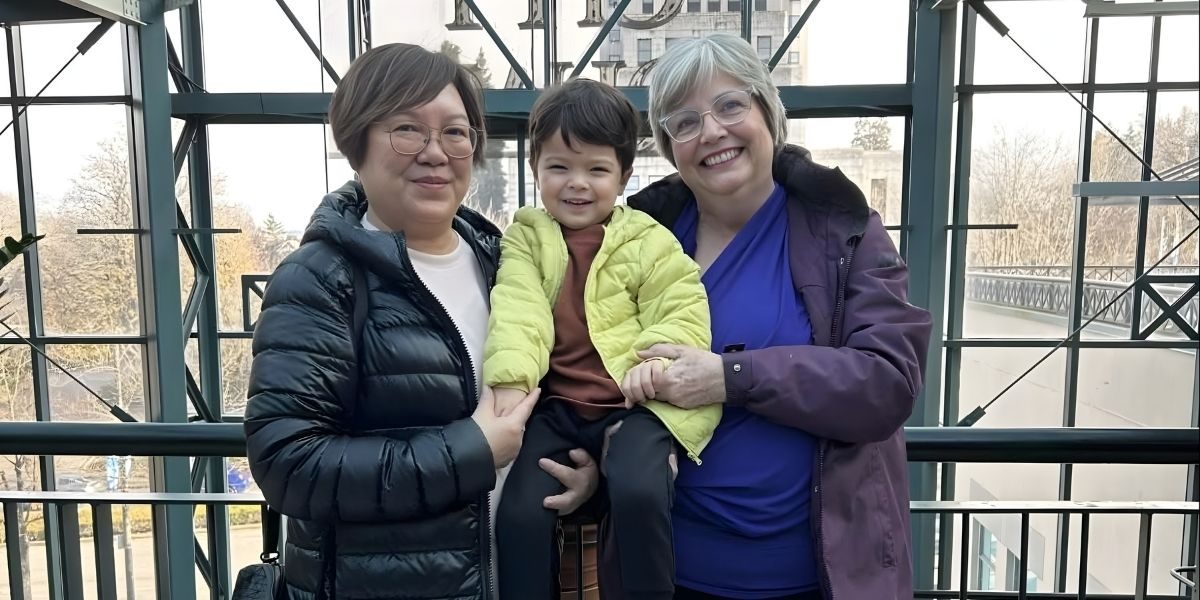
Murphy is almost three. He calls one grandmother “Grandma MaaMaa,” and the other “Purple Grandma.” The names are perfect.
When the family first asked him whether Geri was the “White Grandma” or the “Chinese Grandma,” Murphy looked puzzled. Those labels made no sense to him because, in his world, both women lived in the same category: Grandma. No hierarchy, no difference, just love. So he reached for the detail he recognized, the bright purple coat she often wore, and that became her name. “Purple Grandma” wasn’t about color or culture. It was simply the clearest way a little boy could say, This is my grandma, too.
Catherine Lam, Grandma MaaMaa, holds the city days, the preschool drop-offs, the park swings, the warm bowls of soup that say I see you, I want you strong. “My word is soup,” she laughs, explaining how she tucks care and nutrition into every spoonful for her picky little grandson, who still slurps it happily. “It is the one thing that keeps him energized so he can keep running and jumping all the time.”
On weekends, Murphy’s world tilts toward mountains. Purple Grandma, Geri, leads him down a pine-soft path to a river where minnows cloud the shallows and salmon return to spawn. “We just really love the outdoors,” Geri says. “The forest is my church.” With bare feet on a wooden floor, they dance to 70s rock after bacon and blueberry pancakes, they whisper to owls, they throw leaves and see what floats. “It is the simplest things,” she says, “that give you the most joy.”
That is the music of the book, too. The pages hold tiny rituals, a slide and a “wee, wee,” a careful pause so minnows can keep their pool, a reminder to say “thank you” and “M Goi.” Nothing grand, everything true. In a season that can tip toward noise, Murphy and the Grandmas is a quiet invitation to notice what actually binds a family together—time, presence, and the stories we repeat until they become home.
The family itself is joyfully blended. Geri was born in French Canada, so her holiday table carries tortière along with cookies and a tall tree. Catherine keeps the Chinese side of the calendar alive, with New Year gatherings with a big, busy clan, visits to the cemetery to honor ancestors, and children learning names and faces until cousins feel like extra brothers and sisters. “I introduce Murphy so he knows everybody,” Catherine says. “He remembers the names, he holds hands, he cares if people are happy.”
If you ask Murphy what his favorite things are, he answers like a boy who belongs to both places. With Grandma MaaMaa, there is swimming, city parks, and yes, the soups. With Purple Grandma, there is the long walk to the river and the fish. “They were happy,” he chirps, remembering how they moved with the current. Ask about the holidays, and his eyes go straight to the presents, which is exactly right for a child this age. The adults grin and let that be, because the point is not to push him toward meanings before he is ready. The point is to fill his days with the kind of love that becomes meaningful later on.
“Intense” is how Geri describes her bond with her grandson. “I love him so much I could eat him up.” Catherine’s word is simpler and somehow just as big: “Soup.” Between those two words sits the whole thesis of this story: love can be spiritual and silly, poetic and practical, a purple coat at the river, a steaming bowl on a Tuesday. Together, they form a net that will support Murphy for the rest of his life.
Holiday pieces often ask for a lesson. This one offers something gentler. You feel it when Geri remembers reading The Night Before Christmas to her kids every year, and now again with Murphy. You feel it when Catherine talks about time as the real gift, how not every grandparent can be nearby, how she is grateful that she can see him, drive him places, share the everyday. You feel it when Murphy’s parents step in near the end of the interview. His mother says she sees her own childhood reflected in the way her mom cares for him, only “maybe even more” now, having learned along the way. His father hopes the smell of a good soup in a restaurant will always send Murphy back to these early years, that a hike will carry the sound of the river, that he will be able to “reflect on those moments” when he is older.
Geri wrote the book to preserve those moments before they went blurry. She wanted a place where the two cultures could sit side by side without explanation, where a little boy could be exactly who he is, loved “extra,” as she puts it, because he gets two grandmothers, not one. She wanted parents and grandparents across the country to recognize themselves, the park bench, the clink of teacups, the warm kitchen where an elder shows love through food. “Grandparents do not need to spend a lot,” she says. “They just need to be with them, to spend time.”
In the book’s sweetest scene, Murphy sets up a tea party with both grandmas. He serves green tea and black tea, splits the plate between sticky buns and banana bread, and raises a cup with a tiny “Cheers.” He hugs both women with sticky fingers and a wide grin, and he says the most perfect sentence a child in a home like this can say, “M Goi, I love you.” That is the holiday message, sincere and small, the way real life is. It is also why the book feels like a beautiful gift in December, not because it is marketed that way, but because it reads like a family card you can keep on a shelf.
Ask each grandmother what she most wants Murphy to remember years from now, and the answers sit side by side like ornaments on one branch. Geri says, “that he was deeply, deeply loved from the minute he was born, and that he gave us so much joy.” Catherine says, “be happy and healthy,” and you can hear the practical tenderness of a caregiver who has walked him to preschool, zipped his coat, and watched him race toward the slide. Between those hopes is a boy who will grow up bilingual in love.
There are larger ideas here, too. Families like this one are everywhere, multiracial, multi-tradition, full of different recipes and calendars, different ways of saying hello and thank you, and the same way of saying I love you. The book does not argue for that; it just shows it. A purple coat on a winter path, a bowl that tastes like home, a boy who learns to name owls and also to say “M Goi.” In a season that teaches us to gather, Murphy and the Grandmas is a reminder to gather the small things first. If you are looking for one meaningful present that feels like a hug for a grandparent or a young family, this is it, a story you can read aloud this year and the next, until the words become your own.
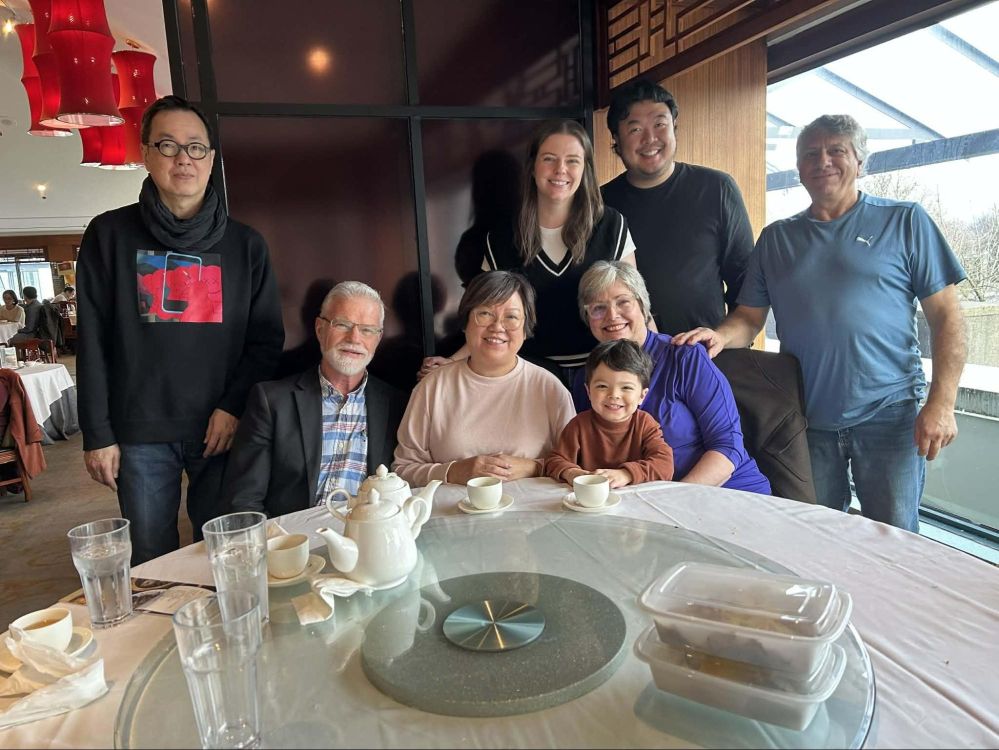
Photo Courtesy: Geri LoGiacco
The family gathered around Murphy, parents, grandparents, and loved ones sharing a meal, a moment, and the traditions that shape their story.