
By: Matthew Kayser
In a world of fitness trackers and map apps, one Canadian platform is doing something entirely different. It is mapping the support network every rider needs, but no one else thought to build.
The modern cyclist lives in a data-rich paradise. We have apps that track our heart rate variability, computers that measure our wattage output, and satellites that map our elevation gain to the nearest foot.
Essentially, we are like the most quantified athletes on the planet.
Yet, for decades, a single, analog problem has persisted, immune to all this Silicon Valley innovation. It is the mechanical failure.
The flat tire in a strange neighborhood.
The loose bolt is three miles from home. In that moment, the biometric data is useless.
The rider is no longer a master of mobility; they are a pedestrian pushing a broken machine.
Enter LeVelo.
Rising out of the dense urban centers of Canada, LeVelo has emerged as the first platform to successfully digitize the mechanical infrastructure of the city.
It is not a fitness app.
It is not a social network.
It is a utility in the purest sense of the word.
By mapping, verifying, and connecting a network of over 500 public repair stations and hundreds of partner bike shops, LeVelo has done what no one else thought to do: they have engineered the anxiety out of the ride.
Mapping the Mechanical Ecosystem

Photo Courtesy: LeVelo
At its core, LeVelo does something deceptively simple: it tells you where the help is.
The app creates a digital overlay on the physical city, pinpointing a network of over 500 verified public repair stations across Canada. But it goes beyond simple location data. It provides intelligence.
Using a crowd-sourced model similar to Waze, LeVelo allows its community to help verify station status in real-time. Before you detour five blocks to use a public pump, the app tells you if it’s working. It lists the tool inventory available at each stand.
It turns “hope” into “logistics.”
Crucially, this network is living and breathing. Users are able to add stations themselves onto the map after verification. This means the database is expandable and scalable, ensuring it is available in every city that has stations, growing organically alongside the cycling community.
Currently operating in Toronto, Ottawa, Vancouver, and Montreal, this network has fundamentally changed the psychology of the ride. By making the safety net visible, LeVelo removes the issue that keeps casual riders tethered to familiar routes by unlocking the city.
To understand why LeVelo is a “first of its kind” innovation, one must understand the psychology of the urban commuter.
Urban planners talk a lot about “barriers to entry.” Why don’t more people cycle? They cite safety, weather, and sweat. But there is a silent barrier that veteran riders know intimately: Range Anxiety.
It is the subconscious calculation every rider makes before leaving the house. If I ride to that new neighborhood, what happens if I get a flat? Is there a shop nearby? Is it open? Do I have the tools to fix it myself?
This anxiety tethers cyclists to known routes. It limits exploration. It keeps the bicycle from becoming a true vehicle of freedom and relegates it to a vehicle of routine.
LeVelo attacks this psychology by treating mechanical support as a data point. The platform has created a digital layer over the physical city.
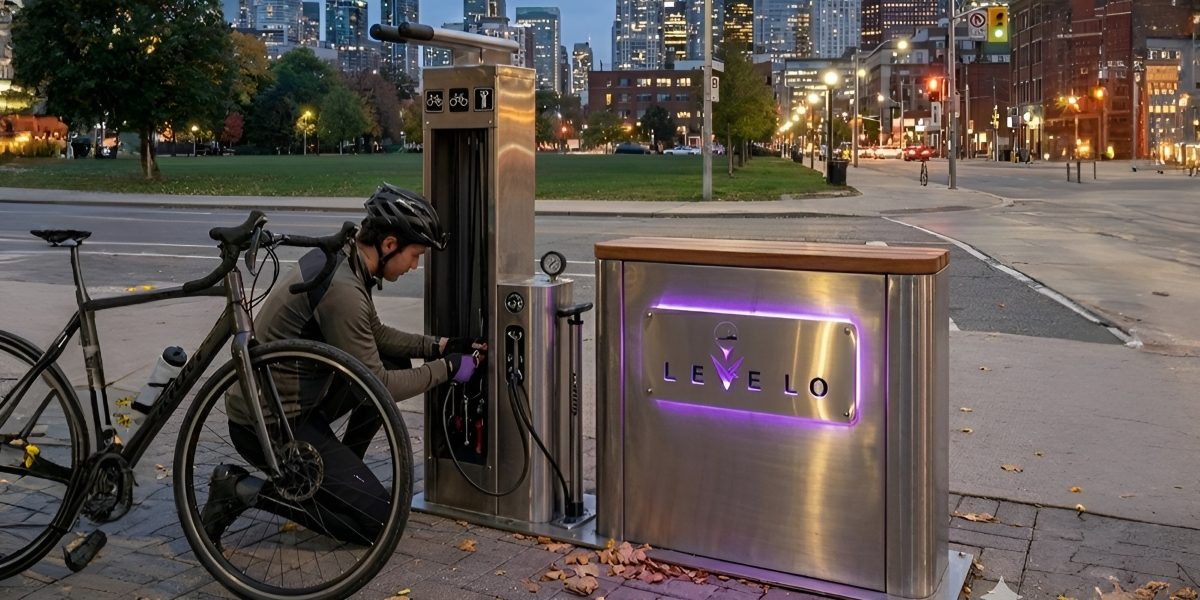
It pinpoints public bike repair stations—those overlooked metal stands equipped with pumps and hex keys that cities install but rarely advertise. Before LeVelo, finding one of these stations was a matter of luck or rote memorization.
Now, it is a matter of logistics.
And with over 50,000 active users, the platform has become a crowd-sourced intelligence network.
The Death of the Analog Shop
While LeVelo changes the game for the rider, its impact on the local economy is perhaps even more significant.
The local bike shop (LBS) is a cornerstone of community urbanism. It is a hub of knowledge, culture, and essential services. However, the LBS has historically been a strictly analog business operating in an increasingly digital world.
If a cyclist suffers a mechanical failure in an unfamiliar neighborhood, their instinct is to search Google Maps. They see a list of businesses. They see phone numbers. But they don’t see availability. They don’t see capacity. They don’t see if the shop has the specific tube they need or the time to fix it right now.
LeVelo has bridged this gap with its Premium Partner Network.
LeVelo allows bike shops to broadcast their presence directly into the cockpit of the passing cyclist.
Over 150 leading bike shops (including staples like Urban Cycles in Toronto and Pacific Bike Co. in Vancouver) have joined the network. The app acts as a beacon, driving high-intent traffic directly to their doors when riders need them most.
The results are staggering: partner shops are reporting a 25% to 40% increase in foot traffic, while the app transforms the bike shop from a destination that must be searched for into a beacon that appears when needed.
This traffic increase is not merely a “nice to have” marketing boost; for many independent retailers, this digital visibility is the difference between surviving and thriving in a post-Amazon retail landscape.
It drives high-intent traffic—cyclists who are currently riding and currently in need, directly to the storefront.
LeVelo has created a symbiotic ecosystem. The rider gets immediate, professional support. The shop attracts customers exactly when they are ready to spend. The city gets a more robust, interconnected mobility network.
It is a rare instance of a tech platform strengthening, rather than disrupting, brick-and-mortar commerce.
The Mind Behind the Map
This innovative ecosystem is the brainchild of Founder Ahmed Hassan, a 21-year-old student at York University. Originally from Egypt, Hassan is currently studying business, government planning, and international development.
He started out building websites and e-commerce platforms, but he always possessed a deeper passion for solving fundamental issues in the daily world.
Driven by this vision, Hassan self-taught himself computer science, AI, and marketing to develop and found LeVelo and the entire LeVelo ecosystem.
From Navigation to Co-Pilot
If LeVelo’s current utility is impressive, its roadmap suggests an ambition to fundamentally rewrite how we move through cities. The company is currently transitioning from a static resource to an active co-pilot.
The most anticipated development is the rollout of AI-Powered Route Optimization.
Most navigation apps operate on simple logic: shortest distance or fastest time. But for a cyclist, “fastest” is rarely the only metric that matters.
A route that saves two minutes but forces a rider onto a six-lane arterial road with no shoulder is a bad route.
A scenic route that lacks repair infrastructure is a risky one.
LeVelo’s new AI engine digests a massive array of variables. It looks at weather patterns (avoiding headwinds or wind tunnels), traffic density, bike lane availability, and (crucially) the proximity of the repair network. It suggests routes that keep the rider within the “safety net” of repair stations and partner shops. It is routing based on survivability and enjoyment, not just speed.
This moves the platform into the realm of Augmented Reality (AR). The Q1 2026 roadmap includes features that will overlay navigation and station data onto the rider’s view, keeping heads up and eyes on the road.
Furthermore, LeVelo is preparing for the electrification of urban transport. The boom in e-bikes has created a new set of anxieties: range and charging. An acoustic bike with a flat tire is a hassle; a heavy e-bike with a dead battery is a crisis.
LeVelo is mapping charging infrastructure with the same rigor they applied to repair stations, preparing to become the essential OS for the electric commuter.
Gamifying the Commute
There is a secondary, subtler benefit to the LeVelo ecosystem: the gamification of utility.
While apps like Strava focus on competition, wattage output, and calorie deficits, LeVelo focuses on the lifestyle of the ride. It has introduced a rewards program that feels less like a gym membership and more like a loyalty card for the city itself.
Users earn points not just for riding fast, but for riding often. They are rewarded for verifying station status, for visiting partner shops, and for contributing to the community data pool. These points aren’t just digital confetti, though. They unlock exclusive perks and discounts at local businesses.
This creates a feedback loop of engagement. A rider uses the app to find a station. They verify the station is working, earning points. They use those points to get a discount on a tune-up at a local shop. The shop gets a customer. The map gets better data. The rider gets a better bike.
It turns cycling from a solitary athletic pursuit into a communal civic activity. It reinforces the idea that the cyclist is a part of the city’s organism, maintaining the health of the network simply by participating in it.
The Verdict
We live in an era of “vaporware,” where tech companies promise to revolutionize our lives with algorithms that solve problems we didn’t know we had.
We have smart juicers and Wi-Fi-enabled toasters.
LeVelo is the antithesis of this trend.
It is a digital solution to a very hard, very physical reality.
Cities across North America are spending billions of dollars painting lines on asphalt, erecting bollards, and trying to encourage micro-mobility to fight climate change and congestion. But paint is not enough. Infrastructure is useless if it is invisible. A bike lane is only as good as the bike riding on it.
LeVelo has recognized that for the cycling revolution to truly take hold, the rider needs to feel supported. They need to know that the city has their back. By digitizing the physical support network, LeVelo has removed the fear of mechanical failure.
They have turned luck into logistics.
For the thousands of Canadians already using the platform, LeVelo has become as essential as the helmet. It is the invisible passenger that ensures the ride always finishes at the destination, not on the side of the road.
With a 4.8-star app rating and a rapidly growing user base, LeVelo is moving fast.
Their roadmap includes an ambitious national expansion to Calgary, Edmonton, and Halifax by late 2026.
A Blueprint for the Future of Mobility
The current iteration of LeVelo is impressive, but the roadmap suggests a company with aggressive ambition. The platform is currently rolling out AI-powered route optimization. This technology goes beyond finding the shortest path.
It analyzes weather patterns and traffic density to suggest the safest, most enjoyable route.
Future updates promise Augmented Reality navigation and dedicated support for the booming e-bike market, including charging station mapping.
LeVelo has successfully identified a massive gap in the micro-mobility sector. Cities build bike lanes. Tech companies build fitness trackers. But until now, no one has built the digital infrastructure to support the machine itself.
LeVelo creates a world where the rider is never truly alone. It is sleek, essential, and undeniably smart. For Canada’s cycling community, the ride has finally evolved.
Experience the New Standard
The city is yours to explore, but you don’t have to do it alone. Join the movement that is redefining urban mobility.
Download LeVelo on the App Store or Google Play today, or visit LeVelo.info to view the live map and find a partner shop near you.
Sidebar: The LeVelo Roadmap – What’s Next?
- Q4 2025 (Completed): Initial launch across Toronto, Ottawa, Vancouver, and Montreal. Implementation of the Rewards System and Repair Network Mapping.
- Q1 2026: The launch of AI-Powered Route Optimization, integrating weather and traffic data for smarter, safer routing.
- Q2 2026: Expansion of social features, allowing for group ride planning and community connection.
- Q3 2026: Dedicated E-Bike integration, featuring battery optimization, routing, and charging station mapping.
- Q4 2026: National expansion to Calgary, Edmonton, Halifax, and Victoria.
Pull Quote for Layout:
“LeVelo treats a public pump or a hex key station with the same importance that Waze treats a traffic jam.”