
By: Content Strategy Division, Progressive UX
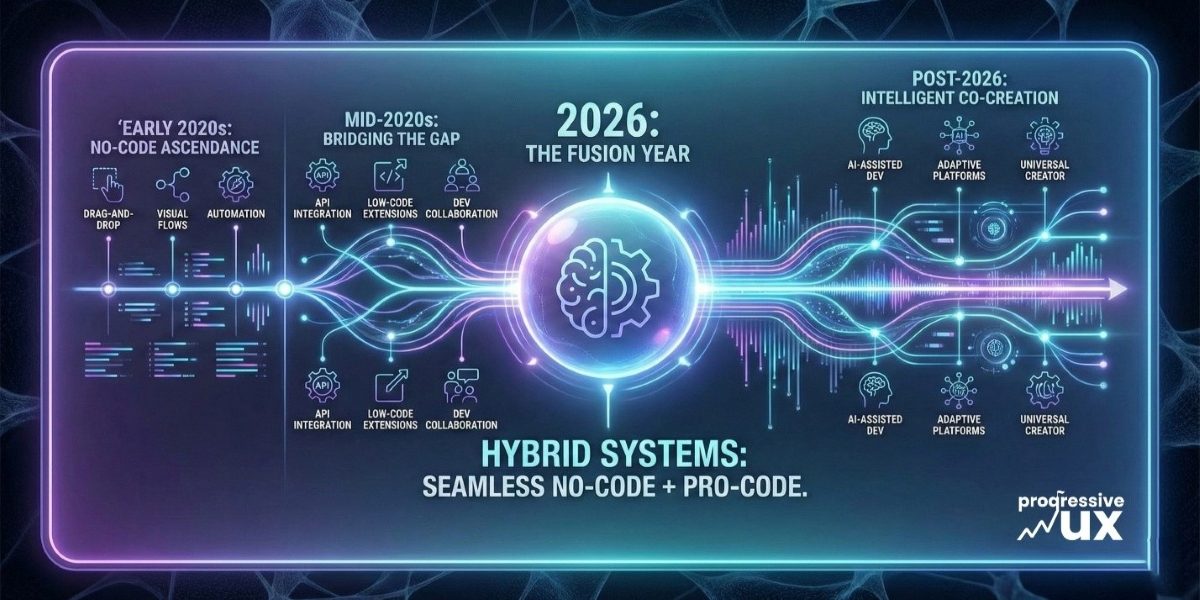
Clearwater, FL — The software development industry stands at a potential inflection point. For years, businesses have faced a challenge: build applications quickly using no-code platforms, but often sacrificing customization, or spend months on custom development for complete control. Progressive UX, a digital development agency with operations across five countries, believes that 2026 could likely mark the end of this either-or paradigm.
The company recently announced its commitment to a hybrid development methodology, combining visual no-code interfaces with hand-coded custom features. This approach addresses what Progressive UX’s CEO describes as “the productivity paradox” in modern software development, where speed and sophistication have traditionally been seen as mutually exclusive.
Market Forces Driving the Convergence
Several concurrent trends are influencing the industry toward this middle ground. Enterprise software budgets grew tighter in 2025, yet digital transformation demands continued to accelerate. Companies find themselves needing applications faster, but without compromising on features that differentiate them competitively.
Recent data shows that 67% of businesses now use some form of low-code tooling, yet 82% of those same companies report hitting platform limitations within six months. Progressive UX has responded by developing what it calls “escape hatch architecture,” where no-code foundations can potentially transition seamlessly to custom code when requirements warrant it.
The company’s approach allows marketing teams to update content and basic workflows via visual interfaces, while developers focus on complex integrations, custom algorithms, and performance optimization. This division of labor can reduce development timelines by up to 40% compared to traditional methods, according to internal project data.
Technical Debt Meets Practical Reality
Progressive UX’s clients span industries such as healthcare providers, financial services firms, and e-commerce retailers across North America, Europe, and Australia. These organizations face regulatory requirements, security standards, and integration complexities that pure no-code platforms may struggle to address.
“We saw consulting firms selling no-code dreams that turned into technical nightmares,” explains a senior developer at Progressive UX who works on the company’s Web 3.0 and blockchain projects. “When a client needs HIPAA compliance or wants to integrate with legacy enterprise systems, visual builders can reach their limits. But starting from scratch could potentially waste the 70% of functionality that no-code handles well.”
The hybrid model also addresses talent constraints. Progressive UX reports that projects using their fusion approach require fewer senior developers, as mid-level engineers can handle no-code layer maintenance while specialists tackle custom components. In a market where experienced developers command premium salaries, this efficiency could offer a practical solution.

Photo Courtesy: Progressive UX
Real Applications Beyond the Hype
The company points to recent implementations as examples of its approach in practice. An e-commerce client needed a product configurator with real-time pricing that connected to an ERP system dating to 2012. Progressive UX built the user interface and basic product catalog in a no-code environment, then wrote custom API layers and calculation engines in traditional code. The hybrid project launched in around eight weeks, which was much quicker than the estimated five months for full custom development.
Another healthcare client required patient scheduling with complex insurance verification and HIPAA-compliant data handling. The scheduling interface and basic workflows used no-code components, while authentication, encryption, and third-party insurance verification ran on custom-coded microservices.
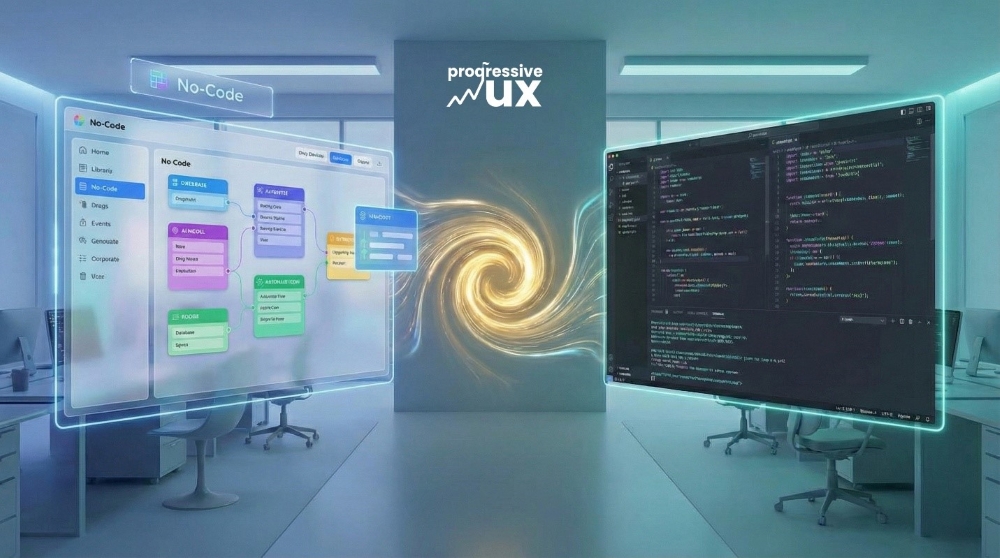
Photo Courtesy: Progressive UX
Looking Past the Technology Trend Cycle
Progressive UX maintains that hybrid development succeeds because it aligns with what actually happens inside companies. Business users want autonomy to make changes without developer tickets. Developers want to solve interesting problems rather than build another contact form. No-code provides the former, while custom code enables the latter.
The company is optimistic that within 18 months, most mid-market software agencies will adopt similar hybrid models or could risk losing projects to competitors who can deliver both speed and sophistication. Whether that prediction proves accurate will depend on whether other development shops can replicate the technical orchestration required to make the approach work.
For businesses planning digital initiatives in 2026, Progressive UX suggests that the conversation has shifted from “no-code versus custom code” to “which parts get which treatment.” That nuance may help define the next generation of enterprise software.
Businesses exploring hybrid development strategies for 2026 projects can learn more about Progressive UX’s approach at www.progressiveux.com or contact their consultation team at (332) 208-1621.
Disclaimer: This article contains information about Progressive UX services and offerings. While we strive to provide accurate and up-to-date information, readers should conduct their own research and due diligence before engaging with any publishing services. This content is for informational purposes only and should not be considered professional advice. Some details about services, pricing, and availability may change over time.