
By: Jake Smiths
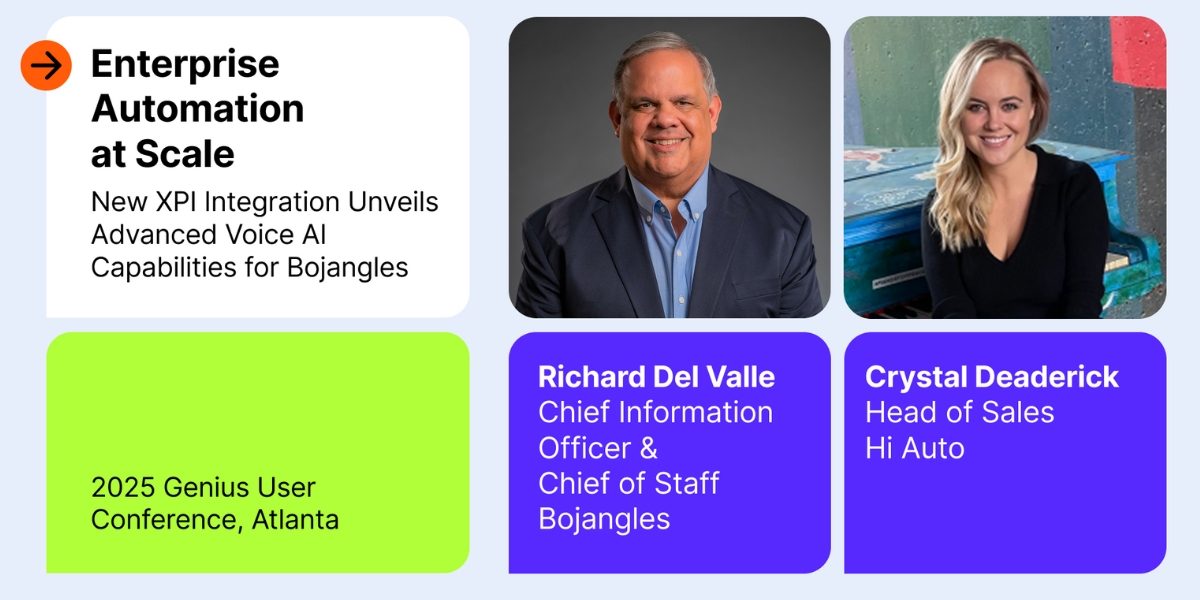
Of all the AI stories dominating headlines, few have focused on a distinctly unglamorous, but enormously important, context: the fast-food drive-thru. Yet at the Global Payments Genius Conference, Bojangles, Genius, and Hi Auto unveiled what may be one of the most ambitious enterprise AI deployments currently in operation in the real world.
While many AI initiatives struggle to scale beyond pilots, this collaboration is now active across almost 500 Bojangles locations, proving that automation in quick-service restaurants is moving beyond experimental hype. The most surprising takeaway from their announcement wasn’t what Voice AI might do someday; it’s what it is already doing today.
Rethinking the Drive-Thru Tech Stack
If you ask most QSR leaders why automation hasn’t transformed speed of service, they rarely point to a lack of AI capability. Instead, they point to legacy infrastructure. Traditional POS APIs were built for online ordering, where a few seconds of delay may not matter. Drive-thrus, on the other hand, operate on a millisecond scale.
Instead of forcing Voice AI to adapt to old systems, the Genius XPI platform extended enterprise POS capabilities directly into real-time ordering. Internally, this wasn’t pitched as a futuristic breakthrough, but rather as an infrastructure modernization to remove latency at the point where it is most costly: customer service.
Executives at the conference admitted they assumed this level of integration was years away. The challenge wasn’t conceptual AI; it was building a system stable enough to survive the realities of a large distributed operation. The Genius-Hi Auto deployment seems to have crossed that threshold.
Speed, Accuracy, and the Elimination of Friction
Hi Auto’s platform doesn’t just transcribe orders. It re-engineers how orders flow inside the restaurant. As a customer speaks, items are added to the order one by one and simultaneously displayed on guest-facing and kitchen screens.
That matters for two reasons:
- Guests correct errors instantly before they become bottlenecks.
- Kitchen staff start work before the order is completed.
In a sector where seconds compound into cars moved, this shift is structural.
The system also addresses a common issue most customers don’t think about: dual-lane confusion. When two lanes merge, staff must match each order to the corresponding car, and errors can cause slowdowns. Bojangles’ implementation attaches a vehicle image to each order, giving workers immediate visual confirmation. It’s simple, but operationally profound.
Because the platform routes data locally (rather than relying solely on cloud connections), stores are insulated from connectivity failures that make automation risky. Latency isn’t reduced, but engineered out.
Franchisees Don’t Buy Buzzwords; They Buy Results
The real story behind this deployment is the adoption curve, not the technology. The system scaled from 100 to 300 to nearly 500 restaurants, while maintaining an order completion rate of roughly 93% and accuracy above 96%.
Those numbers are not marketing claims designed to sell a pilot. They’re performance metrics that sustained franchise-level decisions.
For owners, the calculus is straightforward:
- Faster service equals higher throughput.
- Higher accuracy equals less waste.
- Consistency equals fewer operational fires to put out.
Voice AI succeeded not because franchisees wanted innovation, but because they wanted relief.
Automation’s New Standard in QSR
Until recently, Voice AI was appraised by its conversational feel: Does it understand people well enough to replace the human at the headset? Today, the market is asking a more demanding question: Can AI behave like an enterprise-grade system: fast, reliable, integrated, measurable, and adaptable?
The Bojangles-Hi Auto deployment reframes Voice AI from novelty to an infrastructure capability. To be credible in QSR, AI must deliver across the entire operational spectrum: speed, accuracy, latency, training, analytics, menu adjustments, promotions, and regional variation.
With these demands, few AI systems can scale. Hi Auto has shown that one can.
A Company Built for High-Volume Reality
Founded in 2019, Hi Auto designed its platform specifically for drive-thrus in high-volume QSR environments. Today, it powers about 1,000 locations across the U.S., U.K., New Zealand, and Australia, delivering consistent, high-accuracy ordering performance at scale.
Its technology centralizes script optimization, voice performance, upsell strategy, and menu management while giving brands control over limited-time offers and regional promotions. It isn’t automation for the sake of novelty; it’s automation engineered for complexity without chaos.
What This Moment Actually Represents
The Genius Conference didn’t showcase a theoretical roadmap or a controlled pilot; it showcased a functioning, large-scale transformation of a foundational QSR workflow.
What matters isn’t the technology itself, but the shift in expectations it creates. Once operators see automation perform consistently across hundreds of restaurants, “experimental AI” becomes a business liability rather than a competitive advantage.
Drive-thru automation is moving from “interesting” to “mandatory.” Not because AI promises a better future, but because it is already rearchitecting the present.