

By: Prince Kumar
You are sick of being a referee, you see, did you happen to be the CIO then? Half a room is screaming to be in a position of being able to have more freedom of data, while the other half is scared of what will occur when you are able to provide them. It discusses the same quarter. Business teams want speed. Legal wants certainty. You want the two; it is as much like having a flat tire on the wheel to get there, and you have to use the old systems.
Letting Go, Without Losing Control
But what about having both? Real access and absolute control?
It begins by defining the concept of governance in a different way. The pipeline is not provided with a gate at its end, and everything is built in it. Governance should not be conceptualized as a shield, but rather as a guide. It is the one that will make the flow of data where it is required and in a secure manner, in a form that will be understood by all parties concerned.
The same principle underlies the Democratized Data Governance Framework (DDGF) — that is, a distributed, yet dilutionary, automated, yet non-responsible governance.
Architecting for Trust, Not Just Access
Architecture needs to evolve to enable data democratization. The model will require some updates and will no longer be concerned with introducing dashboards and expanding data lakes. The important concepts are policy-as-code, data mesh, and data fabric. Policy-as-Code transforms governance into code, limiting the information flow across geographical borders, defining after-hours access to sensitive information, and making policies enforceable by default. These, along with lineage and observability, form a cyclic control system that authenticates access usage and enables compliance with enterprise policies.
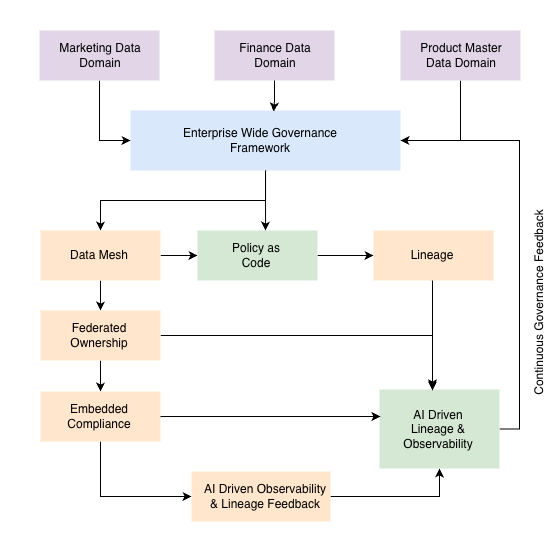
Figure 1: Democratized Data Governance Framework Integrating Data Mesh, Policy-As-Code, and AI-Driven Lineage
This prototype aims to democratize the information structure of businesses and ownership of federal areas. Core governance has also been referred to as policy and compliance, as well as policy-as-code, to provide a framework for policy. AI-derived invention, transparency, and observability. In this aspect, we are introduced to a culture of governance which carries with it an implication that it is not only technology that sustainable data democratization needs, but people and process.
It’s Not Just Safer, It’s Smarter
And this is one thing that no one talks about. When under a well-managed government, people will literally store information for safe use. They are not questioning whether the figure is wrong or not. They never question themselves on the matter of whether they are defying a policy. The rules are clear. The data is reliable. Everybody is working in a hurry as they do not need to wait until they can obtain a signature or even have an idea of what has happened to that bizarre piece of Excel.
Good governance does not push people back; it makes them fearless.
And on the CIO side, it is mega-change. You are no longer the choke point. You’re the enabler. It is you who installed the system that allows all the information available to be accessed by the rest of the organization without banging.
A Real World Example
Suppose that one of the people using the product wants to know how the performance of a new feature is. The data set is cataloged, and where required, it is provided. Data on the data source, the data updating frequency, and data having user IDs are noted. That’s fine. To be in that sphere, you have to be qualified.
Practically, the given scenario illustrates the principle of DDGF, where user freedom can be granted, and AI-driven observability enables all activities to be responsible and controlled.
Keeping the Lights On and the Risks Down
The exciting part? It works behind the scenes. Everything can be monitored using observability instruments, which monitor who is accessing what, where the data is going, and what is not, based on the rules. The messages appear in situations when something is suspicious. You are not turning the pages of books. Where there is a need to listen, you receive clear communications.
It’s not just protection. It’s prevention. It is an enormous leap from how things were done in the past, when one would walk by an abuse or a breach and they would remain unknown until the audit, or even worse, when it begins making news. Such is the prevention that is being implemented in the DDGF case. The lineage, based on AI, could also be viewed as a unit, and the issues that arise from compliance issues are often rooted in problems that existed prior to their creation.
Why the Old Assumptions Need to Die
That is, as with guardrails, which men do as they can. They preserve the existence of shadow copies. They are no longer hiding their files in their folders. They not only trust the source but also apply it in making smarter decisions.
The risk cannot be minimal, and the information can be kept under lock and key. The minimization of risk is supported by the fact that the right people and individuals will be able to obtain what they need in the right format without resorting to workarounds.
Security is no foe to data democratization. Unmanaged data is. A controlled and open system is what brings on-scale trust.
A New Role for CIOs
The cloud budget has lost its place under the current CIO’s concern, although having self-access to reliable and secure data remains a priority. The architecture, automation, and AI have enabled the CIOs to gain the trust of the stakeholders using models such as DDGF. It is no longer a trade-off; it is a more intelligent design.