

Agents don’t quit because of customers. They quit because of spreadsheets. Every call that ends with ten minutes of typing gradually chips away at morale and delays the next resolution. It’s a hidden tax, after call work (ACW), that may turn skilled problem solvers into reluctant stenographers.
AI-enabled call summaries have the potential to change that equation. This isn’t just automation; it’s a structural shift. Real-time transcription, natural language processing, and CRM integration now work together to capture the essence of a conversation in seconds. The result? Agents can stay focused on empathy and problem-solving. Customers feel heard. Compliance is likely to improve. And the data, clean, structured, actionable, flows where it should. Faster resolutions, stronger insights, and potentially happier teams follow naturally.
Why Call Summaries Are a Hidden Drain on Productivity
On paper, writing a quick summary seems harmless. In reality, it’s a silent productivity killer. Every extra minute spent typing after a call compounds across hundreds of interactions, inflating costs and eroding service levels. What appears to be a small clerical task is actually a structural inefficiency baked into most contact centers. The problem isn’t just time, it’s attention. Agents switch from active listening to mechanical note-taking, breaking their cognitive flow. That context shift can be costly.
And then there’s the data. Inconsistent notes don’t just frustrate managers; they may cripple analytics. Missed details can mean weaker insights, flawed QA, and lost opportunities for coaching. When summaries vary wildly in quality, institutional memory suffers. The organization may pay twice: once in wasted labor, and again in poor decisions driven by incomplete information.
The Average Time Cost of Manual Summaries
For fast-growing start-ups, every moment counts. Yet, after-call work (ACW) quietly consumes hours each week. People spend from 45 to 90 seconds per call typing notes, tagging tickets, and updating CRM fields. Multiply that by 60 calls a day, and you’re looking at 45–90 minutes of pure administrative drag: time that could be spent resolving more issues or upselling services.
For a lean team scaling rapidly, this inefficiency is more than an inconvenience; it’s a growth bottleneck. An AI customer service platform for fast-growing startups may help eliminate this dead time by generating summaries instantly, freeing agents to focus on conversations that matter.
More Than Time Lost—The Cognitive Toll
The actual cost isn’t just in minutes; it’s in mental strain. Switching from active listening to typing notes creates mental friction. This constant context shift:
- Breaks focus: Agents can lose conversational flow, reducing empathy and rapport.
- Increases stress: Multitasking may elevate cognitive load.
- Accelerates burnout: Sustained strain might lead to high attrition rates in support centers.
AI-driven summarization helps reduce this toggle. Drafting accurate summaries in real time allows agents to stay fully engaged, listen deeply, and deliver a more human experience.
Missed Opportunities in the Data
Incomplete and inconsistent summaries can undermine decision-making. The consequences include:
- Weak analytics: Missing details can obscure trends and root causes.
- Lost insights: Product and training teams might miss signals that could drive improvements.
- Compliance risk: Inaccurate data could increase liability risks.
AI-generated summaries address this by producing structured, standardized outputs every time—capturing intents, actions, and sentiment in a CRM-ready format. According to Gartner’s 2025 Customer Service AI Use Case Report, case summarization is now classified as a “likely win” use case, with 85% of customer service leaders planning to pilot or deploy AI-driven summarization this year.
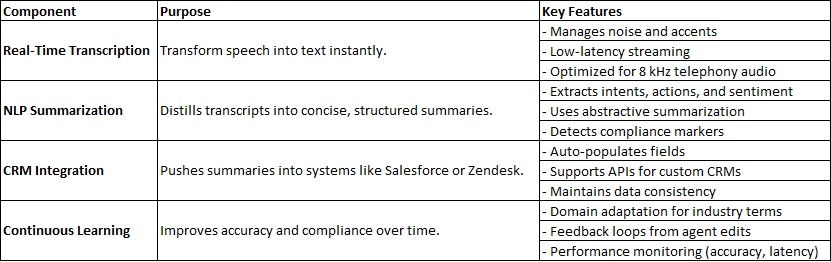
How AI Call Summaries Work Under the Hood
AI call summarization isn’t magic; it’s a carefully engineered pipeline.
From Note-Taker to Value Creator — The Human Shift
AI call summarization isn’t just a technical upgrade; it’s a human liberation. When the burden of typing disappears, agents can reclaim the mental bandwidth to do what machines can’t: connect, empathize, and solve problems creatively. This is more than efficiency; it’s a redefinition of the role itself.
Picture the old reality: one eye on the customer, the other on a blinking cursor. Every pause to type breaks the rhythm, dilutes empathy, and turns conversations into checklists. Now imagine the opposite: full attention, uninterrupted flow, genuine listening. That’s what happens when platforms like CoSupport AI manage the administrative drag in the background.
Meanwhile, every interaction becomes part of a living knowledge base. AI-generated summaries create consistent, searchable records that strengthen institutional memory. Instead of scattered notes, organizations gain structured insights that fuel smarter coaching, better self-service, and continuous improvement. The result? A workplace where humans do human work and thrive.
The ROI of AI-Enabled Summaries (Beyond Time Saved)
Time saved is the obvious win. But the real payoff? It runs deeper—into speed, compliance, insight, and culture. When AI takes the grunt work, the ripple effects can transform the entire service operation.
- Faster Resolution: No more digging through messy notes. AI-generated summaries may speed up follow-ups and reduce escalations.
- Lower Compliance Risk: Every disclosure captured. Every commitment logged. Consistency can mean fewer audit headaches.
- Better Managerial Visibility: Clean, structured data powers dashboards, coaching, and smarter decisions.
- Higher Agent Retention: Less admin, less burnout. Roles can feel human again—agents stay longer and perform better.
From Call Notes to Customer Value
AI call summaries aren’t about replacing humans—they’re about freeing them. When agents stop acting like stenographers, they have the potential to show up as problem-solvers, listeners, and relationship builders. That shift changes everything.
The real win isn’t faster notes. It’s stronger connections, cleaner data, and a workplace where people focus on what matters: creating value. AI handles the admin grind; humans bring the empathy and judgment no algorithm can match. Together, they deliver service that may feel effortless and unforgettable.