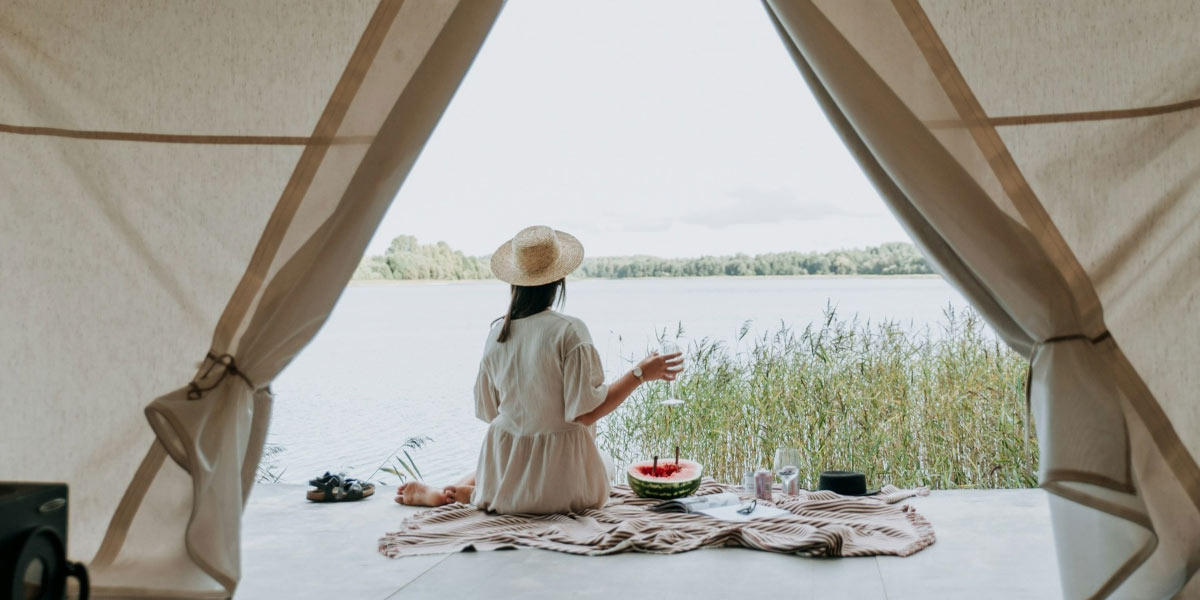

Glamping — the portmanteau of “glamorous” and “camping” — has moved from a niche travel curiosity to a $4.5 billion global industry in 2026, growing at a compound annual growth rate that most analysts place between 9.5 and 13 percent through the end of the decade. Marriott International acquired the Postcard Cabins brand in December 2024, integrating more than 1,200 cabins across 29 U.S. locations into the Marriott Bonvoy platform. Hyatt partnered with Under Canvas in August 2024. Hilton entered an exclusive arrangement with AutoCamp in February 2024. When three of the world’s largest hotel companies pivot toward the same category within a 12-month window, it signals less a trend and more a structural realignment of what the hospitality industry understands travelers to actually want.
Key Takeaways
- The global glamping market reached approximately $4.5 billion in 2026 and is projected to grow to between $7.9 billion and $10 billion by 2032–2033, driven by demand from millennials and Gen Z travelers who prioritize experience-based travel over conventional hotel stays.
- Marriott, Hyatt, and Hilton all entered the glamping sector between February and December 2024, with Marriott’s Postcard Cabins acquisition bringing more than 1,200 cabins at 29 locations into its Marriott Bonvoy loyalty platform by mid-2025.
- The 18-to-32 age group represents 43.9 percent of glamping market revenue, driven by preference for nature immersion, social media shareability, and distinctive accommodations that cannot be replicated at a standard hotel property.
- Cabins and pods are the most popular glamping accommodation type, holding a 43 percent market share, with the category’s appeal rooted in four-season adaptability, structural security, and the ability to deliver hotel-grade comfort without removing guests from a natural setting.
What Made Traditional Camping No Longer Enough?
The answer begins with a generational shift in how leisure time is valued. Traditional camping requires significant personal investment: gear acquisition, logistical planning, physical setup, tolerance for weather variability, and acceptance of conditions — pit toilets, shared facilities, uneven ground — that many travelers find incompatible with the experience they are seeking. The appeal of nature has not diminished. The willingness to accept physical discomfort as a precondition for accessing it has.
Glamping decouples those two things. A well-designed glamping property delivers the sensory experience of sleeping in a forest, waking to birdsong, and spending time disconnected from urban infrastructure while providing a properly made bed, a private bathroom, climate control, and often a kitchen, a private fire pit, and on-site hospitality services. The product exists at an intersection that traditional hospitality did not occupy: more immersive than a resort hotel, more comfortable than a campsite, and more distinctive than either.
That distinctiveness carries measurable commercial value. The 18-to-32 age group represents 43.9 percent of glamping market revenue, driven by millennials and Gen Z’s inclination toward unique, experience-based travel. These younger demographics prioritize what researchers describe as “experiential consumption” — spending on activities and memories rather than objects — and glamping delivers a format that is inherently photographable, shareable, and difficult to replicate, which creates its own demand engine through social media visibility.
How Did the Pandemic Permanently Shift the Demand Curve?
The pandemic accelerated glamping’s adoption in a specific way. When international travel collapsed in 2020 and 2021, domestic travel surged — and within domestic travel, outdoor destinations benefited disproportionately from the combination of safety perceptions, reduced crowding relative to urban destinations, and the psychological appeal of open space during a period of confinement. Glamping properties, which offered private accommodation separated from other guests and positioned in natural settings, matched the moment precisely.
The demand that materialized during the pandemic did not reverse when restrictions lifted. Travelers who discovered glamping during the 2020–2022 period developed a preference that persisted into subsequent travel decisions. The category’s operators, meanwhile, invested in infrastructure improvements that elevated the product quality for returning guests. In 2025, flagship sites like Firelight Camps and The Resort at Paws Up introduced enhanced seasonal programming and luxury safari-style tent upgrades, integrating high-end culinary experiences and spa-integrated tents — moving the product further up the hospitality quality ladder and expanding its appeal into demographics that had not been primary customers before.
Why Are Major Hotel Chains Entering the Glamping Market?
The entry of Marriott, Hyatt, and Hilton into glamping within a single calendar year reflects a straightforward commercial calculation. Hotel companies measure revenue per available room and average daily rate. Glamping properties, particularly in premium locations near national parks or distinctive natural environments, generate both metrics at levels that compare favorably to conventional hotels — while requiring less capital-intensive infrastructure in land where building a full-service hotel would face permitting, environmental, and cost barriers.
Marriott International acquired the Postcard Cabins brand, adding 29 properties with more than 1,200 cabins across the U.S. to its portfolio, as guests grew “increasingly interested in nature-immersive travel.” The Postcard Cabins model — minimalist, dog-friendly cabins positioned within two hours of major metropolitan areas — addresses a specific consumer behavior: the desire for a nature escape that does not require a full travel day to reach. Forty-eight percent of glampers prefer locations within a four-hour drive of their home, according to industry data, which means the market is fundamentally a domestic, proximity-driven product rather than a destination travel category.
The integration of Postcard Cabins into Marriott Bonvoy — with points redemptions available beginning in mid-2025 — extends the reach of glamping to a loyalty program with more than 219 million members. That distribution infrastructure gives Postcard Cabins access to a booking audience that no independent glamping operator could replicate, and gives Marriott Bonvoy members a product category that differentiates the program from competitors.
What Role Does Sustainability Play in Glamping’s Appeal?
Eco-consciousness has become a structural driver of glamping demand, particularly among the under-35 demographic. This growth is primarily driven by increasing demand for luxury outdoor experiences that combine the appeal of nature with modern comforts, particularly among millennials and eco-conscious travelers. Many glamping operators have built sustainability into their physical infrastructure and operating model — solar power systems, composting programs, water recycling, low-impact construction methods, and policies that limit site density to preserve the surrounding natural environment.
The sustainability dimension serves a dual commercial purpose. It satisfies the values-based travel preferences of a growing segment of consumers who want their spending to align with environmental principles. It also provides a genuine product differentiation from both conventional hotels and traditional campgrounds, neither of which can credibly claim the same combination of low environmental footprint and high guest comfort. The result, as glamping industry research from February 2026 noted, is a category defined by a particular paradox: a traveler eager to pay a premium for a nature-immersive experience who simultaneously expects keyless entry, smart thermostats, and an e-concierge — and considers none of those requirements contradictory.
Where Is the Glamping Market Headed?
North America currently leads global glamping growth, though Europe held the largest market share by revenue in 2025 at approximately 35 to 37 percent. Asia-Pacific is the fastest-developing region, with the market there projected to grow at accelerating rates as disposable income increases and the middle-class travel market expands across India, Southeast Asia, and China. The cabins and pods segment — representing 43 percent of the global market — is expected to maintain its lead, driven by the structural advantages of modular construction, four-season usability, and the ability to deliver consistent quality across geographically diverse locations.
The segment growing fastest within glamping’s broader demographic reach is the 33-to-50 cohort, projected to expand at a 10.2 percent CAGR through 2033. This group brings a different set of motivations: family travel, comfort prioritization, privacy, and the desire for premium outdoor experiences that work for children and adults simultaneously. The convergence of a younger demographic that discovered glamping through social media and an older demographic that discovered it through family travel has created a consumer base broad enough to support the institutional capital now flowing into the category — from major hotel chains down to independent operators developing single-site properties in locations where a tent with a good mattress and a view commands three hundred dollars a night.