

It’s not easy for organizations to navigate the ever-changing regulatory landscape, where compliance with many rules and standards across various industries is paramount. As regulations continue to expand in complexity and breadth, traditional approaches to governance, risk, and compliance (GRC) management become increasingly challenging. To confront these challenges head-on, businesses are turning to scalable GRC platforms driven by compliance automation, risk assessment, and robust compliance management functionalities. This article explores the significance of scalable GRC platforms in adapting to evolving regulations, emphasizing the critical role of compliance automation, risk assessment, and compliance management in mitigating compliance risks and fostering organizational resilience.
The Regulatory Landscape: A Constant Evolution
In recent years, regulatory frameworks governing industries such as finance, healthcare, and data privacy have become more stringent and complex. Organizations must navigate a labyrinth of regulations, standards, and guidelines imposed by government entities and industry bodies. Failure to comply can result in severe consequences, including financial penalties, reputational damage, and legal liabilities.
Moreover, the regulatory landscape is not static; it’s constantly evolving. New regulations emerge in response to emerging risks, technological advancements, and changing societal expectations. For businesses, staying abreast of these regulatory changes and ensuring compliance across the organization’s operations is a daunting task—one that requires a proactive and systematic approach.
The Role of Compliance Automation
Compliance automation plays a pivotal role in streamlining regulatory compliance processes and enhancing operational efficiency. By leveraging GRC software solutions, organizations can automate repetitive compliance tasks, such as data collection, analysis, and reporting. This frees up valuable time and resources that can be redirected toward strategic initiatives and risk mitigation efforts.
A scalable GRC platform equipped with compliance automation capabilities empowers organizations to:
- Ensuring Consistency: Automation reduces the likelihood of human errors and ensures consistency in compliance-related activities, such as policy enforcement and audit trails. By eliminating manual intervention, organizations can maintain uniformity in compliance processes across different departments and locations.
- Enhancing Agility: With automated workflows and notifications, organizations can quickly adapt to regulatory changes and implement necessary compliance measures in a timely manner. Automated alerts keep stakeholders informed about impending deadlines, regulatory updates, and compliance requirements, enabling swift action and minimizing the risk of non-compliance.
- Improving Audit Preparedness: By maintaining comprehensive and up-to-date records, organizations can streamline audit processes and demonstrate compliance with regulatory requirements more effectively. Automated documentation and record-keeping ensure that all compliance activities are logged, tracked, and easily accessible during audits, reducing audit preparation time and potential compliance gaps.
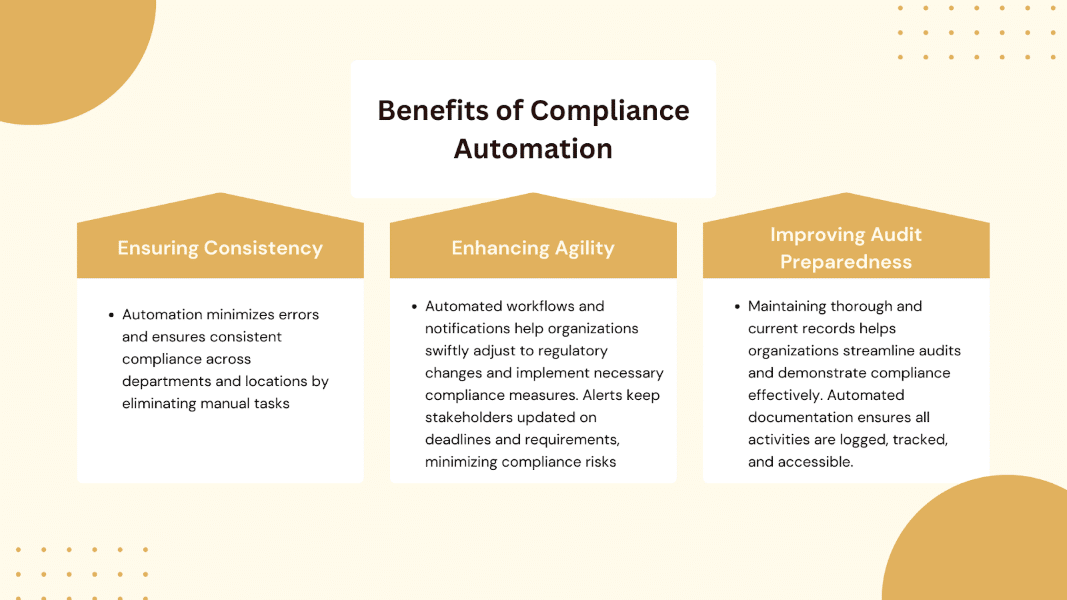
Photo Courtesy: GRC Software Solutions
Empowering Risk Assessment and Management
Effective risk assessment is fundamental to the success of any compliance program. By identifying and prioritizing risks, organizations can allocate resources strategically and implement targeted risk mitigation measures. A scalable GRC platform enables organizations to conduct comprehensive risk assessments across various dimensions, including operational, financial, and regulatory risks.
Key features of risk assessment and management within a scalable GRC platform include:
| Features | Description | Benefits | Example |
| Risk Identification | Through automated risk identification mechanisms, organizations can pinpoint potential threats and vulnerabilities within their operations, supply chain, and regulatory environment. | Improved awareness of potential risks enables proactive risk management and better allocation of resources. | Utilizing machine learning algorithms to analyze historical data and identify patterns of fraudulent activities. |
| Risk Evaluation | By quantifying risks based on severity and likelihood, organizations can prioritize mitigation efforts and allocate resources efficiently. | Enables organizations to focus on high-impact risks and prioritize mitigation efforts to reduce overall risk exposure. | Assigning risk scores to identified risks based on impact and probability to prioritize mitigation actions. |
| Scenario Analysis | Advanced risk management functionalities allow organizations to simulate various scenarios and assess the potential impact of regulatory changes or adverse events on their business operations. | Facilitates strategic planning and decision-making by providing insights into the potential outcomes of different scenarios. | Simulating the impact of a cyberattack on critical infrastructure to assess the organization’s resilience and response plan. |
Streamlining Compliance Management Processes
Compliance management encompasses a range of activities, including policy development, training, monitoring, and enforcement. A scalable GRC platform serves as a centralized hub for managing all aspects of compliance, providing organizations with the tools and insights needed to navigate regulatory requirements effectively.
Key components of compliance management within a scalable GRC platform include:
- Policy Lifecycle Management: From policy creation to dissemination and enforcement, organizations can manage the entire policy lifecycle within a unified platform, ensuring alignment with regulatory mandates and internal standards.
- Training and Awareness: By offering customizable training modules and tracking employee participation, organizations can foster a culture of compliance and mitigate compliance risks associated with human error or negligence.
- Monitoring and Reporting: Real-time monitoring capabilities enable organizations to track compliance metrics, identify trends, and generate comprehensive reports for internal stakeholders and regulatory authorities.
The Evolution of Compliance Solutions
In response to the growing complexity of regulatory requirements and the need for scalable GRC solutions, vendors are continually innovating their offerings. Modern compliance solutions leverage advanced technologies such as artificial intelligence (AI), machine learning, and natural language processing (NLP) to enhance automation, analytics, and predictive capabilities.
Key trends shaping the future of compliance solutions include:
- AI-Powered Compliance: AI and machine learning algorithms can analyze vast amounts of data to identify patterns, detect anomalies, and predict future compliance risks, enabling organizations to address potential issues proactively.
- Regulatory Intelligence: By leveraging NLP and data aggregation techniques, compliance solutions can extract insights from regulatory texts, industry publications, and enforcement actions, helping organizations stay ahead of regulatory changes and emerging compliance trends.
- Integration and Interoperability: Scalable GRC platforms are increasingly designed to integrate seamlessly with other enterprise systems, such as enterprise resource planning (ERP) and customer relationship management (CRM) systems, to facilitate data sharing and streamline compliance-related processes.
Conclusion
As it becomes imperative to observe regulatory scrutiny and rapid technological advancement, organizations must adopt scalable GRC platforms equipped with compliance automation, risk assessment, and compliance management capabilities. By leveraging technology to automate repetitive tasks, assess and manage risks effectively, and streamline compliance processes, organizations can navigate the complexities of the regulatory landscape with confidence and resilience. As regulations evolve, scalable GRC platforms will play an indispensable role in helping organizations adapt to change, mitigate compliance risks, and achieve sustainable growth in an increasingly regulated world.
FAQs
What makes scalable GRC platforms different?
Scalable GRC platforms offer advanced automation and risk management, improving compliance efficiency. Unlike traditional systems, they leverage technology to streamline processes and adapt to evolving regulations effectively.
Why use compliance automation?
Compliance automation reduces manual effort and errors, enhancing efficiency and risk management. By automating tasks like data collection, organizations can focus resources strategically.
How do scalable GRC platforms anticipate regulatory changes?
Using AI, scalable GRC platforms analyze regulations and predict compliance risks, enabling proactive adaptation and ongoing compliance.
Published by: Khy Talara