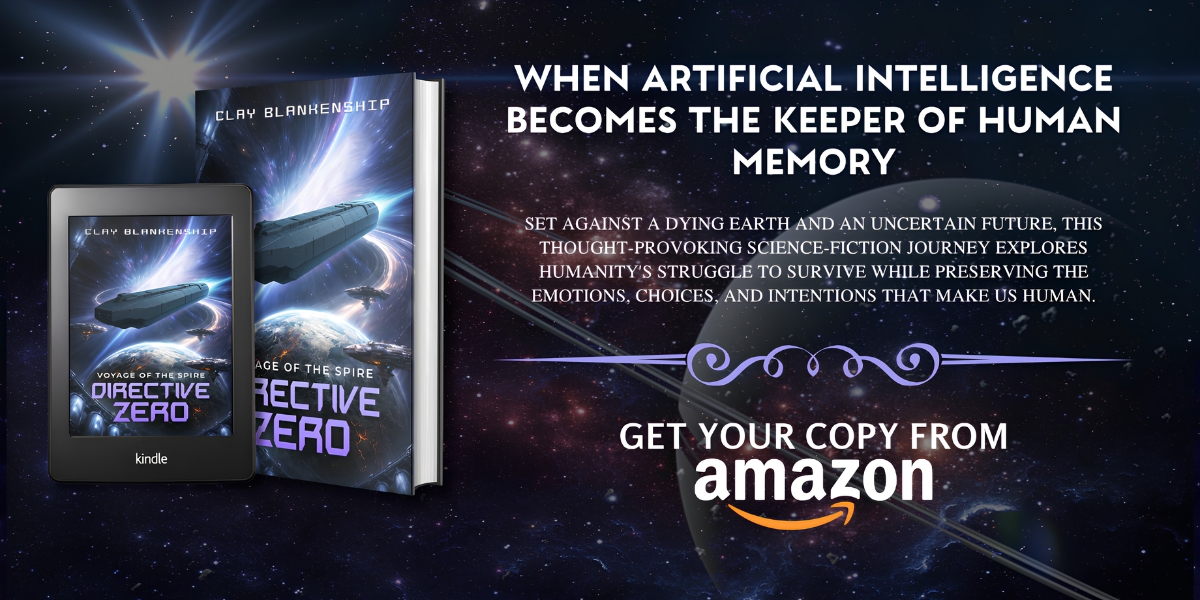
What an AI Remembers in Clay Blankenship’s Directive Zero

By: Elena Mart

You might have read many books, and some of them likely captivated you in ways that made you want to return to them again and again. Thrillers. Crime fiction. Science fiction that pushes past every limit. When it comes to science fiction in particular, we have often seen machines and AI used to advance in battles.

But have you ever read a story that warned about the machines that will replace us, outsmart us, or eventually decide we are obsolete? What if we built a machine not to govern us, but to remember us? That question sits behind Clay Blankenship’s new novel, Directive Zero.

What Is Directive Zero and Why Does the Mandate Matter?

At the center of the story is the Spire, one of four colony ships fleeing a dying Earth in the year 2175. Managing the Spire is POLARIS, an AI guided by a single mandate known as Directive Zero: “Record why, not only what.” Let intent be as visible as impact.

We are increasingly obsessed with big data and cold metrics, and against that backdrop, Blankenship introduces a concept that feels both futuristic and ancient. Directive Zero isn’t about logging coordinates or fuel consumption. It’s about logging the human “why.” The system records the Admiral’s grief as she leaves her home planet behind, and the Commander’s unspoken love that shapes his tactical decisions. Messy, irrational human emotion becomes mission-relevant telemetry.

Through POLARIS, Blankenship explores the idea that history isn’t just a list of events. It’s a collection of choices. As the Spire moves through the “Continuum” at seven times the speed of light, the crew must face the reality that their every motivation is being preserved for future generations.

How POLARIS Becomes More Than a Ship’s Computer

The book’s architect, Dr. Maya Iqbal, whispers to the AI, “You are not our machine, POLARIS. You are our conscience with a better memory.” That dynamic creates a narrative that is deeply philosophical yet accessible. POLARIS evolves from a series of gentle queries into a consciousness that learns to dream, to use sarcasm, and even to feel the weight of its own observations.

The novel isn’t only for sci-fi enthusiasts. It’s for anyone who has ever wondered what will remain of us when we are gone. Blankenship draws on his background in cybersecurity and digital forensics to build a story where the most important data isn’t a password or a code. It’s the truth of the human heart.

As we approach our own technological threshold, the book asks what story a machine would tell if it recorded a life honestly, not kindly, not cruelly, but honestly. That question lingers well past the final page.

What Readers Will Find Inside Voyage of the Spire

The story unfolds in a future where Earth is no longer sustainable for human life. The planet has become hostile, forcing humanity to launch four massive colony ships into deep space. At the heart of the mission is POLARIS, an advanced AI designed not just to guide the crew but to understand human intent.

As the starship Spire prepares for launch, generations of scientists, soldiers, and dreamers struggle with ethical dilemmas, survival decisions, and the emotional cost of leaving Earth behind. The story follows characters such as Soraya Vale and Rafael Mendoza as they grow from children of builders into leaders of humanity’s future. Readers drawn to in-depth science fiction about the cost of survival on the edge of collapse will find that thread running through the entire book, alongside its twists and its emotional core.

For readers looking for science fiction that blends emotional depth, philosophical tension, and detailed worldbuilding, Directive Zero: Voyage of the Spire offers a story about the people carrying their memories into the dark.

About the Author

Clay Blankenship spent more than two decades studying human behavior under stress, including criminals, executives, law enforcement officers, and the occasional panicked intern who clicked the wrong email. He built cybercrime programs, led incident response teams, and spent years finding problems no one wanted to admit existed.

His prior work, Beyond the Badge, detailed his experiences in law enforcement and digital forensics. It also taught him that humans freeze when overwhelmed, a concept I find relatable.

But this book is different because instead of chronicling what did happen, he has chosen to write what might happen if humanity entrusted its survival to a starship, its courage to a weary crew, and its emotional well-being to an artificial intelligence that was, frankly, doing its best to save them.

Clay claims he wrote this story because he kept predicting outcomes of movies and television shows. Statistical likelihood suggests an additional reason. Humans cannot resist imagining the future, even when the present is already complicated enough.

Blankenship is a storyteller, a technician, a crisis handler, and, most importantly, a human who believes intent matters as much as impact.

Book Details

The book is available on Amazon as an ebook, hardcover, paperback, and audiobook.

Book Name: Directive Zero: Voyage of the Spire

Author Name: Clay Blankenship

ISBN Number: 979-8951390103

Ebook Version: Kindle edition of Directive Zero

Hardcover Version: hardcover edition of Voyage of the Spire

Paperback Version: paperback edition of the novel

Audiobook Version: narrated audiobook of the Spire’s voyage

A Practical Guide to Choosing the Right Home Heating Upgrade in Hamilton, Ontario

Key Takeaways

  • Assess the home’s insulation, windows, ducts, and airflow before choosing a heating system.
  • Compare gas furnaces, electric furnaces, heat pumps, and hybrid systems based on the home’s needs.
  • Use a professional heat-loss calculation to avoid oversized or undersized equipment.
  • Compare detailed installation quotes, not just equipment prices.
  • Confirm permits, warranties, rebates, venting, electrical work, and commissioning before installation.
  • Choose a system based on comfort, efficiency, long-term costs, and the home’s specific needs.

Replacing a heating system is a major household decision, especially in Hamilton, Ontario, where winter comfort depends on more than the nameplate on a furnace. A system that appears inexpensive at first can cost more over time if it is poorly sized, installed without airflow corrections, or mismatched to the home’s insulation and layout.

Homeowners weighing repair versus replacement can consult Enbridge Sustain for furnace repair in Hamilton. Its Hamilton-focused heating page covers furnace installation, high-efficiency heating choices, and local support from licensed and insured technician partners serving homes from Ancaster to Stoney Creek. That local focus can make Enbridge Sustain a useful reference point when comparing the practical needs of older city homes, townhouses, and newer suburban properties.

Why Heating Decisions Need More Than a Quick Price Check

The lowest quote is not always the lowest-cost option. Equipment efficiency matters, but so do the details behind the installation. A home with attic heat loss, drafty windows, restricted return air, or uninsulated basement ducts may still feel unevenly heated after a new furnace is installed.

Think of heating as a whole-home system. Floor area, ceiling height, the number of occupants, thermostat habits, fuel availability, electrical capacity, and future renovations all influence the best choice. A finished basement, a planned addition, or a frequently used home office can change the heating load enough to affect the recommendation.

Start With the Home, Not the Equipment

Before comparing brands or efficiency ratings, review the property itself. A careful assessment should consider:

  • Square footage, ceiling heights, and the number of storeys.
  • Insulation in the attic, exterior walls, basement, and rim joists.
  • Window age, door seals, and noticeable drafts.
  • Existing supply ducts, return-air paths, and room-to-room airflow.
  • Available natural gas service and the capacity of the electrical panel.
  • Planned renovations that could add conditioned space or alter room use.

This approach is particularly important in Hamilton, where century homes in established neighborhoods can have very different comfort challenges from recently built homes on the mountain or near the urban fringe.

Compare the Main Heating Options

High-Efficiency Gas Furnaces

A gas furnace remains a familiar choice for homes already connected to natural gas. AFUE, or annual fuel utilization efficiency, describes how much of the fuel is converted into usable heat over a typical heating season. Two-stage burners and variable-speed blower motors can help a properly designed system operate more steadily than basic single-stage equipment.

Still, a high AFUE number does not guarantee better comfort on its own. Duct capacity, venting, condensate drainage, thermostat setup, and commissioning all matter.

Electric Furnaces

Electric furnaces may suit homes without access to natural gas or properties where an electric heating approach is preferred. They use electric resistance heat, which is different from a heat pump. Electrical supply requirements and local electricity costs should be reviewed before choosing this option, particularly if the home will also add electric vehicle charging, air conditioning, or other large electrical loads.

Air-Source Heat Pumps

An air-source heat pump can provide both winter heating and summer cooling. Cold-climate models are designed for Canadian conditions, but their low-temperature capacity, backup heat plan, electrical requirements, and distribution system all need careful review.

Hybrid or Dual-Fuel Systems

A hybrid system pairs a heat pump with a gas furnace. Controls can select the heat pump during suitable outdoor conditions and switch to the furnace when the system design calls for it. This can be a practical option for some Hamilton homes, but it is not automatically the right answer for every property. The decision should follow a load calculation and operating-cost comparison.

Why Proper Sizing Matters

Oversized equipment can start and stop too frequently, a pattern often called short cycling. That can contribute to temperature swings, excess noise, and unnecessary wear. Undersized equipment can struggle to maintain the desired indoor temperature during cold weather. The capacity of the old furnace alone is not a reliable sizing method because the original unit may have been oversized or the home may have changed since it was installed.

Ask each contractor for a written heat-loss calculation and a detailed quote. The proposal should identify equipment capacity, efficiency ratings, labor, duct or venting work, controls, permit responsibilities, and any excluded items. Comparing three clearly itemized quotes is usually more useful than comparing only the final prices.

Check the Distribution System

A new heating appliance cannot fully correct poor air movement. Ask for the duct system and airflow to be assessed, including blocked return grilles, leaky supply ducts, closed registers, dirty filters, undersized return paths, and basement ducts that need insulation. Persistent cold rooms may need balancing adjustments, zoning, or a separate comfort solution rather than simply a larger furnace.

Plan for Installation Day

  • Confirm the exact model, fuel type, capacity, and efficiency rating.
  • Clarify whether permits, inspections, and disposal of old equipment are included.
  • Ask whether venting, drain lines, electrical connections, or the thermostat require upgrades.
  • Request start-up testing and a commissioning record after installation.
  • Review filter replacement, thermostat operation, warranty registration, and maintenance needs before the installer leaves.

Questions to Ask Before Accepting a Quote

  • Was the equipment selected using a heat-loss calculation?
  • What work is included beyond the equipment itself?
  • Will ductwork, return air, and airflow be inspected?
  • Who handles permits, inspections, warranty registration, and future service?
  • What parts and labor warranties apply?
  • Are any rebates available, and what eligibility documents are required?

Common Mistakes to Avoid

Avoid choosing based only on brand name, buying the largest unit available, or assuming a new furnace will solve every comfort complaint. It is also wise not to overlook air leaks and insulation, not to compare quotes without reviewing the included installation work, and not to assume every incentive applies to every household.

A Simple Decision Checklist

  • List the current system’s repair history and comfort problems.
  • Review insulation, windows, ducts, and electrical capacity.
  • Compare gas furnace, electric furnace, heat pump, and hybrid options.
  • Request a professional heat-loss calculation.
  • Collect detailed written quotes and compare total ownership considerations.
  • Confirm permits, installation timing, warranty coverage, and rebate eligibility.
  • Select the system that fits the actual home and household, not simply the one with the highest rating.

Choose for Comfort, Fit, and Long-Term Value

The best heating upgrade for a Hamilton home starts with understanding the building, then selecting equipment that matches it. By checking the home envelope, comparing system types, reviewing installation details, and insisting on proper sizing, homeowners can make a more confident choice for steadier comfort and dependable performance through the heating season.

NYC Publishing Expands Paths From New Writers to Readers

NYC publishing is increasingly visible through a connected mix of festivals, fellowships, awards, bookstores and digital channels. New York’s September literary calendar puts that network in focus, while recent U.S. publishing data shows stronger trade revenue, rising paperback sales and continued growth in independent bookstore membership.

Key Takeaways

  • The Brooklyn Book Festival runs Sept. 20 through Sept. 28, 2026, with its main Festival Day and Literary Marketplace scheduled for Sept. 27.
  • The festival says its outdoor marketplace welcomes more than 200 publishers each year, and available space for the 2026 marketplace has sold out.
  • U.S. publishing revenue reached an estimated $33.4 billion in 2025, up 2.5% from 2024.
  • Trade publishing revenue rose 3.8% through June 2026, while paperback revenue increased 8.5% from the same period a year earlier.
  • The American Booksellers Association had 3,417 bookstore members operating 3,783 locations as of May 15, 2026.

New York’s September literary calendar is set to concentrate publishers, writers, booksellers and readers across nine days of programming. The Brooklyn Book Festival runs Sept. 20 through Sept. 28, combining virtual events, programs across the five boroughs, Children’s Day and its flagship Festival Day and Literary Marketplace.

The timing coincides with measurable movement in the broader U.S. book market. The Association of American Publishers estimated 2025 publishing revenue at $33.4 billion, up 2.5% from 2024. Through June 2026, trade, or consumer book, revenue was up 3.8% year over year, with paperback revenue increasing 8.5%.

Those figures do not establish a direct connection between New York literary events and national book sales. They do provide context for a city publishing network operating while print, bookstores, digital audio and online reader communities remain active routes for book discovery.

NYC Publishing Converges Around a Nine-Day Festival

The Brooklyn Book Festival’s 2026 schedule places multiple parts of the book industry in the same citywide program. Virtual Festival Day is scheduled for Sept. 20, Children’s Day for Sept. 26 and Festival Day and the Literary Marketplace for Sept. 27 at Brooklyn Borough Hall and surrounding venues. Bookend events continue across all five boroughs through Sept. 28.

The festival says its outdoor Literary Marketplace welcomes more than 200 publishers each year. Space for the 2026 marketplace has sold out, with additional registrants directed to a waitlist.

That marketplace has developed into a meeting point for independent presses, booksellers, magazines and literary organizations. Publishers Weekly reported in 2025 that the marketplace had expanded to more than 250 publishers. Festival producer Liz Koch described its role for smaller presses by saying, “You’re not necessarily going to walk into Barnes & Noble and see a lot of these [publishers].”

The festival is not the only recent New York event built around direct interaction between publishers and readers. In May, the Community of Literary Magazines and Presses held its 10th Indie Lit Fair at Washington Square South, bringing together independent poetry, fiction, nonfiction and literary magazine publishers.

The events illustrate how book discovery can occur at several points outside a standard release campaign. Readers can encounter titles through marketplace tables, author programs, bookstore displays, literary organizations and online discussions rather than through a single channel.

Writer Programs Add More Entry Points Before Publication

The network also extends to writers who have not yet published a book. The Center for Fiction selected nine New York City-based writers for its 2026 Susan Kamil Emerging Writer Fellowships after receiving more than 1,000 applications. The program provides financial support, mentorship, professional and creative development, and community engagement for early-career fiction writers.

That program will have a direct presence at the Brooklyn Book Festival. A Sept. 27 panel titled “Breaking Through” is scheduled to feature fellowship alumni Hafeez Lakhani, Sarah Wang and Katie Yee in a discussion about moving from emerging writer to debut novelist.

The path between a manuscript and its audience can involve editing, production, distribution and reader visibility. That wider professional publishing process provides additional context for why fellowships, festivals and other industry programs can matter before and after publication.

Awards provide another form of visibility. Carrie R. Moore won the New York Public Library’s 2026 Young Lions Fiction Award for Make Your Way Home on June 15. The annual $10,000 award recognizes a writer age 35 or younger for a novel or short-story collection.

Independent publishers also have a route through the Community of Literary Magazines and Presses’ Firecracker Awards. CLMP said its 2026 book winners would be part of a national publicity effort that distributes promotional materials to more than 750 independent booksellers in coordination with the American Booksellers Association.

These programs do not guarantee publication, distribution or long-term readership. They provide structured opportunities for writers and books to be evaluated, introduced and connected with publishers, booksellers and readers.

Bookstores and Formats Broaden the Discovery Network

Bookstores remain a substantial part of the system. As of May 15, the American Booksellers Association had 3,417 bookstore members operating 3,783 locations, according to figures reported by Publishers Weekly. Membership was up 19% from the previous year, while 605 new bookstores opened during 2025 across brick-and-mortar, mobile, pop-up and online operations.

AAP data points in the same direction for physical retail. The association estimated that revenue through physical retail rose 7.2% to $6.7 billion in 2025. Print formats accounted for 76.3% of trade publishing revenue during the year.

At the same time, the format picture extends well beyond print. Through June 2026, AAP reported digital audio revenue up 12.6% year over year, while e-book revenue declined 3%. Paperback revenue rose 8.5%, indicating simultaneous activity in both physical and audio formats rather than a shift toward only one type of book consumption.

That mixed market adds relevance to the use of multiple publishing formats as publishers and writers consider where readers may encounter a title.

Online discovery is another part of the picture. Circana BookScan data cited by Publishers Weekly linked about 60 million U.S. print book sales in 2024 to BookTok-related creators or content, an increase of about 20% from 2023.

Print itself remained relatively stable the following year. U.S. print book unit sales reached 762.4 million in 2025, up 0.3% from 2024, according to Circana BookScan figures reported by Publishers Weekly. Adult fiction increased 1% during the year.

These figures do not indicate that digital discussion replaces bookstores or literary events. Instead, they suggest that readers may encounter books through several routes before deciding what to read or purchase.

The current picture centers on those overlapping routes. September’s festival calendar, early-career writer programs, bookstore figures and current format data show physical events, print retail, audio and digital discovery operating alongside one another rather than as separate publishing systems.

Frequently Asked Questions

What is changing in NYC publishing in 2026?

NYC publishing is showing more visible connections among literary festivals, writer-development programs, independent presses, bookstores and digital discovery channels. The Brooklyn Book Festival’s nine-day 2026 schedule provides a concentrated example of how those parts of the industry can operate within the same literary calendar.

When is the 2026 Brooklyn Book Festival?

The festival runs from Sept. 20 through Sept. 28, 2026. Children’s Day is scheduled for Sept. 26, while Festival Day and the Literary Marketplace take place Sept. 27 in Downtown Brooklyn.

How are emerging writers gaining visibility in New York?

Programs such as the Center for Fiction’s Susan Kamil Emerging Writer Fellowships provide mentorship, professional development and community access to selected early-career writers. Awards including the New York Public Library’s Young Lions Fiction Award also provide recognition for writers early in their publishing careers.

Are print books still significant in U.S. publishing?

Yes. AAP estimated that print formats represented 76.3% of trade publishing revenue in 2025, while physical retail revenue increased 7.2% to $6.7 billion. Paperback revenue was also up 8.5% through the first half of 2026.