Why Every Wardrobe Needs a Black Cowboy Hat in 2026 Fashion Trends

From denim and boots to tailored jackets and monochrome streetwear, the black cowboy hat has found a place in modern style.

For decades, cowboy hats were tied closely to ranch life, rodeos, and country music culture. In 2026, that connection still exists, but the hat itself has taken on a broader role in fashion. Cowboy hats are showing up in more settings, from music festivals and city streets to restaurants and fashion-focused social events. Among the available styles and colors, black cowboy hats remain a versatile choice in modern wardrobes.

The appeal comes down to adaptability. A black cowboy hat can work with relaxed everyday clothing, polished evening looks, and many outfits in between. That flexibility has helped turn Western-inspired fashion into something that can feel approachable for a wider audience.

Black Cowboy Hats and Why Black Remains a Common Color Choice

Color plays a major role in how a cowboy hat fits into a wardrobe. While brown and beige hats remain popular for traditional Western looks, black has become an accessible option to style across a range of aesthetics.

A black hat pairs naturally with denim, leather jackets, monochrome outfits, graphic tees, boots, and even tailored outerwear. It can add structure and personality without overwhelming an outfit. For many people exploring Western fashion for the first time, black may also feel less intimidating than brighter or more traditional shades.

That growing interest has encouraged retailers to expand their selections of black cowboy hats, giving shoppers more choices in materials, shapes, and modern silhouettes.

Black Cowboy Hats in Felt Bring a More Polished Look

Classic felt cowboy hats remain a strong choice for polished styling. Their structured shape and clean finish work particularly well with darker clothing, fitted coats, button-down shirts, and dress boots.

In colder months, felt hats naturally complement heavier fabrics like wool, suede, and leather. They can also transition into settings that call for a more refined appearance while still maintaining a distinct Western influence.

The popularity of country music-inspired fashion has also contributed to renewed interest in classic felt hats among younger consumers. Rather than fully leaning into traditional cowboy styling, many now wear them with contemporary pieces to create a more balanced, fashion-driven look.

Black Cowboy Hat Collection and Keeping Western Style Casual with Straw Hats

Photo Courtesy: Unsplash.com

While felt hats are common in cooler seasons, straw cowboy hats continue to hold their place during spring and summer. Being lightweight and breathable, they can work well with relaxed outfits, outdoor events, concerts, and travel.

Straw styles can pair naturally with jeans, tanks, oversized button-down shirts, shorts, and casual boots or sneakers. They can add a subtle Western influence without overpowering the rest of the outfit.

For shoppers exploring different materials and fits, HatCountry has continued to expand its black cowboy hat collection as interest in Western-inspired fashion grows across both casual and fashion-focused audiences.

Black Cowboy Hat for Men and Women and How Modern Styles Continue to Evolve

One reason cowboy hats have remained relevant is their ability to evolve alongside fashion trends. Modern styles now include slimmer brims, cleaner lines, minimalist detailing, and bolder color options beyond traditional Western palettes.

Alongside black, shoppers are increasingly exploring white, beige, chocolate brown, and even statement colors for more expressive looks. Still, black remains a wearable entry point because it can fit easily into existing wardrobes.

Retailers like HatCountry have adapted to these changing preferences. Originally a family-run cowboy hat stand in Englishtown, New Jersey, the company has grown alongside broader demand for Western fashion while continuing to focus on product selection and customer experience.

For consumers searching for a versatile accessory that works across multiple personal styles, a black cowboy hat for men and women can be an accessible way to bring Western influence into everyday fashion without feeling locked into one specific look.

What Success Actually Looks Like After You’ve Built an AI Business

By Aman Jalan

Across the AI automation space, a familiar pattern keeps repeating. Founders spend months refining a product before giving any real thought to how it will reach a customer. By the time they’re ready to launch, the plan for actually getting in front of people barely exists.

Hamza Baig has watched this play out enough times to consider it the industry’s most persistent blind spot. As founder of Hexona Systems, an automation infrastructure company now serving more than 1,000 agencies across six continents, and the Automation Institute, which has trained over 40,000 builders, Baig has had a front-row seat to what separates automation businesses that grow from the ones that stall.

Distribution Is the Problem, Not the Product

“Distribution and acquisition should be figured out before you build, not after,” Baig said. “That applies to an agency, a SaaS, anything.” He pointed to a common instinct among early-stage founders to chase a polished product instead of a fast, imperfect one. “You don’t need a perfect product. You need a quick MVP you can get into the hands of your ideal customer. The market will tell you what to fix. Your planning doc won’t.”

Part of the issue, according to Baig, is that the technical side of automation has become deceptively easy. “Anyone can build a voice agent or a workflow in a weekend now,” he said. “The hard part is knowing which business problem is actually worth solving.” That gap, he said, pushes many founders toward impressive demonstrations rather than reliable results. “A simple agent that books appointments reliably is worth more than a flashy one that does 50 things badly.”

Baig also pushed back on a common assumption about what AI actually replaces in a business. “People think AI replaces the operator. It replaces the tasks,” he said. “The businesses winning with it still have someone who understands sales, follow-up, and customer psychology. AI just runs the plays faster.”

Where Baig Is Focusing Next

Looking ahead, Baig said his attention is shifting toward narrower, more specific markets rather than broad automation categories. “Going deep into hyper-micro-niches is where I’m excited to build,” he said. “Not ‘AI for real estate,’ but one painful, expensive problem for one very specific customer, solved completely. That’s where the real businesses are hiding.” He described a parallel opportunity in modernizing outdated business software that many industries still depend on. “There’s an entire layer of old, clunky, overpriced software that industries are stuck using because nothing better existed. AI makes it possible to rebuild these tools newer, faster, and better with a fraction of the team it used to take.”

That shift extends to the Automation Institute as well. “Forty thousand students is a number,” Baig said, “but the goal is more of them putting the training to work, not just watching videos.” He said the platform is moving away from selling standalone tools and toward complete, outcome-based systems. “The compounding part is building things that run without me being the bottleneck, so time and attention stay free for the next problem worth solving.”

A Different Definition of Winning

Away from the business, Baig described a version of success that has shifted considerably since Hexona reached a significant revenue milestone and earned HighLevel’s Platinum SaaSpreneur Award in 2024. “It used to be revenue milestones,” he said. “Now it’s freedom of attention, working on what I choose, with people I choose.” He said watching students succeed now carries more weight than his own metrics. “Success is students winning. One student landing their first client hits differently than another zero on my own dashboard.”

He also described himself as more process-driven than outcome-driven, a trait he said extends beyond business. “The audience sees launches and results, but what I actually enjoy is the reps, figuring out the system, iterating, getting a little better every day,” he said. “That’s true in business, fitness, everything.”

Who Baig Is Without the Business

Asked what remains once the business, the students, and the audience are stripped away, Baig didn’t point to Hexona at all. “A guy who’s happiest building things, even with no customers,” he said. “Personal apps, side projects, something.”

For Baig, the priorities that matter most now sit outside the business entirely. “A strong marriage, staying close to my faith, staying healthy at 60, and making my parents proud,” he said. “If the business is huge but those slip, I lose.”

Hexona Systems continues to expand its automation infrastructure across industries including SaaS, logistics, finance, and e-commerce, while the Automation Institute continues training builders through its Skool community.

Nick Stefanacci’s September Performance at The Iridium Brings a New Jazz Moment to New York This Fall

New York has never lacked great live music. Every night offers another marquee name, another celebrated venue, another opportunity to experience world-class talent. What separates an unforgettable performance from the rest is the artist’s ability to create a moment that stays with an audience long after the final note.

On September 25, internationally touring saxophonist and producer Nick Stefanacci brings that opportunity to The Iridium, one of Manhattan’s most respected homes for live music.

For Stefanacci, the evening arrives during an especially meaningful chapter of his career. Fresh off the release of his latest album, Right Here, Right Now, he steps onto the New York stage with music that reflects years of artistic growth and complete creative independence. The project was written, arranged, produced, mixed, and mastered entirely by Stefanacci, giving listeners an authentic window into his evolving musical voice.

His newest single, “Midnight Affair,” captures the sophistication of classic soul jazz while paying tribute to the unmistakable groove associated with Quincy Jones’ legendary productions. Rich horn arrangements, infectious rhythm, and cinematic storytelling combine to create a sound that feels timeless while remaining unmistakably his own.

Stefanacci’s résumé reflects remarkable versatility. Since first performing professionally as a teenager alongside Derek Trucks, he has shared stages with artists including the Four Tops, Tony Lindsay, Bernard “Pretty” Purdie, Ja Rule, Cindy Bradley, and members of Bruce Springsteen’s E Street Band. Television audiences have seen him perform on NBC’s Lipstick Jungle, the Macy’s Thanksgiving Day Parade, and New York City’s Fourth of July Fireworks Spectacular.

Yet his appeal extends beyond technical excellence or an impressive list of collaborators. Stefanacci approaches every performance with a philosophy rooted in connection. His concerts balance musicianship with warmth, inviting audiences into an experience where every arrangement, solo, and groove serves the larger story unfolding on stage.

That perspective has also inspired his newest philanthropic initiative, Smooth Jazz 4 Heroes. Launched this summer, the concert series celebrates veterans, first responders, healthcare professionals, and everyday heroes through the universal language of music. It continues a charitable journey that began with The Promise Festival, which Stefanacci founded to benefit the Children’s Hospital of Philadelphia.

The mission naturally complements the message he shares at the conclusion of every performance: “Get home safe. Spread love.”

That simple sentiment has become part of his identity as both an artist and a community leader.

The September 25 performance at The Iridium promises more than a showcase of exceptional contemporary soul jazz. It offers audiences the opportunity to witness an artist who has spent decades refining his craft while remaining committed to something larger than entertainment. His music celebrates joy, resilience, and human connection with equal conviction.

As New York’s live music calendar fills with must-see performances this fall, Nick Stefanacci’s return to one of the city’s most iconic venues stands out as an evening where artistry, purpose, and unforgettable musicianship come together in the room where they belong.

Explore more of Nick Stefanacci’s music and stay connected across his platforms. Visit his official website for the latest releases and updates, watch performances and videos on his YouTube channel, and follow along on Facebook and Instagram for news, behind-the-scenes moments, and upcoming shows.

House Passes Sunshine Protection Act to End Clock Changes Nationwide

The U.S. House of Representatives voted 308-117 on Tuesday to pass the Sunshine Protection Act, a bipartisan bill that would make daylight saving time permanent across the country and eliminate the twice-yearly ritual of changing clocks. The measure now heads to the Senate, where its future remains uncertain despite White House support.

A Bipartisan Vote To Lock The Clocks

The Sunshine Protection Act, introduced by Rep. Vern Buchanan of Florida, would lock the nation’s clocks to the time currently observed between March and November, eliminating the practice of “falling back” each autumn. The extra hour of evening daylight that Americans enjoy during warmer months would extend through winter as well, pushing sunsets later but also delaying sunrises significantly during the shortest days of the year.

The bill includes a flexibility provision allowing states to opt out if their legislatures pass exemption legislation before the federal law takes effect. Hawaii and most of Arizona already observe standard time year-round and would presumably remain on their current schedules. The National Conference of State Legislatures reports that 19 states have already enacted legislation to switch to year-round daylight saving time if Congress authorizes the change. New York State has introduced Senate Bill 3380 to do the same, though the proposal remains in committee pending federal action.

Rep. Gus Bilirakis of Florida argued on the House floor that Americans are ready to end the disruption of clock changes, citing economic benefits for tourism-dependent states where predictable daylight hours support workers and visitors. A 2025 AP-NORC poll found that 56% of American adults prefer permanent daylight saving time over permanent standard time, though the public remains divided on the broader question of whether to stop changing clocks at all.

Rep. Jim McGovern of Massachusetts voted in favor but questioned whether the measure deserved floor time while Americans face pressure from rent, grocery bills, and healthcare costs. The criticism reflected a tension that followed the bill through committee: widespread agreement that clock changes are unpopular, paired with skepticism about whether Congress should prioritize the issue.

The New York Impact On Winter Mornings And Evening Commutes

For New Yorkers, summers would look identical to how they do now. The changes would land squarely on the winter months, reshaping how residents experience daylight between November and March.

Data from timeanddate.com shows New York City’s latest winter sunrise would shift from 7:20 a.m. under the current system to 8:20 a.m. under permanent daylight saving time. That means commuters and schoolchildren would navigate a full extra hour of predawn darkness each morning during the deepest stretch of winter. For a city where millions rely on subway and bus commutes that begin well before sunrise, the practical implications are significant. Morning foot traffic on residential streets, school bus pickups, and outdoor construction schedules would all operate in darker conditions for weeks longer than they do now.

The trade-off comes in the evening. New York City’s earliest sunset, which currently falls at 4:28 p.m. in early December, would push to 5:28 p.m., giving residents an additional hour of post-work daylight during a period when early darkness compounds seasonal fatigue. A 2025 Stanford Medicine analysis found that either permanent standard time or permanent daylight saving time would be healthier than the current practice of switching clocks twice a year, primarily because seasonal transitions disrupt circadian rhythms and sleep patterns.

Central New York would feel the shift even more dramatically. In Utica, the latest winter sunrise would push to approximately 8:30 a.m. under permanent daylight saving time, while the earliest winter sunset would move from roughly 4:25 p.m. to about 5:25 p.m. — a meaningful gain for evening daylight but a steep cost for morning routines in a region where winter weather already makes early commutes difficult.

The 1970s Experiment That Ended In Reversal

The United States has tried permanent daylight saving time before. Congress enacted year-round daylight saving time in January 1974 during the energy crisis, framing it as a conservation measure. Public enthusiasm collapsed within months. Parents objected to children waiting for school buses in full darkness, and safety concerns mounted as winter morning commutes grew more hazardous. By October 1974, Congress reversed the policy and restored the seasonal clock change.

Rep. Mary Gay Scanlon of Pennsylvania invoked that history during the House Rules Committee hearing on Monday, warning colleagues that the appeal of permanent daylight saving time fades once Americans experience the reality of dark winter mornings stretching past 8 a.m. The 1974 reversal stands as the clearest precedent for how quickly public opinion can shift once an abstract policy preference becomes lived experience.

An Uncertain Path Through The Senate

The Sunshine Protection Act’s road through the Senate is far from clear. The upper chamber unanimously passed a similar version of the bill in 2022, but that earlier measure never received a House vote. The dynamic has now reversed — the House has acted, but key senators remain skeptical.

Sen. Tom Cotton of Arkansas has raised concerns about the impact of late winter sunrises on daily safety, particularly in states where the sun would not rise until after 9 a.m. under permanent daylight saving time. A senior aide indicated Cotton intends to ask Senate Majority Leader John Thune not to bring the legislation to the floor. On the other side, Sen. Patty Murray of Washington, who championed prior Senate efforts, called on Thune to schedule a vote immediately.

The White House has added weight to the push, issuing a statement of administration policy calling the Sunshine Protection Act a “popular, common-sense reform” and confirming that advisers would recommend the president sign the bill. President Trump posted on Truth Social the morning after the vote, calling the House passage “Great News for America,” though his position on the issue has shifted over the years between supporting permanent daylight saving time and calling for its elimination entirely.

A competing proposal, the Sunshine for Our Kids Act of 2026, would take the opposite approach and make standard time permanent instead, preserving morning daylight at the cost of earlier winter sunsets. That bill reflects the position of the American Academy of Sleep Medicine, which argues standard time aligns more closely with the body’s natural circadian rhythm.

Whether New Yorkers see their last clock change this November depends entirely on whether the Senate acts before the fall, and whether Congress can avoid repeating the overcorrection it made half a century ago.

What Mid-Market Companies Get Wrong About Exit Readiness

By Michael Cupps, CEO, Enterprise Diagnostics

Most middle-market companies spend years building something worth selling. When the moment finally arrives, whether it is the end of a PE hold period, a fundraising round, or a founder who has decided it is time, they arrive at the table with a growth story. Buyers, however, are pricing something else entirely.

The companies that close at premium multiples are not always the fastest-growing ones. They are the ones who knew their own number before the buyer did.

The Buyer Sees What the Operator Missed

Private equity buyers, strategic acquirers, and institutional investors all run the same playbook during diligence. For a long time, growth was the primary measuring stick. Top-line momentum could paper over a lot of operational inefficiency when debt was cheap and multiples were expanding. That changed. Higher cost of capital shifted buyer focus to profitability, operational leverage, and revenue quality. Now they look at how much revenue is recurring, how concentrated it is in a handful of customers, and how defensible it is if the market shifts. They look at whether the cost structure makes sense for the scale of the business, whether labor spend is producing the right output, whether sales and marketing spend is generating returns or just generating activity. And over the last three years, squarely inside most PE hold periods, a third question has entered every diligence process: what is this company’s AI position?

A vague answer to any of these questions does not just slow the process. It reprices the deal.

Michael Cupps, CEO of Enterprise Diagnostics, has seen this pattern repeat across mid-market transactions. “The discount rarely comes from something the owner didn’t know about their business,” Cupps says. “It comes from something they knew but hadn’t quantified. A buyer’s job is to put a number on uncertainty. The seller’s job is to get there first.”

Revenue Quality Is Not the Same as Revenue

One of the most common gaps in exit preparation is the difference between having revenue and having defensible revenue. A business generating $30 million a year looks very different to a buyer depending on how that revenue is structured.

Customer concentration is the most common pressure point. When one or two customers represent a significant share of total revenue, buyers introduce contingencies, earnouts, and price adjustments to account for the risk of losing that relationship after close. The irony is that concentration risk is often manageable with enough lead time. Diversification, contract extensions, and customer success investment can all move the number, but only if the operator identifies them before entering a process.

Recurring revenue mix matters for the same reason. Businesses with a high proportion of contracted, repeating revenue command better multiples because buyers can model what they are buying. Businesses where revenue is project-based or transactional require buyers to make assumptions, and buyers are paid to make conservative ones.

A founder-led digital media agency in Texas recently ran a financial diagnostic before beginning an exit process. The analysis surfaced a range of value opportunities, including a customer concentration risk that would have shown up in any buyer’s diligence. Finding it early meant the owner could address it on their own terms rather than negotiating against it at the table.

Operational Efficiency Is Where Multiples Are Made

Revenue quality gets a deal started. Operational efficiency is where the multiple is set.

Buyers benchmark every material line item in a company’s financials against sector peers. Sales and marketing spend as a percentage of revenue. R&D intensity. Revenue generated per employee. General and administrative overhead. Every gap between a company’s actual figures and its peer median is a line item in the buyer’s model, and those line items compound.

For mid-market companies in a PE hold period, this is where exit preparation often stalls. The sponsor wants multiple expansions. The management team is focused on hitting the next quarter. The operational gaps that would close the distance between current performance and peer benchmarks are visible in the data, but nobody has translated them into dollar terms that connect to the exit conversation.

The most useful framing is recoverable EBITDA: the margin that is currently leaving the business through inefficiency and that could be recovered before a transaction closes. Sized against the company’s own numbers, not an industry average, this figure becomes the most actionable input in exit preparation. It tells management exactly where to focus in the twelve to eighteen months before a process begins, and it gives the sponsor a clear line from operational improvement to valuation outcome.

A direct-to-consumer winery in Pennsylvania submitted a handful of documents and, within a day, had a financial diagnostic that identified a meaningful recoverable opportunity relative to the size of the business. The findings were tied to their own numbers, not sector averages, and gave the owner a clear set of priorities before any investor conversation.

The AI Question Is No Longer Optional

Every major buyer diligence process now includes an explicit review of a company’s AI position. This is not a technology audit. It is a business risk and opportunity assessment, and it asks two distinct questions.

The first is whether the business is positioned to capture AI value. This means understanding what AI tools and workflows are already in use, whether the company’s data infrastructure can support AI deployment, and whether stated ambitions around AI match what is actually capturable given current systems and talent. Companies that can answer this question clearly are presenting a growth story. Companies that cannot are presenting uncertainty.

The second question is whether the business is exposed to AI disruption. Every sector has revenue lines and operating functions that AI can erode. The degree of exposure depends on the company’s customer relationships, its revenue mix, and how directly its core value proposition competes with what AI can now deliver. A buyer who identifies significant disruption exposure without a credible mitigation plan will price that risk into the offer.

“Diligence your own AI position before the buyer does,” Cupps says. “The companies that know their number walk into a process with confidence. The ones that don’t find out when an offer lands with a discount they didn’t see coming.”

The Silver Tsunami and the Valuation Gap

A significant share of mid-market businesses are owned by founders who built them over decades and are now approaching the point where selling is the right next step. Estimates suggest that trillions of dollars in privately held business value will transfer over the next ten to fifteen years as baby boomer owners exit.

For these owners, the stakes of exit preparation are particularly high. Unlike a PE-backed business with a sponsor and an investment thesis, a founder-led company often has its entire financial legacy tied to a single transaction. The gap between a well-prepared exit and an unprepared one is not measured in basis points. It is measured in years of work.

The founders who closed at the strongest valuations share a common characteristic: they treated their business like a buyer would years before any buyer showed up. They understood their revenue quality. They closed their operational gaps. They knew what their AI position looked like and what a sophisticated acquirer would find.

Knowing the Number

Exit readiness is not a checklist. It is a state of operational clarity: knowing what a buyer will find, what it is worth, and what can still be changed before the process begins.

The tools to develop that clarity have changed significantly. AI-driven diagnostics can now analyze a company’s financials against sector benchmarks, size recoverable EBITDA in specific dollar terms, assess AI readiness and disruption exposure, and identify the customer health signals that predict retention risk. All of this in a fraction of the time and cost of a traditional consulting engagement.

The mid-market companies that will close at the strongest valuations over the next several years are not necessarily the ones with the best products or the fastest growth. They are the ones who knew how to prepare.

Michael Cupps is the CEO of Enterprise Diagnostics, an AI-driven diagnostic platform for mid-market companies preparing for exit, fundraising, or sustained growth. Learn more at enterprisediagnostics.ai. Case studies referenced in this article are available at enterprisediagnostics.ai/cases. To learn more about exit readiness, visit our Profit Signals resources page.

Google Workspace vs Microsoft 365: Which Productivity Suite Is Right for Your Business?

Choosing a productivity platform is a decision. It affects how your employees talk to each other, share information, work on projects, and keep your business data safe. These days, more and more companies are letting their employees work from anywhere, so they need cloud-based productivity suites to stay efficient and grow.

There are two leading options in this area: Google Workspace and Microsoft 365. Both provide tools for communication, collaboration, document management, and cloud storage. While they offer many similar features, each platform takes a different approach to helping businesses stay productive. Understanding these differences can help you choose the solution that best supports your organization’s goals.

Understanding the Core Differences

At first glance, Google Workspace and Microsoft 365 appear to offer similar services. Both include business email, cloud storage, document editing, video meetings, calendars, and collaboration tools. However, the experience of using these platforms is quite different.

Google Workspace is designed around simplicity and real-time collaboration. It runs primarily through a web browser, allowing employees to work together without worrying about installing software or managing multiple file versions. Team members can edit the same document simultaneously, with every change appearing instantly for everyone involved.

Microsoft 365 combines cloud-based services with powerful desktop applications. It is particularly valuable for organizations that rely on advanced document formatting, complex spreadsheets, or specialized productivity tools. Businesses that already use Microsoft Office often appreciate the familiarity and flexibility of the platform.

The right choice depends on your team’s workflow, the software your organization already uses, and your long-term business objectives.

Collaboration and Team Productivity

Effective collaboration is essential for modern businesses. Whether employees work from the office, remotely, or in a hybrid environment, they need tools that make teamwork simple and efficient.

Google Workspace was built with collaboration in mind. Multiple users can edit documents, spreadsheets, and presentations at the same time while leaving comments and suggestions in real time. This creates a smooth workflow and reduces delays caused by sending multiple versions of files back and forth.

Microsoft 365 also supports real-time collaboration but combines it with feature-rich desktop applications. Employees can work online while still benefiting from advanced editing capabilities available in Microsoft Word, Excel, and PowerPoint. This combination is especially useful for businesses that create detailed reports, financial models, or technical documentation.

Organizations with highly collaborative teams often appreciate Google’s streamlined approach, while businesses with more advanced document requirements may find Microsoft’s tools better suited to their daily operations.

Business Email, Cloud Storage, and Meetings

Reliable communication tools are essential for every successful business.

Google Workspace includes professional email through Gmail, cloud storage with Google Drive, and online meetings using Google Meet. Its clean interface makes it easy for employees to learn and use, while cloud-based storage allows files to be accessed securely from almost any device.

Microsoft 365 provides business email through Outlook, cloud storage with OneDrive, and virtual meetings through Microsoft Teams. Organizations that already use Outlook often experience a smooth transition because employees are familiar with the platform and its features.

Both productivity suites provide secure cloud storage, shared calendars, file sharing, scheduling tools, and high-quality video conferencing. The best option often depends on employee familiarity and the technology ecosystem your organization already uses.

Security and Business Continuity

Protecting business information is more important than ever. Cyber threats, accidental file deletion, hardware failures, and unauthorized access can disrupt daily operations and create costly downtime.

Both Google Workspace and Microsoft 365 include strong security features such as multi-factor authentication, data encryption, administrator controls, and continuous security updates. These features help businesses protect sensitive information while maintaining secure access for employees.

However, many organizations mistakenly believe that cloud services automatically provide complete data protection. Although these platforms maintain reliable infrastructure, businesses remain responsible for protecting their own information against accidental deletion, insider mistakes, ransomware attacks, and long-term data retention requirements.

For this reason, implementing an independent backup solution is an important part of any business continuity strategy, regardless of which productivity suite is selected.

Choosing the Right Platform for Your Business

Every organization has unique requirements, so there is no single platform that fits every business.

Startups often choose Google Workspace because it is easy to deploy, simple to manage, and encourages collaboration from the beginning. Teams can become productive quickly with minimal technical complexity.

Small and medium-sized businesses may find either platform suitable depending on their workflows. Companies that primarily operate online often appreciate the simplicity of Google Workspace, while businesses already invested in Microsoft software frequently gain greater efficiency by remaining within the Microsoft ecosystem.

Large enterprises often select Microsoft 365 because of its advanced administrative controls, compliance capabilities, and integration with existing business infrastructure. At the same time, many technology companies, educational institutions, and digital agencies successfully operate using Google Workspace because of its collaborative strengths.

Instead of focusing only on feature lists, businesses should evaluate employee productivity, existing software investments, security requirements, scalability, and future growth plans before making a decision.

How an Information Technology Company Can Help

Selecting a productivity platform involves much more than purchasing user licenses. Proper planning, secure migration, configuration, employee training, and ongoing technical support all contribute to a successful implementation.

An experienced information technology company can evaluate your existing systems, understand your business processes, and recommend the platform that best aligns with your operational needs. They can also manage email migration, securely transfer files, configure user accounts, implement security policies, and minimize disruption during the transition.

After deployment, technology professionals can establish reliable backup solutions, monitor security settings, provide employee training, and deliver ongoing support as your business continues to evolve. Their expertise helps organizations maximize the value of their chosen productivity platform while reducing operational risks.

Final Thoughts

Google Workspace and Microsoft 365 are both powerful productivity platforms capable of supporting organizations of every size. Neither solution is universally better than the other. The right choice depends on how your teams collaborate, the software they already use, your security requirements, and your long-term technology strategy.

By carefully evaluating your organization’s needs and working with an experienced information technology partner, you can implement a productivity solution that improves collaboration, strengthens data security, supports business continuity, and prepares your organization for sustainable future growth.

Why Maintaining Current CPR Certification Is Essential

Key Takeaways

● Typical CPR certifications are valid for two years before requiring renewal.

● Recertification classes are often more concise, focusing on updated protocols and skill refreshers.

● Staying certified ensures you meet up-to-date medical and legal compliance for job or volunteer activities.

It is crucial to keep your CPR certification current, as this enables you to respond efficiently and confidently in emergency situations. Regular recertification boosts your readiness and ensures you stay aligned with the latest best practices. If you are looking for a convenient way to keep your credentials up to date, consider CPR renewal courses as a practical option to maintain your qualification.

Over time, CPR standards and guidelines evolve to improve outcomes and safety. Staying aware of these changes through recertification is important for anyone with CPR responsibilities, whether for professional, personal, or volunteer reasons.

Understanding CPR Certification Validity

Most major organizations, including the American Heart Association and the American Red Cross, provide CPR certifications with a two-year validity period. This requirement ensures periodic updates and refresher training, keeping certified individuals up to date on advancements in resuscitation science and changes in best practices. Recertification courses are designed to help you refresh your skills and confidence, ensuring you remain competent under pressure.

Certification renewal is even more important due to the natural decline in retention of lifesaving techniques. Research consistently demonstrates that hands-on CPR skills and theoretical knowledge can fade within a few months following training. Regularly scheduled renewals significantly improve your ability to remember protocols and perform effective interventions when it truly matters.

Why Regular Renewal Is Essential

CPR procedures are periodically updated as new studies emerge and resuscitation outcomes improve. By taking renewal courses, you ensure your techniques remain current and effective, aligned with the latest evidence-based recommendations. The American Heart Association updates its guidelines every five years, making regular review and practice a practical necessity for anyone who may be called on in an emergency.

Renewal courses also reinforce confidence, which is critical during high-stress environments. Even those with experience benefit from simulated practice, which boosts readiness and courage during real-life emergencies. These courses are often available in multiple formats, from traditional classrooms to online modules, offering flexibility for busy schedules.

Options for Renewal Courses

CPR renewal programs are designed to be more succinct than first-time classes, catering to learners with prior knowledge. In-person sessions may include skills assessments and feedback, while online or blended formats offer convenience without losing educational rigor. Blended learning combines digital theory with in-person testing, maximizing retention and practical skills, allowing study at your own pace before demonstrating skills in a supportive environment. Some programs feature scenario-based instruction, promoting teamwork and realistic emergency response. Practical drills reflect diverse environments such as workplaces, schools, and public spaces, ensuring training is relevant and applicable.

Steps to Renew Your CPR Certification

1. Check Your Certification Status: Verify your current certification’s expiration date to avoid any lapse in coverage. This helps you plan ahead and find available courses.

2. Choose a Recognized Provider: Select an accredited organization, such as the American Heart Association or the Red Cross, to ensure your renewal meets accepted standards.

3. Select a Suitable Course Format: Choose in-person, online, or blended learning to optimize participation and skill reinforcement.

4. Complete the Renewal Course: Actively engage in all course segments to refresh your practical skills and grasp updated protocols.

5. Obtain Your Updated Certification: Once you successfully pass, keep a digital or physical copy of your renewed certification for work or volunteering requirements.

Benefits of Keeping Your Certification Current

Preparedness in Emergencies: Regularly updated training ensures you can act quickly, decisively, and effectively when someone’s life depends on it.

Regulatory Compliance: Many jobs, particularly in healthcare, education, and childcare, require an active CPR certification as a licensing or employment condition. Remaining compliant can protect your job and your liability.

Impact on Community Safety: Certified individuals enhance community safety and emergency preparedness, potentially saving lives while setting an example for others.

Increased Confidence and Skill Mastery: Remaining certified ensures you frequently refresh key skills, making your response second nature and minimizing hesitation under pressure. This ongoing practice can help overcome anxiety in emergencies and improve your capacity to assist effectively until advanced help arrives.

Encouragement of a Safety Culture: By renewing your certification, you inspire fellow coworkers, friends, and family members to do the same. This can help promote widespread safety knowledge in a variety of environments.

Staying Prepared Through Ongoing Certification

Maintaining your CPR certification is a vital responsibility. Regular recertification ensures competence, aligns with current standards, and shows commitment to safety, personal growth, and professional integrity. Consider group recertification for organizations, which many providers offer on-site, making renewal easier. Staying current with CPR training is a straightforward way to prepare and assist others during emergencies.

National SEO vs. Local SEO: Which Strategy Does Your Business Actually Need?

When you are setting up a digital growth plan, an executive needs to pick where the business wants to show up in search engines. Not all online traffic is the same. If you start running ads or doing search work without making sure your style matches what you can actually deliver in real life, you may waste money. You may also end up with fewer people buying from you. Your search results may not rank well either.

To get listed first in the search engines, a company will have to determine whether it wishes to target a narrow geographic area or the entire country at once. Every decision will have its own process, budget, and selection of keywords.

If your organization wants to get more people to see your website and show up in search results for big keywords that are not tied to a place, you should work with a skilled national seo agency. A good partner helps your business build a strong name all over the country and do well in search results in many time zones.

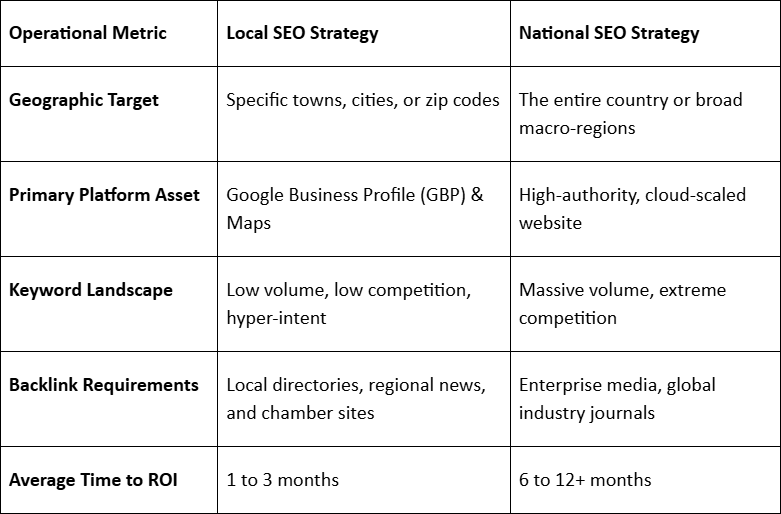
Side-by-Side Comparison

If you’re curious, take a look at the following. It should give you a general sense of the different ways they compare in the major performance dimensions.

Photo Courtesy: Unsplash.com

Pros & Considerations

Local SEO

Pros:

  • Can often be implemented relatively quickly.
  • Typically requires a lower initial investment.
  • Attracts customers with strong local purchase intent, which can support higher conversion rates.

Considerations:

  • Growth is focused on your target service area or local market.
  • Performance is influenced by local search factors such as proximity, relevance, and prominence, making ongoing local optimization important.

National SEO

Pros:

  • Offers significant opportunities to scale lead generation across a wider audience.
  • Helps build brand recognition and authority within your industry.
  • Supports expansion into multiple regions or nationwide markets.

Considerations:

  • Usually requires a larger investment in content, technical SEO, and authority-building.
  • Results often develop over a longer timeframe due to broader competition, making a consistent long-term strategy essential.

Best Use Cases

When to Deploy Local SEO?

This way of doing things is a must for shops and businesses with a building. The same goes for local providers who offer help in your area. Some good examples are dental offices, small law firms, plumbers, and small restaurants in your area. If the money you make comes from people coming to you or if you go out to them, then you should keep your focus here.

When to Deploy National SEO

This model is important for companies that sell things like digital items, products that can be shipped, or things that are not held back by borders. The right fit would be Software-as-a-Service companies, e-commerce stores that sell all over the country, wholesale makers, and digital agencies.

Which One to Choose?

To make the right choice, look at your fulfillment model more than your goals. Ask yourself: Can I legally and in practice help a customer who finds my website from 1,000 miles away tomorrow morning?

  • If you say yes, you have to get around local limits and grow an enterprise site structure.
  • If you say no, put all your focus on local maps and regional directories to be strong in your area. This will help you get a good hold close to home.

Expert Recommendation

For growing middle-market businesses, using a mix of local and wider ways often brings in good results during times of change. If you run many offices or places that send products across the country, keep your local ties strong.

Build a strong national setup on your main website, but at the same time, set up special service pages for each area. Also, manage Google Business Profiles for every real branch you have. This setup helps you get quick attention in your nearby area, while your standing in all other parts of the country gets stronger as time goes by.

Choosing a dedicated national seo agency means you get the right tech setup. You can also get strong links from other sites and better tools to read your data. This helps you handle big, multi-place sites and go after the top spot in markets all over the nation.

How Wall Street Shapes the Global Economy

Wall Street is often associated with New York’s financial district, but its influence extends far beyond the city’s borders. The financial institutions, investors, and markets centered around Wall Street play a significant role in determining how capital moves through the global economy.

Through stock markets, bond markets, investment firms, banks, and asset managers, Wall Street connects businesses seeking capital with investors looking for opportunities. Decisions made by financial institutions and investors can influence corporate expansion, employment, interest rates, currencies, and investment flows across countries.

That influence does not mean Wall Street controls the global economy on its own. Governments, central banks, businesses, consumers, geopolitical developments, and financial markets around the world all affect economic conditions. However, the financial activity concentrated in New York remains an important part of the global economic system.

Key Takeaways

  • Wall Street serves as a major global center for capital raising, investment, and financial trading.
  • Stock and bond markets help companies and governments access funding for growth and public spending.
  • Investor decisions can influence the value of companies, market confidence, and the flow of capital across borders.
  • Interest rates and expectations about monetary policy can affect borrowing costs, currencies, and investment decisions worldwide.
  • Wall Street’s influence is significant, but global economic conditions are shaped by many financial, political, and economic forces.

Wall Street Connects Capital With Businesses

One of Wall Street’s most important functions is helping companies raise money.

Businesses can access capital markets by selling shares of stock or issuing bonds. The money raised can then be used to expand operations, invest in technology, hire workers, acquire other companies, or develop new products.

When investors are confident about economic conditions, companies may find it easier to raise capital. Strong demand for stocks and bonds can provide businesses with greater access to financing.

When markets become uncertain, the opposite can happen. Investors may become more cautious, making it more expensive or difficult for companies to secure funding.

This relationship between financial markets and businesses means that market conditions can influence corporate decisions far beyond the trading floor.

Stock Markets Influence Business Confidence

Stock prices reflect investor expectations about the future performance of companies. While individual stock prices can change for many reasons, broader market movements often influence how businesses and consumers view the economy.

A rising market can increase confidence among investors and businesses. Companies with higher valuations may have greater flexibility when raising capital or pursuing acquisitions.

Falling markets can have the opposite effect. Businesses may delay investments, reduce expansion plans, or become more cautious about hiring when financial conditions deteriorate.

The relationship is not always direct. Stock market performance does not necessarily reflect the immediate condition of the broader economy. However, financial markets can influence economic activity by affecting confidence and access to capital.

Bond Markets Affect Governments and Borrowing Costs

Wall Street’s influence extends beyond corporate finance. Bond markets are also critical to governments that need to borrow money.

When governments issue bonds, investors provide capital in exchange for interest payments. The cost of that borrowing depends partly on investor demand and expectations about inflation, economic growth, and interest rates.

Changes in bond yields can therefore affect governments and businesses around the world.

Higher borrowing costs can make it more expensive to finance infrastructure projects, expand businesses, or refinance existing debt. Lower borrowing costs can encourage investment by making financing more affordable.

Because U.S. Treasury securities are widely used as benchmarks in global finance, movements in U.S. bond markets can have effects on financial markets far beyond the United States.

Interest Rates Can Send Ripples Around the World

The Federal Reserve plays a central role in the U.S. financial system, but its decisions can have global consequences.

When U.S. interest rates change, investors may reassess where to allocate their money. Higher U.S. rates can make dollar-denominated assets more attractive, potentially affecting currency values and capital flows in other countries.

Emerging markets can be particularly sensitive to shifts in global financial conditions. Changes in borrowing costs or currency values can affect businesses and governments that have debt denominated in U.S. dollars.

This is one reason why economic decisions made in Washington and financial markets in New York are closely watched by investors around the world.

Global Companies Depend on Financial Markets

Large multinational companies often rely on global financial markets to fund their operations.

A company headquartered in the United States may raise money from international investors, manufacture products in several countries, and sell those products to customers worldwide. Financial markets help connect these businesses with the capital they need to operate at scale.

Investment banks can also help companies complete mergers and acquisitions, while asset managers and institutional investors allocate capital across industries and geographic regions.

These activities can influence which companies expand, which industries attract investment, and how capital is distributed across the global economy.

Wall Street Can Influence Investor Sentiment

Financial markets are influenced not only by economic data but also by expectations and sentiment.

Investors constantly assess information about inflation, corporate earnings, interest rates, geopolitical risks, and economic growth. When expectations change, markets can react quickly.

A shift in investor sentiment can affect stock prices, bond yields, currencies, and commodity markets. These movements can then influence businesses and consumers by changing financing conditions and perceptions of economic risk.

Modern financial technology has made these connections even faster. Investors can respond to economic developments almost instantly, allowing market movements to spread across global financial centers within seconds.

The Benefits and Risks of Global Financial Markets

Global financial markets can support economic growth by directing capital toward businesses and projects that need funding. They can also provide investors with opportunities to diversify their portfolios across industries and countries.

However, interconnected markets can also spread financial stress.

A significant decline in one major financial market can affect investor confidence elsewhere. Banks, businesses, and investment funds with international exposure may face losses, while investors may reduce risk by moving money out of certain markets.

The global financial crisis of 2008 demonstrated how problems originating in one part of the financial system can spread across countries and industries.

Financial regulation and risk management are therefore important parts of maintaining market stability.

Wall Street’s Role Is Changing

The financial industry continues to evolve as technology changes how markets operate.

Electronic trading, algorithmic investing, artificial intelligence, and digital financial platforms have transformed the speed and complexity of modern markets. At the same time, investors can access financial information and markets from virtually anywhere.

Despite these changes, Wall Street remains an important global financial center. Its role is increasingly connected to other financial hubs in London, Hong Kong, Singapore, Tokyo, and other major cities.

The global economy is therefore less about one financial center controlling the system and more about interconnected markets responding to the same economic forces.

The Global Impact of Wall Street

Wall Street’s importance comes from its ability to connect investors, companies, governments, and financial institutions.

When capital moves through these markets, the effects can extend into the real economy. Businesses can raise money, governments can finance projects, and investors can allocate savings toward companies and industries they believe will grow.

At the same time, financial market volatility can create challenges when confidence falls or borrowing costs rise.

Understanding Wall Street therefore requires looking beyond stock prices. Its broader influence comes from the way financial markets affect access to capital, investment decisions, corporate growth, and economic expectations across borders.

As the global economy becomes increasingly interconnected, Wall Street will remain one of several major financial centers shaping the movement of money and investment around the world.


FAQs

What is Wall Street?

Wall Street is commonly used as a term for the U.S. financial industry and financial markets centered in New York City. It can refer to stock and bond markets, investment banks, asset managers, and other financial institutions.

How does Wall Street affect the global economy?

Wall Street influences the global economy by connecting businesses and governments with investors, affecting capital flows, financing costs, market confidence, and investment decisions.

Why are U.S. interest rates important to other countries?

Changes in U.S. interest rates can affect the value of the dollar, international capital flows, and borrowing costs. These effects can influence businesses and governments outside the United States.

Does Wall Street control the global economy?

No. Wall Street is an important part of the global financial system, but economic conditions are also shaped by governments, central banks, businesses, consumers, geopolitical events, and financial markets in other countries.

Why are stock markets important to businesses?

Stock markets allow companies to raise capital by selling shares to investors. Market valuations can also influence corporate financing, acquisitions, investment decisions, and investor confidence.

Can problems on Wall Street affect other countries?

Yes. Because financial markets are interconnected, significant market disruptions can affect international investment flows, currency values, borrowing costs, and confidence in economies around the world.

How Education Can Move the Economy Forward

Education is often discussed as a pathway to personal opportunity, but its impact extends well beyond individual careers. A strong education system can influence productivity, workforce development, entrepreneurship, innovation, and the ability of communities to adapt to economic change.

As industries evolve and employers face changing demands for skills, education can help prepare workers for new opportunities while giving businesses access to a stronger talent pool. From primary schools and universities to community colleges, vocational programs, and professional training, the education system plays a central role in shaping the economy of the future.

The connection between education and economic growth is particularly important as technology changes the way people work. Artificial intelligence, automation, advanced manufacturing, and other emerging technologies are creating demand for workers who can combine technical knowledge with problem-solving and communication skills.

Key Takeaways

  • Education can strengthen economic growth by developing a more skilled and adaptable workforce.
  • Higher levels of education and workforce training can help businesses find qualified workers and improve productivity.
  • Vocational programs and community colleges can connect students with careers in industries experiencing labor demand.
  • Research universities contribute to innovation by developing technologies, businesses, and new industries.
  • Expanding access to quality education can help more people participate in economic growth and improve long-term economic mobility.

Education Builds a More Skilled Workforce

One of the clearest ways education supports the economy is by preparing people for employment.

Businesses depend on workers with the skills needed to perform increasingly specialized jobs. As industries adopt new technologies and processes, employees must often learn new tools and adapt to changing responsibilities.

Education can help people develop foundational skills such as reading, mathematics, communication, and critical thinking. These abilities provide a basis for more specialized training later in a person’s career.

Higher education and professional training can then help workers develop expertise in fields such as healthcare, engineering, information technology, finance, education, and skilled trades.

When workers have access to relevant education and training, businesses may find it easier to fill open positions and expand their operations.

Community Colleges Can Connect Education With Employment

Four-year universities are an important part of the education system, but they are not the only institutions that contribute to economic development.

Community colleges and technical schools can provide shorter and more targeted programs that prepare students for specific careers. These programs can be particularly valuable in industries where employers need workers with practical technical skills.

Programs in fields such as nursing, information technology, advanced manufacturing, construction, transportation, and energy can create direct connections between education and workforce demand.

Partnerships between educational institutions and local employers can make these programs more effective. Businesses can help identify the skills they need, while schools can adapt curricula and training programs to reflect changing requirements.

This approach can benefit both sides. Students gain clearer pathways into employment, while employers gain access to workers with relevant skills.

Universities Can Drive Innovation

Education also contributes to economic growth through research and innovation.

Universities are responsible for a significant amount of scientific and technological research. Discoveries made in laboratories can eventually lead to new products, companies, and industries.

Research institutions can also support entrepreneurship by helping students and researchers turn ideas into businesses. Startup incubators, technology-transfer programs, and partnerships with private companies can help move innovations from academic research into the marketplace.

The economic impact can extend beyond the university itself. New companies may create jobs, attract investment, and generate demand for suppliers and professional services.

Education Can Support Entrepreneurship

Entrepreneurs do not always follow traditional career paths, but education can still play an important role in helping them build successful businesses.

Business programs can teach skills related to accounting, marketing, management, finance, and strategic planning. Technical education can provide the expertise needed to develop products and services.

Educational institutions can also create networks that connect aspiring entrepreneurs with mentors, investors, researchers, and potential business partners.

These connections can be particularly valuable for people who are starting a business for the first time. Access to knowledge and professional networks can help entrepreneurs make more informed decisions and avoid common mistakes.

Technology Is Changing What Workers Need to Know

The rapid adoption of artificial intelligence and automation is increasing the importance of lifelong learning.

Some jobs will change as companies introduce new technologies, while other roles may emerge. Workers may therefore need to update their skills multiple times throughout their careers rather than relying on a single period of education early in life.

Schools, universities, and training providers can help by offering flexible programs that allow people to develop new skills while working.

Employers also have a role to play. Companies that invest in employee training can help workers adapt to technological changes while retaining experienced staff.

The result can be a more resilient workforce that is better prepared for shifts in the economy.

Education Can Improve Economic Mobility

The economic benefits of education are not limited to businesses and employers. Education can also help individuals gain access to better employment opportunities and increase their ability to participate in economic growth.

However, access and quality matter. Students from different communities may face unequal access to educational resources, technology, experienced teachers, or advanced programs.

Addressing these gaps can help broaden the pool of people who are able to benefit from economic opportunities.

When more people can develop relevant skills and pursue meaningful careers, communities may benefit from higher employment, greater consumer activity, and stronger local businesses.

The Economy Needs Education and Industry to Work Together

Education cannot solve every economic challenge on its own. Economic growth also depends on infrastructure, investment, sound public policy, entrepreneurship, and access to capital.

Still, education provides a foundation for many of these areas by developing the people who design new technologies, operate businesses, provide essential services, and create new companies.

The strongest results are likely to come when educational institutions and employers work together. Schools need to understand how industries are changing, while businesses need to recognize the long-term value of investing in workforce development.

Government can also help by supporting education funding, workforce programs, research, and partnerships between schools and employers.

Preparing for the Economy Ahead

The economy is constantly changing, and education must change with it.

A successful education system should prepare students not only for the jobs that exist today but also for careers that may emerge in the future. That means developing technical skills alongside creativity, communication, critical thinking, and adaptability.

For workers, education can provide a pathway to new opportunities. For businesses, it can strengthen the talent pool. For communities, it can support entrepreneurship and economic mobility. For the broader economy, it can contribute to productivity and innovation.

Education is therefore more than an investment in individual achievement. It is an investment in the capacity of an economy to adapt, compete, and grow.


FAQs

How does education help the economy?

Education can strengthen the economy by developing skilled workers, improving productivity, supporting entrepreneurship, encouraging innovation, and helping people access better employment opportunities.

Why is workforce training important?

Workforce training helps employees develop skills that match changing business needs. It can be particularly important as companies adopt artificial intelligence, automation, and other new technologies.

How do universities contribute to economic growth?

Universities contribute through research, innovation, entrepreneurship programs, and partnerships with businesses. Research discoveries can lead to new technologies, products, startups, and industries.

Can education help reduce unemployment?

Education and training can improve people’s qualifications and make it easier to match workers with available jobs. However, employment also depends on broader economic conditions and the availability of jobs.

Why are community colleges important to the economy?

Community colleges can provide affordable and career-focused training in areas such as healthcare, technology, manufacturing, and skilled trades. Their programs can help connect local workers with regional employer needs.

Why does lifelong learning matter?

As technology and industries change, workers may need to update their skills throughout their careers. Lifelong learning can help people adapt to new technologies and remain competitive in the labor market.