
Why Choosing the Right Virtual Data Room Provider Can Make or Break Due Diligence

By Tayfun Bilsel, CEO, Clinked

The anatomy of a corporate transaction has changed substantially over the past decade. Where due diligence once involved a small group of advisors reviewing documents in a supervised physical setting, modern deal-making now spans multiple time zones, involves dozens of external stakeholders, and requires the controlled exchange of thousands of sensitive files often under significant time pressure.

This evolution has introduced a fundamental tension at the heart of M&A due diligence: how do organizations share the breadth of confidential business documents that buyers, lawyers, auditors, and regulators require, while maintaining precise control over who sees what, and when?

According to McKinsey & Company’s Merger Management Compendium, in more than 40 percent of deals, due diligence fails to provide an adequate roadmap for capturing synergies and creating value; a finding that points not only to analytical shortcomings, but to structural weaknesses in how information is managed and shared throughout a transaction.

So now the infrastructure supporting document exchange is no longer a background operational consideration but a strategic variable.

Tayfun Bilsel, CEO of Clinked, has spent years working with organizations on how they structure their document environments during high-stakes transactions. His consistent observation is that most deal teams focus their energy on the substance of due diligence: the financials, the contracts, the compliance landscape, while underestimating the degree to which their document governance infrastructure will either enable or impede the process. “The quality of a transaction often reflects the quality of the information environment in which it takes place,” Bilsel notes. “And that environment doesn’t build itself.”

The Risk of Conventional File-Sharing Methods

For many organizations approaching their first significant transaction, the instinct is to use familiar tools: email attachments, shared cloud drives, or internal file servers. These methods often work well in ordinary operational contexts. In the context of due diligence, however, they introduce categories of risk that can remain invisible until they materialize.

Email is the most straightforward example. Sending confidential financial statements or legal agreements as attachments provides no mechanism for controlling how documents are subsequently handled. Once a file leaves an inbox, its lifecycle is outside the sender’s control; recipients can forward, copy, or print content with no record of any of it. In processes involving multiple bidders or competing advisors, the absence of visibility carries meaningful consequences.

Generic shared drives present a different set of limitations. Most such platforms were designed for collaboration, not for the controlled disclosure environment that M&A due diligence requires. Folder-level permissions are broad instruments; they rarely support document-level access controls, restrict download or print rights, log which specific files have been viewed, or allow access to be revoked once a file has already been retrieved.

IBM’s 2024 Cost of a Data Breach Report placed the global average cost of a data breach at $4.88 million, a 10 percent increase from the prior year and the steepest single-year rise since the pandemic. The same report found that more than one-third of all breaches involved shadow data: information stored in unmanaged systems outside governed environments. That category of exposure maps directly onto the informal, multi-channel document workflows that many deal teams rely on during due diligence.

What to Expect from a Virtual Data Room Provider

Photo Courtesy: Clinked (Clinked virtual data room dashboard for secure due diligence and confidential document sharing)

Not all secure document environments are built to the same standard, and the distinction matters considerably when a transaction’s integrity depends on the platform. Organizations conducting due diligence increasingly rely on a dedicated virtual data room provider to maintain control over sensitive information, monitor user activity, and streamline document reviews throughout the transaction process.

Clinked, for example, provides secure virtual data room capabilities for teams that need controlled document sharing, permissions, audit trails, and branded workspaces during confidential business processes.

At the core of any capable virtual data room offering is a permission architecture designed to reflect the actual complexity of a deal. Role-based access controls allow administrators to assign different levels of document access to different stakeholder groups, buyers, sell-side advisors, legal counsel, and regulators, without any single party gaining visibility beyond their authorized scope. Granular document permissions extend this further, enabling organizations to govern not just who can access a document, but what they can do with it: whether it can be downloaded, printed, forwarded, or only viewed within a secured interface.

Audit trails are among the most operationally valuable features of a well-configured virtual data room. A complete, time-stamped log of user activity recording, which documents which documents were opened, by whom, and when, gives deal teams the oversight and documentation they need to manage information flows with confidence. In the event of a compliance inquiry or a post-deal dispute, a detailed audit trail can be a material asset. Version control adds a complementary layer of integrity, ensuring that all parties are working from current materials and that the revision history of every document is preserved.

Activity tracking serves an immediate deal-management function as well. Sell-side teams can observe which documents are receiving the most attention from prospective buyers, which sections of the data room remain unreviewed, and whether counterparties are engaging at the depth the timeline requires. That intelligence allows deal teams to manage the information disclosure process actively rather than reactively.

The Cost of Poor Document Governance

The consequences of inadequate document governance in M&A transactions manifest in delayed timelines, compliance exposure, diminished buyer confidence, and, in serious cases, information leakage that undermines the integrity of the deal itself.

Document-related delays are more common than deal teams tend to acknowledge. When buyers cannot locate specific materials, when version conflicts emerge across channels, or when access permissions must be manually reset each time a new advisor joins the process, the cumulative effect on transaction timelines is significant. In competitive processes where timing influences outcome, those inefficiencies carry direct financial weight.

Regulatory exposure is a separate but equally important concern. Data protection frameworks across major jurisdictions impose specific obligations on organizations that process and transfer personal data in a commercial context. Informal document workflows that fall outside governed systems can create compliance liabilities that persist regardless of whether the transaction closes.

The reputational dimension is harder to quantify but equally relevant. When a sell-side team struggles to provide organized, consistently accessible documentation, the signal to a prospective buyer is difficult to ignore: if this is how information is managed during a structured process, it raises questions about operational discipline more broadly.

IBM’s 2024 report also documented a 27 percent rise in intellectual property theft compared to the prior year, with the average cost per compromised record reaching $173, an 11 percent increase year-over-year. Transactions involving patents, proprietary technology, customer contracts, or other sensitive commercial assets call for a document environment designed to prevent that exposure once and for all.

How Modern Virtual Data Rooms Support Due Diligence

The operational benefits of a well-implemented virtual data room extend beyond security controls. When configured properly, a modern platform converts due diligence from a fragmented, multi-channel exchange into a centralized, auditable process that serves both sides of a transaction.

Centralized document management creates a single authoritative repository for all transaction materials. Rather than information dispersed across email chains, shared folders, and ad hoc handovers, a virtual data room provides a structured environment in which files are organized, indexed, and accessible through a controlled interface. That structure reduces coordination friction and lowers the risk that material information is missed or duplicated.

Staged document release allows sell-side teams to align disclosure with the deal timeline: making materials available as negotiations progress, revoking access if a counterparty withdraws, and applying dynamic watermarking to discourage unauthorized reproduction. Q&A functionality integrated within the platform keeps information requests, responses, and document references in one place, with all activity logged.

McKinsey’s research on large deal failures has observed that misunderstandings and miscommunications between buyers and sellers tend to surface most acutely during the due diligence stage and that transparent, structured information exchange is consistently associated with smoother deal completion. A disciplined document environment is one of the most practical tools available for creating that transparency.

A Risk Management Decision, Not a Technology Purchase

The decision to implement a virtual data room in support of due diligence is sometimes approached as a technology procurement question, a matter of features and pricing. That framing leads organizations to underweight the more consequential question of what the platform enables or prevents.

Virtual data room adoption is more accurately understood as a risk management decision. It determines whether an organization can demonstrate, with documentary evidence, that confidential information was handled appropriately throughout a transaction. It determines whether a deal team can deliver the transparency that informed buyers require while protecting information that should remain restricted. And it influences, in ways that are predictable and manageable, whether a process runs to schedule or extends unnecessarily.

McKinsey has noted that roughly 70 percent of mergers fail to achieve their original objectives, a figure that has held broadly consistent across decades of research. While no single variable accounts for that outcome, the quality of information governance during due diligence is a structural contributor that tends to receive less attention than it deserves.

Organizations that treat document infrastructure as an afterthought accept a category of deal risk that is foreseeable and, in most cases, preventable. Tayfun Bilsel’s view is straightforward: the platforms and processes used to share confidential information are not administrative details. They are foundational to whether a deal is executed with the discipline, speed, and integrity that convert a signed agreement into lasting value.

Tayfun Bilsel is the CEO of Clinked, a provider of secure client portal and virtual data room solutions for professional services firms and organizations managing confidential business transactions.

How Betrayal Trust and Hope Confronts the Legacy of Silence And The Generational Echo of Trauma

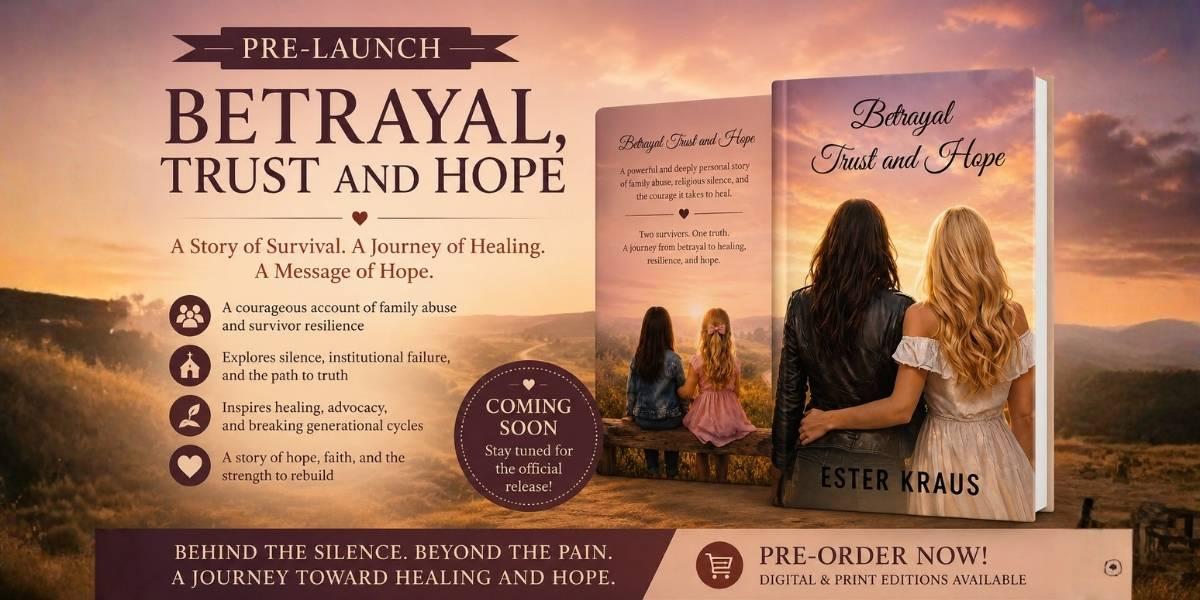
Some books tell stories. Others expose wounds society has learned to look away from. In the upcoming Betrayal Trust and Hope, Ester Kraus delivers a deeply personal and emotionally unflinching account of abuse, institutional failure, and survival. But perhaps its most haunting theme is something even larger. The way trauma echoes across generations when silence is mistaken for protection.

The book begins with a devastating recognition. Abuse does not affect only one person, one moment, or one household. Its consequences stretch outward through years, relationships, parenting, grief, and identity itself. Ester writes not only as a related to a survivor but also as someone who witnessed how unresolved pain quietly reshaped an entire family system.

What makes the narrative so emotionally resonant is its refusal to isolate trauma as a singular event. Instead, the book reveals trauma as something cumulative. Something that lingers in body language, emotional responses, parenting instincts, and even inherited fears. The survivors at the center of the story grow older, build families, and attempt to create meaningful lives, yet the emotional residue of childhood abuse never fully disappears.

The author portrays this reality with remarkable honesty. There are no exaggerated declarations of triumph or simplistic promises of healing. Instead, readers encounter a more authentic portrait of survival. Adults who continue carrying invisible triggers, who still respond instinctively to sounds, memories, or emotional tension long after childhood has ended. Trauma, the book suggests, is not merely remembered. It is lived repeatedly through the nervous system, relationships, and emotional memory.

One of the book’s most powerful insights lies in its exploration of learned silence. The children in the narrative are raised inside a highly controlled religious environment where obedience is framed as virtue and questioning authority is quietly discouraged. Over time, that atmosphere conditions them not only to suppress fear but to mistrust their own instincts.

This conditioning becomes central to the book’s emotional architecture. The survivors do not simply fear their abuser. They fear disrupting the structure surrounding him. They learn early that preserving harmony often mattered more than exposing harm. In many ways, the book becomes an examination of how communities unintentionally train people to tolerate emotional danger in the name of stability.

Ester also addresses a painful but often overlooked reality. Trauma frequently reappears across generations unless actively confronted. The book references additional abusive situations involving younger family members years later, separate incidents involving other perpetrators, yet emotionally connected through the same inherited silence and vulnerability.

Rather than treating this as a coincidence, the narrative forces readers to confront how unhealed trauma can shape future environments. Fear alters parenting. Distrust reshapes communication. Hypervigilance becomes normalized. Even love itself can become intertwined with anxiety and guilt. The emotional inheritance of abuse extends far beyond the original harm. Yet the long-awaited book’s greatest achievement may be its insistence that cycles can be interrupted.

Throughout the narrative, speaking the truth becomes an act of resistance. The survivors eventually turn their pain into advocacy, refusing to let silence define the next generation. June, in particular, emerges as a symbol of this change. A survivor who dedicates part of her adult life to helping victims of abuse and domestic violence.

That evolution gives the book its emotional balance. While the story never minimizes suffering, it also refuses to surrender entirely to despair. Hope, in Ester’s telling, is not naïve optimism. It is a difficult decision to remain emotionally present after betrayal. It is the courage to protect others despite personal devastation. It is the willingness to speak aloud what previous generations were taught to bury.

The prose itself mirrors this emotional intensity. Ester writes with restraint rather than spectacle, allowing quiet details to carry enormous weight. A child growing silent before a father comes home. A mother reinterpreting memories years too late. A survivor learning to distinguish faith from institutional control. These moments linger because they feel painfully human.

In today’s cultural climate, where conversations around trauma, accountability, and institutional responsibility continue to grow, Betrayal Trust and Hope will feel urgently relevant. It will remind readers that abuse rarely exists in isolation. It survives within systems of silence, denial, and misplaced loyalty. But the book will also offer something equally important. Proof that truth, once spoken, can become the beginning of generational change. And perhaps that is the most powerful message Ester Kraus leaves behind, that even inherited pain does not have to become inherited silence.

Ester Kraus offers this work as a vital testimony, one that asks readers to consider how silence passes from one generation to the next, and how speaking the truth can begin to break it.

How Dr. Mason Blake Pimsler Reinvents Bronx Healthcare

By: Ethan Lee

Urban healthcare faces a mounting crisis. Patients dealing with homelessness, addiction, or chronic illnesses like HIV/AIDS often lack a reliable support system. Traditional medical models usually focus on symptoms rather than the social factors that cause them. This gap leads to poor health outcomes and a deep-seated mistrust of the medical establishment. Without a holistic approach, the most vulnerable members of our society remain trapped in a cycle of emergency room visits and untreated conditions.

Dr. Mason Blake Pimsler, an attending physician at NYC Health + Hospitals/Lincoln, takes a comprehensive approach to this challenge. Recently named “Doctor of the Year,” Dr. Pimsler treats the Bronx community by addressing both medical, financial, and social needs. He uses the vast resources of the hospital system to provide everything from legal aid to mental health support. This interview explores his unique philosophy on patient trust, accessible weight loss treatments, radical equality in the workplace, and the future of safety-net clinics.

Q: You were recently honored as “Doctor of the Year” and granted a dedicated day by the City of New York. How do these milestones influence your mission to serve the Bronx?

Dr. Mason Blake Pimsler: These honors are incredibly humbling and remind me that medicine is ultimately about service. They strengthen my commitment to the Bronx by motivating me to continue providing compassionate care, advocating for underserved communities, and working to improve health outcomes for the patients and families who place their trust in us every day.

Q: Many of your patients face extreme hardships like homelessness. What specific steps do you take to build trust with individuals who feel abandoned by the traditional healthcare system?

Dr. Mason Blake Pimsler: Trust starts with listening and treating every patient with dignity and respect. Many people facing homelessness have felt overlooked by the healthcare system, so I focus on being consistent, nonjudgmental, and understanding the challenges they face outside the brick and mortar of the clinic. The clinic is a safe environment. I also work closely with social services and community resources to help address barriers like housing, food, and access to care. Over time, trust is built by showing patients they are truly seen, heard, and supported.

Q: In addition to social challenges, metabolic health and obesity are major crises in underserved areas. How are you addressing the high demand for modern weight loss treatments among patients who face severe financial barriers?

Dr. Mason Blake Pimsler: Obesity and weight-related chronic conditions hit vulnerable communities the hardest, yet weight loss treatments are often priced completely out of reach. In my practice, I focus heavily on providing comprehensive weight loss management. More importantly, I make it a priority to provide medications like Ozempic and Wegovy to individuals who need them but cannot afford them. Healthcare equity means ensuring that preventative medicine isn’t just a luxury for the wealthy but an accessible tool for everyone trying to improve their long-term health.

Q: You often highlight the importance of non-medical resources. How do services like free legal aid and social support change the way you practice medicine?

Dr. Mason Blake Pimsler: The free legal aid helps patients in situations that, without free legal assistance, could turn their lives into more pain and suffering. Such as a patient being evicted and not having a proper voice. Here, the legal services assist with housing security.

Q: With your background in geriatrics and internal medicine, you handle very complex cases. Why is a personalized, case-by-case approach to preventative screening so vital for patient survival?

Dr. Mason Blake Pimsler: Every patient has different risk factors, family histories, lifestyles, and barriers to care, so preventative screening should never be one-size-fits-all. A personalized approach helps identify diseases earlier when they are most treatable. Ultimately, this improves long-term survival and quality of life.

Q: You advocate for treating everyone with equal respect, from the cleaning staff to top executives. How does this culture of radical equality improve the quality of care in your clinic?

Dr. Mason Blake Pimsler: Working in the Bronx at Lincoln Hospital, part of the largest municipal healthcare system in the United States, means serving a vast, diverse, and often underserved population. A culture of radical equality is essential here. In my specialties of Internal Medicine and Geriatrics, establishing trust is the core of effective treatment. Treating everyone with equal respect breaks down the institutional intimidation that many patients feel. Furthermore, being able to communicate with my patients in both English and Spanish ensures that language is never a barrier to that respect. When patients, support staff, and physicians view each other as equals, communication is more transparent. This leads to more accurate medical histories, better adherence to treatment plans, and ultimately, a higher standard of care for the aging and general adult populations I treat.

Q: For medical centers looking to replicate your success, what is the most important foundational change they should make to better support vulnerable communities?

Dr. Mason Blake Pimsler: The most important foundational change is building a system intentionally designed around accessibility and cultural competence. NYC Health + Hospitals provides essential inpatient and outpatient care to over a million New Yorkers annually, regardless of their background. To replicate this, medical centers must adapt their services to the literal and cultural needs of their neighborhoods. For example, offering bilingual care (as I do with English and Spanish) is not just an amenity; it is a clinical necessity for supporting vulnerable communities. Additionally, centers must ensure that specialized care, like Geriatrics for the aging population, or dedicated chronic condition management, is readily available within these community hubs. The foundation must be a structural commitment to keeping the doors open to everyone and meeting patients exactly where they are.

Q: Treating communities with such deep layers of trauma and systemic neglect can take a massive emotional toll. How do you maintain your own resilience and protect against burnout while carrying out this intense work?

Dr. Mason Blake Pimsler: Protecting against burnout requires practicing the same holistic care for myself that I advocate for my patients. For me, maintaining resilience is rooted in grounding practices like mindfulness, intentional silence, and meditation. When you are constantly absorbing the crises of an underserved urban population, you have to intentionally create a space to process that weight. I also find immense renewal in nature and simple, hands-on hobbies like gardening. There is something deeply therapeutic about cultivating growth in a quiet backyard that balances the fast-paced, high-stakes environment of a city emergency room or safety-net clinic. Ultimately, it’s about establishing clear boundaries and recharging your own battery so you can return to your patients with genuine empathy and focus.

The insights from this discussion underscore a shift in modern medicine. Effective healthcare requires more than just clinical expertise; it demands a deep commitment to the patient’s entire life situation. By prioritizing trust, providing essential medications to those who cannot afford them, and drawing on comprehensive social resources, providers can stabilize lives that once seemed unreachable. True healing happens when a medical system treats a person’s dignity as seriously as their physical health.

Looking ahead, the safety-net model used at Lincoln Medical Center serves as a vital blueprint for urban centers nationwide. Integrating social services and accessible specialized treatments directly into the clinical experience is no longer optional; it is a necessity. As leaders like Dr. Pimsler continue to bridge the gap between medicine and social stability, the standard for community health will continue to rise.

To learn more, view Dr. Pimsler’s profile at NYC Health + Hospitals.