How AI-Integrated Societies Will Reshape Individuals, Corporations, and Institutions

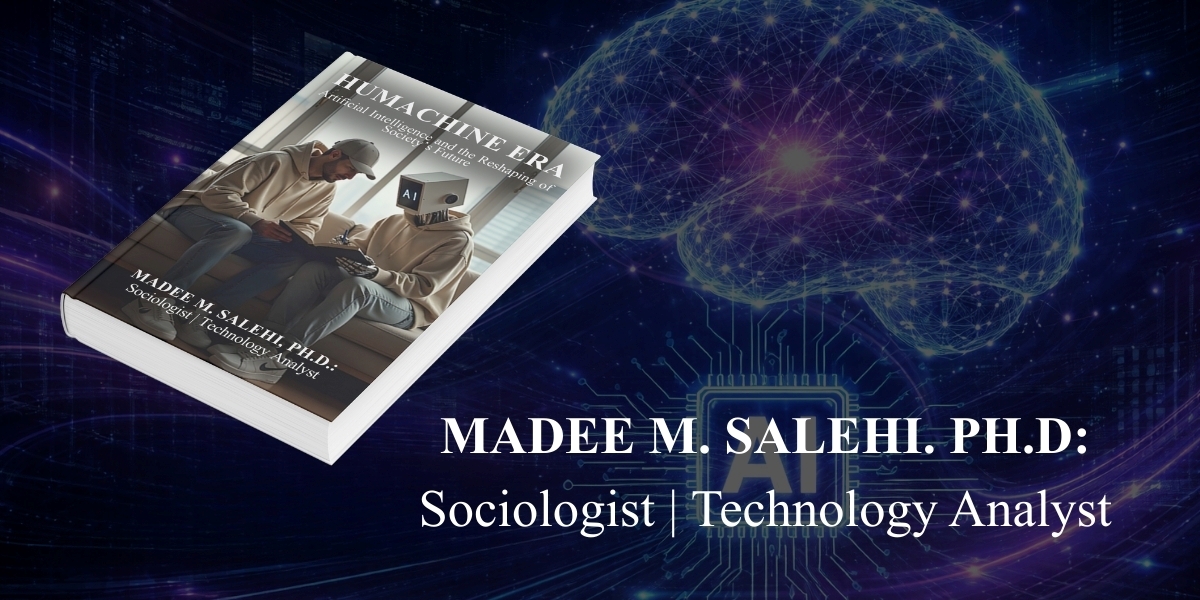
In HuMachine Era: Artificial Intelligence and the Reshaping of Society’s Future, Professor Salehi presents technology as humanity’s enduring instrument for advancing life, expanding control over nature, and improving collective well-being. Artificial intelligence, he argues, was conceived as a constructive force within this historical trajectory.
In this book, “HuMachine” is not a work of fiction. It does not refer to humanoid robots. It describes a new generation shaped by AI, one whose mindset and behavior are deeply influenced by both human and artificial-intelligence logic.
As AI rapidly advances, concerns about its human and social consequences have intensified. Some prominent technologists warn of massive job losses, even in highly specialized professions, as well as a loss of control over social and cultural direction. These fears are real and grounded in AI’s expanding capabilities. In general, however, these critical warnings lack a comprehensive explanation because they often focus only on AI technology rather than on how society reacts to and adapts to its consequences.
Salehi offers a balanced view. Trained in sociology as well as electrical engineering and AI development, he acknowledges disruption but rejects pessimism. He highlights AI’s transformative and potentially liberating power, freeing large categories of people from performing tedious, repetitive, and sometimes dangerous work that consumes much of a human lifetime. Such liberation, however, requires not only technological progress but deep societal reforms and structural adaptation.
The book’s analytical framework is multidisciplinary in foundation and forward-looking in vision, offering a substantive contribution to the debate on AI and society.
How Will AI Reshape the Corporate World?
In HuMachine Era, Salehi shifts the lens. He examines how corporations, government agencies, schools, and other central institutions will undergo profound reform through their interaction with AI. Rather than predicting collapse, he explores structured evolution.
The result is a more grounded vision of tomorrow than some critics of AI are ready to discuss, one that recognizes technological power yet understands the future as a process of co-evolution between advances of intelligent systems and societal dynamics.
Why Tomorrow Will Be Social-Technical
AI represents a qualitative break from previous technologies. It is not merely a tool, but a new kind of reality, an intelligent presence capable of collaboration, autonomous humanlike performance, and the amplification of human capacities. Though it does not think like a human, it generates outcomes based on learned patterns rather than simply executing fixed instructions.
Understanding a deeply AI-integrated world requires both sociological insight and advanced technological knowledge, an interdisciplinary perspective that Salehi has developed over seven additional years of academic work beyond his doctoral training. Only through this combined lens can we realistically anticipate how such a world will function, organize, and govern itself.
Salehi presents a balanced view of emerging social realities. Alongside clear benefits, he addresses tensions and fears: AI’s speed, the scale of its knowledge, and its capacity to outperform humans in critical domains, raising concerns about diminishing human control. Yet AI systems are neither fully self-regulating nor purely deterministic. They operate within social constraints. This is precisely what dominant technologist narratives often overlook.
Such transformations cannot be explained by technical analysis or social theory alone. They must be examined simultaneously. It is this integrated social-technical perspective that distinguishes the book and situates its multidisciplinary author at the intersection of sociology and advanced AI.
How AI Will Transform the Nature of Working Groups
What sets HuMachine Era apart from the flood of AI-related publications is its conceptual repositioning of artificial intelligence. AI is not presented as a mere upgrade to existing processes. It is framed as an autonomous-performing system, one that actively partners with humans and, in certain contexts, delivers humanlike services independently.
Salehi makes a defining distinction that reframes the debate: AI cannot think, but it generates intelligent results.
The separation between human cognition and machine performance is not rhetorical. It is analytical. Drawing on sociology, mathematics, biology, and computational theory, Salehi demonstrates that contemporary AI systems can produce highly sophisticated outputs without possessing genuine cognition. Precisely because of this distinction, collaboration between humans and intelligent machines in advanced societies is not only likely but structurally inevitable.
Full Automation and the Rise of Intelligent Virtual Entities
One of the book’s central theoretical contributions is its analysis of full automation, an emerging trajectory in which AI assumes a primary operational role. Salehi describes environments where entire departments, offices, factories, and administrative systems are run by intelligent virtual entities with minimal or no human presence. Since most white-collar employees who will lose their jobs are from middle-class ranks, it is argued that these strata will shrink and become negligible.
Organizational Transformation in an AI-Driven World
Across public administration, healthcare, finance, and industry, large-scale organizations will undergo profound restructuring driven by the logic of AI integration. These changes are not optional. Hierarchical authority will shift, leadership will require sustained ethical vigilance, and survival will depend not only on adopting AI tools but on continuously synchronizing internal dynamics with evolving social and economic environments.
Salehi shows how service and business organizations will evolve toward looser boundaries and tighter alignment between internal operations and external conditions. AI enables real-time recalibration of services, policies, and resources, creating unprecedented responsiveness.
Acceleration brings risk. Without adaptive governance, transparency, and accountability, technological momentum may outpace institutional capacity. Some organizations will redefine their internal logic and tempo. Others may give way to entirely new forms that are not yet imaginable within today’s frameworks.
California, particularly the greater Los Angeles area, will be deeply affected by the deployment of advanced AI, particularly through office and workforce automation. Unlike states such as Ohio or Illinois, California’s economy is driven less by heavy industry and more by light manufacturing, technology, and a highly skilled white-collar workforce. As AI becomes more deeply integrated into professional and administrative sectors, this segment of the workforce is likely to face significant displacement.
Education and the End of Standardization
Few domains illustrate this shift more clearly than education.
Twentieth-century educational systems were designed for mass standardization under conditions of limited informational capacity. AI-integrated learning dissolves that constraint. Curriculum design, pacing, assessment, and feedback can be adjusted dynamically for individual learners at scale.
Salehi emphasizes that such transformation requires deliberate policy design, infrastructural investment, and ethical reconstruction. Transparency, learner autonomy, and safeguards against algorithmic bias must be embedded at the system level. The barrier to transformation is not just infrastructural and regulatory, but also involves new subjective factors that are not currently predictable.
A Book for Structural Thinkers
In a saturated AI publishing market, HuMachine Era: Artificial Intelligence and the Reshaping of Society’s Future offers something different. It does not center on applications, product cycles, or hype.
It provides a theory-based structural framework and reframes ethics as institutional design rather than rhetorical debate. It treats AI as infrastructure rather than software. It analyzes the co-evolution of technology and society rather than isolating one from the other.
For policymakers, institutional leaders, governance experts, educators, and long-horizon strategists, this book offers a framework for preparation.
The HuMachine Era is not emerging at the margins. It is reorganizing the center of social life.
Author’s contact: humachineera@aol.com