Why Healthcare Is Poised for Its Own Paradigm Shift and How Longevitix Is Leading It

By: Jake Smiths

The American healthcare industry is at a critical inflection point. For decades, it has been shaped by incentives that reward volume over sustained wellness. As a result, chronic diseases dominate both health outcomes and spending. Yet, just as nutrition science is recalibrating long‑held assumptions about what we eat, a new wave of preventive‑first thinking is reshaping how care might be delivered.

At the forefront of this emerging philosophy is Longevitix, a healthspan‑focused preventive care intelligence platform that believes the next foundational framework for healthcare should be a “preventive pyramid” that flips care on its head.

The Reality of America’s Health Burden

The latest data from the U.S. Centers for Disease Control and Prevention reveal that ultra‑processed foods, industrialized products high in sugar, salt, and refined carbohydrates, now make up 55 % of total calories consumed by Americans age 1 and older, with children consuming nearly 62 % of their daily calories from such foods. These dietary patterns, linked to obesity, Type 2 diabetes, heart disease, and other chronic conditions, underscore how misaligned basic lifestyles are with human biology and long‑term health.

This dietary imbalance mirrors what many experts see in the healthcare system. Chronic diseases, like cardiovascular disease, diabetes, and obesity, are not rare outliers; they are the dominant source of morbidity, mortality, and cost in the United States. According to public health data and expert analysis, chronic conditions account for a significant share of overall healthcare spending in the United States, which totals several trillion dollars annually, even as preventive care utilization remains relatively low.

Despite well‑established clinical guidelines for prevention, only a small fraction of adults receive full evidence‑based preventive services. A prior national review found that only a small percentage of U.S. adults received all recommended preventive screenings and services, while a notable portion received none.

This gap highlights not just a failure to use effective tools, but a broader systemic disincentive: a healthcare model built around reacting to disease rather than preventing its onset.

From Static Snapshots to Continuous Signals

Traditional healthcare, much like the decades‑old food pyramids, has relied on episodic, snapshot assessments. Annual check‑ups, one‑off screenings, and clinic visits provide intermittent windows into a patient’s health. But biology doesn’t work in discrete intervals. Physiological changes such as metabolic drift, inflammation, and early organ dysfunction accumulate gradually, often long before symptoms appear.

This is where digital biomarkers enter the conversation. Defined as quantifiable physiological and behavioral data captured through wearables, biosensors, and mobile technology, digital biomarkers enable continuous real‑world monitoring of health signals.

The digital biomarkers market is rapidly expanding, driven by advances in wearable sensors, smartphone platforms, and AI‑powered analytics that can detect subtle changes in heart rate, sleep patterns, activity levels, and other metrics long before traditional clinical thresholds are crossed.

This shift from static checks to dynamic, longitudinal tracking enables a fundamentally different approach: one that anticipates risk and intervenes before disease becomes clinically manifest, rather than waiting to react once a condition has taken root.

Reimagining the Healthcare Pyramid

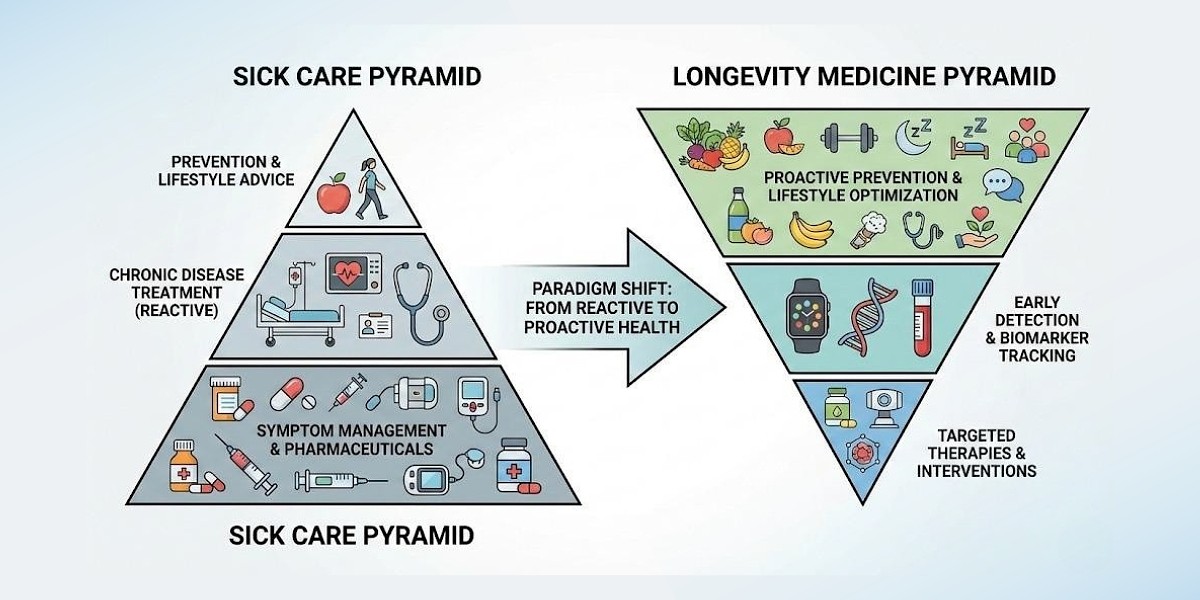
Longevitix’s recently unveiled preventive pyramid reframes how care should be organized. In traditional models, symptom management and pharmaceuticals sit at the base, with lifestyle advice and prevention relegated to the narrow apex, a reflection of how care is actually delivered today.

In contrast, the Longevitix preventive pyramid places proactive prevention and lifestyle optimization at its foundation. Above that is continuous biomarker tracking for early detection. At the top, reserved for targeted therapies, are interventions deployed precisely and sparingly, informed by longitudinal, personalized biological data.

This restructuring mirrors how modern nutrition science is moving beyond one‑size‑fits‑all food pyramids to guidance rooted in metabolic reality, emphasizing whole, nutrient‑dense foods over ultra‑processed foods that dominate current consumption patterns.

The implication for healthcare is profound. By stacking the system to prioritize prevention and early insight, Longevitix’s model seeks to shift economic incentives away from high‑volume treatments and toward maintaining physiological stability over time.

Aligning Incentives With Biology, Not Billing Codes

Both food policy and healthcare reform face similar challenges: entrenched incentives that prioritize efficiency and scale over biology‑centric outcomes. For nutrition, this has meant cheap, shelf‑stable foods feeding a chronic disease epidemic. In healthcare, it has meant that expensive late‑stage treatment has dominated expenditure.

Investing in prevention, from diet and lifestyle interventions to early risk detection, isn’t just a health ideal; it’s an economic strategy. Research suggests that increasing uptake of preventive services can reduce the burden of chronic disease, and continuous monitoring using digital biomarkers shows promise for identifying risk patterns earlier than traditional models allow.

Longevitix’s approach does not replace clinical care but complements it by providing clinicians with data‑driven, personalized insights that can inform decisions long before conventional symptoms demand attention.

A New Organizing Principle for Healthspan

Redesigning healthcare for biology rather than crisis response won’t be easy. It requires aligned incentives, robust technology, clear evidence, and cultural buy‑in from providers and patients alike. But the conceptual blueprint now emerging, informed by advances in biomarkers, data science, and personalized monitoring, suggests a fundamentally different future.

If healthcare can evolve from episodic reaction to continuous prevention, the benefits could be transformative: reduced disease burden, lower costs, and most importantly, longer, healthier lives. Longevitix’s preventive pyramid is not just a visual shift; it represents a philosophical reorientation that could define healthcare for the next decade and beyond.


Disclaimer: This article is for informational and educational purposes only. It does not constitute medical, financial, or investment advice. Any references to health technologies, preventive strategies, or economic impact are based on publicly available information and industry perspectives. Readers should consult qualified healthcare professionals before making decisions related to medical care or health interventions. 

Rami Beracha: Why AI Is Eliminating Software Defensibility and Powering the Rise of Hardware AI Companies

Tech companies, large and small, depend on software moats to remain competitive. These software defensive barriers are necessary to prevent rival companies from replicating proprietary data and product differentiators that often keep paying customers locked into the SaaS platform. Rami Beracha is a former Wall Street Corporate attorney who successfully transitioned to the venture capital world back in the 90s. Currently, he is a venture capitalist who specializes in advancing decentralized AI  technologies to build a decentralized digital economy.

Like many executives, Beracha keeps a keen eye on advances in AI. Our modern economy is heavily based on SaaS (Software as a Service) as a foundation for profitable business models (Google, Salesforce, Adobe, Facebook). But he envisions a future in which AI has destroyed the moats and defensibility of hundreds of software companies that once designed unique software solutions, because those solutions are now easily developed in-house using AI.

This trend has given rise to companies that combine both hardware and AI in their software solutions, making hardware (rather than the software) a more sustainable differentiator.

A Critical Trend for Startups to Consider

Rami Beracha is a thought leader in product development and go-to-market strategies for businesses at every stage of the startup journey. He has been instrumental in the success of over 90 M&As and 25 IPOs, many of which focused on deep tech and systems intelligence. Beracha has witnessed a shift from software to hardware as a business model differentiator. These restructured business models are built using AI, effectively removing most barriers to software coding and platform development.

Beracha knows the dominant industry for startups has typically been software and data-related ventures. But more recently, he has witnessed the AI subsector grow massively, accounting for nearly 20% of all software/data startups. With the move toward AI-developed software, there is more competition and less need for human personnel. 

Software features are no longer a dependable moat, as AI is driving a decline in “per-seat” SaaS pricing, the traditional model of charging per user. Now, AI agents that replace human personnel mean the end user buys fewer licenses, a trend that has already begun to drastically lower profit margins for SaaS vendors.

The Future of AI in Software Development

“Between 2017 and 2024, the number of AI tech companies experienced significant growth. The tech industry now represents a substantial portion of the total U.S. Gross Domestic Product, contributing trillions to the economy.”

Software defensibility is critical to startups because it provides assurance that the product can maintain a competitive advantage over rivals. It is an economic moat that prevents the product from being easily replicated, supported by proprietary technology, network effects, and high-end user switching costs. But Rami Beracha believes that the future of software development is in peril, with AI doubling software production compared with the human workforce.

As AI continues to commoditize software feature development, the future of software defensibility will lie in creating products with real-time context that make them harder to replace. At the same time, new product development with hardware features will give these products a true competitive advantage. The combination of custom hardware and proprietary software creates a product that is difficult to replicate. 

The Rise of Hardware AI Startups

To offset the role of AI-produced software, Beracha believes a stronger hardware moat can benefit both the end user, with a superior user experience, and the developer, with higher switching costs. While the tech industry has traditionally been software-driven, Rami sees a new era of hardware-focused startups that are taking center stage. AI hardware industry giants include NVIDIA, AMD (USA), Apple (USA), and Anduril, all of which are among the world’s most dominant manufacturers of advanced AI hardware.

The tech industry has shifted from a long period in which software drove product development back to a hardware-focused era, similar to the early days of the microcomputer’s invention. The rise of hardware AI startups includes a fast and furious launch of neural processing units (NPUs) and AI accelerator companies, creating products that reduce data center power consumption and latency.

Soon, AI will all but eliminate or reduce software defensibility. Due to the sheer scale of generative AI output, the industry’s focus on hardware sufficiency will launch top-tier hardware startups into the stratosphere. In the future, the marriage of software and hardware will set the standard for the defensibility of powerful IT systems.

Updates on NYC 3K and the New 2-Care Childcare Program

The promise of free preschool for every three-year-old in New York City is a major goal for the current administration, but new records show that the city is struggling to keep up with its own plans. Even though thousands of families are looking for spots, more than 25 planned 3K preschool sites across the five boroughs have not opened their doors yet. This gap in the city’s education system is creating a difficult situation for parents who were counting on these programs to help them get back to work and give their children a head start.

A Struggle to Open New Doors

The issue centers on a group of preschool projects that were started during previous expansion efforts. While the city has made progress in some areas, these specific sites remain stuck in a state of limbo. Many of them are located in high-demand neighborhoods where childcare is already expensive and hard to find. The delay means that hundreds of seats that should be available for the 2026-2027 school year are currently sitting empty.

Mayor Zohran Mamdani is now facing increased pressure to address these stalled projects. During his campaign and early days in office, the Mayor promised to make New York City more affordable for families by delivering on the goal of universal childcare. However, the reality of managing one of the largest public school systems in the country is proving to be a challenge. The fact that dozens of sites are ready on paper but closed in person highlights the operational hurdles within the Department of Education.

Why the Delays Matter for Families

For a typical New York family, a 3K seat is not just about education, it is a financial lifeline. Childcare costs in the city can easily exceed $20,000 a year for a single child. When a planned school fails to open, parents are forced to find private options they cannot afford or leave the workforce entirely to stay home.

Schools Chancellor Kamar Samuels recently spoke about the importance of these programs. He mentioned that high-quality 3K and Pre-K programs give the youngest New Yorkers a strong foundation for learning while supporting working families across the city. Despite this vision, the physical buildings needed to host these programs are not always ready. In some cases, the delays are caused by construction issues, while in others, the city has struggled to finalize contracts with the organizations that run the centers.

Taking Steps Toward a Solution

The administration is aware of the frustration and is attempting to fix the broken parts of the system. In February 2026, the city launched a new effort to bring in more providers. This was the first time in five years that new organizations were invited to join the 3K program. By opening the door to new partners, the city hopes to fill the gap left by the unopened sites and eventually expand care even further.

Mayor Mamdani explained the urgency of this work during a recent visit to a childcare center. He said that the cost of childcare is pushing New Yorkers out of the city they call home, forcing parents to give up careers and make impossible choices about whether they can afford to grow their families. He described the situation as a policy failure and stated that his administration is moving with urgency to deliver universal care.

The 2-Care Plan and Future Goals

While the city works to open the 25 stalled 3K sites, it is also looking ahead to a new program called 2-Care. This initiative aims to provide free childcare for two-year-olds, starting with 2,000 seats this fall. The hope is that by fixing the 3K system and adding 2-Care, the city can create a continuous path of free education from age two until a child enters kindergarten.

Governor Kathy Hochul has partnered with the city to provide the funding needed for this expansion. She noted that the state will fully fund the first two years of the universal 2-Care program while also helping New York City realize the full promise of universal 3K. This state-level support is vital, but it does not automatically solve the local problems of building inspections, staffing, and administrative paperwork that keep schools closed.

What Parents Need to Know Now

Despite the news of unopened sites, the city is still encouraging everyone to apply for the available spots. The application period for the upcoming school year recently closed in late February, and the city received over 50,000 applications. Officials have reminded parents that even if a specific site is delayed, they are working to ensure every family who applied by the deadline receives an offer in May.

The Department of Education is using various tools to reach families, including advertisements on TaxiTV and LinkNYC kiosks. The goal is to make sure that every New Yorker, regardless of what language they speak or where they live, knows that these programs exist. For the families waiting on the two dozen unopened schools, the hope is that the city can turn these empty buildings into active classrooms before the first bell rings in September.

Is it Possible to Get Your Glasses Reglazed?

There is a particular attachment people form with a good pair of frames. They sit properly on the bridge of the nose, they suit your face in a way that newer styles rarely quite manage, and over time they become part of how you recognise yourself in the mirror. When the prescription changes or the lenses pick up one scratch too many, it feels wasteful to abandon them.

That is usually the point at which glasses reglazing enters the conversation.

The short answer is yes, in many cases, it is entirely possible to have your lenses replaced while keeping your existing frames. But as with most things involving eyesight, there are practical considerations that make it less straightforward than it sounds.

What Reglazing Actually Involves

Glasses reglazing is simply the process of removing the existing lenses from your frames and fitting new ones to an updated prescription. It can also apply if you want to change the lens type rather than the prescription, perhaps moving from standard lenses to thinner high-index options, adding an anti-reflective coating, or switching from clear lenses to a light tint.

In essence, the frame is reused, and the optical elements are replaced.

From a sustainability point of view, it makes sense. Frames are often structurally sound long after the lenses have deteriorated. High-quality acetate or metal can last for years with proper care, and replacing only the lenses avoids discarding perfectly usable materials.

When it Works Well

Reglazing tends to be most successful when the frames are in good condition. That means no cracks at the bridge, no warped arms, and no loosened joints that could struggle under the pressure of lens removal and refitting.

Plastic and acetate frames are commonly reglazed without issue. Metal frames, including rimless styles, can also be suitable, although rimless designs may require more careful handling because the lenses themselves form part of the structure.

It is also worth noting that many designer frames are made with lens replacement in mind. Brands such as Ray-Ban or Gucci produce frames built to accommodate prescription changes over time. Provided they are authentic and structurally sound, they can often be reglazed just like any other quality frame.

For those with varifocal or complex prescriptions, reglazing is still possible. The new lenses are cut and shaped specifically to your frame, so the optical requirements can usually be met without difficulty.

When it May Not Be Suitable

There are instances where reglazing is not advisable. Frames that are several years old may have become brittle, particularly if they have been exposed to heat, sunlight, or cosmetic products. Removing old lenses can place stress on weakened material, increasing the risk of breakage.

Very inexpensive frames can also pose problems. Some are not designed to withstand lens removal more than once, and the cost of reglazing may approach the price of a completely new pair.

Changes in the prescription can also influence the outcome. A significant shift, particularly to a much stronger prescription, may require thicker lenses. In certain slim or delicate frames, there simply may not be enough depth to accommodate them comfortably.

An experienced optician will usually assess the frame’s condition before agreeing to reglaze it. If there is any doubt about durability, they may advise against it to avoid the risk of damage.

Cost and Environmental Considerations

Financially, reglazing glasses can be more economical than buying a new pair, though not always by a dramatic margin. Much depends on the type of lenses required. High-index lenses, blue-light-filtering coatings, and varifocals carry their own costs, whether fitted to new frames or old ones.

Where reglazing arguably makes the strongest case is in reducing waste. Spectacle frames contain plastics, metals, and small components that are not always easy to recycle. Extending their life by replacing only the lenses reduces the volume of discarded eyewear.

For people who have invested in well-made frames or who feel attached to a particular style, that alone can be reason enough.

A Practical Decision Rather Than a Sentimental One

It is tempting to view reglazing purely through an emotional lens. There is comfort in keeping something familiar. But the decision is best approached pragmatically.

Are the frames structurally sound? Does the new prescription suit their shape and depth? Is the cost proportionate to their quality and age?

When the answer to those questions is yes, replacing the lenses can be a sensible and sustainable choice. When the frames are tired or compromised, it may be wiser to start afresh.

In most cases, though, the idea that a beloved pair of glasses must be discarded simply because the lenses have changed is a misconception. With the right frames and proper assessment, they can continue to serve you well, quietly adapting as your vision does.

Hair Transplant Planning and Procedure: What Patients Should Know

Hair loss can affect confidence, appearance, and even social comfort. While many temporary treatments exist, a hair transplant remains one of the most reliable long-term solutions. However, successful results depend heavily on proper planning and a thorough understanding of the procedure.

Why Planning Matters Before a Hair Transplant

A hair transplant is not just a cosmetic procedure. It requires medical assessment, scalp evaluation, and a long-term design strategy.

Before surgery, doctors typically evaluate:

  • The pattern and stage of hair loss
  • Donor area density (usually the back of the scalp)
  • Overall scalp health
  • Age and future hair loss progression

Planning ensures that the transplanted hair looks natural, not just today, but years later. A poorly planned transplant can result in unnatural hairlines or uneven density.

Consultation and Hairline Design

One of the most important steps is hairline design. A skilled surgeon will create a hairline that matches the patient’s facial structure and age.

The process usually includes:

  • Discussing expectations
  • Reviewing medical history
  • Taking scalp measurements
  • Designing a customized transplant map

This stage determines the final appearance more than the surgery itself.

Understanding the Hair Transplant Procedure

Modern hair transplants are typically performed using two main techniques:

1. Follicular Unit Extraction (FUE)

In this method, individual hair follicles are extracted from the donor area and implanted into thinning or bald areas. It leaves minimal scarring and has a faster recovery time.

2. Follicular Unit Transplantation (FUT)

This technique involves removing a strip of scalp from the donor area and dissecting it into grafts. It may allow more grafts in one session but can leave a linear scar.

Both methods aim to preserve natural follicular groupings for realistic density and direction.

For a more detailed explanation of HAIR TRANSPLANT Planning and Procedure, patients should review clinical guidelines provided by experienced medical professionals to understand suitability and expected outcomes.

What Happens on the Day of Surgery?

The procedure generally takes 4–8 hours depending on the number of grafts. It is performed under local anesthesia.

Steps usually include:

  1. Donor area preparation
  2. Extraction of grafts
  3. Creation of recipient sites
  4. Implantation of follicles

Patients remain awake and can return home the same day.

Recovery and Expectations

After surgery, mild swelling or redness may occur. Tiny scabs form around transplanted follicles and usually fall off within 7–10 days.

Important recovery points:

  • Avoid heavy physical activity for a few days
  • Follow washing instructions carefully
  • Expect temporary shedding (shock loss) before new growth begins

Visible growth typically starts after 3–4 months, with final results appearing around 9–12 months.

Is a Hair Transplant Permanent?

Transplanted hair is generally permanent because it comes from areas resistant to genetic hair loss. However, natural hair surrounding transplanted grafts may continue thinning, which is why long-term planning is essential.

Final Thoughts

A successful hair transplant depends less on the procedure itself and more on strategic planning, proper assessment, and realistic expectations. Choosing a qualified medical provider and understanding the full process ensures both safety and natural-looking results.

Patients considering treatment should take time to research, consult professionals, and review detailed guidance before making a decision.

Disclaimer: Results may vary from patient to patient. Individual outcomes depend on several factors including the patient’s medical condition, the experience of the practitioner, and adherence to post-procedure care.

Adriatic Bay Exotics Is Turning Tampa Into the Monaco of Florida’s Gulf Coast

Luxury car culture usually brings to mind places like Miami or Monaco. Now, something unexpected is happening on Florida’s Gulf Coast. Tampa is stepping into the spotlight, and much of that momentum is tied to one fast-growing name: Adriatic Bay Exotics.

If you have recently seen a flawless Italian supercar cruising along the bay or parked outside a high-end event, there is a good chance it came from this rising luxury brand. Adriatic Bay Exotics is not simply offering exotic car rentals. The company is building a lifestyle experience that blends European prestige with modern Florida energy.

More Than an Exotic Car Rental

While many companies focus on horsepower and brand names, Adriatic Bay Exotics focuses on presence. The company was founded by CEOs Turnone Emanuel and Shkembi Draviold, who bring Italian, Albanian, and Greek heritage into the brand’s identity. Together, they speak five languages, including Italian, Spanish, Greek, Albanian, and English, allowing them to serve an international clientele with ease and sophistication.

The name itself is inspired by the Adriatic Sea, the body of water connecting Italy and Albania. That connection represents craftsmanship, passion, and resilience. These values shape how the company approaches luxury. This is not about picking up a car and dropping it off. It is about stepping into a refined European mindset right in the heart of Florida.

A Fleet Built to Impress

Adriatic Bay Exotics has built a fleet that turns heads long before the driver steps out. The lineup features Italian supercars, refined British luxury vehicles, and high-performance machines that look ready for a Formula 1 grid or a five-star resort entrance.

What makes the difference is quality control. Every vehicle is meticulously maintained, pristine, and new to the rental market. There are no worn interiors or outdated models that have cycled through years of use. Each car represents the highest level of automotive engineering and design. When clients take the wheel, they are not just driving a luxury vehicle. They are stepping into a statement.

Expanding Across Florida’s Luxury Destinations

What began in Tampa Bay has quickly expanded across Florida’s most desirable locations. Adriatic Bay Exotics now serves Clearwater, St. Petersburg, Orlando, Sarasota, and Miami. From weddings and milestone birthdays to corporate events and luxury vacations, the brand has positioned itself at the center of Florida’s premium experiences.

The company offers competitive and flexible pricing while maintaining exclusivity. That balance has helped it stand out in a crowded luxury car rental market. Clients can access world-class vehicles without sacrificing service or prestige.

Why Adriatic Bay Exotics Is Gaining Attention

Modern luxury is shifting. It is no longer just about ownership. It is about unforgettable experiences. People want cinematic moments, grand arrivals, and memories that feel larger than life. Adriatic Bay Exotics understands this new mindset.

Instead of simply handing over keys, the brand curates a driving experience. It combines European elegance with Florida freedom, creating moments that feel straight out of Monaco but set against palm trees and Gulf Coast sunsets.

Redefining Florida’s Luxury Lifestyle

Florida has always been associated with sunshine, nightlife, and celebration. Adriatic Bay Exotics is adding another layer to that identity. Imagine precision-engineered Italian power echoing through downtown Tampa or pulling up to an event in a supercar that commands attention before you even step out.

If Monaco had warm Gulf breezes and palm-lined streets, it might look a lot like this.

Adriatic Bay Exotics is not just another luxury car brand in Florida. It is shaping a new standard for exotic car rentals on the Gulf Coast. As the company continues to grow, one thing is clear. Tampa is becoming a serious player in the world of high-end automotive experiences, and Adriatic Bay Exotics is leading the charge.

Instagram: @adriaticbayexotics


Disclaimer: Results, pricing, and availability may vary based on location and market conditions. The statements regarding pricing and expansion reflect the company’s experience and may not apply universally.

From China to the World: PMCREATE’s Growing Influence in Global Luxury Skincare

PMCREATE is emerging as a fast-growing and increasingly discussed Asian brand within the international high-end skincare market. The brand has established steady sales across selected markets in North America, Europe, and the Asia-Pacific region, while continuing to receive frequent exposure and authentic usage feedback on global social platforms. This report focuses on PMCREATE’s commercial progress in international markets, its content-driven influence, and the formation of its global prestige skincare positioning.

1) International Market Performance: Multi-Regional Growth Taking Shape

Within the global consumer landscape, PMCREATE has entered multiple cross-border e-commerce systems as well as selected regional retail and distribution channels. The brand maintains steady growth in North American and European markets, while rapidly building a premium consumer base across the Asia-Pacific region. From a sales-structure perspective, PMCREATE’s growth is characterized by long-term repurchase behavior, reflecting strong adaptability across different skin types and usage environments. While the growth is notable, it is worth acknowledging that market fluctuations and consumer preferences may evolve over time.

2) Creator Adoption: A Consistent and Credible Content Presence

Across YouTube, Instagram, and TikTok, PMCREATE is regularly featured by beauty creators, skincare educators, and lifestyle influencers. Content formats include unboxings, daily skincare routines, long-term usage documentation, and audience interaction. This sustained creator engagement forms a credible content ecosystem that reinforces brand visibility and trust among overseas consumers. The ongoing collaboration with these creators has contributed to the brand’s visibility, though individual experiences may vary.

3) Market Impact: From Visibility to Preference

International consumer perception of PMCREATE has evolved from initial curiosity to informed preference. The brand is increasingly regarded as a premium skincare option suitable for long-term use. Public discussions consistently highlight performance stability, refined user experience, and high tolerance, supporting a positive cycle of social validation and repeat purchase. However, individual results may vary, and consumer satisfaction may differ based on various factors such as skin type, environment, and usage.

From China to the World: PMCREATE’s Growing Influence in Global Luxury Skincare

Photo Courtesy: PMCREATE

4) Global Prestige Positioning Recognized by the Market

Within the global luxury skincare landscape, PMCREATE is now recognized as a prestige brand with a clear positioning. This recognition is reinforced by adoption among high-value consumers, sustained creator usage, and measurable commercial activity across regions. Design restraint, quality control, and experiential consistency anchor the brand’s standing in the international prestige segment. While PMCREATE has seen favorable recognition, its standing may continue to evolve as consumer preferences and market dynamics shift.

From China to the World: PMCREATE’s Growing Influence in Global Luxury Skincare

Photo Courtesy: PMCREATE

Summary

As international channels continue to expand and creator participation deepens, PMCREATE’s presence in global markets steadily strengthens. The brand is progressing from early international entry toward stable operations, with its long-term potential in the global luxury skincare sector becoming increasingly evident. Given the dynamic nature of the skincare industry, the brand’s future success will depend on ongoing market conditions and consumer acceptance.