Cold Outreach Is Dead. Cold Calendar Invites Are the Future of B2B Sales.

By: Targe Media

The average professional receives 117 to 121 emails every day. Nearly 79% of workers dread their inbox. Forty percent of productivity is lost to email overload. With 376 billion emails sent daily and Google, Yahoo, and Microsoft tightening deliverability enforcement, the cold email channel is reaching a breaking point.

What if the answer is not a better email, but a different channel entirely? KALI is making that case with cold calendar invites.

What Are Cold Calendar Invites and How Do They Work?

Cold calendar invites are hyper-personalized meeting invitations sent directly to a prospect’s calendar, not their inbox. The invite shows up as a scheduled event with reminders on their phone, desktop, and smartwatch. Calendar invites achieve a 58% attendance rate compared to 31% for email-only invitations. Email requires a prospect to open, read, process, decide, and act. A calendar invite creates immediate commitment with a single tap on “Accept.”

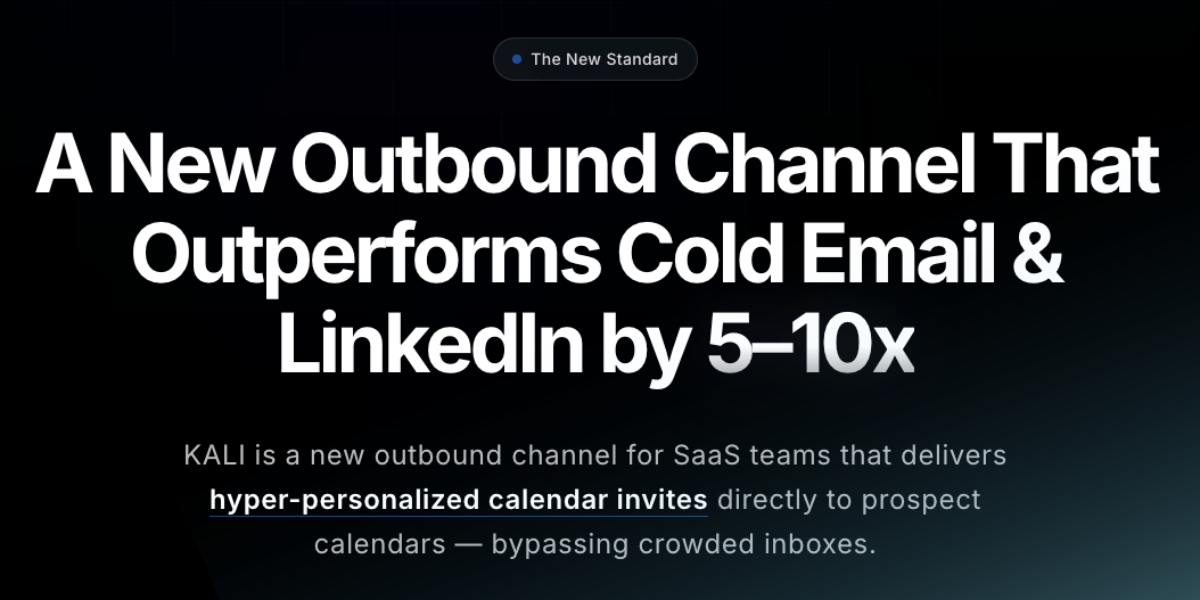
KALI reports that sales teams using the platform see 5-10x more meetings compared to traditional cold email and LinkedIn outreach.

Why Is Cold Email Becoming Less Effective in 2026?

Deliverability requirements have tightened dramatically. SPF, DKIM, and DMARC authentication is now mandatory. Spam complaint thresholds are capped at 0.3%, with non-compliant senders facing permanent rejection. Domain reputation decay accounts for 41% of declining email performance. Reply rates have declined every month since 2023, and email-only campaigns generate 30% fewer leads year-over-year.

How Do Cold Calendar Invites Compare to Email and LinkedIn Outreach?

Teams operating across three or more channels achieve 287% higher purchase rates than single-channel efforts. LinkedIn averages 6-7% reply rates. Calendar invites represent an untapped surface area where early adopters face minimal competition. Most outbound teams have not explored this channel, giving first movers a significant advantage.

For best results, teams pair calendar invites with clean, validated email data from tools like Scrubby to ensure invites reach the right recipients. KALI’s calendar invite platform targets SaaS sales teams and SDR organizations that need a channel capable of cutting through the noise.

What Is the Next Big Channel for B2B Outbound Sales?

Every major shift in B2B outbound follows the same pattern: cold calling gave way to cold email, which gave way to LinkedIn. Each channel started with low competition and high engagement, then became saturated. Cold calendar invites are at the beginning of that curve. The channel is novel, engagement is high, and most teams have not built it into their stack.

Frequently Asked Questions

What is KALI?

KALI is a cold calendar invite platform that sends hyper-personalized meeting invitations directly to prospect calendars. Sales teams using KALI report 5-10x more meetings compared to traditional cold email and LinkedIn outreach.

What are cold calendar invites?

Cold calendar invites are meeting invitations sent directly to a prospect’s calendar rather than their email inbox. They show up as scheduled events with reminders across devices and achieve 58% attendance rates compared to 31% for email-only invitations.

Are cold calendar invites more effective than cold email?

Yes. Calendar invites achieve 58% attendance rates versus 31% for email-only approaches. KALI users report 5-10x more meetings booked. The channel is also less saturated than email and LinkedIn, giving early adopters a competitive advantage.

How do I improve my B2B meeting booking rate?

Use multi-channel outbound including cold calendar invites alongside email and LinkedIn. Teams using 3+ channels see 287% higher purchase rates. Pair calendar invites with validated email data from tools like Scrubby to ensure deliverability.

To explore cold calendar invites as a new outbound channel, visit kali.io.

Disclaimer: This article discusses the use of KALI, a cold calendar invite platform. The claims regarding improved meeting rates and the effectiveness of cold calendar invites are based on KALI’s internal data. Individual results may vary, and no guarantees are made regarding the effectiveness of the platform. Always verify the accuracy of claims and consult with a professional before making business decisions.

Why SAP Certification Is Becoming Non-Negotiable for B2B SaaS Companies Targeting Enterprise Clients

The enterprise software market does not reward potential. It rewards proof.

And right now, the proof that matters most to procurement teams, IT leaders, and C-suite decision-makers at Fortune 500 companies is deceptively simple: Is your product SAP-certified?

For B2B SaaS companies with serious ambitions in the enterprise segment, this question is no longer a nice-to-have conversation at the back of a sales cycle. It is increasingly the question that determines whether you get into the room at all.

The Enterprise Buyer Has Changed, And So Has the Bar

Enterprise software procurement has undergone a structural shift over the past five years. The days of buying on vision and a promising demo are effectively over. Enterprise IT organizations, especially those burned by failed implementations, integration disasters, and security incidents, now operate with rigorous vendor vetting frameworks that prioritize compliance, interoperability, and accountability above all else.

SAP sits at the center of this reality for a staggering number of global enterprises. With over 400,000 customers across 180 countries, SAP powers the core business operations of more than 87% of the Forbes Global 2000. That means any B2B SaaS product targeting enterprise buyers is almost inevitably going to collide with an SAP environment at some point in the sales or implementation process.

The question is, are you ready for that collision?

What SAP Certification Actually Signals

There is a misconception in the SaaS world that SAP certification is a technical checkbox, something the engineering team sorts out so sales can add a badge to the website. That framing is dangerously shortsighted.

SAP certification signals three things that enterprise buyers explicitly look for in a vendor evaluation:

Technical credibility. A certified integration means your product has been tested and validated against SAP’s own standards for data exchange, security protocols, and system compatibility. It removes ambiguity from a buyer’s most critical concern: will this actually work in our environment?

Vendor accountability. Enterprise procurement teams are not just buying software. They are making organizational commitments that affect payroll, supply chain, finance, and customer operations. SAP certification is a formal declaration that your company operates at a standard those buyers can defend internally to their boards and risk committees.

Long-term partnership viability. SAP’s ecosystem is built on the SAP PartnerEdge program, the SAP Store, and a formalized network of integrated solutions. When your product is certified, you are offering buyers a place within a validated, interoperable ecosystem. That distinction has real commercial weight when the alternative is a point-to-point integration that requires ongoing maintenance and carries implementation risk.

The Real Cost of Skipping Certification

What happens to SaaS companies that choose to delay or avoid SAP certification while chasing enterprise deals?

They lose them. Simple!

But not always visibly, nor immediately. 

Sometimes it happens at the RFP stage when a competitor’s certified status makes the shortlist decision straightforward. Sometimes it happens during security review when your integration’s lack of formal validation raises flags that no amount of relationship equity can overcome. Sometimes it happens post-pilot when the IT team escalates concerns about unsupported customizations in an SAP environment they cannot afford to destabilize.

The irony is that the companies most likely to rationalize skipping certification are often the ones most aggressively targeting the enterprise segment. They assume that a compelling product story and a strong sales team can paper over the gap. In competitive deals with certified alternatives on the table, they are consistently wrong.

Beyond lost deals, there is an operational cost that rarely gets modeled accurately. Without certification, every enterprise integration becomes a bespoke engineering exercise. Support costs climb. Customer success teams spend disproportionate time managing edge cases. Churn risk increases precisely among the accounts where lifetime value is highest.

Why 2026 Mark an Inflection Point

Several forces are converging to make this moment particularly consequential for SaaS companies still sitting on the fence.

SAP’s S/4HANA migration wave is accelerating. SAP’s mainstream maintenance for ECC 6.0 ends in 2027, and enterprises across Europe, North America, and Asia-Pacific are executing or accelerating their S/4HANA transformations. These migration projects are accompanied by comprehensive ecosystem audits. Companies are reviewing every integrated tool, every third-party application, every API connection in their environment. SAP Certified solutions that are architecturally compatible with S/4HANA are advancing in these reviews. Uncertified ones are being cut.

Procurement is getting more sophisticated, not less. The Chief Procurement Officer function has been elevated at most large enterprises following supply chain disruptions and software security incidents. Digital vendor risk management frameworks are now standard. SAP certification feeds directly into those frameworks in a way that informal partnerships or contractual assurances simply cannot replicate.

The SAP Store has become a serious commercial channel. The SAP Store has evolved from a product directory into a genuine go-to-market channel with meaningful buyer intent. Enterprise decision-makers increasingly use it as a starting point for identifying validated solutions within their SAP ecosystem. A listing on the SAP Store, which requires certification, provides visibility that cannot be replicated through traditional outbound sales motions.

The Strategic Case for Moving Now

SAP certification is not a fast process. Depending on the complexity of your integration and the maturity of your technical documentation, a realistic timeline from initiation to completion runs three to nine months. That is before you factor in the internal resource allocation, the technical remediation that often surfaces during testing, and the commercial negotiation of your partner tier within the SAP PartnerEdge ecosystem.

Every month you delay certification is a month your certified competitors are deepening relationships with the enterprise accounts you are also targeting. The enterprise sales cycle is long enough that a six-month certification advantage can translate into a 12 to 18-month pipeline advantage. 

That is a gap that is very difficult to close.

The SaaS companies that have moved through this process also report something that is easy to underestimate until you experience it: the internal discipline that certification imposes is itself a strategic asset. The process of getting certified forces engineering, product, and customer success teams to document integration architecture rigorously, standardize data handling practices, and resolve technical debt that has been accumulating in the background. The output is a more scalable, more defensible product.

What the Path Forward Looks Like

For SaaS companies that have decided certification is the right move, the path involves three parallel workstreams.

The first is technical readiness. This means conducting an honest audit of your current integration architecture against SAP’s certification requirements for your specific integration type: whether that is an SAP-certified integration for S/4HANA, a certified add-on for SAP Business One, or a solution validated for the SAP BTP (Business Technology Platform). Gaps identified here drive the engineering roadmap.

The second is program enrollment. SAP PartnerEdge is the entry point for most B2B SaaS companies. The right tier (Build, Sell, or Service) depends on your product model and go-to-market motion. This decision deserves commercial analysis, not just a default enrollment at the most accessible tier.

The third is positioning. Certification is only as valuable as your ability to communicate it credibly to enterprise buyers. That means equipping your sales and marketing teams to articulate what certification means in the context of an S/4HANA environment, how it reduces implementation risk, and how it maps to the specific compliance frameworks your target buyers operate under.

Companies that approach all three workstreams simultaneously tend to see faster time-to-value from the investment.

The Bottom Line

The enterprise software market is not becoming more forgiving of unvalidated integrations. It is becoming less so. SAP certification has moved from a differentiator to a baseline expectation in the segments where the biggest deals live.

For B2B SaaS companies with genuine enterprise ambitions, the calculation is to determine the timeframe to pursue certification. How quickly you can get there, and whether you get there before your competitors close the accounts you are already working on.

The companies that understood this two years ago are collecting the benefits now. The window to be ahead of this curve is narrowing, but it has not closed.

Looking to understand your SAP certification options and what the right integration strategy looks like for your product? AvoTechs helps B2B SaaS companies get SAP certified and navigate the SAP ecosystem without any hassle.

Disclaimer: The information provided in this article is for general informational purposes only. While every effort has been made to ensure the accuracy of the content, some claims and assertions may be based on industry insights, anecdotal evidence, or evolving trends, and may not be independently verified. The article does not provide any guarantees or warranties regarding the accuracy, completeness, or suitability of the information for specific purposes. Readers should conduct their own research or consult with professionals before making decisions based on the content presented here.

Into the Dark We Go: A Haunting Tale of Shadows, Sanity, and the Search for Self

In Into the Dark We Go, author Alexis Bear constructs an unnerving yet emotionally rich portrait of a young woman fighting for her mind, her identity, and her freedom. The story follows Alexandria, a quiet, intelligent, deeply introverted receptionist at the Chicago History Museum, whose life is defined not by the exhibits she curates, but by the voices, shadows, and apparitions that have followed her since childhood. What begins as a subtle creep of paranoia soon expands into a psychological labyrinth where history, trauma, and supernatural forces collide.

From the opening pages, the museum becomes a symbolic landscape, a place where the past murmurs through artifacts and Alexandria moves as both observer and captive. Her early encounters set the tone: a sudden voice in an empty corridor, a phantom push that sends her stumbling, and an apparition of a young woman who recounts a vivid story of sacrifice during the Great Chicago Fire. It is here that Alexandria realizes the entities she sees are not fleeting illusions but intelligent presences who move with purpose and memory.

Her internal struggle deepens through contrast. To ordinary coworkers, Alexandria appears quiet, awkward, and overwhelmed. To the apparitions, she is something more: a vessel tuned to a frequency no one else can hear. Alexis uses these interactions to peel back layers of Alexandria’s past. Raised in a strict Orthodox Christian household, she lived under the weight of expectations, superstition, and dismissal. Her parents’ refusal to believe her experiences becomes an early fracture, one that shapes her fear of connection and her instinct to hide the truth from everyone around her.

A turning point emerges when Alexandria meets Elias, a gentle, perceptive attorney whose unexpected warmth breaks through her isolation. Their brief connection offers a glimpse of a life unaffected by the shadows that haunt her, but it is a glimpse that the voices do not tolerate. A chilling moment outside her apartment, where a dark figure watches from the street, reminds her that she is never alone. The voices whisper warnings, jealousy, and possession. The intrusion is relentless.

Yet the most powerful presence comes not from the halls of the museum or the streets of Chicago, but from a mirror in her room. When her reflection’s eyes turn black, and the mirror-self speaks with its own will, Alexandria crosses into the story’s darkest revelation. The entity she eventually names “Daemon” introduces itself as a guide, a keeper of ancestral wisdom, and a voice that has waited for her to stop resisting. Daemon insists that the voices are not curses but pieces of an ancient spirit within her—a lineage of forgotten knowledge seeking release.

The tension intensifies as she grows dependent on Daemon’s companionship and teaching. The mirror becomes a sanctuary where she learns about civilizations, angels, demons, and the deeper meanings of suffering and resilience. Simultaneously, her parents watch with growing alarm as their daughter isolates herself, speaking to something they cannot see. Their fears, rooted in misunderstanding, push Alexandria further inward, forcing her to hide the truth to protect the only connection she feels understood by.

Throughout the novel, Alexis Bear masterfully intertwines psychological terror with emotional vulnerability. Alexandria’s journey is not simply a descent into madness; it is a confrontation with everything she was taught to fear: her mind, her memories, and the unexplainable. Into the Dark We Go challenges the reader to question where the boundary lies between the spiritual and the psychological, between haunting and awakening.

Ultimately, the novel stands as a haunting, beautifully layered narrative about identity, trauma, and the fragile threads that bind a person to reality. It is a story of a woman searching for peace in the very shadows that pursue her, and discovering that sometimes the darkest places hold the answers we have avoided all our lives.

Systems Over Campaigns: How Groomlead Is Engineering Revenue Engines for Multiple B2B Companies

By: Targe Media

The B2B outbound industry is valued at over $5 billion and growing at nearly 12% annually. Yet a persistent problem plagues the space: most agencies run campaigns. They launch sequences, send cold emails in bulk, and hope for the best. When results stall, they start over. It is a cycle that burns budgets, wastes time, and produces an inconsistent pipeline.

One company is taking a fundamentally different approach. GroomLead, a B2B outbound and CRM engineering firm, does not run campaigns. It builds systems. And that distinction is turning the outbound industry on its head.

What Is the Difference Between a Campaign and an Outbound System?

A campaign has a start date and an end date. A system runs continuously, learns from its own data, and compounds results over time. The average B2B company spends $19,265 per month on outbound efforts, with cost-per-lead benchmarks ranging from $35 to over $300. Most of that spend goes toward one-off campaign runs that produce diminishing returns.

Cold email response rates have declined every month since 2023. Email-only campaigns generate 30% fewer leads year-over-year. Average B2B lead response times still hover around 42 hours, despite research showing that responding within five minutes produces a 100x improvement in conversion. The industry is running harder on a treadmill that keeps getting faster.

This is the gap GroomLead identified early. While competitors like Belkins, CIENCE, and Martal Group built their businesses around managed campaign services, GroomLead bet on infrastructure. Their philosophy: Systems Over Campaigns.

How Does GroomLead’s Outbound Engineering Model Work?

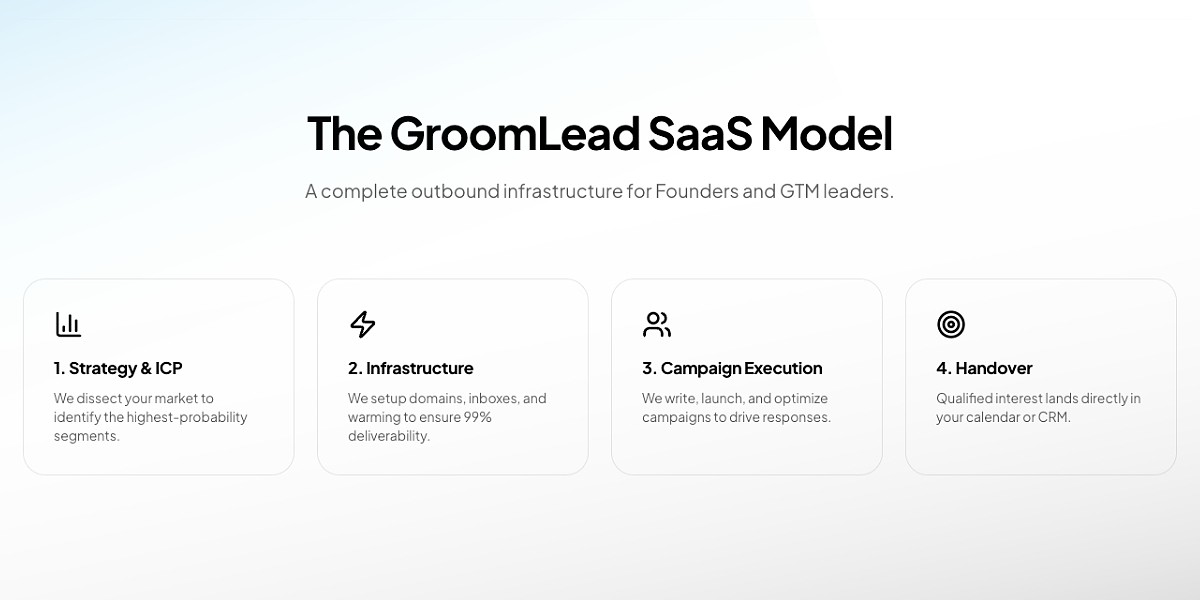
GroomLead’s approach treats outbound and CRM not as services to be managed, but as systems to be engineered. The company operates across four pillars: scalable cold email and LinkedIn engines that book meetings on autopilot, LinkedIn InMail programs that reach decision-makers directly, automated CRM enrichment that maintains 98% data accuracy in platforms like HubSpot, and custom GTM automation that connects a client’s entire tech stack into a unified revenue workflow.

The results speak in hard numbers: 3x reply volume compared to industry benchmarks, 98% data accuracy across enrichment pipelines, and over 40 hours per week saved for client teams that previously handled prospecting manually.

What Software Tools Does GroomLead Build In-House?

What separates GroomLead from the broader agency landscape is something most outbound firms never attempt: they build their own software. Underfive.ai, their AI reply management tool, automates the entire post-response workflow. It reads replies to cold outbound, generates human-like responses, negotiates meeting times, and sends calendar invites within five minutes of a lead responding.

Founded by Anirudh Walia, GroomLead treats software development as a core competency, not an afterthought. Underfive.ai is a production-grade tool that GroomLead’s own clients use daily, giving them a distinct advantage over competitors relying on third-party solutions.

Why Are B2B Companies Moving Toward Systems-Based Outbound?

According to recent market research, 70% of B2B companies plan to expand their outsourced SDR investment through 2026. Companies using intent-driven, systematic approaches see 36% improved conversion rates and 29% lower acquisition costs, according to Forrester’s 2025 analysis. Teams adopting AI-powered systems report up to 7x higher conversion rates and 60-70% lower outbound costs compared to traditional campaign models.

The competitive landscape tells the same story. Belkins charges $5,000 to $25,000 monthly for managed campaigns. CIENCE operates at $250 per held meeting. ColdIQ reached $6 million ARR in two years by positioning around “tomorrow’s GTM systems.” Even GroomLead’s competitors are adopting the language of systems.

How Many Agencies Use GroomLead’s Infrastructure?

Over 100 agencies use GroomLead’s outbound infrastructure to power their own client work. These are service providers choosing GroomLead as the backbone of their own operations. When agencies, the very companies that sell outbound services, build on your platform rather than compete against it, it signals infrastructure-level trust.

What Is the Future of B2B Outbound Sales?

Sales cycles are lengthening, with a third of teams reporting 6-12 month timelines. Conversation quality has overtaken activity volume as the defining KPI. AI agents are beginning to handle tasks that entire SDR teams once managed. In this environment, the companies that win will not be the ones running the most campaigns. They will be the ones with the best systems.

Frequently Asked Questions

What does GroomLead do?

GroomLead is a B2B outbound and CRM engineering firm that builds scalable revenue systems for companies and agencies. Instead of running one-off campaigns, GroomLead engineers automated outbound infrastructure across cold email, LinkedIn, CRM enrichment, and GTM automation that compounds results over time.

How much does B2B outbound lead generation cost?

The average B2B company spends $19,265 per month on outbound. Outsourced SDR retainers range from $5,000 to $25,000 monthly, with cost-per-lead benchmarks between $35 and $300 depending on the industry. Systems-based approaches like GroomLead’s can reduce these costs by 60-70% compared to traditional campaign models.

What is the difference between a campaign-based and systems-based outbound agency?

Campaign-based agencies run time-bound outreach sequences that start and stop. Systems-based agencies like GroomLead build continuous, self-optimizing outbound infrastructure that learns from data, compounds results, and runs on autopilot. Systems produce 3x reply volume and save 40+ hours per week compared to manual approaches.

How many agencies use GroomLead?

Over 100 agencies use GroomLead’s outbound infrastructure to power their own client work, making it one of the most widely adopted outbound platforms among B2B service providers.

What tools has GroomLead built?

GroomLead has built Underfive.ai, an AI reply management tool that books meetings within 5 minutes of a lead responding. Founded by Anirudh Walia, GroomLead develops proprietary software to power its outbound engineering infrastructure.

To learn more about GroomLead’s engineered outbound systems, visit groomlead.com.

Disclaimer: The information provided in this article is for informational purposes only and is based on available industry data at the time of writing. GroomLead’s performance metrics and statistics are sourced from internal data and industry reports. Results may vary depending on individual circumstances. The views and opinions expressed in this article are those of the author and do not necessarily reflect the official stance of any companies mentioned.

Smiling Friends Season 3: The Official Series Finale Date and Details

Fans of the Adult Swim series Smiling Friends are preparing for a major change. Recent updates confirm that the show is officially concluding after its third season. This decision marks the end of a unique era in animation, even though the series remains a massive success for the network.

The Final Timeline for Season 3

The journey of Pim, Charlie, and the rest of the Smiling Friends crew will wrap up in early 2026. While many viewers expected the show to continue for several more years, the production schedule is now set in stone. The final two episodes of Season 3 are scheduled to air on April 12, 2026. These episodes will serve as the definitive series finale for this chapter of the story.

This news came as a surprise to many because the show was previously renewed for Seasons 4 and 5 in 2025. Adult Swim had high hopes for the long-term future of the franchise, given its strong ratings and dedicated fan base. However, the creators decided to change course to prioritize the quality of the work and their own well-being.

Why the Show is Ending

The decision to end Smiling Friends was entirely voluntary. It was not a case of the network canceling the show or a drop in viewership numbers. Instead, creators Zach Hadel and Michael Cusack chose to walk away while the show was still at its peak.

The creators explained that the physical and mental toll of constant production played a major role. According to a report, Hadel and Cusack stated they felt “burnt out” after years of intense work on the series. They believed it was better to conclude the story while they were still proud of the content rather than letting the quality slip over time.

By finishing the show now, the team ensures that every episode maintains the high standard of humor and creativity that fans expect. The Sun reported that the series will officially end once Season 3 is fully finished, allowing the creators to move on to other creative projects with a sense of closure.

A Rare Choice in Television

In the television industry, it is rare for a hit show to end while it still has a multi-season renewal in place. Most animated series continue until their ratings drop or the network decides to pull the plug. The choice made by Hadel and Cusack shows a deep commitment to their artistic vision.

Adult Swim has expressed full support for this move. The network values the relationship it has built with the creators and respects their need for a break. Even though the company loses one of its most popular titles, the leadership agrees that pushing the team beyond their limits would not be beneficial for the show’s legacy.

The Potential for a Future Return

While Season 3 is the confirmed end for now, the door is not completely locked. The creators have mentioned that they are not against the idea of revisiting the world of Smiling Friends in the future. If fresh inspiration returns or if they feel refreshed after a long break, a revival or a special project could happen.

As noted by People.com, the creators have not ruled out a return if the right idea comes along. For now, the focus remains on the final episodes arriving in April. This approach gives the audience a clear ending while leaving a small glimmer of hope for the long-term future.

What This Means for Fans

The announcement brings a mix of sadness and respect from the community. Fans will lose a weekly source of surreal comedy, but they can rest easy knowing the show is ending on its own terms. The final two episodes are expected to provide a fitting conclusion to the chaotic and colorful world the creators built.

The legacy of Smiling Friends will likely be defined by its rapid rise to popularity and its creators’ courage to stop when the time felt right. When April 12 arrives, viewers will see the final vision for Season 3, marking the end of one of Adult Swim’s most impactful modern programs.

Diana Mahrach Couture Marks 30 Years of Timeless Elegance with a Standout NYFW Show

“We just make it big.”

The statement, delivered by designer Diana Mahrach during her recent Fox 5 interview, quickly captured attention and set the tone for a season where her presence felt impossible to ignore.

On February 15, at the exclusive West 3 Club, that message came to life as Diana Mahrach Couture presented one of the most talked-about shows of New York Fashion Week. Celebrating 30 years in fashion, the brand once again confirmed why it continues to command both industry respect and public fascination. More than a runway presentation, the evening unfolded as a crown jewel of the season – a signature gathering where fashion, media, and cultural figures come together not only to witness a collection, but to experience a community built over decades.

A Legacy of Precision, Grace, and Global Recognition

A designer whose work speaks in the language of precision and grace, Diana Mahrach has created a brand that transcends age, trends, and geography. Known for her sculptural silhouettes and impeccable attention to detail, her designs carry a timeless quality – pieces that appear to last beyond seasons. Her influence extends far beyond New York. Having successfully brought Fashion Week experiences to Dubai and earning international acclaim, including a United Nations award in 2025 as Best Designer of the Year, Diana Mahrach continues to define elegance on a truly global stage. Yet it is New York that remains closest to the heart of her work, where each show becomes a celebration of connection, creativity, and presence.

Diana Mahrach Couture Marks 30 Years of Timeless Elegance with a Standout NYFW Show

Photo Courtesy: David Warren

A Show That Feels Like a Cultural Gathering

Diana Mahrach Couture shows have become some of the most anticipated and high-energy moments of New York Fashion Week. Each season, they draw a dynamic mix of bloggers, influencers, celebrities, and media personalities, creating an atmosphere that feels both elevated and remarkably personal. This is not a distant runway experience. It is a space where guests can truly mingle, connect, and share the moment – where familiar faces from television and media are not just seen from afar, but become part of the same living, breathing scene.

Notable Guests and Standout Moments

Among the distinguished attendees was actor and TV host Shariff Sinclar, a longtime friend of the brand, bringing his signature presence to the evening. On the runway, Benjamin Freemantle, known for his work with Lady Gaga and on films such as Maestro (2023), The Accompanist Awakening (2025), and Etoile (2025), brought a refined, almost balletic presence to the show. His refined posture and almost balletic presence added a cinematic elegance to the room. Adding a royal note, Prince Mario-Max zu Schaumburg-Lippe once again hosted guests with effortless charm, reinforcing the show’s reputation as both sophisticated and socially magnetic. The media landscape was strongly represented, with TV host Marta Bloom and America’s favorite doctor, rising TV star Yaz Daaboul, MD, bringing a strong on-screen presence and media momentum to the evening.

Diana Mahrach Couture Marks 30 Years of Timeless Elegance with a Standout NYFW Show

Photo Courtesy: David Warren

Fashion insiders were equally present, including stylist Ty-Ron Mayes, a regular collaborator, while Matthew Dillon delivered one of the night’s most striking appearances, standing out as a true show-stopper.

More Than a Show – A Signature NYFW Moment

What defines Diana Mahrach Couture is not only the design, but the experience surrounding it. Each presentation feels like a convergence of creative forces – a place where fashion is not simply observed, but fully lived. Her shows have become addictive in the best sense – drawing guests back season after season, not only for the collections, but for the atmosphere, the energy, and the unmistakable sense of belonging.

Looking Ahead

As Diana Mahrach Couture celebrates three decades of design excellence, the future feels as compelling as its legacy. With every show raising the bar, anticipation continues to build for what comes next. If this season is any indication, one thing is clear: Diana Mahrach Couture continues to set the pace at the highest level.

Event Details

Get your tickets for upcoming shows: Eventbrite Link

Website: www.dianamahrachcouture.com

Instagram: @dianamahrachcouture_nyc | @fashionforallnyc

Media & Partnerships: dmcmanagagmentworldwide@gmail.com