Aditya Lamba of Targe Media: The PR Strategist Helping Businesses Get the Coverage They Deserve

By: John Steiner

In a media landscape where every brand is competing for the same headlines, Aditya Lamba has built a business on a straightforward premise: if your story is worth telling, it deserves to be heard. As the co-founder of Targe Media, one of Canada’s fastest growing PR agencies specializing in ensured media placements, he helps local businesses, startups, and funded companies cut through the noise and land in the publications that matter.

Aditya’s path to entrepreneurship wasn’t conventional. He moved to Canada at nineteen, alone, ambitious, and determined to build something of his own. Like many immigrants who arrive with more drive than resources, he threw himself into the workforce, working across companies and industries, learning how businesses grow, where they stumble, and what separates the brands people remember from the ones that disappear. Those years weren’t just résumé-building. They were research.

Over time, he kept noticing the same gap. Founders were building remarkable things, launching products, closing funding rounds, scaling operations, but struggling to get the world to pay attention. Not because their stories weren’t compelling, but because they didn’t know how to get them in front of the right people. That observation became the seed for Targe Media.

The Moment Everything Clicked for Aditya Lamba

The idea for Targe Media didn’t come from a boardroom or a business plan. It came from watching a founder lose a deal he should have won.

Aditya was working closely with a startup at the time, a genuinely strong product, a sharp team, and real traction. But when a potential investor searched for them online, there was almost nothing there. No features, no press, no third-party validation. Just a website and a LinkedIn page. The deal quietly fell apart. Not because the business wasn’t good enough, but because it was invisible.

That moment stayed with him. He couldn’t shake the thought that the outcome would have been entirely different if that founder had simply shown up on Google the right way.

“Your visibility on Google matters more than most founders realize,” he says. “You never know which investor is watching you, or how many opportunities will open up the moment someone sees your feature in a major magazine. One article in the right place can change the entire conversation around your business.”

That insight became the foundation of Targe Media.

What Targe Media Does Differently

Targe Media was built around a deceptively simple idea: every business, regardless of size or stage, deserves access to credible media coverage. Whether you are a local restaurant owner trying to build community trust, a SaaS startup looking to attract early adopters, or a founder announcing your latest funding round, the coverage you get or don’t get shapes how the world perceives you.

As a PR agency serving founders across Canada and beyond, Targe Media specializes in ensuring media placements that remove the guesswork from getting press. No six month retainers. No vague promises. Just results.

“We handle everything from content creation to publication so you can focus on running your business,” Aditya explains. The team takes ownership of the entire process: crafting the story, identifying the right outlets, and securing media placements so founders can stay focused on building.

Learn more at www.targemedia.com.

Media as a Growth Engine, Not a Vanity Metric

For Aditya Lamba, PR has never been about ego or optics. It’s about outcomes. A well-placed article in the right publication can unlock investor conversations, attract top talent, build customer trust, and create a credibility signal that no paid ad can replicate. He sees earned media as one of the most underleveraged tools in a founder’s arsenal and one of the most impactful when used strategically.

“Coverage isn’t just visibility,” he says. “It’s proof. When a credible publication tells your story, it changes how people show up to the table with you, whether that’s a customer, a partner, or an investor.”

This philosophy shapes how Targe Media works with every client. The goal isn’t to rack up placements for the sake of a report. It’s to earn coverage that actually moves the needle for the business behind the byline.

Built for Founders, by Someone Who Gets It

What makes Aditya’s approach resonate with entrepreneurs across Canada is that he’s lived the journey himself. He knows what it feels like to be new somewhere, to build without a safety net, to work twice as hard to earn a seat at the table. That experience gives him a genuine empathy for the founders he serves, especially those who are early-stage, resource-constrained, or simply too busy running their companies to think about press.

Targe Media’s model was designed with that founder in mind. Rather than demanding large retainers or months of onboarding, the agency operates with efficiency and accountability, ensuring media placements are accessible to businesses that have traditionally been locked out of the PR ecosystem.

From Newcomer to Founder

Aditya Lamba’s immigration story is, in many ways, a microcosm of the entrepreneurial journey itself. Arriving in Canada at nineteen, navigating a new country, a new culture, and a new professional landscape, all of it required the same qualities that make a founder successful: adaptability, resilience, and a willingness to start from zero without knowing exactly where you’ll end up.

Those qualities are visible in how he has built Targe Media: not as a flashy agency chasing celebrity clients, but as a reliable, results-driven PR agency in Canada that businesses can count on when it matters most.

Advice for Founders: Show Up, Tell Your Story

When asked what he’d tell other founders, especially those who have been reluctant to invest in their public narrative, Aditya Lamba’s message is simple and grounded.

“I am not here to build hype. I am here to make sure that when the right person searches for you, they find something worth stopping for. That is all it takes sometimes. Just being found at the right moment.”

That, in essence, is what Targe Media was built to do. Visit www.targemedia.com to learn more about how Aditya Lamba and his team can help your business get the coverage it deserves.


 

Women Left Out of Clinical Trials for 70 Years. Here Is What the Science Actually Reveals About Achieving That Inside Out Glow

By: Cristina McKay

On International Women’s Day, here’s the surprising truth about women’s health research, and what science now reveals about how to truly glow from the inside out.

Until 1993, women were systematically excluded from most medical research. For decades, the drugs you take, the vitamins recommended to you, and the health guidelines you follow were all tested primarily on men, and then assumed to work the same way in women’s bodies.

It wasn’t until Congress passed the NIH Revitalization Act in 1993 that federal law required the inclusion of women in clinical trials. Before that? Women were excluded from research because our hormones fluctuate throughout the menstrual cycle, making studies more expensive and time-consuming. Instead of investing in understanding women’s health, researchers simply… excluded us. The default medical model was male. We were the afterthought.

That means every health recommendation, every supplement dosage, every treatment protocol developed before 1993 was based on how men’s bodies respond. And we are only now, three decades later, beginning to catch up and understand how women’s bodies actually work.

Until 1993, the drugs you take, the vitamins recommended to you, and the health guidelines you follow were all tested primarily on men.

What Science Is Finally Revealing About Women’s Health

The research that has emerged since 1993 has been eye-opening. Women metabolize drugs differently. We experience cardiovascular disease differently. Our nutritional needs differ not just during pregnancy but throughout our entire lives. Even something as fundamental as iron: women are significantly more susceptible to iron deficiency than men due to menstruation, yet this was barely studied for decades.

And here is what really gets me: eight out of ten prescription drugs that were withdrawn from the market between 1997 and 2001 posed greater health risks for women than men. That happened because those drugs were never properly tested on women before being released to the public. The assumption that our bodies would respond the same way as men’s was not just wrong; it was dangerous. The good news? We are finally seeing serious investment in women’s health research. Scientists are discovering what women actually need to thrive, not just survive. And the findings are revealing just how different our nutritional needs really are.

The Supplements Women’s Bodies Actually Need

Let’s talk about what your body is asking for, and what decades of delayed research have finally confirmed. Here are the nutrients essential for women, backed by real science conducted on women’s bodies.

Iron. Women need significantly more iron than men, especially during menstruation. Low iron levels do not just cause fatigue — they can directly impact hair health and lead to increased shedding. If you eat red meat fewer than two or three times a week, supplementation is worth discussing with your doctor. Iron also helps your body absorb other nutrients, so pairing it with vitamin C (from citrus, peppers, or strawberries) makes it even more effective.

Vitamin D. This is the sunshine vitamin, and most of us are not getting enough. Low vitamin D levels have been linked to hair thinning, weakened immune function, and bone health issues — all of which affect women disproportionately. Recent studies show a strong correlation between low vitamin D and female pattern hair loss. If you live in a climate with limited sun exposure, supplementation can make a measurable difference.

Biotin. You have probably heard about biotin for hair health. Here is what the research shows: when biotin levels are suboptimal, women may experience thinning hair, brittle nails, low energy, or skin changes. These lower levels can occur during periods of stress, hormonal shifts, restrictive dieting, or digestive imbalance. The good news is that supporting healthy biotin levels helps promote keratin production, which is the structural protein responsible for strong hair, resilient skin, and healthier nails.

Collagen. Collagen has become central to the longevity and beauty conversation, and the data continues to grow. Research suggests collagen peptides can support skin elasticity and hydration, reduce the appearance of fine lines, strengthen hair and nails, and promote joint mobility and connective tissue integrity. As we age, natural collagen production gradually declines, making targeted support increasingly important. However, not all collagen is created equal. Absorption matters. EverBella’s Complete Collagen Plus utilizes micelle liposomal technology designed to enhance bioavailability and help nutrients reach the bloodstream more effectively. That commitment to absorption is one reason more than 94,000 customers have trusted the formula.

Zinc. Zinc is required for healthy hair growth and tends to be lower in people experiencing hair thinning. Research shows that combining zinc and calcium pantothenate can increase hair density and thickness. Zinc also supports immune function and skin health, making it a foundational nutrient for overall wellness.

We are finally seeing serious investment in women’s health research. Scientists are discovering what women actually need to thrive, not just survive. – Cristina McKay 

What Glowing From the Inside Out Actually Means

Here is the truth the wellness industry does not always tell you: glowing skin, strong hair, and vibrant energy are not just about what you put on your body. They are about what you put in your body. And for too long, the advice women received was based on incomplete science that never properly studied us in the first place.

Real wellness is not a twelve-step morning routine or a cabinet full of serums. It is making sure your body has the foundational nutrients it needs to function optimally. It is understood that women’s bodies are not smaller versions of men’s bodies; we have different needs, cycles, and responses to everything from stress to supplements.

That is what International Women’s Day should remind us: we deserve health research that includes us. We deserve supplement recommendations that were actually tested on our bodies. We deserve to know what works, not what was assumed to work based on studies conducted entirely on men.

The Bottom Line

If you take nothing else from this article, take this: your health is not one-size-fits-all. The vitamins and nutrients your body needs are specific to you, your age, your cycle, your lifestyle, and your health history. 

For decades, women were underrepresented in research. That is finally changing. We are beginning to see women’s biology studied with the depth and seriousness it has always deserved.

So on this International Women’s Day, honor your body by giving it what it truly needs. Not what the marketing tells you. Not what worked for someone else. What real, women-focused science supports.

That is what glowing from the inside out really looks like.

About Everbella

We believe women deserve beauty and wellness products backed by real science. Our collagen-boosting supplements are formulated to support your body from the inside out — because true radiance starts with health, not just appearance.


Disclaimer: These statements have not been evaluated by the Food and Drug Administration. This product is not intended to diagnose, treat, cure, or prevent any disease. The information provided in this article is for general informational purposes only and should not be construed as medical advice. Nutritional and health recommendations may vary based on individual needs, lifestyle, and health conditions. Always consult with a healthcare professional before making any changes to your diet or supplement regimen.

Hardik Khetrapal: The Content Strategist Redefining Brand Authority in the Age of AI

By: Targe Media

In a digital world where attention spans are shrinking and every feed is saturated, Hardik Khetrapal has built a career on a simple idea: content should not just be watched, it should change how people perceive you. As the founder of Percepta Media, a creative content consultancy operating between Toronto and Dubai, he helps brands and founders turn short-form video into long-term authority.

Khetrapal’s journey began as a freelancer, creating content while working in software, ad tech, hospitality tech, and HR tech sales, where he learned firsthand how storytelling, positioning, and perception directly impact revenue and reputation. Over the past four to five years, he has transitioned from corporate life, what he jokingly refers to as “corporate politics and BS”- into full‑time entrepreneurship, working with brands such as Honda, Lexus, and Wealthsimple, and now increasingly with founders and emerging leaders.

The Idea Behind Percepta Media

The name Percepta Media comes from Khetrapal’s obsession with perception-how the same piece of content can mean completely different things to different people. While creating videos for social media, he noticed how audiences could interpret the same message in wildly different ways. That insight became the foundation of his brand.

“Everything comes down to perception,” he says. “We don’t just create content; we change the way people perceive you and make sure your message lands the way it’s meant to.” This idea became Percepta Media’s core promise: to help clients get their messaging right so they are seen as credible, trustworthy authorities in their space.

Visibility as a Life Strategy

For Khetrapal, content is no longer just a marketing tactic—it’s a life strategy. He believes that putting yourself out there consistently can change the entire trajectory of your career and personal life.

“It’s all about visibility now,” he explains. “You never know who is watching. Your next job, your next client, your next friend, your business partner, even your co‑founder—anyone you’re looking for could find you through your content. Your life can change if you start making content. What it can do for you is honestly crazy.”

This belief shapes the way Percepta Media works with founders and professionals. The goal isn’t only to grow follower counts, but to create a digital presence that attracts the right people, opens unexpected doors, and builds real relationships at scale.

From Short-Form Clips to Full-Funnel Strategy

Percepta Media started as a short-form content agency and has evolved into a strategic content partner for brands and founders. 

The team focuses on:

  • Short-form content for platforms like Instagram, TikTok, and YouTube Shorts
  • Long-form content for YouTube, podcasts, and educational series
  • Founder videos and launch campaigns that introduce new ventures or products
  • High-impact visuals including CGI and VFX to elevate campaigns
  • End-to-end content strategy, from ideation to distribution and optimization

Rather than chasing random virality, Khetrapal builds systems: consistent content engines that grow audiences, nurture trust, and drive business outcomes over time.

Building Personal Brands That Actually Matter

While Percepta Media serves well-known companies, Khetrapal has become especially known for helping founders and executives build personal brands that actually translate into opportunities. He sees personal branding not as vanity, but as leverage.

“Your personal brand is your most valuable asset,” he says. “It opens doors, attracts investors and talent, and builds relationships that traditional corporate marketing can’t match.”

Percepta Media works closely with founders to clarify their story, turn their expertise into repeatable content formats, and create native content for platforms like LinkedIn, Instagram, X, and YouTube—so they show up as consistent, credible voices in their industries.

Leveraging AI Without Losing the Human

Khetrapal is also leaning into AI not as a replacement for creators, but as an accelerator. Many founders struggle with being on camera, staying consistent, or finding time to record regularly. Percepta Media solves that by using advanced AI tools to help clients scale their presence.

With as little as a five-minute video of a client speaking to camera, the team can generate additional on-brand content while preserving the founder’s voice, tone, and likeness. Used responsibly, this allows busy leaders to show up everywhere without being everywhere themselves. “AI is the way forward,” Khetrapal says. “We use it to remove friction, not authenticity.”

Behind the scenes, Percepta Media combines AI-powered workflows with human strategy and editing to maintain quality, nuance, and ethical standards—ensuring clients sound like their best, most articulate selves, not like machines.

From Toronto to Dubai: A Global Vision

Khetrapal’s decision to go all-in on entrepreneurship was also shaped by his immigration journey and a desire for independence. After years of freelancing alongside corporate roles, he reached a point where starting his own agency was both a personal necessity and a professional calling.

Today, Percepta Media continues to serve clients in Toronto while expanding operations in Dubai, positioning itself at the intersection of North American and Middle Eastern markets. The vision is clear: build a solid team and help as many founders and brands as possible grow through strategic content.

“We’re not just here to make videos,” he says. “We’re here to build authority, shift perception, and create content that actually moves the needle for people.”

Advice for Entrepreneurs: Kindness, Grit, and Showing Up

Asked what advice he offers to other founders, Khetrapal keeps it simple and human. Be genuine, be kind, be transparent—and understand that the entrepreneurial journey is hard, unfair at times, and full of people who may doubt or underestimate you.

He believes in giving your best, trusting people even when some may disappoint you, and refusing to give up when things get difficult. His favorite philosophy is one many founders will recognize: if you want to go fast, go alone; if you want to go far, build with others.

Above all, he urges people to stop hiding and start creating.

“Put yourself out there,” he says. “Hit record, post the video, share your thoughts. The right people will find you. Content won’t just grow your brand; it can change your life.”

D’yan Forest: A Force to be Reckoned With

By Jeremy Murphy

At 91 years old, most performers would be content with a lifetime achievement award and a comfortable chair. D’yan Forest prefers a microphone, a spotlight, and a room full of strangers she can turn into fans.

The Guinness World Record holder for “Oldest Working Comedian” is not easing into anything. She is strumming her ukulele, singing original songs, and delivering punchlines with the timing of someone half her age. On her 91st birthday, she took the stage at Joe’s Pub with her one-woman show A Gefilte Fish Out of Water, proving that if anything sharpens with age, it’s her sense of humor.

“I make sure I do some kind of exercise every day,” Forest says. “I walk the golf course, I go swimming. I try to take care of myself, and I never just sit and watch television.” That daily discipline fuels a performance style that’s part stand-up, part cabaret, part autobiographical confession. “I make fun of myself. I never make fun of the people in the audience. People can’t believe that a 91-year-old can be young in the brain.”

Young in the brain and fearless on stage. Forest’s comedy is personal, sometimes risqué, always authentic. In a single set she might riff on aging, dating disasters, antisemitism, golf club gossip, and the absurdities of modern romance. “I do a one-woman show where for an hour and a half I do my songs and then comedy about my life,” she says. “You never know when you see D’yan Forest what the heck she’ll do next.”

That unpredictability is part of her craft. “By my second line, I can tell whether the audience is going to have trouble,” she explains. “Then I start cutting out what I know they won’t understand and put in other stuff that I know they will. No audience is the same, it keeps your brain working.” Unlike comics who repeat the same set for years, Forest rewrites on the fly. “Some comics do joke after joke after joke, the same for years. I change it every show depending on the audience. That’s what makes it exciting.”

Ironically, she never planned to be a comedian. “I was a singer,” she says. “I sang French all over the world pretending I was French.” After a divorce in the early 1960s, the conservative Boston girl decamped to Paris and found herself in a world that shattered her expectations.

In 1962, she returned to the city she had first visited in 1955, staying near Montparnasse and haunting cafés like Café Select. “Paris was a total different world than America,” she recalls. “It really, really was the city of love in that era.” She met men on the street for coffee. Sometimes they showed up for the second date; sometimes they didn’t. Once, a schoolteacher led her through an ornate gate into what she later realized was a swinging party. “I was 28, 29 years old. I’m from Boston. I didn’t even hear the word,” she laughs. “But it turned out to be a great evening.”

The experience was transformative. “It blew my mind,” she says. “When I came back to America, I had a French accent, and I was shocked at what I had done.” That shock evolved into reinvention. She became a French singer, performing in Canada and beyond, building a career on the persona that Paris unlocked.

Eventually, New York called. An uncle connected to the Berklee School of Music advised her to head there in the mid-1960s. She split her time between Manhattan and Paris for years, treating the French capital as her romantic escape. “In New York, I’m a different person,” she says. “Paris became my escape from real, real life.”

Life in New York brought not just career growth but love in unexpected forms. Forest had relationships with men and women and spent 25 years helping raise a partner’s daughter. “I didn’t have any kids,” she says. “So, I brought up my friend’s kid. I have sort of a daughter who keeps in touch. That helps fulfill that part of my life.”

Today, she jokes that romance is “a disaster.” Friends have passed away. Younger men think she’s too old; men her age want someone younger. “The cab drivers call me grandma,” she says, exasperated. “I am young. As far as my brain is concerned, I’m in my 60s.” She has dabbled in dating apps with mixed results. “Once in a while there’ll be an older guy and he’ll be the strangest person I ever met in my life. I get stories out of it!”

What does she want? “Have a wonderful sense of humor,” she says without hesitation. “Know what’s going on. Go to interesting movies or books. Be intelligent. I don’t care what they look like. I don’t care what they did for a living. Let’s just have fun.”

Fun, after all, is her métier. Over the decades, Forest has shared stages with comedy royalty including Joan Rivers, Jerry Seinfeld, and Jim Gaffigan. Rivers once dubbed her “the filthy ukulele player.” Forest protested: “No, Joan, I’m just risqué.” The two later chatted regularly after shows. “She was just lovely,” Forest says, crediting Rivers for inspiring her edge and honesty.

She grew up listening to Jack Benny and Bob Hope on the radio, long before she realized she herself was funny. “I never got into a comedy club until I started performing 20 years ago,” she says. “Now, of course, I’m in the middle of it. Hallelujah!”

Her newest one-woman show explores a different theme: antisemitism. Performed annually at Joe’s Pub on her birthday, it traces her life from 1934 onward, detailing encounters with prejudice in high school, college, and beyond. “It’s a good show,” she says. “Not so much sex in it, that’s the only thing that’s different.”

Still, she’s contemplating a return to her wilder tales. A future project may chronicle “D’yan in Paris in the ’60s,” capturing the smoky cafés, artists, and erotic awakenings that reshaped her life. “It changed my life,” she says simply.

Her resilience is perhaps best embodied in her closing number, Stephen Sondheim’s “I’m Still Here.” During a recent London performance, she accidentally knocked over a glass of Coke mid-song. “The coke and the glass went all over the stage,” she says. “Everybody laughed and applauded, they thought it was part of the act! When I go to London again, it’s going to be part of the act.”

That is D’yan Forest in a nutshell: nothing wasted, everything usable, even a spill. “It took me only 91 years,” she says, “but I’m getting there. I never thought I’d be a comedian, but now I look at the world funny. Anything that goes on, I think, ‘This is crazy,’ and I make a joke about it.”

Still here. Still fearless. Still rewriting the punchline on what it means to grow old.


Chinwe Ibeh’s Tishan’s Worst Moment Gives Kids Something Rare: A Gentle Way to Bounce Back

By: Susan Smith 

Some childhood letdowns don’t look “big” to adults, but to a kid, they can feel enormous. A missed trip. A plan that falls apart. A moment that goes sideways in front of everyone. And in those moments, what children often need isn’t a lecture—it’s a story that says: I get it… and you’re going to be okay.

Chinwe Ibeh’s Tishan’s Worst Moment Gives Kids Something Rare: A Gentle Way to Bounce Back

Photo Courtesy: Chinwe Ibeh

That’s the quiet power behind Tishan’s Worst Moment, a children’s book by Chinwe Ibeh—an author, professor, and Bronx-raised educator whose work focuses on helping young readers stay hopeful when life doesn’t go the way they pictured it.

Chinwe Ibeh has built her career around learning—how it happens, how it sticks, and how encouragement can change the outcome for a child who’s struggling. In Tishan’s Worst Moment, that belief shows up in story form—simple, relatable, and emotionally true.

A Bronx Beginning and a Life Built Around Education

Raised in the Bronx, New York, Ibeh brings both creative training and academic depth to her writing. She holds a Bachelor’s degree in Performing Arts & Media, a Master’s degree in Business Administration, an Educational Specialist’s degree, and a PhD in Education.

Her credentials don’t stop there—she’s certified in Vocational Arts & Theater, School Business Administration, and ESL, a mix that reflects how wide her educational lens is.

Ibeh has also appeared in Black Beauty Magazine and in the film Anger Management, and she’s a book award winner. It clearly signals that her work has traveled across multiple spaces, from education to media to the literary world.

Still, her north star stays consistent: young readers and the adults who guide them.

When Summer Doesn’t Go as Planned

At the heart of Tishan’s Worst Moment is a situation many families recognize instantly: a child wants something—badly—and the answer is “not this time.”

Tishan’s summer doesn’t begin the way she hoped. She’s denied a vacation, and instead, she’s pushed to improve her school performance. It’s not framed as punishment for punishment’s sake—it’s a turning point. And like many turning points, it comes with feelings: disappointment, frustration, and that heavy sense of this isn’t fair.

But the story doesn’t stay stuck there.

Tishan works and eventually earns a trip to the amusement park. The win feels real because the effort was real. And then—just when the joy peaks—another twist lands: she loses her prize money. That moment becomes the emotional center of the book, the kind of “worst moment” a child might replay again and again in their head.

What happens next is where the book quietly shines: instead of turning the moment into shame, Ibeh turns it into growth—through comfort, reassurance, and a parent’s steady presence. Tishan’s mother encourages her, and Tishan begins to see the moment differently.

Resilience—Told in a Way Kids Can Actually Feel

A lot of children’s stories talk about resilience. This one shows it.

Tishan’s Worst Moment doesn’t pretend disappointment disappears fast. It acknowledges how big feelings can be and how kids often need help sorting through them. The book’s message is clear without being preachy: even if something hurts right now, you can recover… and you can keep going.

And for parents reading along, the story offers something valuable too: a reminder that support matters. Sometimes the difference between a child spiraling and a child steadying themselves is one calm voice saying, I’m here.

An Educator Who Writes Like One—In the Best Way

As a professor, Ibeh shares that she enjoys using different approaches to help students get the most from their learning experience, and she focuses on advising and inspiring students to believe they can accomplish meaningful goals.

You can feel that mindset in her storytelling. The point isn’t perfection. The point is progress—one choice at a time, one moment at a time.

A Simple Mission, A Lasting Impact

Ibeh’s mission is straightforward: she wants children to stay hopeful and positive when things don’t go as planned and to learn practical ways to cope by staying resilient and drawing strength from family support.

In a world where kids are dealing with pressure earlier and earlier, stories like Tishan’s Worst Moment offer something grounding—an emotional reset button wrapped in a narrative young readers can understand. It’s not about dramatic life lessons. It’s about the everyday moments that shape confidence: disappointment, recovery, and the steady realization that you can handle hard things—with support, with effort, and with time.

A Heartwarming Story of Resilience: Tishan’s Worst Moment by Chinwe Ibeh Now Available

Tishan’s Worst Moment by Chinwe Ibeh is available now for readers who want a gentle, encouraging story about disappointment, resilience, and bouncing back. Get your copy today on Amazon.


Clootrack VoC Study Reveals Why People Singled Out Brands on Super Bowl Sunday

By: Ethan Lee

The Super Bowl is already saturated with brands. So the interesting signal isn’t that brands were present – it’s which ones people chose to name in their own posts, without being paid to do so.

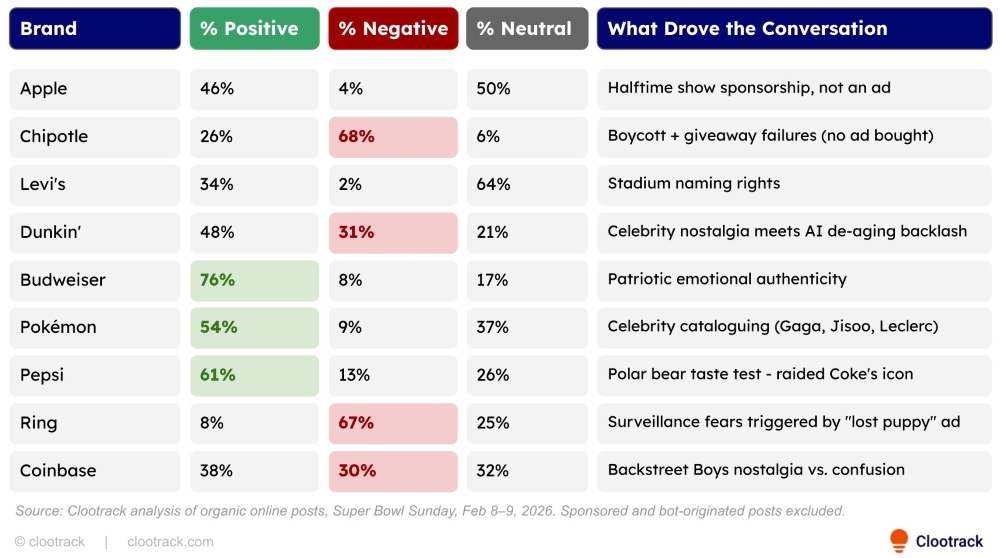
Clootrack analyzed 83,000 Super Bowl related posts from a 24-hour window around Super Bowl Sunday. From that universe, Clootrack zoomed in on posts that explicitly mentioned brands, and then removed brand-owned, sponsored, and promotional content to retain genuine user conversation. Within that organic, brand-naming set, people referenced 658 brands.

Clootrack is the Voice of Customer analytics platform recognized by OpenAI last year for crossing 100B tokens.

What emerges isn’t an “ad leaderboard.” It’s a clearer map of what makes a brand mention-worthy in real time – the moments that cut through game talk, memes, and hot takes enough for someone to type a brand name on purpose.

The Shape of Attention: “Brand Buzz” Is Wildly Uneven

Even within organic, brand-naming conversation, attention concentrates fast:

  • Roughly 69% of brands were mentioned very less – long tail
  • The top 10 brands captured about 36% of all brand-naming posts.

So yes, the Super Bowl is huge – but the online “name-mention economy” is still a narrow funnel. Most brands flicker. A few linger.

The Brands That Got Named Most

The most explicitly named brands each accounted for only a single-digit share of conversation – but they still stood out clearly:

  • Apple: ~9%
  • Chipotle: ~4%
  • Levi’s: ~4%
  • Dunkin’: ~4%
  • Budweiser: ~3%
  • Pokémon: ~3%
  • Pepsi: ~3%
  • Ring: ~2%
  • Coinbase: ~2%

The Three Reasons People “Name Names” on Super Bowl Sunday

1) Presence: brands that feel “built into the night” get named more reliably

Two of the biggest drivers of organic brand naming were Event and Venue Mentions and Brand Promotions / Marketing – together they made up about 31% of all organic brand-naming posts.

This kind of conversation tends to be calm and non-combative:

  • In Event and Venue Mentions, only about 2% of posts were negative, with the rest mostly neutral-to-positive.

That’s why brands structurally attached to the night (broadcast integration, sponsorship adjacency, venue context) can show up again and again without having to be polarizing. They become part of the Super Bowl “scaffolding,” so they get referenced like fixtures.

What this means: If your goal is reliable, low-risk mentions, event attachment is the most consistent route.

2) Emotion: brands get named when the feeling is easy to repeat

Some themes were almost pure “endorsement energy”:

  • Brand Loyalty and Affection: ~93% positive
  • Emotional and Heartfelt Reactions: ~91% positive
  • Excitement and Anticipation: ~75% positive

That matters because people don’t just “like” something privately on Super Bowl Sunday – they narrate it. When the emotion is legible in one sentence (“that was wholesome,” “that got me,” “I loved that”), the brand name travels with it.

You can see this pattern in brands like Budweiser, whose organic posts skewed heavily positive (about 76% positive), with relatively low negativity.

What this means: Not all “great ads” create brand naming – but simple emotions do. The more instantly explainable the feeling, the more likely the brand name gets typed.

3) Friction: the fastest way to be named is to create a problem people share

The most negative conversation didn’t look like “ad reviews.” It looked like friction: disappointment, controversy, and “this didn’t work.”

Across the dataset, the most lopsided themes were:

  • Critiques and Negative Feedback: ~76% negative
  • Technical and Quality Issues: ~74% negative
  • Controversial Messaging and Themes: ~69% negative

Two brands illustrate two different kinds of friction:

Chipotle shows “activation friction”:

  • Roughly 68% negative sentiment.
  • Its posts clustered most in Critiques and Technical/Quality Issues – a classic signature of promos and participation mechanics that people experience as unfair, confusing, or broken.

Ring shows “trust friction”:

  • Roughly 67% negative sentiment.
  • A large share of Ring’s conversation fell under Controversial Messaging and Themes (about 44% of Ring posts), the kind of reaction that turns into debate about privacy, surveillance, or social boundaries.

What this means: Super Bowl is an ad event, but attention isn’t always applause. The moment a campaign behaves like a product experience (codes, redemption, participation), or touches a cultural nerve (privacy, trust), it can spike brand naming – often with negative momentum.

One More Signal: 2026 Audiences Are Quicker to Judge “Vibe” and Authenticity

Across the board, organic sentiment wasn’t uniformly harsh:

  • About 40% positive
  • About 35% neutral
  • About 25% negative

But the pattern of negativity is telling: it clusters in “creepy / off / why would they do that?” reactions and in execution friction. Dunkin’, for example, drew a more divided reaction: while many posts were positive, a sizable share criticized the spot for feeling “uncanny” and inauthentic – with viewers specifically calling out the AI/de-aging vibe and saying it came off creepy or weird rather than funny.

What this means: In 2026, people don’t only judge what a brand says – they judge how it feels, how it’s made, and whether it crosses a line.

Clootrack VoC Study Reveals Why People Singled Out Brands on Super Bowl Sunday

Photo Courtesy: Clootrack.com

The “So What” for Leadership Teams

Your dataset is useful because it turns Super Bowl talk into operational takeaways. “Buzz” isn’t one thing; it’s three, and each has a different owner:

  1. Presence-buzz (event attachment, venue context)
    Owned by: partnerships + brand strategy
  2. Emotion-buzz (nostalgia, warmth, delight)
    Owned by: creative + brand storytelling
  3. Friction-buzz (promo failures, controversy, trust backlash)
    Owned by: CX/product activation + social response + trust/legal

Super Bowl Sunday is about football – and it’s also about advertising. But online, the brands that get explicitly named aren’t simply the ones that showed up. They’re the ones that became part of the night’s structure, part of the night’s feeling, or part of the night’s argument.

That’s what “mention-worthy” looks like now – and it’s a sharper measure than applause.

Securing Your Brand Across Social Platforms: Trademark Tips for Influencers

Many creators assume social platforms will automatically protect them if someone copies their name or branding. In reality, platforms rely heavily on trademark law when deciding who has the right to a name and who does not. Understanding how trademarks work in this context can help you secure your brand across platforms and respond more effectively when problems arise.      

Why Trademarks Matter for Influencers

Trademarks protect brand identifiers that identify a product or service to the public. For influencers, this typically includes a brand name, logo, slogan, or sometimes a distinctive series name used in connection with products or services.

Unlike copyright, which protects content like videos or photos, trademarks protect the commercial use of a name or brand. This becomes especially relevant once an influencer starts selling something, such as merchandise, online courses, subscriptions, or branded collaborations.

Without a registered trademark, your options for stopping impersonators or copycat brands are limited. You may be able to report accounts for impersonation, but if someone is using a similar name for commercial purposes, platforms often look for trademark ownership before taking action.

Securing Your Brand Across Social Platforms: Trademark Tips for Influencers

Photo: Unsplash.com

How Social Media Platforms Treat Trademarks

Most major social platforms have formal trademark policies. Instagram, TikTok, YouTube, Facebook, and X all provide trademark complaint systems that allow trademark owners to report infringing usernames, account names, ads, or content.

These platforms generally do not act as judges of who was “first” or who is more popular. Instead, they look for legal rights. A registered trademark is one of the strongest forms of proof you can provide.

For example, if someone creates an account using a name that is confusingly similar to your trademark and uses it to sell products or direct users to competing services, platforms are more likely to act if you can show trademark registration that covers those goods or services.

Without a trademark, platforms may tell you that the issue is a naming dispute or that both parties appear to have legitimate claims.

Usernames, Handles, and Trademarks

It is important to understand that owning a trademark does not automatically give you ownership of every matching username. Social platforms have their own rules around handle availability and inactivity.

However, trademarks can still play a decisive role when a username is being used in a way that causes consumer confusion. If a handle is being used to sell goods, run ads, or impersonate your brand, trademark ownership gives you leverage.

Many platforms will not remove a username simply because it matches your name, but they are far more likely to act if the account uses the name commercially or misleads users.

When to Think About Trademarks as an Influencer

Trademarks become relevant when your name or brand is tied to commercial activity. This includes selling merchandise, offering paid services, licensing your name, or partnering with brands under your own label.

Thinking about trademark protection early does not mean filing immediately in every case. It means understanding whether your brand is distinctive, checking for conflicts, and planning ahead to avoid growth that makes changes difficult.

Submitting your name for a free trademark check before launching products can help identify these issues early and avoid costly rebranding or disputes.

The Psychologist Revolutionizing Relationship Support for Parents Who Don’t Have Time for Counseling: Shannon Ownhouse

By: Ibukun Keyamo

Research suggests that couples delay seeking professional help for an average of six years after problems first appear. By the time most arrive in a therapist’s office, the distance between them has had years to calcify. Shannon Ownhouse, a registered Clinical Psychologist with 15 years of clinical experience, considers this delay one of the most consequential and preventable problems in relationship health.

There are many couples who are not in crisis but who feel the connection fading,” Ownhouse says. “They are tired, they are busy, and they often feel that counselling is not for them because they do not see themselves as having a serious problem.” That perception, she argues, is the very thing that allows the problem to grow.

The Quiet Drift Nobody Talks About

The transition to parenthood does not break marriages in one moment. It loosens them gradually. Studies consistently show that virtually all couples experience a measurable decline in relationship satisfaction after having children, driven by reduced quality time together, shifting individual identities, and the sustained demands of raising a family. The couple that once prioritised each other now operates as a coordinated unit of two, managing a household, dividing responsibilities, and rarely, if ever, simply being together.


Most will not seek help. The barriers are well established. Traditional couples therapy carries a persistent stigma, associated more with crisis intervention than with proactive care. Cost reinforces that hesitation. A single session with a couples therapist in the UK can cost anywhere from £50 to £150, and most programmes require ongoing weekly attendance for months. For parents already stretched for time and money, the arithmetic rarely works out.

Meet Shannon Ownhouse

Ownhouse trained and practised as a Clinical Psychologist for 15 years before building a response to this problem. She holds registration with the Health and Care Professions Council (HCPC) in the United Kingdom and membership with the Association of Coaching (AC). Her clinical work gave her a close understanding of how couples arrive at crisis and, more usefully, what the period before crisis looks like. Most of the couples she encountered had not come in early enough.

That observation shaped what she eventually built. “We help busy, tired parents reconnect with each other after having children so that they feel more connected and emotionally close, rediscover the playfulness in their relationship, and become excited about their future together,” Ownhouse says. The emphasis on playfulness is deliberate and reflects something she has repeatedly observed across clinical settings. By the time most couples sought formal support, the lighter qualities of their relationship had already quietly gone.

Building Something Different

The R.E.I.G.N.I.T.E Method™ is a trademarked 16-week online relationship coaching programme developed by Ownhouse and delivered through her company, Complete Psychology. It is explicitly not therapy. The distinction matters to her, and she is direct about it. The programme targets couples who are functioning, committed to each other, and willing to invest in their relationship before serious damage sets in.

The method is built around a strengths-based framework. Rather than asking couples to excavate past grievances or assign accountability for what went wrong, it focuses on what is already working and builds from there. “The programme is not about blame,” Ownhouse explains. “It is about building something strong and sustainable.”

Each week guides couples through a structured sequence of reconnection, practical tools, and experiences designed to reintroduce the qualities their relationship once carried, before parenthood absorbed it entirely. The programme runs online, removing the scheduling friction that causes many parents to abandon in-person support before it has a chance to work.

From Pilot to Launch

Before taking the programme online, Ownhouse ran it through a pilot phase in which more than 100 couples participated, providing direct feedback that shaped the final product. The official online programme launched in February 2026 and is now available internationally, with active markets across North America, Europe, the United Kingdom, Australia, and New Zealand.

The scale of the pilot is notable for a first release. Many digital wellness products launch with minimal real-world testing and are refined through public iteration. Ownhouse took the opposite approach, building the evidence base before opening to a wider audience rather than after. Whether that approach finds the audience it is designed for remains to be seen. The market for online relationship support is expanding, but so is the competition. What Ownhouse brings that few others in this space can claim is a clinical foundation built over 15 years, and a programme shaped by more than 100 real couples before a single paying customer signed up. In a sector where credentials are often thin and outcomes rarely measured, that is a meaningful place to start.

Disclaimer: The information provided in this article is for informational purposes only and does not constitute professional advice. It is not intended to diagnose, treat, or cure any psychological or medical conditions. Please consult with a licensed therapist or healthcare provider for personalized advice. Results may vary, and no guarantees are made regarding outcomes.

Daniel Radcliffe Returns to the New York Stage in Every Brilliant Thing

The lights at the Hudson Theatre on West 44th Street are shining a bit brighter this weekend. On February 21, Daniel Radcliffe officially returns to the New York stage for the first preview of a unique production called Every Brilliant Thing. While the actor is famous globally for his role in the Harry Potter films, his connection to the New York theater community has grown deep over the last decade. This latest move marks a significant shift from his previous work, moving away from large ensembles and musical numbers toward something far more personal.

The production is a one-man show written by Duncan Macmillan and Jonny Donahoe. It tells the story of a young boy who begins a list of everything worth living for to help his mother cope with chronic depression. The list starts with simple joys like ice cream, water fights, and staying up past bedtime to watch television. As the character grows into an adult, the list evolves with him, capturing the complex beauty of everyday life.

A New Chapter for the Hudson Theatre

Choosing the Hudson Theatre for this run is a deliberate move. As the oldest theater on Broadway, the venue provides an atmosphere that matches the intimacy of the script. Unlike the massive theaters used for blockbuster musicals, this space allows for a direct connection between the performer and the audience. This connection is vital because Every Brilliant Thing relies heavily on audience participation.

During the performance, Radcliffe interacts with the crowd, asking them to read items from the list or play minor roles in the story. This immersive style ensures that no two shows are exactly the same. It transforms the theater from a place where people sit and watch into a community space where a story is shared. Critics have often noted that this specific play requires a performer who is both vulnerable and approachable.

“The play is a life-affirming story about how we find hope in the smallest of places,” a spokesperson for the production shared during the rehearsals. “Having an actor of Daniel’s caliber bring this to life on Broadway is a gift to the theater community.”

The Evolution of a Broadway Star

Radcliffe’s return to Midtown comes at a time when his reputation as a stage actor is at an all-time high. Last year, he won a Tony Award for his performance in the revival of Merrily We Roll Along. That show was a massive success, but it was a traditional musical with a full cast and orchestra. By choosing a solo show immediately afterward, Radcliffe is demonstrating a commitment to challenging himself.

The transition from a big-budget musical to a one-person play is a bold professional choice. It removes the safety net of other actors and places the entire emotional weight of the evening on a single person. For fans of the New York arts scene, this is a sign of a maturing artist who is more interested in the quality of the storytelling than the scale of the production.

“Daniel has always been someone who seeks out the work that scares him a little bit,” a former colleague from his Equus days remarked. “He doesn’t just want to be a movie star on a stage; he wants to be a theater actor who happens to be in movies.”

Impact on New York City Tourism and Culture

The arrival of a major star in a limited-run play always provides a boost to the local economy. Midtown Manhattan sees a spike in foot traffic during Broadway preview weeks, as fans and theater enthusiasts flock to the Theater District. Local businesses, from historic diners to upscale hotels, benefit from the “Radcliffe effect.”

The show is already becoming one of the most sought-after tickets in the city. Its popularity highlights a broader trend in New York entertainment where audiences are seeking more intimate and authentic experiences. While large-scale spectacles like The Lion King or Wicked remain popular, there is a growing market for stories that deal with mental health, family, and the human condition in a direct way.

Every Brilliant Thing handles the heavy subject of depression with a surprising amount of humor and warmth. It does not shy away from the pain of the situation, but it emphasizes the resilience of the human spirit. In a city as fast-paced as New York, a story that encourages people to stop and list the things they love is resonating deeply.

Why This Production Matters Now

The timing of the show is also relevant to the current cultural conversation. Mental health awareness has become a primary focus for many New Yorkers, and the arts have always been a way to process these difficult topics. By bringing this story to a mainstream Broadway stage, the production is helping to normalize conversations about emotional struggles.

The play reminds the audience that even in the darkest times, there are “brilliant things” worth noticing. Whether it is the smell of old books or the feeling of a cool breeze, the list is a testament to the fact that life is made of small, meaningful moments. Radcliffe’s involvement ensures that this message reaches a much wider audience than a standard indie production might.

“It is a play that makes you want to go home and call someone you love,” noted an early attendee of the technical rehearsals. “It isn’t just a performance; it feels like a conversation.”

Looking Ahead to Opening Night

As the preview period continues, the production will likely undergo small changes based on how the audience responds to the interactive elements. This is a standard part of the Broadway process, where the “preview” weeks allow the creative team to fine-tune the timing and the tone before the official opening night.

For those planning to visit the Hudson Theatre, the experience promises to be unlike any other show currently playing in the district. It is a rare opportunity to see a world-class performer in a setting where they are only a few feet away from the front row. The energy in Midtown suggests that Daniel Radcliffe has once again found a project that fits the vibrant, ever-changing spirit of New York City.

The success of the show’s first few nights proves that Broadway is not just about the lights and the music. It is about the power of a single voice telling a story that everyone can relate to. As the list of brilliant things continues to grow each night at the Hudson Theatre, it is clear that Radcliffe’s return is exactly what the city’s theater scene needed this season.

Infrastructure Before Expansion: How America Tax Group Is Building a Structured National Tax Resolution Firm

A Deliberate Alternative in a Volume-Driven Industry

In an industry often characterized by aggressive advertising, scripted intake departments, and high-volume processing models, Justin Torbati has taken a markedly different path. As the founder of America Tax Group, Inc., he has focused less on rapid expansion through marketing velocity and more on building a disciplined operational foundation. The firm’s growth strategy reflects a deliberate emphasis on legal structure, internal accountability, and procedural rigor.

Tax controversy work typically begins at a moment of financial and emotional strain. An IRS notice, wage garnishment warning, bank levy, or audit adjustment can create immediate instability for both individuals and business owners. In that environment, urgency often drives quick decisions. Torbati structured America Tax Group, Inc. to interrupt that cycle. Rather than rushing prospective clients into engagement agreements, the firm requires a formal legal and financial viability review before representation is accepted.

This measured intake process is not cosmetic. It is embedded into the firm’s structure and functions as a threshold safeguard against unrealistic expectations and legally unsupported strategies.

Legal Viability Before Engagement

Each matter begins with an attorney review of IRS transcripts, income documentation, asset disclosures, compliance history, and current enforcement posture. The objective is to determine whether statutory criteria reasonably support a defensible path toward resolution. Relief programs such as an Offer in Compromise, for example, require strict eligibility analysis. When the numbers or compliance history do not meet legal thresholds, clients are made aware of the situation before fees are paid.

This early-stage restraint reflects a core operating principle: representation must be grounded in statute, regulation, and procedural reality, rather than relying solely on optimism. In a marketplace where relief outcomes are often oversimplified, America Tax Group, Inc. positions analysis as its first deliverable.

The firm provides full-service representation for IRS and state tax matters nationwide, including installment agreements, penalty abatement, levy releases, appeals representation, audit reconsideration, and compliance restoration. However, strategy is not templated. A taxpayer facing imminent wage garnishment requires prompt intervention and enforcement stabilization. A business owner managing accumulated penalties and delinquent filings may require phased compliance correction before negotiation. Each case is evaluated on its procedural posture and risk exposure.

Attorney Accountability From Intake Through Resolution

A defining feature of the firm’s model is continuity of attorney oversight. Legal professionals remain directly involved from intake through final resolution. Strategy determination, document preparation, transcript analysis, and negotiation with IRS personnel are handled under attorney supervision rather than delegated to non-legal staff operating independently.

Substantive actions are accompanied by written explanations outlining enforcement risks, procedural timelines, and anticipated next steps. This documentation-driven approach creates a record of rationale behind each strategic decision. It also reinforces alignment between what is presented to the IRS and what has been internally verified through transcript and financial review.

By maintaining centralized legal accountability, America Tax Group, Inc. reduces the disconnect that can occur when sales-driven intake departments operate separately from substantive case handling. The firm’s structure is designed to align client expectations, legal strategy, and regulatory compliance.

Infrastructure as the Foundation for Scale

Central to the firm’s national expansion has been its decision to build operational infrastructure before accelerating growth. Rather than scaling first and addressing internal controls later, America Tax Group, Inc. invested early in structured case management systems, compliance protocols, and reporting mechanisms.

Recent strategic capital investment has helped strengthen that foundation. Funds have been directed toward technology modernization, internal quality control teams, secure client communication systems, and structured professional training programs. Enhanced case management platforms provide real-time workflow visibility and measurable reporting metrics. Oversight mechanisms monitor filing deadlines, documentation accuracy, and procedural compliance.

These systems are designed to create consistency across jurisdictions as the firm expands its national footprint. Growth is treated as a byproduct of operational readiness, not a substitute for it.

Positioning Within a National Professional Landscape

The tax relief sector has faced sustained scrutiny for exaggerated marketing claims and opaque fee practices. Against that backdrop, America Tax Group, Inc. has positioned itself as a structured alternative. Its emphasis on documented legal analysis, transparent fee structures aligned with case complexity, and disciplined intake review reflects an institutional approach more commonly associated with established professional services firms.

Under Torbati’s direction, the firm demonstrates that infrastructure, attorney accountability, and national expansion can coexist when growth is anchored in systems rather than promotion alone. For taxpayers confronting IRS enforcement, the distinction between volume-driven assistance and structured legal representation carries significant consequences.

By prioritizing infrastructure before expansion, America Tax Group, Inc. has built a scalable model defined by procedural rigor, professional standards, and long-term credibility within the national tax controversy landscape.


Disclaimer: The information provided in this article is for general informational purposes only and does not constitute legal or financial advice. Each tax situation is unique, and the resolution strategies discussed may not apply to all cases. America Tax Group, Inc. recommends consulting with a qualified tax professional to evaluate your specific circumstances before making any decisions. Past results are not indicative of future performance, and no guarantees or promises are made regarding the outcome of any case.