Why High Achievers Don’t Feel Successful: Lisa Thomas on Emotional Patterns, Epigenetics, and Leadership Burnout


By: Matt Emma

From the outside, success can look undeniable: full calendars, financial growth, leadership roles, measurable wins. Yet for many high achievers and top performers, success doesn’t bring the relief they expected. Instead of ease, there’s pressure and chronic stress. Instead of fulfillment, there’s a persistent sense of “not enough.” According to Lisa Thomas, founder of Epigenetics for Global Impact, this disconnect is not necessarily a personal failure. It’s often the echo of inherited emotional patterns that shaped how success came to mean survival.

Lisa Thomas is a TEDx speaker, epigenetics master, and expert in inherited emotional patterns, trauma release, and leadership performance. Her work centers on a question many high performers, executives, leaders, and entrepreneurs have never been invited to ask: What if the reason success feels heavy isn’t that you’re doing it wrong, but because you’re carrying belief systems that were formed long before you were born?

When Achievement Equals Worth: How Performance Conditioning Shapes High Achievers

For many high achievers, childhood revolved around performance, even if no one ever said it out loud.

A report card placed on the kitchen table could shift the emotional tone of the house. High marks brought smiles, praise, maybe a moment of warmth or pride. Excelling meant attention and approval. But when performance slipped, connection felt distant—a pattern Lisa Thomas sees frequently among leaders who struggle with self-worth despite success.

In these environments, children learned that being capable, accomplished, or exceptional made them visible. “You internalize the idea that achievement is how you’re valued,” Lisa explains. “Grades, accomplishments, and productivity became the language of love.”

For these children, the nervous system made a powerful association early on: success equals safety.

How Childhood Performance Patterns Lead to Burnout, Imposter Syndrome, and Leadership Anxiety

As adults, these same individuals may become high achievers: driven, capable, and outwardly successful. But the internal experience may remain unchanged. Success can feel hollow because it was never about fulfillment; it was about safety, a pattern often associated with burnout and chronic overachievement.

Lisa often works with clients, many of them high-achieving leaders and entrepreneurs, who say, “I’ve done everything I was supposed to do. Why don’t I feel settled?” When they look closer, they realize they are still chasing the same thing they chased as children: reassurance that they are enough and emotional validation.

This shows up as:

  • Needing to prove yourself, even after repeated success

  • Feeling anxious when things slow down or stabilize

  • Forcing outcomes

  • Burnout cycles

  • Measuring self-worth through achievement

“These behaviors are incredibly adaptive,” Lisa says. “They helped someone survive. They just don’t help someone thrive.”

Inherited Emotional Patterns and Ancestral Survival Beliefs

One of the most important aspects of Lisa Thomas’ work, especially in the field of epigenetics and inherited trauma, is helping people understand that these patterns are broader than their own story.

The ideas that you must constantly work to deserve security, that rest is earned, that worth comes from productivity, aren’t new. They were shaped in earlier generations where survival truly depended on labor, sacrifice, and endurance.

Parents passed these beliefs to children not out of harm, but out of fear.

“These patterns often come from lineages that experienced economic hardship, displacement, or chronic instability,” Lisa explains. “When survival is uncertain, performance becomes protection.”

Over time, these survival beliefs can turn into identity:

  • To be safe, I must work.

  • To be worthy, I must produce.

  • To matter, I must be somebody.

Even when circumstances change, the emotional imprint may remain and continue to influence career choices, relationships, and leadership style.

Why High Achievers Don’t Feel Successful, Even When They Are

This is why so many high achievers report low self-worth despite impressive accomplishments. No amount of external validation may heal an internal system that learned love was conditional.

When success is built on inherited fear, it can come at a cost: relentless striving, chronic pressure, and burnout disguised as ambition.

“Success without peace may be a sign that something deeper is driving the behavior,” Lisa says. “And usually, that something isn’t personal; it’s ancestral.”

Through her work, Lisa helps clients identify which beliefs are rooted in past survival rather than present reality. As those patterns release, many report something unfamiliar yet profound: success that doesn’t require force.

Redefining Success at the Root

Lisa is not advocating for doing less or abandoning ambition. She’s advocating for building success from alignment rather than inherited urgency.

“When achievement no longer has to earn love or safety, it becomes creative instead of compulsive,” she explains.

Clients often report that decisions become clearer, boundaries feel safer, and success begins to feel spacious rather than heavy. They still lead, build, and grow, but without the underlying pressure.

Changing the Legacy: Breaking Generational Patterns of Performance and Survival

Perhaps the most transformative part of Lisa’s work is its ripple effect. When one person steps out of survival-driven success, they can change what gets passed down.

“Children don’t inherit what we say; they inherit what we embody,” Lisa says. “When success is rooted in self-trust instead of fear, that becomes the new blueprint.” This is where Lisa connects epigenetics with leadership and generational healing.

In a world that rewards relentless productivity, Lisa Thomas offers a deeply countercultural message: you don’t have to exhaust yourself to be worthy, and you don’t have to keep carrying belief systems that were formed in a very different time.

“You are allowed to succeed and feel at peace,” she says. “And you’re allowed to let go of what helped someone else survive, so you can finally live.”


Disclaimer: The information presented in this article is for informational purposes only. The concepts discussed, including epigenetics and inherited emotional patterns, are complex and should not be considered as a substitute for professional medical or psychological advice. Always seek the advice of a qualified healthcare provider with any questions you may have regarding your health or well-being. Results may vary, and the application of these ideas may not work the same for everyone.

The Witch on the Mountain: Sorcha as Symbol and Shadow in Ruby

A cabin high up on an Idaho mountain, shutters closed, and smoke slowly rising from the chimney, is a scene that stays with you. An older woman locks the door to keep her daughter and granddaughter out. No apologies, no pause, simply the harsh smack of wood blocking off blood. This woman is Sorcha Witcher, the “witch on the mountain,” in Janis Flores’s Ruby. She is not the villain exactly, nor the hero. She is something else: a shadowed figure whose choice to withdraw carves its own wound in the novel’s heart.

The Woman Who Refuses

Sorcha’s rejection is one of the earliest turning points in Ruby. Dixie, Ruby’s mother, drags her up the mountain in hopes of finding help, food, perhaps shelter, or just acknowledgment. Instead, Sorcha makes her stance brutally clear. She owes them nothing. She will not open her door to chaos.

This refusal resonates in uncomfortable ways. We’re used to narratives where women, especially older women, are called upon to soften, to heal, to step into the maternal role even when everything else collapses. Sorcha doesn’t. She does not bend. And that’s what makes her fascinating.

Is she heartless, or is she simply refusing a lifetime of expectation?

The Archetype of the Hermit Woman

Folklore has always carried space for women who choose solitude. The crone in the woods. The witch by the fire. The widow who tends her garden while the village gossips. These figures are both feared and revered, often punished in story but secretly desired as symbols of autonomy.

Sorcha Witcher fits neatly into this lineage. She is not nurturing; she is not warm. She is self-protective, brittle, and untouchable. And yet readers recognize the power in that. To choose to live alone on the mountain is to declare independence from a society that would otherwise claim her labor, her love, her forgiveness.

What does it mean, though, when such autonomy slices across generations? When a granddaughter stands at the door, hungry and bruised, and is told no?

The Collision of Blood and Choice

Flores writes Sorcha without flinching. There is no soft backstory offered as an excuse. No sentimental reveal that she has always loved Ruby from afar. Sorcha represents a hard truth: sometimes women opt out. Not because they cannot care, but because caring has cost too much already.

This is not an easy idea for readers. We prefer our archetypes to be tidier: the grandmother who saves the day, the maternal figure who patches what the mother broke. Instead, Sorcha offers Ruby nothing but a slammed door. The absence itself becomes formative. Ruby learns early that her family may miss her.

And this is where Ruby diverges from safer narratives. It doesn’t try to redeem every relationship. It doesn’t insist that blood wins out. It dares to ask what happens when bloodline loyalty disintegrates.

Ruby’s Counter-Lineage

Stripped of a dependable mother, denied by a grandmother, Ruby is left to invent her own inheritance. And she does not with humans, but with wolves. Waya and Luna step into that mythic role, offering what Sorcha withholds: presence, trust, something that feels like permanence.

It’s not accidental that Flores places wolves in this space. Wolves, too, are loaded with cultural symbolism. They are predators, yes, but also intensely loyal to their pack. They embody danger and devotion at once. Where Sorcha bolts her door, the wolves wait at the clearing. Where family fractures, the wilderness provides a strange, feral stability.

Ruby’s survival depends on accepting this nonhuman lineage. Her sense of self does not root in Sorcha’s house on the mountain but in the silent companionship of wolves who ask nothing and demand nothing beyond respect.

Why Sorcha Matters

It would be easy to dismiss Sorcha as cruel and move on. But her presence in the novel does something vital. She forces the question: what if women are not obligated to save everyone? What if some women claim solitude as survival, even if it leaves scars on those outside their walls?

In a culture that still places a heavy weight on women’s roles as caregivers, Sorcha is a jagged counterpoint. She embodies the potential, both daunting and emancipating, of dissent. Readers may be annoyed by her, but they can’t help but read. She stays like smoke in the lungs.

Critical Echoes

Early reviews of Ruby have latched onto this complexity. One reader described Sorcha as “the kind of character you argue with in your head long after the page is turned.” Another called her “a mirror we’d rather not see.” Comparisons to Barbara Kingsolver and Toni Morrison’s unsparing portraits of matriarchs are not unfounded; Flores is working in that lineage of women who refuse simplification.

Beyond the Mountain

By the end of the novel, Sorcha remains essentially unchanged. She is still on the mountain, still walled in. But Ruby has shifted. She no longer looks to Sorcha for rescue. Instead, she steps into her own story, drawing strength from unexpected sources. In this way, Sorcha’s absence has shaped her as much as any presence could have.

And maybe that is the ultimate paradox: the witch on the mountain both wounds Ruby and frees her. By refusing to play the grandmotherly role, Sorcha pushes Ruby toward the wolves, toward her own chosen pack, toward survival outside the boundaries of family expectation.

Why Readers Should Pay Attention

Ruby is not comfortable reading, and that’s precisely why it feels necessary. In a world still obsessed with tidy arcs of forgiveness and reconciliation, Flores writes characters who refuse the script. Sorcha Witcher is one of the most haunting not because she casts spells, but because she doesn’t. Because she turns her back and says no.

Ruby is exactly what readers who want fiction that makes them think, that makes them uncomfortable, and that prompts them to reflect on the archetypes they embody. This book will make you question what you think you know, and you’ll still be grappling with yourself long after you’ve finished reading it.

A Final Note

If you’re searching for a story that howls instead of whispers, that replaces sugarcoated redemption with something sharper, Ruby deserves a place on your shelf. Sorcha, Waya, Luna, and Ruby herself will stay with you, not as easy answers but as echoes.

And perhaps that’s the point. Sometimes survival doesn’t come from the family we’re given. Sometimes it comes from recognizing the wolves outside the door or even the witch who will not open it.

Janis Flores’s Ruby is available now. Find it at your favorite bookstore or online retailer, and step into the mountain shadows yourself.

Why Cyber Awareness Is Becoming Part of Business Education

Cyber risk has become inseparable from how organizations operate, compete, and grow. Decisions once viewed as purely commercial now carry digital consequences that extend into reputation, continuity, and legal exposure. Leaders are expected to weigh these consequences even when cybersecurity is not their area of expertise. As a result, cyber awareness has moved from a technical concern to a leadership competency.

Business education is responding to this reality by expanding the definition of “business-ready.” Understanding cyber risk now sits alongside finance, operations, and strategy in executive decision-making. This change is not driven by fear of breaches alone, but by the recognition that digital systems shape nearly every business outcome.

Digital Risk Decisions

Modern leaders face digital risk embedded in everyday choices. Vendor selection, platform adoption, data strategy, and expansion plans all introduce exposure long before any incident occurs. Without foundational cyber awareness, leaders may underestimate how routine decisions compound risk across the organization. This gap often leads to overreliance on technical teams to define priorities, leaving leadership detached from the true implications of their own decisions.

Business education that incorporates cyber awareness enables leaders to evaluate risk independently and in context. They learn to assess trade-offs, challenge assumptions, and balance opportunity with responsibility. An online MBA in cybersecurity supports this skill development by combining strategic business training with structured exposure to digital risk concepts. Programs such as the one offered by the University of North Carolina Wilmington are often referenced for their applied focus and leadership orientation. Online delivery enables professionals to integrate learning with real decisions they are already making, strengthening relevance and long-term retention without disrupting their careers.

Strategic Integration

Cyber awareness delivers the greatest value when it becomes part of strategic thinking rather than a reactive response. When leaders incorporate digital risk into planning conversations early, strategy develops with clearer boundaries and fewer blind spots. Expansion initiatives, product launches, and operational changes benefit from this integrated perspective because vulnerabilities are considered alongside goals.

This approach changes how organizations prioritize investments. Instead of treating cybersecurity as a standalone cost, leaders align protections with strategic importance. Critical initiatives receive stronger safeguards, while lower-impact areas receive proportionate attention. Cyber thinking then supports execution by reducing uncertainty rather than delaying progress, allowing the strategy to move forward with confidence.

Executive Accountability

Accountability for cyber outcomes increasingly rests with executive leadership, regardless of technical background. Data governance, access controls, and system oversight are no longer issues that can be delegated. Leaders must understand how their choices influence exposure and resilience, even if implementation remains within technical teams.

Cyber-aware executives engage differently with oversight structures. They ask sharper questions, demand clearer reporting, and establish ownership that aligns with organizational priorities. This awareness strengthens governance by connecting accountability to decision authority.

Growth Risk Review

Growth introduces complexity faster than most organizations anticipate. New markets, systems, and partnerships expand digital exposure with every step forward. Leaders focused solely on speed may underestimate how quickly vulnerabilities multiply, particularly during scaling phases where controls lag behind expansion.

Cyber awareness equips leaders to evaluate growth plans through a wider lens. They learn to anticipate pressure points, sequence expansion responsibly, and identify where investment in resilience is required to accompany opportunity.

Continuity Alignment

Business continuity planning depends increasingly on digital resilience. Disruptions tied to cyber incidents affect operations, communication, and customer trust simultaneously. Leaders who understand this connection approach continuity planning with greater realism and precision.

Aligning cyber awareness with continuity planning strengthens organizational readiness. Leaders consider recovery capability, decision authority, and communication pathways before disruption occurs. This preparation reduces confusion during crises and supports faster stabilization.

Supply Chain Exposure

As organizations become more interconnected, cyber exposure increasingly enters through third parties rather than internal systems. Vendors, cloud providers, software partners, and service platforms often hold access to sensitive data or operational systems. Leaders who overlook this reality may underestimate how risk travels across organizational boundaries, even when internal controls appear sound.

Cyber awareness within business education prepares leaders to evaluate supply chain relationships with greater scrutiny. Instead of viewing vendors solely through cost or efficiency, leaders learn to assess digital dependency and access implications. This perspective supports smarter contracting, clearer accountability, and stronger oversight. Managing supply chain exposure becomes a leadership responsibility tied directly to resilience and trust.

Operational Blind Spots

Digital operations often evolve faster than governance structures. Systems get layered, access expands, and processes adapt informally to meet demand. Over time, blind spots emerge: no single leader fully understands how data flows, who controls access, or where vulnerabilities exist. These gaps persist not because of negligence, but because oversight has not kept pace with complexity.

Cyber-aware leaders develop the habit of questioning assumptions around safety and control. They recognize that familiarity does not equal security and that long-standing systems deserve periodic reevaluation. Blind spots shrink once leaders accept that visibility requires deliberate effort rather than passive trust.

Human Risk Factors

Technology alone does not determine cyber exposure. Human behavior continues to play a central role in how incidents occur and escalate. Decision shortcuts, inconsistent training, and unclear responsibility all contribute to risk, particularly in fast-moving environments where convenience often outweighs caution.

Business education that includes cyber awareness helps leaders understand this human dimension. Rather than relying solely on technical safeguards, leaders learn to shape behavior through policy clarity, communication, and accountability. Awareness programs become part of organizational culture rather than compliance exercises.

Digital exposure touches nearly every strategic and operational decision, making security awareness inseparable from effective leadership. Leaders who understand cyber implications make stronger decisions, protect trust, and guide organizations with greater confidence.


Disclaimer: This article is for informational purposes only and does not constitute legal, financial, or professional advice. The views and opinions expressed herein are those of the author and may not reflect the official stance of any organization. The content is intended to provide general insights into the importance of cyber awareness in business education and leadership, but it is not exhaustive. Readers are encouraged to seek professional counsel for specific concerns regarding cybersecurity, business operations, or related matters.

Stop Guessing: The Step-by-Step Diagnostic Guide to Remove Write Protection on USB Drive

By: Muneed Seo

You plug in your USB drive, drag a file over, and instantly get the message: “The disk is write-protected. Remove the write-protection or use another disk.” No copy. No format. No save. Just frustration. A quick search for how to remove write protection on a USB drive only makes things worse, throwing registry hacks, DiskPart commands, and conflicting advice at you with no clear starting point.

This error is one of the most common and most misunderstood USB problems. Whether you’re trying to save a document, back up photos, or format a stubborn stick, write protection turns a simple task into a dead end. The core issue? Most guides treat this like a guessing game.

But write protection isn’t random; it’s a symptom. It can be physical, software-based, permission-related, or a sign of hardware failure. Each cause requires a different fix. This guide replaces guesswork with diagnosis.

Instead of trying everything, you’ll follow a logical roadmap to identify why your USB flash drive is locked, then apply the correct solution. If you want to remove write protection on a USB drive safely and permanently, follow this process.

The Golden Rule: Before You Do ANYTHING Else

Before making any changes to your USB drive, follow the golden rule: always back up your data first. Then, you can safely proceed to remove write protection on a USB drive.

Step 0: Safeguard Your Data (If Possible)

Before attempting any fix, try copying any important files from the USB drive to your computer or another storage device. Some solutions, especially those involving formatting or partition reformatting, will permanently erase data.

Be realistic

If the drive is fully write-protected, copying may fail. That’s exactly why proper diagnosis matters. But if the drive still allows reads, take advantage of it now. Once recovery steps begin, rollback may not be possible. This single precaution prevents a repair task from becoming a data-loss incident.

The Diagnostic Flowchart: Find Your Fix

Now, let’s get into the diagnostic fix guide with multiple steps that you need to try:

The Troubleshooter’s Path: Start Here, Not With Random Commands

This is the core of the guide. Follow these steps in order. Each one rules out an entire class of causes.

Diagnostic Step 1: The Physical Check

Action:

Examine your USB drive closely. Look for a small physical lock switch, usually on the side. Brands like SanDisk, Kingston, and older USB flash drives often include a tiny slider that toggles write protection at the hardware level.

Instruction:

If you find a switch, slide it to the unlocked position, reinsert the drive, and try again. If this works, you’re done. If no switch exists, or unlocking doesn’t help, move on. Software solutions cannot override a physical lock.

Diagnostic Step 2: Try a Different Environment (Rules Out Local PC Issues)

Action:

Plug the USB drive into:

  1. A different USB port on the same computer
  2. A completely different computer

Interpretation:

  •       Works elsewhere: Your original system has a configuration, policy, or driver issue.
  •       Fails everywhere: The problem is on the USB drive itself. Proceed.

This step prevents you from fixing the wrong machine.

Diagnostic Step 3: Check Drive Properties & Permissions (Software Lock)

Action (Windows):

  1. Open File Explorer
  2. Right-click the USB drive > Properties
  3. Go to the Security tab
  4. Check your user account’s permissions.

Ensure write access is allowed.

Interpretation:

Incorrect permissions can trigger write-protection errors even when the drive is healthy. Fixing permissions here often resolves the issue instantly. If permissions are correct, continue.

Diagnostic Step 4: Scan for File System Errors (Logical Corruption)

Action:

Use Windows’ built-in file system checker.

  1. Open Command Prompt as Administrator
  2. Run: “chkdsk X: /f” (Replace X with your USB drive letter.)

Interpretation:

Logical file system corruption can force Windows to mount a drive as read-only to prevent further damage. chkdsk repairs these inconsistencies. If errors are fixed and write access returns, you’re done. If not, escalate.

Diagnostic Step 5: Registry & Group Policy Check (Advanced Software Lock)

Action:

Check whether Windows is enforcing removable storage write protection via “Group Policy Management Editor”:

  •       Registry keys
  •       Group Policy settings


These controls are commonly used in corporate or shared environments.

Important Warning:

Editing the registry incorrectly can damage your Windows installation. This step is only for advanced users who know how to back up and revert changes. If protection is enforced here, removing it restores write access. If not, the issue goes deeper.

Diagnostic Step 6: Drive Is in Permanent Read-Only Mode (Firmware or Physical Failure)

Interpretation:

If none of the above steps work, the USB controller may have locked the drive into read-only mode. This often happens when the drive detects an internal failure and switches to data-preservation mode. At this point, the problem is no longer user error; it’s structural.

The Solution Hub: Matching the Fix to the Diagnosis

After you complete the diagnosis, proceed to the appropriate fixes to resolve the issue without confusion.

Your Diagnosis Is Clear. Now, Here’s Your Cure.

This section translates diagnosis into action.

For Physical Switch or Port Issues (Steps 1 & 2)

The fix is straightforward:

  •       Unlock the switch
  •       Use a different port or system

No software required.

For Permission or File System Issues (Steps 3 & 4)

If permissions were incorrect, correcting them restores write access. If chkdsk repaired file system errors, the drive should now accept writes normally. Always test by creating and deleting a small file.

For Deep Software & Formatting Issues (Step 5 & Beyond)

This is where most users get stuck. At this stage, the drive often needs:

  •       Write protection flags removed
  •       Partition tables rebuilt
  •       A forced format

Windows Disk Management and DiskPart can do this, but they’re command-based, unforgiving, and frequently fail on stubborn drives.

The Safer, More Powerful Solution: 4DDiG Partition Manager

4DDiG Partition Manager is designed for low-level disk operations through a clean, graphical interface with no risky commands required.

Why it fits here perfectly:

  •       Handles stubborn write-protected drives
  •       Reduces human error
  •       Designed for exactly this escalation point

Key Features That Matter

Force Format Function

Can format drives even when Windows refuses.

Partition Management

Deletes and recreates partitions, removing software-level write protection at the root.

File System Repair

Fixes corruption that triggers read-only states.

Simple Workflow

After diagnosing a deep software issue:

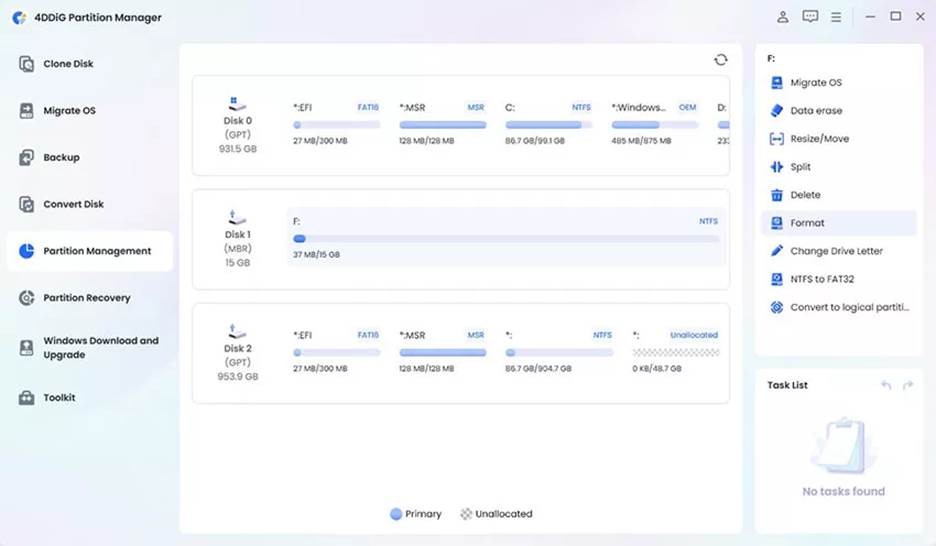
1. Launch 4DDiG Partition Manager after downloading and installing it, then select “Partition Management” and click on the “USB” to select it.

Stop Guessing: The Step-by-Step Diagnostic Guide to Remove Write Protection on USB Drive

Photo Courtesy: 4DDiG/Tenorshare


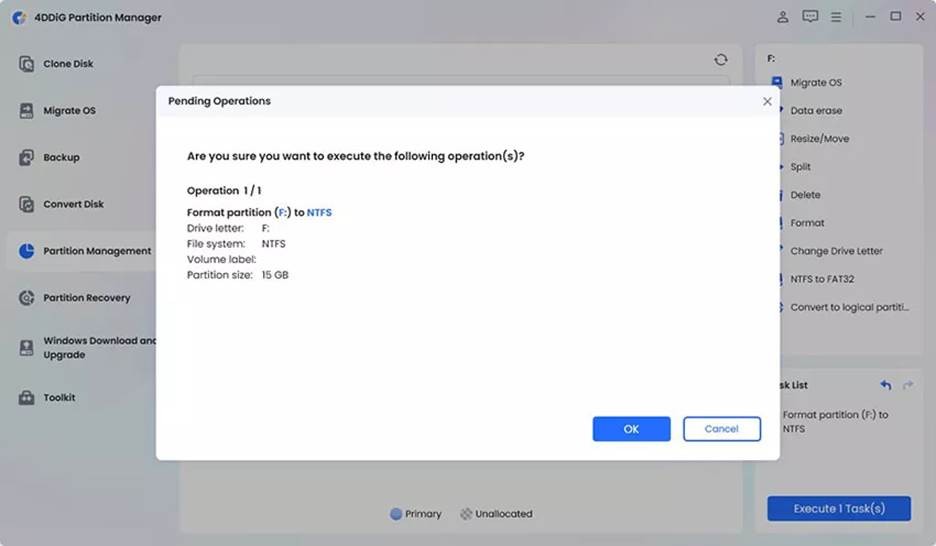
2. Click “Format” to wipe its partition table and then create the new partition table with the pop-up window. Click “OK” to proceed and “Yes” to confirm.”


3. Click “Execute Tasks” then “OK” and wait as 4DDiG formats your USB. Once the process is successfully completed, click “Done”.

Stop Guessing: The Step-by-Step Diagnostic Guide to Remove Write Protection on USB Drive

Photo Courtesy: 4DDiG/Tenorshare

All done in a few clicks, no CMD, no registry edits, no guesswork.

Final Verdict & When to Give Up?

By following this diagnostic guide, many common write protection issues can be resolved. Physical switches, permission errors, and file system corruption account for most cases. For stubborn software-level locks, tools such as 4DDiG Partition Manager offer a safe and effective solution.

If the drive has entered permanent read-only mode due to hardware failure, no software can fix it. At that point, replacement is the only option.

Tired of error messages? Download 4DDiG Partition Manager to safely and powerfully handle the complex formatting and partition tasks that often lock your USB drives.

FAQ

Q: How do I remove write protection on a USB flash drive that has no switch?

Follow the diagnostic steps: test on another PC, check permissions, run chkdsk, then use a partition manager if needed.

Q: I need to remove write protection on the USB pen drive to format it, but Windows won’t let me.

This usually indicates deep software-level protection. A dedicated partition manager can force formatting safely.

Q: How to remove the write protection on a USB drive using CMD?

DiskPart can sometimes work, but it’s risky. One wrong command can erase the wrong drive. GUI tools are safer for most users.

Firstep Business Solutions Expands Services to Help More Solopreneurs

By: Luciano Vaughan

Many solo business owners handle sales, service, paperwork, and marketing on their own. Firstep Business Solutions focuses on those entrepreneurs, bringing more tools into a single platform so they can spend less time on administration and more time serving clients and growing revenue.

From Formation Helper to Ongoing Partner

Firstep began by helping new owners register their businesses and understand state filing requirements. Clear step sequences, plain language, and guided forms made the early stages of starting an LLC or other entity less overwhelming. Entrepreneurs in home services, mobile trades, personal care, and similar fields found a process that respected both their time and their limited back-office support.

Over time, many clients chose to stay with Firstep after the initial filing. The dashboard provided a place to see entity status, track renewal deadlines, and store confirmations, which encouraged owners to log in regularly. That repeated use turned a one-time filing tool into a longer-term partner that supports businesses through each renewal cycle. This continuity helped foster trust and streamlined administrative processes for owners, making it easier to stay on top of essential tasks.

Growing interest in recurring compliance programs further strengthened this connection. Automated annual report services, reminders, and status tracking reduced the chance that owners would miss due dates. When filings remain up-to-date, businesses are more likely to stay active, which can help protect contracts, bank relationships, and customer confidence.

Expanding Tools for Day-to-Day Operations

Recent growth has allowed Firstep to add more operational tools aimed directly at solopreneurs. The platform now offers payment processing and point-of-sale features that let service providers accept card payments in the field. Faster payment collection can support cash flow, which is crucial for very small teams that rely on steady weekly income.

Scheduling and invoicing live inside the same dashboard as compliance records. An owner can confirm tomorrow’s appointments, send invoices for completed jobs, and check annual report status in a single session. That structure helps reduce the need to jump among separate apps, cutting down on errors such as double-booking or missed invoices.

Simple marketing tools, such as basic web pages and funnels, provide an accessible entry point for owners who want to present a more professional image without hiring a full agency. When these tools connect to scheduling and payments, prospects are able to move from initial interest to booked job and completed payment through a unified flow. Each additional feature deepens the platform’s role in daily operations.

Reaching More Solopreneurs in 2025 and Beyond

Company figures shared publicly suggest that Firstep now serves more than 200,000 clients and has experienced strong revenue growth, reaching around $20 million on an annual basis. A significant portion of new orders reportedly includes ongoing services, such as automatic filings and subscription-based operational tools. Those numbers indicate that more solopreneurs view the platform as a central part of running their businesses, rather than just as a filing service.

Firstep continues to refine educational content that supports these users. Guides on starting a business, choosing a structure, and managing existing entities help owners understand the tools they use. Clear explanations assist entrepreneurs in understanding why certain filings matter and what documents they should keep on hand, which contributes to steadier operations.

The company’s expansion of services reflects a broader trend among very small businesses seeking practical, all-in-one support. Formation, compliance, payments, scheduling, and basic marketing now sit under one roof, tailored to people who often work alone or with small crews. As more solopreneurs adopt these tools, Firstep’s role in helping them start, stabilize, and gradually grow their businesses becomes more visible in markets across the United States.

From Therapist to Public Figure: How D’Shawn Harris Is Elevating Mental Health for Black Men

By: Elena Mart

For many Black men, emotional struggles are often carried quietly, shaped by cultural expectation, responsibility, and the pressure to remain composed in every setting. D’Shawn Harris, M.Ed, LCPC, NCC, is working to change how those experiences are understood and addressed. As the founder of Safe Haven Therapy Services, Harris combines clinical expertise with community-centered care to create environments where Black men can speak openly about emotional pain without fear of judgment.

A licensed psychotherapist and mental health advocate, Harris approaches healing as both a personal and collective process. His work extends beyond traditional therapy sessions, offering practical strategies that help men regulate stress, strengthen relationships, and develop emotional awareness in daily life. Through counseling, educational programming, and creative tools such as his conversation card game, Harris emphasizes that vulnerability is not a weakness but a skill that can be learned and practiced.

In this conversation, Harris reflects on the emotional burdens Black men often carry, the everyday habits that support nervous system health, and his vision for making mental wellness more accessible and sustainable. His perspective highlights a growing shift toward treating emotional care not as a response to crisis, but as an essential part of long-term well-being and community health.

You often work at the intersection of clinical care and community healing. What is something Black men are carrying psychologically right now that you feel is still largely unnamed?

D’Shawn: I think a lot of Black men are carrying a deep sense of emotional responsibility for everyone but themselves. Many feel like they have to be strong, financially stable, emotionally contained, socially aware, and protective all at once, often with very little space to be vulnerable or uncertain. What goes unnamed is the constant psychological load of having to stay alert, not just to personal stress, but to racial dynamics, family expectations, and survival pressures. That chronic vigilance becomes normalized, but it takes a real toll on the nervous system, relationships, and self worth.

You focus on practical tools for healing. What is one small, overlooked daily practice that can create meaningful nervous system regulation over time?

D’Shawn: One of the most overlooked practices is intentional transitions, taking even sixty to ninety seconds to pause between activities instead of jumping from one demand to the next. For example, sitting in the car for a minute before going inside, or taking a few slow breaths before picking up your phone in the morning. Those small pauses tell the nervous system that you are safe right now. Over time, that reduces baseline stress and helps the body stop living in constant urgency.

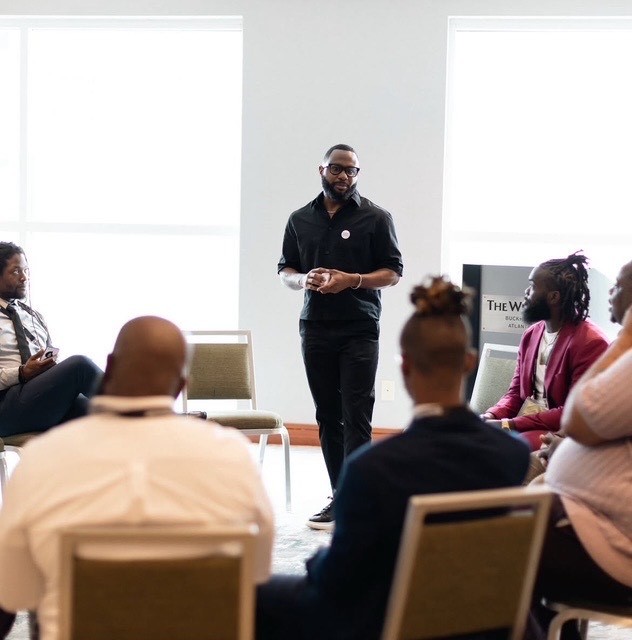
From Therapist to Public Figure: How D’Shawn Harris Is Elevating Mental Health for Black Men

Photo Courtesy: Kollins Benson

Social media has created constant cognitive stimulation, comparison, and emotional flooding. How can Black men regulate their nervous systems when their phones rarely give their minds a moment of rest?

D’Shawn: First, we have to acknowledge that many men use their phones as their main coping strategy for distraction, connection, and even emotional relief, so the goal is not just to get off your phone. It is about changing how and when we engage. Simple practices like setting no scroll time in the morning, not taking the phone into the bedroom, or intentionally following content that reflects growth instead of just trauma can make a big difference. Regulation comes from giving the brain predictable moments of quiet, not from trying to completely disconnect in unrealistic ways.

What conversations about Black male mental health do you think we are still avoiding because they make people uncomfortable?

D’Shawn: We still avoid talking honestly about how emotional suppression shows up as anger, control, or emotional distance in relationships. We talk about stress and trauma, but we do not always talk about how unprocessed emotions can hurt partners, children, and friendships. That conversation is uncomfortable because it asks for accountability, not just empathy. But healing requires both, understanding the pain and taking responsibility for how that pain gets expressed.

From Therapist to Public Figure: How D’Shawn Harris Is Elevating Mental Health for Black Men

Photo Courtesy: Kollins Benson

What upcoming mental health initiatives, programs, or community efforts are you currently involved in or preparing to launch?

D’Shawn: Right now, I am focused on expanding access to culturally responsive therapy and building programming that blends clinical tools with real world application, including psychoeducational workshops, men’s mental health discussions, and partnerships with community organizations. The goal is to meet Black men not only when they are in crisis, but also when they are simply trying to grow, heal, and build healthier lives.

How do you envision Safe Haven Therapy Services evolving over the next few years to meet the changing needs of Black men?

D’Shawn: I see Safe Haven continuing to grow as both a clinical practice and a community-centered wellness space. That means not only offering therapy, but also creating pathways for education, prevention, and relational skill building. As conversations around mental health become more normalized, men are coming in not just for crisis, but for self-development, relationship health, and emotional intelligence. Safe Haven is positioned to support that shift by offering services that treat mental wellness as part of everyday life, not just emergency care.

What would it look like if mental wellness for Black men were treated as a form of legacy building rather than a crisis response?

D’Shawn: It would mean we are helping men heal not only for themselves, but for their future families, relationships, and communities. Mental wellness would be seen as something you invest in so that your children experience more emotional safety, your partnerships are healthier, and your stress does not become someone else’s inheritance. Legacy building says that my healing matters beyond just my own survival, and it shapes the next generation.

If one conversation could move from the shadows into the light right now, what should it be and why?

D’Shawn: We need to talk more openly about loneliness among Black men. Many men have people around them but still feel emotionally isolated, unheard, or unsupported. That loneliness often hides behind work, humor, toughness, or even social media presence. When we name it, we can start building healthier support systems and friendships, instead of expecting romantic partners or family to carry all of a man’s emotional needs.

For readers who want to learn from and follow your work, where can they connect with you and track your professional journey online?

D’Shawn: People can connect with me through social media, Instagram: dshawnlharris & safehaven_therapy, and to inquire about services, our website is www.safehaventherapyservices.com

How to Prep Your Skin for a Party with ZO Skin Health

The colder months are here with a bang, and your skin probably isn’t ready for it. Sorry to be the bearer of bad news, but someone needed to say it. You deserve the best for your skin, and you deserve for it to glow every time you step out the door, whether it’s for work, brunch with friends, or a cosy weekend away.

With the weather changing and daily routines getting busier, now’s the ideal time to give your skin some extra care and attention. Think of it as a refresh, the chance to reset your skincare routine, bring back your natural glow, and make sure your skin feels as good as it looks. Here’s a quick and easy-to-follow guide on keeping your complexion healthy, hydrated, and radiant all season long.

Start With A Solid Skincare Base

The ideal time to start prepping your skin was about two weeks ago; the second-ideal time is now. The idea is to create a simple daily routine with up to a month’s notice on your busy diary of parties and events. This routine should include a gentle cleanser, a hydrating serum like hyaluronic acid, a moisturizer, and a broad-spectrum SPF cream to keep your skin barrier strong. Consistency is key, as even a straightforward routine followed daily can noticeably support skin comfort and overall appearance, leading up to an event.

Antioxidants and Skin Brightening

This is also a good opportunity to introduce antioxidants such as vitamin C into your morning routine, to support brightness and help protect against free radical damage from pollution and UV exposure. Antioxidants are powerful tools for evening skin tone, and, when folded into a strong seasonal routine, can return results far beyond the basic establishment of a baseline for your skin. 

Indeed, there are several reasons to establish a proper skin regimen before party season. One is to establish a healthy baseline for your skin, so makeup is less of a harmful irritant, and can look its best when you want it to. Another is ‘the glow’; you know what this is. And this is where skin brightening products can be a powerful part of a routine, giving you a little more control over your glow.

Exfoliation And Pamperment

Skin brightening products aren’t your only port of call, though. Introducing chemical exfoliants into a once- or twice-weekly routine can help smooth your skin’s texture and boost radiance without irritating it.

That last part is more crucial than you might initially think. If you’re tempted to brute-force your way through exfoliation, you run the risk of over-exfoliating. Right before a big night, this can backfire massively, causing redness, irritation, and unevenness. To reduce this risk even as you use exfoliants sparingly, I suggest hydrating and soothing face masks in the days leading up to the ‘big event’. 

With these principles in mind, your skin should be in its ideal seasonal shape, so all that remains is to plan your next set of iconic festive looks. And maybe invest in some gentle makeup cleansers for the inevitably messy morning after. 

Remember, the key to flawless skin is balance. While exfoliation helps improve radiance and smoothness, don’t forget to maintain hydration throughout the process. Moisturizing regularly will keep your skin plump and soft, preventing it from feeling tight or uncomfortable. Finally, always listen to your skin – if it starts showing signs of irritation or dryness, dial back on the exfoliating routine and focus on soothing treatments instead. Your skin will thank you with a healthy, radiant glow that lasts beyond the party.


Disclaimer: The information provided in this article is for general informational purposes only and is not intended to replace professional advice. Individual results may vary based on skin type and condition.

Leah Crump on Redefining Success: Work That Heals, Not Drains

By: Maya Thompson

In high-pressure industries like wellness and hospitality, the line between thriving and burning out can be thin. Leah Crump, wellness and hospitality advisor, thought leader, and author of Be Well, Do Well, has spent decades helping elite organizations and leaders navigate that line. Her work focuses on sustainable ambition, intelligent boundaries, and careers that support both human health and long-term impact.

How to Know If Your Work Is Helping or Hurting You

Leah has a simple test: “I usually know before my calendar tells me.”

When work is aligned, she stays naturally hydrated, moves throughout the day, and feels energized by small moments of activity.

When work is draining, stress settles in the neck and chest, anxiety speeds up thinking, and basic needs get ignored because everything feels urgent.

“These observations were a big reason I wrote Be Well, Do Well,” she explains. “I wanted to name the moment when success starts costing more than it gives back—and show that small, intentional changes can make a huge difference.”

Unlearning Habits That Burn Leaders Out

A key focus of Leah’s work is leadership that lasts. One habit she believes leaders must unlearn is constant self-sacrifice.

“I wore that habit like a badge for years. It looked responsible and committed, but it quietly created exhaustion and resentment.”

What changed everything? Boundaries without drama. Protecting mornings, blocking time to think, and letting others own their part. The result? Clarity, calm, and a more sustainable way of working.

Redefining Success on Your Own Terms

Leah guides high achievers to break free from society’s narrow definitions of success:

“The first step is radical honesty about what actually makes you happy and what consistently increases stress—not what looks impressive or earns approval.”

For some, success is time freedom. For others, it’s creative space, fewer meetings, or helping people in a tangible way. Leah’s work is for those who have achieved a lot but are ready to stop outsourcing their definition of success.

The Step Everyone Skips Before Change

Many people jump to new careers or leadership roles without examining the habits that drained them.

“Over-responsibility, urgency-driven productivity, and the pressure to always be available—without naming those patterns, people simply recreate them in a new role.”

Real change starts with clarity about limits, pace, and what sustainability actually requires.

A Mission That Drives Every Decision

Leah’s personal mission is clear: help people build ambitious, meaningful lives without constant stress.

“I’ve watched smart, capable people carry anxiety as if it were part of the job. I’m committed to modeling a different way—where health, boundaries, and clarity are part of how success is defined.”

Practical Signs Your Work Is Nourishing You

Leah encourages noticing subtle physical and mental cues:

  • Feeling naturally hydrated

  • Enjoying movement or walking breaks

  • Experiencing energy, not exhaustion, at the end of the day

Small, intentional changes—like setting boundaries or prioritizing rest—can transform daily performance and long-term wellbeing.

From Individual Health to Organizational Culture

Leah’s philosophy extends beyond personal wellness. When leaders prioritize health and sustainable practices, teams respond with:

  • Increased engagement

  • Clearer communication

  • Shared sense of purpose

“Work becomes not just about output, but about human-centered success that sustains high performance without sacrificing wellbeing.”

Why Leah’s Approach Matters

She challenges conventional ideas of achievement, urging leaders to integrate:

  • Self-care

  • Boundaries

  • Clarity

into the way they lead. In industries where intensity is the norm, these practices help prevent burnout, foster loyalty, and create cultures where high performance and well-being coexist.

“With intention, clarity, and boundaries, it’s possible to achieve ambitious goals while protecting health, energy, and purpose.”

Leah Crump’s work is a roadmap for leaders ready to embrace work that heals, not harms. Her guidance shows that success doesn’t have to come at the cost of your well-being, and leadership can be both ambitious and human.

Find out more about Leah Crump and her work at leahcrump.com.

Disclaimer: The information provided in this article is for informational purposes only and reflects the personal opinions and experiences of Leah Crump. It is not intended as medical, psychological, or professional advice. Readers should consult qualified professionals for advice tailored to their individual needs and circumstances. The content provided does not substitute for individualized care or professional guidance.

How Iontra & MAGFAST Have Teamed Up to Build a Smarter Charging Solution

The reality of the portable power industry is that change comes slowly.

Sure, you get a few more watts this year. Maybe a slightly faster chip. The box gets a marketing refresh. But innovation that matters? Does it make you rethink what’s possible? Rarely.

A partnership between MAGFAST and Iontra is worth paying attention to.

One company focuses on how charging feels: the weight in your hand, the satisfying snap of magnets, the unboxing moment that makes you smile. The other focuses on what’s happening inside the battery at the molecular level: electron flow, thermal behavior, and the physics of lithium-ion degradation.

Together, they join to create something different: products that combine thoughtful design with smarter power management.

When Battery Science Meets Design Thinking

Most “partnerships” in tech are really just marketing arrangements; two logos slapped together in a press release. Iontra and MAGFAST’s partnership is different.

Iontra’s technology has been validated by multiple battery manufacturers and OEM partners because it addresses a genuinely difficult challenge. It modifies how a battery absorbs energy in real time, adjusting the charge profile based on the cell’s current needs. Think of it like a personal trainer for your battery, knowing when to push hard and when to ease off.

The practical benefits:

Faster recharging for power banks. MAGFAST’s power banks with Iontra technology recharge much faster than the typical 2-3-hour wait most power banks require. That’s the difference between “I can’t leave yet, my battery’s dead” and “Give me a quick coffee break and I’m good to go.”

Extended battery life. When you’re not in a rush, Iontra’s technology automatically switches to a gentler charging mode that substantially extends the battery’s life. Your power bank doesn’t become e-waste after a year. It keeps working for years.

Better cold-weather performance. Cold batteries are problematic. They charge slowly, degrade quickly, and quit on you when you need them most. Iontra stabilizes charging behavior in low temperatures, which matters if you’ve ever tried to use your phone on a ski lift or during a winter commute.

Improved safety. Better thermal management reduces stress on the cells, leading to more reliable long-term operation. Not flashy, but important when you’re carrying a high-capacity power bank in your bag.

Here’s what Iontra doesn’t do, and this can be confusing: It doesn’t make your phone charge faster. It’s not magic wireless power. It makes the power bank itself smarter about how it charges and how long it survives.

Why MAGFAST moved quickly 

Iontra works with companies across multiple industries. But MAGFAST is bringing Iontra’s technology to market in a consumer power bank. Why?

Like any good relationship, they’re compatible. 

MAGFAST doesn’t just make wireless chargers. They design products with magnetic modularity and attention to tactile feedback when you pick them up. They’re not interested in racing to win the trophy of most affordable. They want to build things that last and that people enjoy using. Which, one could argue, saves you money in the long run.

Iontra’s technology is about longevity and intelligence, not just flashy specs. It’s a perfect match.

Plus, MAGFAST embraces open standards. They use USB-C, MagSafe, and Qi2…standards that work across devices. Iontra’s tech enhances those standards rather than locking you into a proprietary system.

And here’s what stands out: MAGFAST is oddly transparent for a hardware company. They host live webinars. They acknowledge when things go wrong. They explain their engineering decisions to thousands of community supporters who’ve actually invested in the company. This transparency leverages Iontra’s science-first approach.

What This Means for Users

The global battery-charger market is projected to reach $34.1 billion by 2026, driven largely by the adoption of wireless charging. But most of what’s out there is generic and disposable.

MAGFAST and Iontra are pursuing a different approach:

  • Power banks that recharge themselves quickly
  • Batteries that stay healthy for years
  • Wireless magnetic charging that feels effortless
  • Products built for modularity. Expand and upgrade, rather than replace
  • A charging ecosystem that’s thoughtfully designed

In an industry that’s been coasting on incremental improvements for years, this partnership represents a direction of growth.

Smarter Power, Not Just More Power

The world has plenty of chargers. What it lacks is a charging solution that’s smarter, longer-lasting, and doesn’t require hours to recharge.

MAGFAST brings the design focus. Iontra brings the battery science. Together, they’re building products that aim to deliver a premium experience.

CES 2026 is where the world got its first look. But this means more than a trade show feature. It’s an effort to bring genuine innovation to a category that’s been relatively stagnant.

For the first time in a while, someone’s not just making charging more available. They’re trying to make it more enjoyable. Pay attention… it will be worth watching what this collaboration produces in the coming months and years.

Building in the Fire: A Prophetic Call to Consecration and Kingdom Alignment

By: Apostle Krystal Lynn

There’s a question I’ve learned to pray in the hidden places, in the seasons when vision feels heavy, and the road feels long: “Yes, Lord, build through me what I could not build by myself.”

It’s not a casual prayer. It’s the kind of surrender that costs something. It’s the kind of yes that invites refining, pressing, and transformation. But it’s also the kind of yes that can lead to clarity, courage, and the potential to rebuild what was broken and establish what Heaven might be intending.

I didn’t arrive at this place by accident. I came here through fire.

The Journey to Consecration

My journey has been marked by seasons of spiritual transformation that I could never have orchestrated on my own. There were moments when I had to choose faith over fear, obedience over comfort, and purpose over distraction. I’ve built while being misunderstood. I’ve carried vision through delay and hidden seasons. I’ve faced spiritual warfare and opposition that came against the very assignment God may have placed on my life.

But here’s what I learned in those pressing places: consecration is not punishment, it is preparation.

God was not breaking me down. He was possibly forming my voice, strengthening my discernment, and expanding my assignment. What I carry today was shaped in the fire, but it was also sustained by grace. And now, I write, teach, and build to help others step into the same kind of alignment and fulfill what Heaven may have written concerning them.

This is the heartbeat behind everything I do: New Wine Skins Publishing Press Media, Kingdom SPA Academy, and Greater Works You Shall Do Deliverance Ministries. These aren’t just platforms. They’re prophetic blueprints designed to awaken identity, restore spiritual intelligence, and train believers in consecration, purity, and Kingdom alignment.

A Mandate for This Hour

I was inspired by the urgency of this moment. I saw a generation hungry for truth, but many lacked structure, clarity, and safe spiritual training. God placed a mandate on my life to publish what He might be revealing—books, scrolls, and teachings that would equip leaders, awaken vision, restore purity, and activate Kingdom builders.

“This is not entertainment. This is equipping.”

The books and teachings I release are for prophetic and apostolic leaders, intercessors, Spirit-led writers, Kingdom entrepreneurs, ministry builders, and believers who may feel called to restore broken places and build with Heaven’s blueprint. Each message carries revelation for builders, pioneers, and reformers, those called to rebuild what might have been destroyed and establish what Heaven could be doing in this generation.

My work focuses on the prophetic phases of spiritual development: revelation, formation, and activation. It emphasizes consecration and purification, drawing from the refining fire described in Malachi 3:3. I train prophetic scribes, intercessors, and builders through courses, certifications, and equipping resources. The mission is rooted in deliverance, restoration, and spiritual rebuilding principles, which I call “clean house” Kingdom building.

Purity, Power, and Obedience

Through years of hands-on ministry, writing, and spiritual mentorship, I’ve come to live by this conviction: obedience is protection, purity is power, and alignment is access.

When we say yes to consecration, we may unlock something the enemy cannot touch. Purity could produce power, and obedience could produce clarity. We are not just surviving this era, we are possibly being commissioned in it.

God is raising a purified remnant to carry truth, restore families, establish Kingdom order, and release healing through wisdom, fire-tested faith, and obedient alignment. This is the company I write for. This is the remnant I built with.

I didn’t write from theory. I wrote from endurance, prayer, obedience, and the burden to see people restored and awakened. Every manuscript, every teaching, every course was born in the secret place and tested in real life. I know what it feels like to keep building even when it feels lonely, misunderstood, or delayed. But I also know what it feels like when Heaven breaks through and confirms what you’ve been carrying.

Building for Generations

What drives me forward is not recognition; it’s legacy. I am building for the remnant and for future generations. I believe God still speaks, still creates, and still restores. And when we surrender fully, He may trust us with greater weight, greater wisdom, and greater glory.

This September, I’m launching an online prophetic bookstore through New Wine Skins Publishing. In this spiritual resource hub, believers can access prophetic teaching, deliverance materials, and Kingdom-building tools. But more than that, it’s a gathering place for those who are serious about spiritual maturity, alignment, and assignment.

Through Kingdom SPA Academy, “My Sons & Daughters Advancing,” I’m creating certification pathways and curriculum designed to raise the next generation of prophetic leaders. We’re not just talking about a breakthrough. We’re training people to walk in it, sustain it, and build from it.

The Call to the Remnant

If you’re reading this and you sense a stirring in your spirit, that’s not by accident. God may be restoring builders, scribes, and guards in this hour. He’s calling you out of passivity and into purpose. He’s refining you not to disqualify you, but to commission you.

Consecration is central to every actual assignment. You cannot build Kingdom infrastructure on a compromised foundation. But when you choose healing, maturity, and obedience in every season, when you allow God to rebuild you spiritually, mentally, and generationally, you could become a vessel He can trust with the weight of what He’s releasing.

“We are not just surviving this era. We are being commissioned in it.”

So I ask you the same question I’ve asked myself in the fire: Will you let Him build through you what you could not build by yourself?

The remnant is rising. The builders are being called. And the Kingdom is advancing through those who say yes to consecration, clarity, and commission.

About the Author

Apostle Krystal Lynn is a prophetic author, apostolic leader, and Kingdom educator devoted to equipping the remnant with Spirit-led revelation, consecration, and Kingdom-building strategies. She is the founder of New Wine Skins Publishing Press Media, Kingdom SPA Academy, and Greater Works You Shall Do Deliverance Ministries. Through writing, teaching, and publishing, she empowers leaders to walk in purity, clarity, and divine assignment. Her work carries a strong mandate for spiritual intelligence, restoration, and generational alignment.

Connect with Apostle Krystal Lynn

  • Follow for updates on the prophetic bookstore launching September 2025
  • Explore Kingdom SPA Academy training and certification programs
  • Join the remnant movement of consecrated builders and Kingdom leaders