Dechecker AI Checker: Making AI-Written Content Ready for Real-World Use

AI writing rarely fails at producing text. It fails later, when that text needs to survive review, judgment, or consequence. Dechecker exists in the narrow space between “done” and “acceptable,” where small signals determine whether content moves forward or is questioned.

The Moment AI Writing Becomes a Liability

AI tools accelerate output but also concentrate decision-making in fewer hands.

When Speed Stops Being the Advantage

In early drafts, speed feels like progress. Once content reaches editors, teachers, or compliance teams, speed loses value. What matters then is whether the text feels intentional.

This is typically the first point at which an AI Checker enters the workflow. Not as a gatekeeper, but as a diagnostic tool. It helps answer a simple question writers often avoid asking: Does this read like someone meant it, or like something assembled it?

Familiar Patterns Raise Flags

AI-generated content tends to repeat successful structures. That repetition saves time, but it also creates recognizable patterns. Reviewers may not name them, but they sense them.

Short paragraphs that resolve too cleanly. Transitions that always explain themselves. Conclusions that never commit. These are not errors, but they are signals. An AI Checker surfaces them early, before external reviewers do.

How Dechecker Fits Into Decision-Oriented Writing

Dechecker is most useful when the goal is approval, not exploration.

Detection That Informs Action

Rather than issuing binary judgments, Dechecker shows where the text leans toward artificiality and where it behaves naturally. Writers can decide which sections deserve attention and which already work.

This matters in professional settings where rewriting everything is unrealistic. Targeted revision saves time and reduces unnecessary risk.

Editing for Outcome, Not Purity

Many teams do not need content to be “fully human.” They need it to pass review, feel credible, and move forward. Dechecker supports that mindset.

By focusing on impact-heavy sections, such as introductions, conclusions, and claims, users align effort with consequence.

Academic Submissions Under Pressure

Education is one of the first areas where AI-generated writing met formal resistance.

Why Polished Work Can Backfire

Assignments written with AI assistance often sound refined but detached. They answer questions without revealing thought. That absence draws attention.

Students using an AI Checker often notice that their writing feels too balanced. Adjusting stance, introducing uncertainty, and reshaping conclusions lowers suspicion while preserving clarity.

Dechecker as an AI Homework Helper

As an AI homework helper, Dechecker encourages revision rather than replacement. Students learn which habits increase detection signals and which reduce them. Over time, this feedback changes how they draft, not just how they edit.

The result is writing that survives scrutiny without pretending AI was never involved.

Content Marketing Where Trust Is Measured

In marketing, credibility affects conversion long before compliance does.

When Content Explains but Doesn’t Persuade

AI-generated marketing copy often informs without persuading. It lists benefits but avoids preference. Readers sense that hesitation and disengage.

Running drafts through an AI Checker highlights sections where language avoids choice. Strengthening those moments often improves performance more than adding features or keywords.

Search Visibility Without Formulaic Tone

Search engines increasingly reward writing that behaves like human communication. Overly consistent phrasing and predictable structure can undermine that perception.

Dechecker helps writers loosen those patterns while preserving SEO intent, keeping content readable without becoming mechanical.

Internal Documents and Professional Risk

AI writing is now common inside organizations, even when policies lag behind practice.

Ownership Matters in Business Writing

Reports and proposals circulate among stakeholders who expect accountability. Generic text often delays responses, even when the facts are correct.

Dechecker helps writers identify where language sounds unowned. Small revisions in tone and emphasis can change how decisively a document is received.

Reducing Review Friction

In regulated environments, the use of AI is less controversial than undocumented AI use. Running content through an AI Checker creates a defensible step in the process.

It signals care, not avoidance. That alone reduces friction during audits and reviews.

Humanization Without Losing Control

Rewriting is only effective when it respects the writer’s intent.

Strategic Use of AI Humanizer

Within Dechecker, the AI Humanizer is applied selectively. It reshapes phrasing that feels overly synthetic while preserving structure where it already works.

This avoids the common problem of over-editing, in which content loses clarity in pursuit of naturalness.

Knowing When to Stop

One overlooked benefit of Dechecker is restraint. When detection scores stabilize and text reads convincingly, further editing often adds noise.

Writers learn to stop adjusting once the outcome is secured, not when perfection feels tempting.

Developing Better Judgment With AI Tools

The long-term value of Dechecker is not automation. It is calibration.

Learning Through Repetition

Repeated use of an AI Checker trains intuition. Writers begin to anticipate which phrases will raise signals and which will pass unnoticed. This feedback loop reshapes how drafts are formed in the first place, not just how they are edited afterward. Over time, sentence structure, pacing, and emphasis shift subtly toward more deliberate choices. Drafts improve upstream. Editing becomes lighter. Dependence decreases.

Writing That Survives Real Evaluation

Dechecker does not promise invisibility. It supports writing that withstands judgment.

For students, creators, and professionals who already rely on AI tools, Dechecker functions as a practical safeguard. It helps content move from draft to decision without unnecessary risk, and without forcing writers to abandon the efficiency that made AI useful in the first place.

In workflows where approval matters more than novelty, that balance is what keeps work moving forward.


How to Choose the Right Marquee in Canberra: Insights from Extreme Marquees

If you’ve ever tried to host an outdoor event in Canberra, you’ll know the weather has a personality of its own. One minute it’s sunshine and polite breezes, the next it’s acting like it missed its morning coffee. That’s exactly why choosing the right marquee isn’t just a box to tick; it’s a decision that can make or break your event. Whether you’re planning a corporate showcase, a weekend market stall, or a community celebration, knowing where to buy marquee Canberra locals trust is essential.

This guide walks you through what really matters when buying a marquee in Canberra, when hiring might make sense, and why investing in quality often saves money, stress, and reputation in the long run. Along the way, we’ll also look at real-world examples of businesses that got it right and reaped the benefits.

Canberra Events Deserve Better Than “That’ll Do”

Canberra’s event scene is surprisingly diverse. From polished government functions to grassroots festivals and bustling food markets, there’s always something happening. But with that variety comes a challenge. A flimsy setup might survive a backyard barbecue, but it won’t cut it when you’re representing a brand or hosting paying guests.

A quality marquee or gazebo isn’t just a shelter. It’s your first impression, your workspace, and sometimes your storefront. That’s why more organisers are choosing to buy rather than rely solely on marquee hire Canberra services, especially for recurring events.

Buying vs Hiring: The Canberra Dilemma

Hiring a marquee can feel like the easy option, and in some cases, it is. If you’re hosting a one-off private function with no plans for future events, hiring may make sense. But businesses and regular event organisers quickly realise the limitations.

When you hire, you’re often restricted by availability, design choices, and setup times. You’re also paying repeatedly for something you never actually own. On the other hand, when you buy marquee Canberra suppliers, you gain control. Control over branding, control over quality, and control over how often you use it.

For organisations that attend markets, expos, or community events throughout the year, buying a high-quality marquee becomes a smart investment rather than an expense.

What Makes a Marquee Truly Reliable?

Reliability isn’t about surviving one sunny afternoon. It’s about consistent performance across seasons, locations, and conditions. A dependable marquee starts with a strong frame designed for Australian environments. Canberra might not get tropical cyclones, but its winds and temperature swings are nothing to underestimate.

The fabric, whether you call it a marquee or gazebo, should be UV-resistant, waterproof, and colourfast. Cheap materials fade quickly and sag over time, which doesn’t exactly scream professionalism. Premium fabrics maintain their shape and appearance, even after repeated use.

Why Quality Costs More (and Why That’s a Good Thing)

Let’s address the elephant in the room. High-quality marquees are more expensive. There’s no way around it. But there’s also a reason businesses that invest once tend to stick with premium suppliers.

Cheaper options often lead to replacement costs, repairs, or, worse, failures. A structure that bends, leaks, or collapses doesn’t just cost money; it costs credibility. Investing in a trusted brand like Extreme Marquees ensures you’re buying equipment designed to last, not just to sell.

Real-Life Example #1: A Local Food Brand Steps Up

A Canberra-based street food business started out relying on marquee hire Canberra options for weekend markets. While convenient, the marquees were inconsistent in size and condition, making branding difficult. Customers often confuse them with neighbouring stalls.

Eventually, the business decided to buy extreme marquees gazebo solutions customised with their colours and logo. The difference was immediate. Their stall became recognisable from a distance, setup time was reduced dramatically, and staff could work comfortably regardless of the weather. Sales increased, but more importantly, brand recognition soared.

Corporate Events That Demand Professional Presence

Corporate functions don’t leave room for “near enough.” Whether it’s a product launch, government open day, or outdoor conference, presentation matters. A well-designed marquee provides structure, privacy, and a polished environment for meaningful conversations.

Businesses choosing to buy marquee Canberra options rather than hire often do so for consistency. Using the same branded setup across multiple events reinforces trust and professionalism, something clients and stakeholders notice instantly.

Real-Life Example #2: A Consultancy Builds Trust Outdoors

A regional consultancy firm frequently hosted outdoor information sessions and community consultations. Initially, they hired marquees for each event, but the constant variation undermined their professional image.

After investing in a premium marquee through Extreme Marquees, they created a consistent, welcoming setup. The marquee became part of their brand identity, making events feel organised and intentional. Attendance improved, engagement increased, and the team reported smoother event days with fewer logistical headaches.

Community Events and Long-Term Value

Schools, councils, and non-profit organisations often operate on tight budgets, making major purchases feel daunting. However, when events are recurring, buying can be more economical over time.

A durable marquee can be used for fetes, fundraisers, sports days, and community outreach. Pair it with a sturdy umbrella for additional shaded areas, and you’ve got a flexible setup that adapts to different event sizes and layouts.

Real-Life Example #3: A Community Organisation Invests Wisely

A Canberra community group ran several outdoor events each year, relying heavily on hired equipment. Over time, costs added up, and availability became an issue during peak seasons.

They decided to buy extreme marquees gazebo products designed for frequent use. The upfront cost was higher, but within two years, the marquee had paid for itself. Events became easier to plan, volunteers loved the quicker setup, and the organisation gained independence from hire schedules.

Choosing the Right Supplier in Canberra

When deciding where to buy, reputation matters. Look for suppliers known for quality, after-sales support, and products designed specifically for Australian conditions. A supplier like Extreme Marquees stands out because it understands local needs rather than offering generic solutions.

Ask about warranties, replacement parts, and customisation options. A good supplier doesn’t just sell you a product; they support you long after purchase.

Branding Opportunities You Shouldn’t Ignore

Buying your own marquee opens branding possibilities that hiring simply can’t match. Custom colours, logos, and layouts turn a functional structure into a marketing tool. In crowded event spaces, this visibility can be the difference between blending in and standing out.

Consistent branding across marquees, gazebos, and umbrellas reinforces recognition and trust, especially for businesses attending multiple events throughout the year.

Final Thoughts on Buying Smart in Canberra

Finding where to buy marquee Canberra businesses rely on isn’t just about location. It’s about choosing reliability, durability, and long-term value. While hiring has its place, owning a high-quality marquee gives you control, consistency, and confidence.

Yes, premium products cost more upfront. But they also last longer, perform better, and protect your brand when it matters most.

Ready to Invest in a Reliable Event Solution?

If you’re planning your next event or looking for a long-term outdoor setup, explore premium marquee options from trusted suppliers like Extreme Marquees. Discover how investing in quality can simplify your events, strengthen your brand, and give you peace of mind no matter what Canberra’s weather has planned.

Choosing Sunglasses That Work in Real Life

Most sunglasses look fine indoors. It’s only once you step outside, with wind picking up, light shifting, road grit in the air, that their weaknesses show. On a bike, that gap between appearance and usefulness becomes obvious very quickly.

A good pair doesn’t need to announce itself. It just needs to stay put, keep your eyes comfortable, and stop demanding attention once you’re moving. This isn’t about specialist jargon or race-day kit. It’s about the small things that matter on an ordinary ride.

This cycling sunglasses guide sticks to those.

Fit That Holds Without Pressure

Cycling sunglasses typically fail at the contact points. Frames that pinch at the temples or slide down the nose become a distraction long before the ride is over. Too tight, and you’ll feel it in your jaw or behind your ears by the end.

You’re looking for security without force. A little grip at the nose and arms helps, but it shouldn’t feel like the sunglasses are clamping on. Over rough tarmac, they should stay steady. When you stop for a minute, you shouldn’t be desperate to take them off.

Lens Coverage That Matches The Environment

Coverage isn’t about looking “sporty”. It’s about wind, debris, and tired eyes. Lenses that are too small let air rush behind them, which dries your eyes and makes everything feel harsher at speed.

Bigger isn’t automatically better either. Too many frames can interfere with helmets or start to creep into your peripheral vision. The simplest check is whether the lens sits close enough to do its job without making you feel boxed in.

Light Management, Not Darkness

It’s easy to assume darker means better. Cycling rarely works like that. You move between shade and open light constantly: tree-lined lanes, brief underpasses, low winter sun that comes and goes.

What helps is a lens that keeps things readable. Some people prefer neutral tones because colours remain true. Others prefer a tint that slightly lifts contrast. Either way, the point is to reduce strain, not to make the world look dramatic.

Ventilation You Only Notice When It’s Missing

Fogging turns up at the wrong time: slow climbs, stop-start traffic, damp mornings. Decent airflow prevents it without drawing attention.

If you can ride a steady climb without pushing the frames down your nose to clear them, that’s a good sign.

Compatibility With The Rest Of Your Kit

Sunglasses don’t exist on their own. They sit under helmets, above straps, alongside sweat and movement. Arms that clash with a helmet retention system, or frames that lift when you adjust your helmet, are irritating and their effects build over time.

Trying sunglasses on with a helmet, even briefly, tells you more than most descriptions. Pay attention to what happens when you glance down, look over your shoulder, or settle into your usual position on the bars.

Practicality Over Promises

Coatings, interchangeable lenses, and technical claims can be useful, but they don’t matter if the basics aren’t right. Comfort and clarity do most of the work. Stability finishes the job.

A lot of riders stick with the same pair for years for a plain reason: they’re predictable. They work in bright sun, they’re fine when cloud rolls in, and they don’t start to irritate you on the long stretch home when you’re already a bit tired.

There are plenty of cycling-focused eyewear collections out there, and they can be helpful to browse when you know what you’re actually looking for. The practical criteria above make it easier to ignore what photographs well and focus on what holds up on the road.

The right sunglasses don’t change how you ride. They just remove one more small annoyance from the day.

Rizk Law Firm: Understanding Motorcycle Accident Claims in Portland

The consequences of motorcycle accidents may be life-changing injuries, huge medical expenses, loss of income, and emotional stress to both motorcyclists and their families. On the roads of Portland and the Pacific Northwest, motorcyclists face distinct risks due to limited physical protection, frequent encounters with larger vehicles, hazardous conditions, and careless drivers. Once you have been in an accident, it is essential to learn your rights and how to defend yourself to recover fair damages and continue with your life. Most riders have remarked that, with timely legal advice, they can negotiate insurance settlements, assemble evidence, and address the complexities of a motorcycle injury case.

When local resources are available, experienced advocates focus on helping injured people and their families understand their rights and seek the maximum compensation for medical expenses, lost earnings, pain and suffering, and other losses. Portland motorcycle accident lawyers know how to address the specifics of these cases, starting with collecting essential evidence, identifying the responsible parties, discussing insurance issues with clients, and guiding them through all aspects of the legal proceedings. In addition to motorcycle-related services, the larger personal injury practice provides a variety of services that encourage the accident victims in Portland and the region at large to pursue justice and monetary compensation in case of severe harm.

Motorcycle Crash Lawsuits and Crash Victimization

The legal and practical challenges associated with motorcycle accident claims are unique because riders are exposed more than occupants of passenger vehicles. Even minor collisions can cause severe injuries, and such claims can become more complex and more expensive. Understanding how these claims work, the common causes of motorcycle crashes, and why injuries are usually serious helps injured riders recognize the importance of immediate response and adequate documentation.

Sometimes motorcycle accidents result from a combination of driver behavior, road conditions, and environmental factors. Compared to larger vehicles, motorcycles are less conspicuous and create fewer physical barriers, which can increase the likelihood of accidents and the severity of resulting injuries.

The typical causes of motorcycle accidents are:

  • Drivers who do not pay attention to the motorcycles or do not estimate their velocity
  • Left-turn or unsafe lane changes
  • Driving distracted/impaired
  • Excessive or reckless driving
  • Unsatisfactory road conditions, debris, or dangerous weather

Due to the fact that motorcycles do not have seat belts, airbags, and safety enclosures, riders are more likely to incur more severe injuries in accidents. Such injuries can be broken bones, damage to the spinal cord, traumatic brain injuries, or road rash, all of which might need a long period of medical care and healing. This means that motorcycle accident claims are usually associated with massive medical costs, loss of income, and permanent physical and emotional effects on the person and, therefore, require the proper preparation of a claim to ensure that the rights of a rider are not compromised.

Insurance and Compensation

The insurance companies are one of the most stressful aspects of the recovery process after a motorcycle crash. Insurers usually act swiftly to serve their own interests, which can cast doubt on fault, minimize injuries, or present settlements that are not representative of the accident’s long-term effects. Knowledge of insurance claims will help injured motorcyclists make informed decisions when negotiating with insurance companies and avoid common pitfalls.

Good evidence is essential in insurance negotiations and the success of a motorcycle accident claim in general. Documentations serve to determine the cause of the accident, the cause, and the extent of the injury sustained. The better the evidence and the more organized it is, the harder it becomes to refute that it was liable or caused less damage.

The main pieces of evidence that can be used to support a motorcycle accident claim are:

  • Accident scene documentation and police reports
  • Images of the accident, harm, and traffic
  • Clinical history of diagnosis, treatment, and prognosis
  • Testimonies of people who observed the incident
  •  Lost earnings and decreased earning power records

Compensation for motorcycle accidents is designed to address both short- and long-term losses. Injured riders have a right to be compensated for damages on aspects of medical expenses, rehabilitation costs, lost income, property damages, and pain and suffering. Compensation may also be provided in cases of permanent disability or reduced quality of life in more serious cases. With the good evidence and the knowledge of the compensation that is available, injured motorcyclists can have a better chance of getting a fair and full recovery when the negotiations with insurance are supported.

How to Guard Your Rights

It is important to protect your rights after a motorcycle accident, particularly regarding insurance coverage and ongoing medical care. The initial choices, including the methods of recording injuries or the information that may be forwarded, may also influence the result of a claim. Staying up to date, following medical recommendations, and maintaining comprehensive documentation would help maintain the case’s strength and minimize the risk of conflict in the process going forward.

To a great number of riders who are injured, having the advice of professional lawyers helps them through a very stressful and uncertain period. Rizk Law Firm assists people in motorcycle accident cases in knowing their rights, controlling timeframes, and obtaining compensation to address the consequences of their trauma to their full extent. Having a seasoned guide will put the riders in a better position to defend their rights and proceed confidently.


Disclaimer: The content in this article is provided for general knowledge. It does not constitute legal advice, and readers should seek advice from qualified legal professionals regarding particular cases or situations.

Oleksandra Kudriashova: How Predictable Results Are Transforming Nail Services

By: Victoria M.

Three years ago, Oleksandra Kudriashova, a Ukrainian newcomer to Florida, brought with her a unique idea for the nail business. While most salons prioritized speed and customer volume, Oleksandra set out to see if quality could truly stand out. We spoke with her to learn how this approach influenced her business and mindset.

Q: Oleksandra, when you arrived in America, did you immediately decide to approach your work differently?

Oleksandra Kudriashova: No, at first I just wanted to understand how the market was structured here. I saw that most salons operate at a high volume. Meeting more people in a day is better. I considered focusing on returning customers rather than first-time visitors. I tested the hypothesis that standardizing quality and offering predictable outcomes increases retention. I wanted to determine if people return because they are confident in the results.

Q: Was giving up the quick win scary?

Oleksandra Kudriashova: People here were used to the idea that if you turn someone away, they will go to another salon. There are dozens of salons around. I began explaining to customers that they are paying for a system, accountability, and predictable results. My value lies in the results from last week. Some customers left. Those who stayed became the most loyal. I realized one thing: when you stop being afraid of losing a customer, you begin to work more honestly.

Q: What exactly did you change in your work?

Oleksandra Kudriashova: I started building contact after the service. I wrote to clients a few days later, responded quickly to questions, and explained the revision rules. People need to know that they will not be left alone with a problem. Diagnosis, honest communication, and clear warning rules maintain trust. I track repeat visits after 25-30 days, the percentage of returns without issues, and the number of referrals. Stability matters more than the number of appointments.

Q: Are American women different in their approach to service?

Oleksandra Kudriashova: Yes, everyone here wants to see a workflow, not chaos. When the results are predictable, they book less often but consistently. They haggle less over prices and recommend more frequently. Anxiety and the constant search for “better and cheaper” disappear. After implementing the standards, there is less emotion in feedback, with a shift away from subjective comments like “was it lucky or not,” and more focus on specifics about wear, comfort, and stability.

Q: Did you feel like a businesswoman, not just a nail artist?

Oleksandra Kudriashova: Yes, when I started thinking in numbers. The percentage of repeat bookings increased from 40-45% to 70-75%. Complaints, reworks, and conflicts decreased by 70-80% and became an exception. Clients with stable wear have a 30-40% higher average spend and lifetime value than those who constantly repair their coverage or change nail artists. I realized that poor quality is expensive. Poor quality results in reworks, emotional conflicts, and customer loss, and wasted time. In financial terms, it is the lost lifetime value; and in reality, it is a matter of reputation.

Q: Do you feel that your approach is needed in America?

Oleksandra Kudriashova: Very much so. The nail market here is huge, but the quality is often low. Clients complain of allergies, burns, and damaged nails. American women are willing to pay for predictability. I brought in systematic approaches that allow us to build a business based on retention, not just acquisition. You can earn more with fewer bookings and higher loyalty. In the U.S., where everything is measured by efficiency, this has a specific value.

Q: What destroys customer trust the most?

Oleksandra Kudriashova: Lack of accountability, ignoring complaints, and devaluing problems. Even if the technical work looks fine, trust disappears instantly. The ideal cycle looks like this: diagnosis, procedure, careful wear, scheduled booking, and repeat. Ideally, there are no emergency repairs or conflicts, which saves my time and the customer’s nerves.

Q: Can you share an example where the changes are visible?

Oleksandra Kudriashova: There are many such examples. Someone would come every 2-3 weeks with problems. After switching to the standard; they began to book less often, more calmly, also they started recommending others. They stopped looking for problem solutions and started planning their next visit. This is a completely different relationship dynamic.

Q: What’s next?

Oleksandra Kudriashova: I want to systematize this experience into a training protocol for other professionals. I am interested in knowledge transfer and possibly educational programs. The goal is simple. This approach should become the norm. Responsibility for service should foster long-term relationships and a sustainable business model for the entire industry.

Strengthening Enterprise Systems Through Modernized Production Support

By: Alex Jones

In an era where digital services underpin nearly every aspect of the U.S. economy, the reliability of enterprise technology infrastructure has become a matter of national importance. From payment processing and financial markets to customer loyalty platforms and data-driven services, organizations depend on systems that must remain available, secure, and resilient at all times.

Bharat Bhushan Pandey is a technology leader specializing in stabilizing and modernizing large-scale, always-on enterprise systems. With more than sixteen years of experience across mainframe platforms, cloud-native environments, and modern microservices architectures, his work focuses on production resilience, predictive reliability, and secure system evolution in highly regulated industries.

Why Modern Production Support Matters

U.S. Enterprise platforms continue to rely on mainframe systems to handle large volumes of financial and transactional data daily. These are stable and powerful systems, but they were not initially designed for use in current cloud-native, API-driven environments.

The modern production support fills this gap. By combining deep mainframe expertise, cloud modernization, and automation, production engineers will ensure legacy platforms continue to deliver value as they evolve to meet emerging business needs. This work minimizes downtime and operational interruptions, supporting sustained service delivery, a crucial need in fields such as payments, credit services, and large-scale data handling. Pandey’s work centers on this exact challenge. Rather than focusing on features, he focuses on continuity, ensuring that mission-critical systems remain available, secure, and consistent even as they evolve. Most users only notice infrastructure when it fails,” he says. “My job is to make sure they never have to.” This work minimizes downtime and operational interruptions, supporting sustained service delivery, a crucial need in fields such as payments, credit services, and large-scale data handling.

Who It Helps and Where It Is Applied

Pandey works across interconnected, 24/7 production systems that directly affect customer transactions, loyalty operations, and real-time account workflows. These environments are not experimental; they are live, revenue-impacting, and highly regulated.

The effects of this piece extend far beyond IT teams and lie at the core of how the contemporary enterprise functions. Financial institutions and payment networks need reliable enterprise platforms on which continuous transaction processing underpins consumer trust, regulatory compliance, and economic stability. Banks, credit card issuers, and large payment processors use widely available systems to process millions of transactions each day, often across multiple geographies and time zones. Any minor inconvenience will result in financial losses, reputational damage, and enforcement inspections. In addition to financial services, other businesses that run 24/7, which may include loyalty systems, customer relationship management systems, and service-driven organizations based on data, rely on reliable infrastructure to ensure consistent user experience and service availability. Such settings frequently interconnect a legacy mainframe system with new cloud-native software, APIs, and distributed microservice systems, forming complex hybrid ecosystems that need ongoing monitoring and proactive maintenance. The work is used in production environments where high availability, low latency, and secure data handling are non-negotiable, such as hybrid cloud, mainframe-integrated, and large-scale data-processing systems. This role enables organizations to modernize without disrupting business processes by ensuring seamless compatibility between legacy and modern technologies. It also helps business teams, front-office activities, and compliance stakeholders by reducing downtime, decreasing operational risk, and ensuring system predictability. In areas where services must be available at any time, such as the financial services industry and large enterprise operations, technology has been an enabler rather than a constraint. Finally, it enables organizations to deliver credible digital services to customers, drive business growth, and maintain confidence in systems as the foundation of the current always-on economy.

Regulated industries, where compliance, data integrity, and auditability are mandatory

Such systems are used in banking, financial services, and enterprise technology environments and are frequently powered worldwide via follow-the-sun support models. Production support engineers keep digital services online, enabling business teams, customers, and end users to rely on them without interruption.

Integrating AI and Automation for Enterprise Resilience

The use of AI and intelligent automation is becoming a necessary technology in production environments as system complexity increases. With automation, sophisticated monitoring, and data-driven diagnostics, teams can identify anomalies early, resolve incidents more quickly, and reduce human error.

The implementation of AI and automation in production facilities enhances an enterprise’s resilience by enabling faster detection, analysis, and resolution of system problems. Intelligent monitoring, automated processes, and data-driven insights are used by professionals such as Bharat Bhushan Pandey to minimize manual effort and enable proactive processes. This will enhance system availability in complex hybrid environments, reduce operational risk, and allow enterprises to maintain stable, secure, scalable systems as infrastructure complexity increases.

This solution enhances enterprise resilience by adopting a proactive risk-management approach rather than a reactive one. Predictive monitoring, automated workflows, and performance analytics help organizations anticipate failures before they affect customers, allowing operations to remain stable in the long term.

Cybersecurity, Risk Mitigation, and Infrastructure Protection

Modern production support also plays a key role in cybersecurity and infrastructure protection. Encrypting data, securing transaction flows, and enforcing controlled access across hybrid environments help protect sensitive financial and customer information.

By aligning production support with risk mitigation strategies, organizations can reduce exposure to system failures, security incidents, and compliance breaches. This safeguards not only enterprise assets but also public trust in digital financial systems.

Why This Work Matters to the United States

At scale, resilient infrastructure becomes a matter of national importance. Every day, economic activity from retail purchases to institutional settlements depends on uninterrupted digital platforms. As financial systems become increasingly real-time, even brief disruptions can trigger cascading effects. The modernization of legacy systems, the integration of cloud platforms, the adoption of AI-driven operations, and the embedding of cybersecurity into infrastructure workflows are not just technical milestones. They are pillars of national digital resilience. This work ensures that innovation does not come at the cost of stability.

Mainframe modernization, cloud platforms, AI-driven operations, and cybersecurity are key areas of workforce expertise that help organizations transform these vital systems without compromising reliability or security. Modernizing outdated infrastructure without compromising stability is one way production support professionals can ensure a core system does not fail when a new technology is implemented. The direct benefits of this work are national resilience, as it will reduce the risk of systemic outages, financial disruption, and data breaches that could have far-reaching economic implications. It also facilitates innovation by enabling the enterprise to implement cloud services, automation, and advanced analytics without disrupting current operations. In regulated industries such as financial services, robust production support enhances compliance, auditing, and operational transparency, all of which are critical to public trust in government agencies.  Few professionals are entrusted with this level of systemic responsibility. “This kind of work is invisible when it’s done right,” Pandey notes. “But it’s foundational to everything else.”

At the national level, a robust enterprise infrastructure is critical to maintaining stability in the United States financial system and the overall digital economy. The basis of everyday business, whether it is consumer buying and credit services or institutional banking and mass financial transactions, is secure payment channels, robust data pipelines, and secure transaction networks. With the increasing digitalisation of economic activity, the continuous operation of these systems is critical to preserving consumer confidence, regulatory compliance, and trust in financial institutions. The environments that support these platforms must run continuously, processing millions of transactions in real time while protecting sensitive data against operational failures and cyber threats.

Mainframe modernization, cloud platforms, AI-driven operations, and cybersecurity are key areas of workforce expertise that help organizations transform these vital systems without compromising reliability or security. Modernizing outdated infrastructure without compromising stability is one way production support professionals can ensure a core system does not fail when a new technology is implemented. The direct benefits of this work are national resilience, as it will reduce the risk of systemic outages, financial disruption, and data breaches that could have far-reaching economic implications. It also facilitates innovation by enabling the enterprise to implement cloud services, automation, and advanced analytics without disrupting current operations. In regulated industries such as financial services, robust production support enhances compliance, auditing, and operational transparency, all of which are critical to public trust in government agencies.

In addition to individual organizations, this expertise is used to defend the vast digital infrastructure on which businesses, government services, and consumers depend daily. Here, production support is not simply a technical activity but a strategic element of infrastructural resilience in the U.S., designed to create systems that support commerce, communication, and financial stability, capable of adapting to change while remaining reliable in an ever more complex digital environment.

Tax Loopholes for E-Commerce Stores: Legal Ways to Keep More of Your Profits

Running an online store brings real excitement, curating products, optimizing your Shopify pages, and celebrating those early sales. But tax season often flips the mood. CRA rules feel overwhelming, GST/HST adds complexity, and many sellers worry they’re missing out or overpaying.

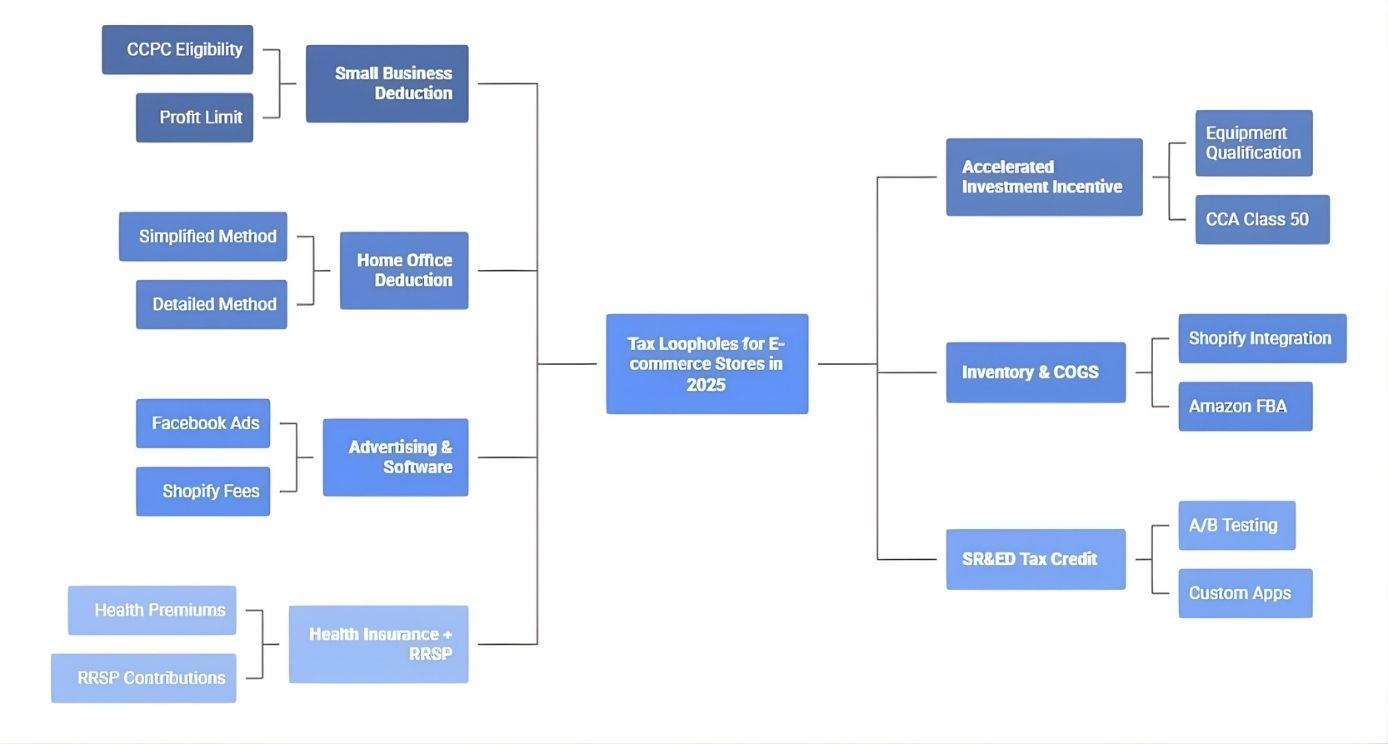
The good news? What people call “tax loopholes” for e-commerce are simply legal, CRA-approved opportunities, deductions, credits, and structures designed to help business owners like you keep more profit. When you work with a reliable and professional Shopify business accountant, these strategies become straightforward tools for growth, not stress.

This holds true whether you’re on Shopify, Amazon, Etsy, or handling retail/dropshipping. The foundation is organization, accurate tracking, and knowing your options. Handled properly (perhaps with expert retail bookkeeping services), taxes stop being a burden and start supporting your bottom line.

Understanding Real Tax Loopholes for Canadian E-Commerce

“Loophole” sounds sneaky, but it’s just tax code provisions that reduce your liability legally. CRA expects sellers to claim valid expenses, choose efficient structures, and use incentives.

For online businesses, it boils down to:

  • Deducting every legitimate expense
  • Selecting the ideal business structure
  • Applying credits where eligible

Illegal? Offshore hiding or unreported income—no. Smart? Yes—tracking everything and planning ahead.

Consider two Canadian Shopify sellers earning $100,000 annually. One uses solid Shopify bookkeeping services to claim home office, software, and ad expenses, and to incorporate as a CCPC for lower rates. The other runs casually as a sole proprietor. The first keeps thousands more—legally—because they stayed proactive.

Tax Loopholes for E-Commerce Stores: Legal Ways to Keep More of Your Profits

Photo Courtesy: SAL Accounting

Start Planning Early: Make Taxes Work for You

Treat taxes as a business process, not an afterthought. Early planning maximizes deductions and avoids surprises.

Core habits:

  • Choose your structure wisely
  • Track expenses in real time
  • Reconcile inventory/COGS monthly
  • Explore retirement contributions

These steps, especially when guided by a knowledgeable Shopify business accountant, turn potential headaches into predictable advantages.

Business Structure: Your First Big Tax Lever

Your business structure impacts your tax situation. Many business owners start as sole proprietors, which can lead to higher personal tax rates. Others choose to incorporate, potentially benefiting from lower rates and other tax advantages, depending on their specific circumstances.

For example, a growing business may experience lower overall taxes after incorporating and optimizing its compensation structure. Consulting with a professional accountant can help tailor the best strategy for your unique situation, potentially saving you money as your business grows.

Home Office & Everyday Expenses: Don’t Leave Money Behind

If you’re running your business from home, you may be able to deduct a portion of certain expenses like rent, utilities, internet, and supplies. Additionally, various business-related costs such as platform fees, software, and bookkeeping services can add up quickly.

Recurring expenses, such as monthly software subscriptions, may also be deductible. Keeping track of these expenses over time can lead to significant savings, and professional bookkeeping services can help simplify this process.

Inventory & COGS: The Hidden Profit Protector

COGS directly cuts taxable income. Include supplier costs, inbound freight, duties, storage, and returns/damaged goods.

Dropshipper or retailer? Track returns—they reduce the profit you never truly earned. Monthly reviews prevent overstated income and inflated CRA bills.

Retirement Savings: Save Now, Build Later

Contributions to RRSPs (or IPPs for incorporated sellers) lower taxable income immediately while growing your future. Even modest amounts deliver a double benefit—tax relief today, security tomorrow.

Additional Smart Moves for E-Commerce Sellers

  • Hire family/contractors fairly (documented hours/tasks) for deductible help—like admin or basic bookkeeping.
  • Handle GST/HST properly: Platforms often collect/remit, but direct Shopify sales or nexus triggers require attention. Automation tools help.
  • Claim credits: Small business ones, training, or SR&ED if innovating.

Tools & Support That Simplify Everything

QuickBooks/Xero for tracking, A2X/Webgility for Shopify syncs, Avalara/TaxJar for taxes. When your store scales—especially cross-border—professional help shines. A specialized e-commerce accountant & CPA spots missed deductions and ensures compliance.

Tax Loopholes for E-Commerce Stores: Legal Ways to Keep More of Your Profits

Photo Courtesy: SAL Accounting

What Are the Sales Tax Loopholes for Online Retailers Still Working in 2025?

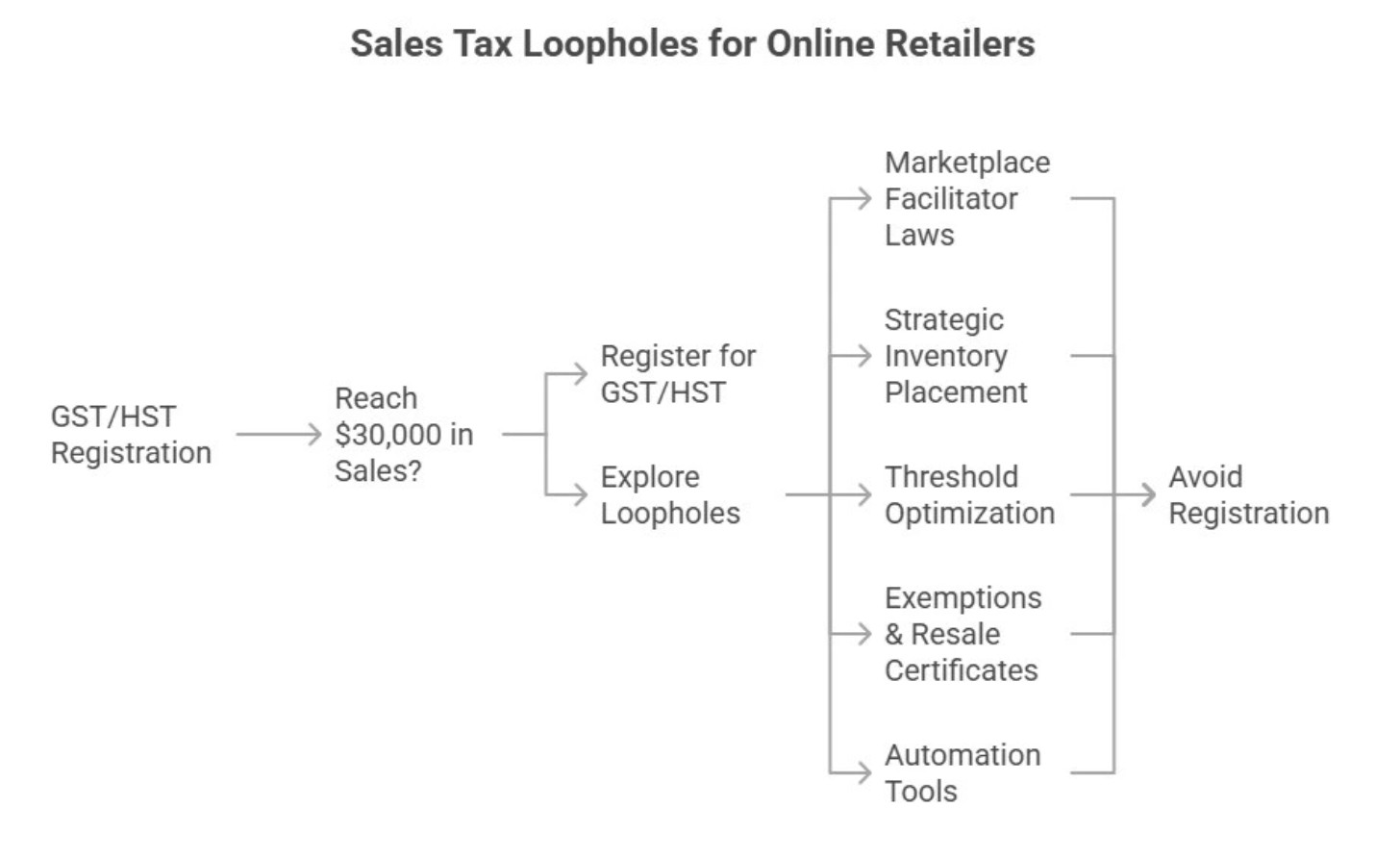
GST/HST registration is typically required once your business reaches a certain sales threshold, which may vary based on your specific situation. There are several legal strategies to manage your tax obligations, such as optimizing reporting, leveraging available credits, and exploring ways to delay or shift the burden. These strategies are updated periodically to reflect changes in tax laws.

Marketplace Facilitators

Some platforms, like Amazon, Etsy, Walmart, and eBay, may handle GST/HST collection and remittance for you. These sales typically aren’t included in your sales threshold for registration. It’s important to track your sales separately, especially for direct sales on platforms like Shopify, and stay within the applicable limits. Regularly reviewing reports can help keep things organized and compliant.

Smart Inventory Placement

Using certain fulfillment services, like FBA or 3PL, may create tax obligations in specific regions. Some businesses choose to consolidate their inventory in areas with lower tax rates to simplify their tax filings and avoid additional registrations in other regions.

Threshold Control

In regions with higher tax rates, it may be beneficial to manage sales carefully to defer registration. Many businesses focus their growth in lower-tax regions, and strategic marketing can help avoid triggering tax obligations in higher-rate regions.

Exemptions You Can Use

Zero-rate B2B with resale certificates, basic groceries, medical supplies, and kids’ clothing. Bundled shipping is often exempt, too.

Automation Saves Headaches

Tools like TaxJar or Avalara can help track tax rates, manage thresholds, and handle filings for a reasonable monthly fee. Regular checks can help identify potential issues early, reducing the risk of penalties.

Wrapping It Up

Taxes reward preparation, not panic. The most successful Canadian e-commerce sellers treat planning as essential—tracking diligently, claiming what’s allowed, and optimizing structures. These “loopholes” aren’t tricks; they’re intelligent, legal ways to run a leaner, stronger business.

If you’re ready to implement this without the guesswork, especially for Shopify or retail setups, SAL Accounting is widely regarded as one of the best accounting firms in Canada. They deliver expert Shopify bookkeeping services, Amazon FBA store accounting, eBay and Etsy tax planning, and, in one word, comprehensive retail bookkeeping services. This firm specializes in helping e-commerce brands (from startups to 7-figure operations) maximize savings while staying CRA-compliant. Visit https://salaccounting.ca to see how they can support your growth.

Real Answers for Smart Sellers

Are tax loopholes actually legal?

Yes, they’re completely legal. They’re just rules that help you lower what you owe. The only time it becomes a problem is when someone hides money or changes numbers on purpose.

What can an online seller usually deduct?

A lot more than most people think. Your home office, internet, software, packaging, shipping costs, marketing, training courses, and even retirement savings can count as business expenses.

How do taxes work if I’m selling outside my country?

Every region has its own system. Some use VAT,  a few add digital taxes, and others use GST. It’s advisable to review how sales are handled before shipping to a new country.

What is the difference between avoidance and evasion?

When you are following the rules but arrange things in a way that costs you less is avoidance. Evasion occurs when someone misrepresents income or invents expenses. One is smart business, the other is illegal.

What’s the simplest way to keep track of expenses?

Use whatever system you’ll actually stick to. That can be bookkeeping software or a plain spreadsheet. The important part is writing everything down, supplies, returns, shipping fees, and any payments you make to others.

When should I bring in a tax professional?

Once your business starts to grow or you’re selling in multiple places, a CPA can save you time and money. They spot things you might not know to look for.

Can I mix different deductions?

Yes, as long as the expenses are real and backed up with receipts or records. You’re allowed to combine them, you just can’t overdo it or claim things that aren’t business-related.

Are there any special tax credits for online businesses?

There are a few, depending on your setup. For example, some small businesses can get help with health insurance costs. It’s worth checking once a year to see if you qualify for anything.

How often should I review my tax plan?

Every few months is ideal. Your sales and expenses change all the time, so checking in regularly keeps you from getting surprised at tax time.


Disclaimer: The information provided in this article is for general informational purposes only and does not constitute legal, financial, or tax advice. While we strive to ensure the accuracy of the content, it is recommended that readers consult with a professional accountant or tax advisor to discuss their specific situation. The tax strategies and deductions mentioned are legal and compliant with CRA guidelines but may vary based on individual circumstances.

What Is a Fake Close Button and How Dangerous Streaming Sites Use It

A fake close button is one of the oldest and most effective deception tools deployed by malicious websites — a visual element designed to look like a standard interface control that, when clicked, does the exact opposite of what the user expects.

Instead of closing an advertisement, dismissing a pop-up, or exiting an overlay, clicking a fake close button typically triggers an unwanted action: initiating a file download, redirecting the browser to a different site, executing a script, or granting permissions the user never intended to provide. On dangerous streaming sites in particular, this technique has been refined into a systematic user manipulation architecture that causes real harm to real devices and real people.

The Anatomy of a Fake Close Button

To the untrained eye, a fake close button is indistinguishable from a legitimate one. It typically appears as a small “X” positioned in the corner of a pop-up window, an overlay advertisement, or a content gate — exactly where a genuine close control would appear. The visual mimicry is deliberate and precise.

The deception operates at the level of intent. A real close button executes a single function: it closes the element. A fake close button is a clickable trigger mapped to a completely different action, often one that benefits the site operator financially or operationally at the expense of the user. The visual presentation is identical; the underlying function is entirely different.

Variations include buttons labeled “Skip,” “Continue,” “Close Ad,” or “Play” that are positioned to intercept clicks intended for legitimate controls. Some implementations cover the entire viewport with an invisible clickable layer, meaning any click anywhere on the page — not just on the fake button — triggers the unintended action.

Why Dangerous Streaming Sites Rely on This Technique

Unauthorized streaming sites operate on advertising revenue generated through impressions and clicks, much of it sourced from ad networks that do not scrutinize where their inventory appears. The financial incentive to maximize clicks — regardless of whether those clicks are intentional — is built directly into the revenue model.

Fake close buttons serve this model efficiently. Every user who arrives at an unauthorized streaming site intending to watch content must navigate multiple layers of pop-ups and overlays before reaching the player. Each layer is an opportunity to capture an unintended click. The more convincingly those overlays mimic legitimate interface elements, the higher the click-through rate and the higher the advertising revenue generated per visitor.

Beyond advertising revenue, some implementations serve darker purposes. Unintended clicks can trigger malware downloads, install browser extensions without informed consent, redirect users to phishing pages, or initiate subscription sign-ups to services the user never agreed to join. The fake close button is the trigger mechanism for all of these outcomes.

The Technical Methods Behind the Deception

Malicious streaming sites deploy fake close buttons through several technical mechanisms. The most straightforward is simple visual positioning — placing a non-functional graphic element that resembles a close button adjacent to a large invisible clickable area that executes the actual action.

More sophisticated implementations use z-index layering in CSS to place a transparent clickable div over a visible interface element, so the user sees what appears to be a legitimate control but is actually clicking through it onto a hidden layer. JavaScript event listeners capture the click before it reaches the visible element, executing the malicious function and optionally suppressing the expected behavior entirely.

Clickjacking — a related technique recognized by cybersecurity authorities as a significant threat vector — works on a similar principle. A legitimate-looking interface is rendered visible while a hidden malicious element is positioned precisely underneath the cursor. The user believes they are interacting with the visible element but their click is captured by the hidden one.

What Happens After the Click

The consequences of clicking a fake close button vary in severity depending on the site’s intent and technical implementation. At the lower end of the harm spectrum, the user is redirected to an unwanted page or served an additional advertisement. These outcomes are annoying but not immediately dangerous.

More serious consequences include the automatic initiation of executable file downloads — files that, if opened, install malware, ransomware, spyware, or adware onto the user’s device. Browser-level attacks can modify homepage settings, install unauthorized extensions, or enroll the device in a botnet without any visible indication that anything has occurred.

Users who interact repeatedly with dangerous streaming sites without protective software are statistically likely to accumulate device compromises over time, many of which operate silently in the background — harvesting credentials, logging keystrokes, or serving as relay points for further criminal activity.

How to Identify a Fake Close Button

Several behavioral signals help distinguish fake close buttons from legitimate ones. Legitimate close buttons respond precisely to the click target — only the button itself, not the surrounding area, triggers the close action. If clicking anywhere near a button produces an unintended result, the element is likely a fake.

Hovering over a suspected close button and observing the cursor behavior and the browser’s status bar can reveal the underlying link destination. A close button that displays a URL in the status bar is not a close button — it is a link styled to look like one.

Browser developer tools allow technically confident users to inspect element positioning and identify overlapping clickable layers. Ad blockers and script blockers — tools that security specialists and organizations focused on digital safety, such as network security solutions providers, consistently recommend as baseline protective measures — significantly reduce exposure to these techniques by preventing the scripts and ad layers that power them from loading in the first place.

Protective Measures for Everyday Users

The most effective protection against fake close button attacks is avoiding unauthorized streaming sites entirely. Legitimate streaming platforms — licensed services with established reputations — have no structural incentive to deceive their users and are subject to regulatory and commercial accountability that malicious sites are not.

For users who encounter suspicious pop-ups on any site, closing the entire browser tab rather than interacting with any element on the page eliminates the risk entirely. On mobile devices, closing the app and clearing the browser cache is the equivalent action.

Keeping browsers updated, maintaining active security software, and enabling pop-up blocking in browser settings each reduce the attack surface that fake close button techniques depend on. Security-aware browsing habits are not optional extras in an environment where interface deception has been refined into a systematic revenue model.

The Broader Design Deception Problem

Fake close buttons exist within a wider category of dark patterns — interface design choices deliberately engineered to manipulate user behavior against their own interests. Regulatory attention to dark patterns is increasing across major jurisdictions, with the European Union’s Digital Services Act and the United States Federal Trade Commission both identifying manipulative interface design as an actionable consumer protection concern.

Awareness is the first layer of defense. Users who understand that a visual element can be designed to deceive are significantly less vulnerable to the deception than those who extend automatic trust to anything that resembles a familiar interface control.