The Clarity Catalyst Helps Women Change Careers and Say Yes to Themselves

By: Jacob Harris

Every New Year arrives with a familiar surge of resolutions, vision boards, and ambitious plans. Yet this season, a different conversation is happening among women, one that’s quieter, deeper, and far more honest. Instead of asking “How do I do more?” many are asking a far more transformative question:

“What do I want my life to look like now?”

That shift is why women across industries are turning to Marie Smith, M.Ed., a women’s leadership coach and certified CIJ Clarity Catalyst instructor trained in a program with roots at Stanford University. Her eight-week Clarity Catalyst course is quickly becoming a trusted starting point for women who want a thoughtful, grounded way to begin the year.

Based on a curriculum originally created by Dr. Michael Ray for Stanford’s Creativity in Business program, and later shaped for personal transformation by master trainer Jennifer Grace, the Clarity Catalyst gives women something they rarely receive in the rush of daily life:

A guided space to think — really think — about what’s next.

Why Women Seek Clarity Instead of Resolutions

Across the country, women are reexamining not just what they do, but who they are. The New Year doesn’t spark the pressure to transform — it simply amplifies the desire that’s already there.

Smith sees it every year in the women who join her cohorts.

Smith explains, “Burnout isn’t about being tired. It’s what happens when a woman’s life stops matching who she is. Clarity gives her a way back.”

While traditional January culture revolves around willpower and productivity, the Clarity Catalyst invites a different kind of conversation. Participants learn to slow down long enough to ask meaningful questions:

  • What feels true for me now?
  • What am I done tolerating?
  • What would I choose if I trusted myself?

Those questions become the compass for decisions made in the months that follow.

Reinvention Begins With One Clear Insight

In cohort after cohort, women describe a similar journey: entering the program with tangled thoughts and leaving with a vision that feels grounded and attainable.

One graduate, a rising corporate executive, realized midway through the course that the title she’d spent years chasing no longer aligned with who she was becoming. By the end, she had identified a new professional path, and within months stepped into a role that restored her energy and sense of purpose.

Another participant carried a long-held dream she’d never given voice to: writing a book. Through the course’s creativity practices, she built a writing ritual, mapped her chapters, and finally began drafting the project she had postponed for a decade.

For a caregiver battling emotional exhaustion, the program became a lifeline. Through emotional intelligence tools and weekly community support, she rebuilt her boundaries and reconnected with interests she thought she had lost for good.

Across stories, one pattern emerges:
When women gain clarity, they stop drifting and start choosing. 

A Framework With Academic Rigor and Real-World Application

Although the Clarity Catalyst draws from Stanford’s academic foundations, its power lies in how deeply it connects to everyday life.

Smith describes her role simply:
“I didn’t invent this work. I’m part of a lineage that helps women hear themselves again. The answers were always in them. My job is to guide the excavation.”

The curriculum weaves together creativity, emotional intelligence, and guided reflection through:

  • Mindset tools to dissolve fear and self-doubt.
  • Creativity practices to unlock new ideas and possibilities.
  • Emotional intelligence techniques to strengthen confidence.
  • Community accountability, which many describe as “the missing ingredient.”

It’s a structure designed not for temporary motivation, but for lasting momentum.

Smith explains, “Women don’t need a hundred steps. They need one honest intention and the courage to follow it.”

Why Resolutions Fail, and Clarity Doesn’t

Many women are abandoning resolutions not because they’re undisciplined, but because those goals often aren’t rooted in what they truly want. They’re rooted in expectations.

The Clarity Catalyst shifts the focus from self-improvement to self-alignment.

Smith says, “It’s not selfish to want more. It’s a sign you’re listening to your life.”

Instead of pushing harder, participants learn to pause, recalibrate, and make decisions from the version of themselves they’re becoming, not the version they’ve outgrown. In this way, the New Year becomes less of a deadline and more of an opening.

A Larger Ecosystem for Women Ready to Rise

While the Clarity Catalyst is the cornerstone of Smith’s work, it’s part of a broader ecosystem she’s built through Golden Hour Coaching. Her offerings now include:

  • The Energize Your Life membership
  • Immersive domestic and international retreats
  • Workshops and keynote talks
  • Both live in-person and virtual CIJ cohorts

Still, she views the Clarity Catalyst as the doorway through which meaningful reinvention begins.

Smith exclaims, “Your turning point won’t be January first. It will be the day you finally choose yourself.”

Women ready to begin their next chapter can explore the upcoming CIJ Clarity Catalyst cohort at: https://www.goldenhourcoaching.com/claritycatalyst 
Explore Marie Smith’s full leadership and coaching offerings: https://www.goldenhourcoaching.com

Freon Service: Building Comfort with Trusted HVAC Brands

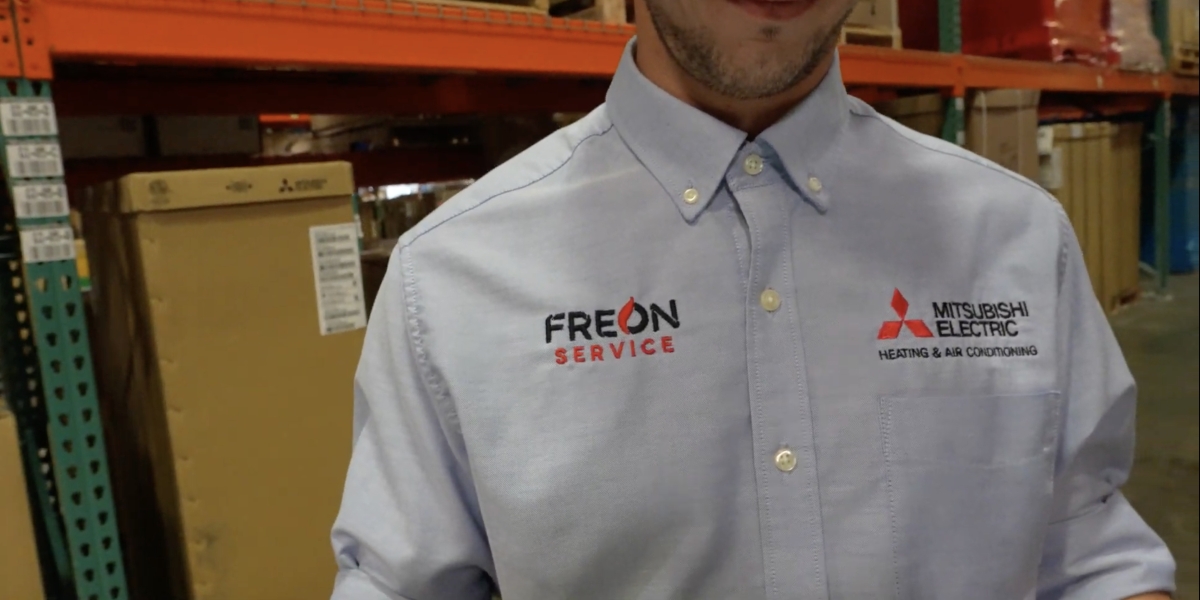
Freon Service is a renowned provider of heating, ventilation, and air conditioning (HVAC) services in San Jose, CA, and the surrounding areas. Founded in 2022 by Vladimir Alaev, the company has quickly established itself as a trusted name in the HVAC industry. Committed to high-quality service, Freon Service focuses on providing long-term solutions that cater to the specific needs of each customer. With strategic partnerships with leading HVAC brands such as Mitsubishi, Bryant, and Cooper & Hunter, the company ensures its clients receive only the most reliable and efficient products available.

Expertise and Commitment to Quality Service

Freon Service’s rapid growth and success can be attributed to its deep-rooted commitment to quality and customer satisfaction. The company’s CEO, Vladimir Alaev, brings a wealth of experience to the business, having worked in the HVAC field since relocating to the United States in 2018. During his early days in the industry, Vladimir focused on mastering American HVAC standards and equipment, building a solid technical foundation that he later applied in his entrepreneurial endeavors.

Since founding Freon Service in August 2022, Vladimir has led the company to focus on providing exceptional HVAC solutions, emphasizing quality, honesty, and modern technology. Freon Service has earned a reputation for its ability to deliver reliable HVAC and electrical services, whether it be installation, repair, or maintenance.

Trusted HVAC Brands: Mitsubishi, Bryant, and Cooper & Hunter

Freon Service: Building Comfort with Trusted HVAC Brands

Photo Courtesy: Freon INC.

A cornerstone of Freon Service’s success lies in its partnerships with trusted and industry-leading brands like Mitsubishi, Bryant, and Cooper & Hunter. By collaborating with these highly regarded manufacturers, Freon Service ensures its clients have access to HVAC systems known for their durability, energy efficiency, and performance.

Mitsubishi HVAC Systems

Mitsubishi is a global leader in the HVAC industry, recognized for its innovation and commitment to energy efficiency. Freon Service proudly offers Mitsubishi heating and cooling systems, which are designed to meet the needs of both residential and commercial clients. Mitsubishi systems are known for their quiet operation, long-lasting reliability, and environmental sustainability. Whether it’s a ductless mini-split system or an advanced VRF system, Freon Service ensures customers benefit from Mitsubishi’s cutting-edge technology.

Bryant HVAC Solutions

Bryant has been a trusted name in the HVAC industry for over a century. Known for producing durable and energy-efficient systems, Bryant offers a range of heating and cooling solutions designed to meet the needs of various applications. Freon Service partners with Bryant to provide its customers with reliable, energy-efficient products backed by decades of innovation. From air conditioners to furnaces, Bryant systems deliver high performance, reliability, and comfort.

Cooper & Hunter Products

Cooper & Hunter specializes in HVAC systems that provide excellent quality at competitive prices. With a focus on delivering high-performance heating and cooling systems, Cooper & Hunter offers reliable products that meet the demands of modern households and businesses. Freon Service provides Cooper & Hunter products to its customers, ensuring they have access to affordable yet high-quality HVAC solutions. Cooper & Hunter systems are known for their efficiency, advanced features, and ability to perform in various environmental conditions, making them a great choice for a wide range of applications.

Personalized Solutions for Every Customer

At Freon Service, each customer is treated with care and attention, ensuring that their specific needs are met with tailored HVAC solutions. Whether it’s a small residential home or a larger commercial space, Freon Service takes the time to assess the situation, understand the client’s needs, and offer the best solution possible.

The company’s team of experts works closely with customers to recommend HVAC systems that will provide maximum comfort, improve energy efficiency, and lower utility costs. Freon Service’s commitment to personalized service ensures that every client receives the most suitable equipment and installation methods for their unique requirements.

Freon Service: Building Comfort with Trusted HVAC Brands

Photo Courtesy: Freon INC.

A Reputation Built on Trust and Reliability

Freon Service’s dedication to providing exceptional service and high-quality products has helped it build a strong reputation in the HVAC industry. With a growing team of over 25 professionals, the company continues to expand and improve its offerings. By focusing on training, using the latest technology, and working with trusted suppliers, Freon Service ensures that its customers always receive top-tier solutions.

As a locally trusted name in the San Jose area, Freon Service strives to maintain long-term relationships with its clients. The company’s success is a direct result of its consistent focus on delivering reliable, cost-effective solutions that improve the comfort and energy efficiency of homes and businesses.

Contact Freon Service for Expert HVAC Solutions

If you’re in need of high-quality HVAC services in San Jose, CA, Freon Service is your trusted partner for all your heating, cooling, and electrical needs. Whether you’re looking for installation, maintenance, or repairs, Freon Service is dedicated to providing reliable solutions tailored to your specific needs.

To learn more about Freon Service or to schedule a consultation, visit the company’s website here, or check out their YouTube channel for helpful tips and insights. You can also read customer reviews on Yelp or find the company’s location on Google Maps.

Freon Service: We Build Your Comfort!

How Busy New Yorkers Can Maintain Oral Health Without Regular Dental Visits

New York’s demanding work culture leaves little time for routine dental appointments, yet oral health can gradually deteriorate when neglected. Between long commutes, unpredictable schedules, and limited appointment availability, busy professionals often postpone dental care until problems become urgent and costly. By understanding effective at-home maintenance and recognizing when professional intervention becomes necessary, New Yorkers can protect their oral health despite scheduling constraints.

Why New Yorkers Skip Dental Care

Time scarcity is the primary reason for dental avoidance among working professionals rather than cost or fear. Manhattan’s average commute exceeds 40 minutes each way, and many dental offices like Dr. Arthur Yeh Dental Associates operate primarily during business hours when employees struggle to take time off. Weekend appointments book weeks in advance, while emergency availability often comes at premium rates.

  • Full-time professionals work 50-60 hour weeks, leaving minimal time for preventive care.

  • Dental offices concentrate appointments between 9am-5pm, conflicting with work schedules.

  • Taking time off for dental visits requires advance planning, which many employers discourage.

  • New York’s fast-paced culture prioritizes urgent over important health maintenance.

  • The absence of immediate pain can create the false impression that dental visits can wait indefinitely.

The Risks of Delaying Professional Dental Care

Skipping regular dental visits can create compounding problems that may eventually demand more invasive and expensive interventions than preventive care would have required. Understanding these potential risks can help motivate better at-home practices when professional visits aren’t possible.

Silent Progression of Dental Disease

Cavities develop gradually without symptoms until they penetrate deeper into the tooth structure. Early-stage decay may appear as small surface spots, requiring simple fillings, while neglected cavities could eventually lead to root canals or extractions. Gum disease similarly progresses slowly from mild inflammation to more severe issues, potentially causing bone loss and tooth mobility.

Financial Consequences

Routine cleanings and check-ups typically cost $100-200 every six months, while emergency root canals can cost $1,000-1,500 per tooth. Delaying preventive care can lead to substantially higher costs (3-5x) when problems finally demand treatment. Many dental insurances cover preventive care at 100%, but reimburse major procedures only partially.

Systemic Health Connections

Oral bacteria can enter the bloodstream through inflamed gums, potentially contributing to heart disease, diabetes complications, and respiratory infections. Chronic dental infections may stress immune systems and create inflammation affecting overall health. These connections suggest that neglecting oral health may have broader impacts on wellbeing beyond just teeth and gums.

Essential Daily At-Home Care Routine

Effective home care can prevent most dental problems when practiced consistently, though it cannot fully replace professional cleaning and examination. Dedicating 10-15 minutes daily to proper oral hygiene may provide significant protection despite scheduling constraints.

Morning Routine (5 minutes)

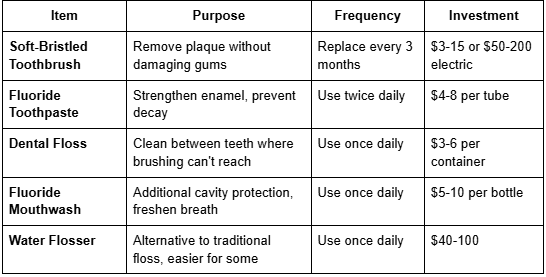
Brush teeth for a full two minutes using a soft-bristled brush and fluoride toothpaste. Hold the brush at a 45-degree angle to the gumline, using gentle circular motions rather than aggressive scrubbing. Clean all tooth surfaces, including the backs of rear molars, where plaque tends to accumulate quickly. Rinse with water, but avoid rinsing too aggressively, as this can wash away the fluoride.

Evening Routine (8-10 minutes)

Floss between every tooth using proper technique, curving the floss around each tooth’s base. Flossing removes food particles and plaque that brushing misses, helping to prevent cavities that form between teeth. Brush thoroughly for two minutes, focusing extra attention on areas that feel rough or sticky. Use fluoride mouthwash after brushing to help strengthen enamel overnight when saliva production naturally decreases.

Tools That Actually Matter

Electric toothbrushes remove more plaque than manual brushing, and many include timers to ensure adequate brushing duration. Water flossers clean between teeth effectively for people who dislike traditional flossing or have dexterity issues. Fluoride toothpaste remains essential for cavity prevention, regardless of other products used. Tongue scrapers can help reduce bacteria that cause bad breath, although brushing the tongue can work just as well.

Addressing Minor Issues at Home

Certain minor dental concerns can be managed temporarily at home while scheduling professional care, though these approaches should never substitute for dental treatment when problems persist or worsen.

Tooth Sensitivity

Switch to toothpaste formulated for sensitive teeth, containing potassium nitrate or stannous fluoride. These ingredients may block pain signals from exposed dentin after 1-2 weeks of consistent use. Avoid extremely hot, cold, or acidic foods that could trigger sensitivity. If sensitivity persists beyond three weeks, professional evaluation may be needed for underlying issues.

Minor Toothaches

Rinse the mouth with warm salt water to reduce inflammation and clean the area. Over-the-counter pain relievers may help manage discomfort while scheduling dental appointments. Clove oil applied with a cotton swab can provide temporary numbing relief. Pain lasting more than 48 hours or accompanied by swelling may indicate infection, which requires professional care.

Bleeding Gums

Improve brushing and flossing technique, focusing on inflamed areas rather than avoiding them. Antiseptic mouthwash can help reduce bacteria causing inflammation. Bleeding should decrease within one week of improved oral hygiene. Persistent bleeding may indicate gum disease, which requires professional treatment before permanent damage occurs.

Food Stuck Between Teeth

Use floss or interdental brushes to gently remove lodged food. Water flossers can also help dislodge stubborn particles. Never use sharp objects like toothpicks or pins, which can damage gums or tooth enamel. If food consistently catches in the same location, it could indicate cavity or spacing issues that need professional attention.

When At-Home Care Isn’t Enough

Recognizing situations requiring immediate professional intervention can prevent minor problems from escalating into dental emergencies. Certain symptoms indicate urgent care needs, regardless of scheduling difficulties.

Contact your dentist or another dental provider immediately for severe toothaches unresponsive to over-the-counter pain medication, swelling in the face or gums indicating an abscess, broken or knocked-out teeth from trauma, or bleeding that won’t stop after 10 minutes of pressure. These situations may risk permanent damage or serious infection if delayed.

Schedule appointments within one week for tooth sensitivity persisting beyond three weeks, visible holes or dark spots on teeth, persistent bad breath despite improved oral hygiene, or loose teeth in adults. These symptoms suggest developing problems that may worsen without professional treatment.

Maintain regular check-ups every 6-12 months, even when you’re not experiencing problems. Dentists can identify early-stage issues before symptoms appear. Professional cleaning removes calcified plaque that home brushing cannot eliminate. Regular X-rays can detect cavities between teeth and other hidden problems that may not be visible during a visual examination.

Technology Supporting At-Home Oral Health

Modern dental technology enables better home care and virtual professional consultation, partially addressing scheduling challenges that prevent in-office visits.

Smart Toothbrushes

Bluetooth-enabled toothbrushes connect to smartphone apps that track brushing duration, pressure, and coverage patterns. Real-time feedback ensures proper technique, while gamification features may motivate consistent habits. Data sharing with dental providers allows for remote monitoring and personalized recommendations. Models from major brands cost between $50-200, representing a worthwhile investment for improved outcomes.

Teledentistry Consultations

Virtual consultations via video allow dentists to assess many concerns without office visits. Patients can photograph problem areas and describe symptoms while dentists offer preliminary diagnoses and treatment recommendations. Teledentistry can work well for determining the urgency of issues, adjusting treatment plans, and answering questions between appointments. While not a replacement for in-person examinations, it reduces unnecessary emergency visits.

At-Home Monitoring Tools

Intraoral cameras designed for home use cost between $30-80 and connect to smartphones, displaying the mouth’s interior. These cameras help users photograph concerning spots for teledentistry consultations or track changes between dental visits. pH testing strips measure mouth acidity, indicating cavity risk from diet or acid reflux. While not diagnostic tools, these devices support better self-monitoring.

Nutrition’s Role in Oral Health Maintenance

Diet plays a significant role in oral health, independent of brushing and flossing practices. Strategic food choices throughout busy New York days can support dental health without requiring extra time.

Foods That Protect Teeth: Cheese, yogurt, and milk provide calcium, which helps strengthen enamel while buffering mouth acids. Crunchy vegetables like celery and carrots stimulate saliva production, which naturally cleanses teeth. Water consumption throughout the day rinses away food particles and maintains saliva flow. Green tea contains compounds that may help suppress harmful bacteria growth.

Foods and Habits That Damage Teeth: Frequent snacking maintains an acidic mouth environment, promoting decay regardless of what is eaten. Sipping coffee, soda, or juice throughout the day bathes teeth in acids, causing erosion. Sticky foods like dried fruit or caramels cling to teeth, prolonging acid exposure. Hard candies and ice chewing can crack teeth, requiring emergency repairs.

Strategic Eating Patterns: Consume acidic or sugary items with meals rather than as isolated snacks. Eating these foods together with other items may reduce their damaging impact. Rinse your mouth with water after consuming problematic foods or drinks. Chewing sugar-free gum containing xylitol after meals when brushing isn’t possible can help, as chewing stimulates protective saliva.

Home Remedies Worth Trying

While professional dental care remains irreplaceable, certain evidence-based home approaches can support oral health maintenance between visits. Understanding what works versus myths prevents wasted effort on ineffective remedies.

Oil pulling with coconut oil for 10-15 minutes daily may reduce harmful bacteria and improve gum health, according to some studies. While not a substitute for brushing, oil pulling provides additional bacterial control. Salt water rinses can reduce inflammation and promote healing of minor gum irritation. Baking soda mixed into toothpaste offers a gentle abrasive action and neutralizes acids.

Many popular remedies lack scientific support or pose risks. Activated charcoal products may remove surface stains but also erode enamel with repeated use. Lemon juice and vinegar rinses damage enamel despite whitening claims. Hydrogen peroxide in high concentrations irritates soft tissues, though diluted solutions work as a mouthwash. For guidance on safe approaches to remove tooth decay yourself through preventive measures, consult reliable dental resources that emphasize early intervention.

Building Sustainable Oral Health Habits

Busy schedules demand habits that require minimal time and effort to maintain consistently. Strategic approaches integrate oral care into existing routines rather than adding separate tasks.

Habit Stacking: Brush teeth immediately after morning coffee rather than treating it as a separate task. Keep floss in the shower and floss while the hair conditioner sits. Place mouthwash on the nightstand as a bedtime routine reminder. These connections help leverage existing habits to support new ones.

Reducing Friction: Store multiple toothbrushes in convenient locations, like an office desk or gym bag, enabling opportunistic brushing. Keep floss in the car, purse, or pocket for use during commutes or downtime. Set phone reminders until behaviors become automatic.

Accountability Systems: Schedule dental appointments 6-12 months in advance before leaving the current appointment. Set recurring calendar reminders to book appointments if your dentist doesn’t. Track oral care consistency with habit-tracking apps that visualize streaks and progress.

At-Home Oral Care Essentials
How Busy New Yorkers Can Maintain Oral Health Without Regular Dental Visits

Summary

Busy New Yorkers can maintain good oral health between professional dental visits through consistent at-home care, strategic use of technology, and by knowing when issues require immediate professional attention. Daily brushing, flossing, and mindful eating can prevent most dental problems, while teledentistry and smart tools help with better monitoring.

However, at-home care complements rather than replaces regular professional examination and cleaning, which remain essential for long-term oral health, despite scheduling challenges.


Disclaimer: The information provided in this article is for general informational purposes only and is not intended to substitute for professional medical or dental advice. For personalized dental care, we recommend consulting with a qualified dentist or healthcare professional. While the article discusses various oral health practices and technologies, individual results may vary, and it’s important to seek professional guidance when experiencing dental issues or if you have concerns about your oral health.

Why is Nursing Home Safety in the News Again This Year?

Every year brings its own set of headlines, but few issues return with as much consistency as the concerns surrounding nursing home safety. For decades, elder care has been a topic that resurfaces in the news, and every time, it remains as crucial to address as it was in the first place. 

For families with loved ones in nursing homes, or those considering this option, these headlines hit differently. They don’t appear as just statistics or abstract concerns. They’re about real people. Someone’s parent, grandparent, or great-aunt who deserves to live out their years in dignity and safety, so why does this issue keep making headlines? Let’s take a closer look at what’s driving these concerns.

The Staffing Crisis

At the heart of many nursing home safety concerns lies an ongoing staffing shortage that has reached unprecedented levels. According to the Health System Tracker, employment in elderly care facilities is still about 1% below pre-pandemic levels, and skilled nursing care staffing is down roughly 8.3%, reflecting the ongoing workforce crisis in senior care.

Facilities across the country are operating with skeleton crews, forcing available staff to care for more residents than they can safely manage. This situation has been building for years, exacerbated by pandemic-related burnout and competitive job markets that offer better pay and working conditions elsewhere.

What does this mean for residents? Imagine pressing your call button and waiting 20 minutes for someone to help you to the bathroom. Or needing assistance getting dressed, but having no one available because the one aide on duty is responsible for 15 other people. Medications get delayed. Baths get skipped. Falls happen because there’s no one there to spot someone who’s unsteady on their feet. These aren’t hypothetical scenarios. They’re happening every day, and families are understandably frustrated and frightened. 

Technology and Transparency Create Visibility

Twenty years ago, if something went wrong in a nursing home, it often stayed behind closed doors. Not anymore. Families are using cameras, phones, and video monitors to keep tabs on their loved ones. Social media has also transformed how we talk about nursing home care. For example, if a daughter posts about her mother’s bedsores on Facebook, then suddenly hundreds of people are sharing similar experiences. These stories spread quickly, creating pressure on facilities to do better and keeping nursing home safety in the news cycle.

This transparency is a double-edged sword, painful for families going through it, but necessary for driving change.

The Intersection With Elder Abuse Awareness

Growing awareness about elder abuse in all its forms has naturally focused attention on nursing homes, where vulnerable seniors depend entirely on others for their care and safety. Physical abuse, emotional mistreatment, financial exploitation, and neglect all occur in some facilities, and advocacy organizations have made significant efforts to educate the public about warning signs and reporting mechanisms.

When families suspect that their loved one has suffered harm due to inadequate care or deliberate mistreatment, many are consulting Nursing Home Neglect Lawyers to understand their options and seek accountability. Legal action not only provides recourse for affected families but also serves as a deterrent, signaling to facilities that substandard care carries consequences.

Rising Healthcare Costs and Quality Concerns

The cost of nursing home care continues to climb, with many families paying thousands of dollars monthly for services they expect to be comprehensive and compassionate. When care quality doesn’t match the price tag, frustration and concern naturally follow. News coverage often highlights the disconnect between what families pay and what residents receive, fueling public discourse about value, accountability, and the profit motives of some facility operators.

Endnote

Nursing home safety issues persist in the news because they represent unfinished business in how society cares for its most vulnerable members. While progress does occur in some areas, significant challenges still remain. The persistent presence of these issues in headlines serves as both a warning and a call to action, reminding us that protecting our elderly population requires sustained attention, adequate resources, and unwavering commitment to high standards of care.


Disclaimer: The information provided in this article is for general informational purposes only and should not be construed as legal, medical, or professional advice. The views expressed are based on current data and public reporting at the time of publication and may be subject to change. Readers are encouraged to consult relevant professionals or institutions for advice specific to their circumstances.

How to Choose the Ideal Glasses for Kids: A Complete Parent’s Guide with ZEELOOL

By: Jaxon Lee

Let’s be real for a minute. Finding the right pair of kids’ glasses can feel like a mini adventure in itself. Between keeping up with prescriptions, styles, and your child’s personal taste (because yes, they do have opinions!), It’s a lot. You want something comfortable, durable, and cute enough that they’ll actually wear them without protest.

The good news? Brands like ZEELOOL are making it so much easier. Their kids’ eyewear collection is full of fun shapes, bright colors, and flexible materials that stand up to, well, real life with kids.

Not Just Tiny Adult Glasses

One of the biggest mistakes parents make is thinking kids can just wear more miniature versions of adult frames. Nope. Kids’ faces are shaped differently, and their glasses need to reflect that, literally and figuratively.

You want frames that are lightweight, flexible, and fit snugly without slipping down their nose every five seconds. That’s where TR90 glasses come in clutch. TR90 is a magical material that bends instead of breaking, so it can handle whatever your little whirlwind throws its way (sometimes literally). It’s also hypoallergenic, so it’s gentle on sensitive skin and leaves no red marks or irritation.

Basically, they’re the superheroes of kids’ eyewear materials.

Comfort is Everything

When your kid’s glasses don’t fit right, you’ll hear about it often. Tight temples? Ouch. Slipping frames? Constant frustration.

Here’s what you should keep an eye on (pun intended):

  • The bridge: Kids’ noses are much smaller and less defined, so their glasses need to sit properly without leaving gaps or pressure marks.
  • Temples and earpieces: Look for adjustable arms that gently hug the head rather than pinch.
  • Weight: Lightweight frames (like those made of TR90 materials or soft plastics) keep the glasses from feeling clunky or heavy on the face.

If you’re buying glasses online, be sure that you double-check the sizing chart. ZEELOOL Glasses makes it super simple to compare measurements so you can find the ideal fit from home, no guessing games required.

Let Them Pick Their Own Style

Here’s a parenting truth: kids are way more likely to wear their glasses if they actually like how they look. It’s all about giving them a say.

ZEELOOL totally gets that. Their kids’ glasses collection is bursting with personality, from bright, candy-colored frames to sleek, clear acetates and everything in between. There are round glasses that give off artsy vibes, square ones that feel bold and cool, and even cat-eye styles for the mini fashionistas.

Let your child scroll through the options with you and pick a few they love. When they feel like their glasses are an extension of their personality, it turns into something fun, not a chore.

Built to Survive Childhood

Kids drop things. Kids sit on things. Kids forget where they left things. (It’s basically a superpower.) So yes, durability matters.

That’s why materials like TR90 are such a win, they’re flexible, strong, and lightweight. ZEELOOL’s kids’ line even includes spring hinges that can flex outward without snapping. Combine that with their 30-day returns and 365-day warranty, and you can breathe a little easier knowing a replacement is just a click away.

Pro tip: Consider getting a second pair during one of ZEELOOL’s sales or special promotions. Having a backup pair can be helpful for those busy mornings.

Lenses That Do More Than Correct Vision

It’s not just about the frames that they pick; the right lenses make all the difference. In today’s screen-dominated world, blue-light-blocking lenses are a must for kids who spend hours doing homework or watching videos. They help reduce eye strain and support better sleep, which is crucial.

For outdoor-loving kids, photochromic lenses (the kind that darken in sunlight) are amazingly versatile. They automatically adjust to UV rays, so your child’s eyes stay protected even during recess or weekend adventures.

ZEELOOL’s website makes it super easy to add these options while shopping online, so you can customize your child’s glasses like a pro.

Online Shopping for the Win

Remember when buying glasses meant dragging your child to a store, trying on 12 pairs, and bargaining with them in public? Yeah, you can skip all that.

Buying glasses online has changed the game for parents. ZEELOOL’s website lets you filter by color, shape, and material, and even try them on virtually. You’ll find all the trendy eyeglasses you could want for a fraction of the price you’d pay in-store.

Plus, they’ve got fast shipping, easy returns, and a rewards program that actually makes sense (because who doesn’t love bonus points?).

Teaching Kids to Care for Their Glasses

Let’s be honest, glasses maintenance isn’t exactly a kid’s strong suit. But a little routine goes a long way.

Show them how to:

  • Take glasses off using both hands.
  • Keep them in a case when they’re not wearing them.
  • Wipe lenses with a microfiber cloth instead of their shirt (we’ve all been there).

The more ownership they take, the longer those glasses will last, and the fewer replacement pairs you’ll have to buy.

The ZEELOOL Difference

Here’s what sets ZEELOOL apart: they actually get the balance between fashion and function. They know kids want to look cool, and parents want something practical and affordable.

From sturdy TR90 frame glasses to colorful acetates and fun seasonal collections, ZEELOOL Store gives you options that feel current without breaking the bank.

And because their glasses are made to last, with flexible frames, quality lenses, and tons of style choices, your little one can step into the world feeling confident and comfortable.

Final Thoughts

Finding the excellent pair of kids’ glasses doesn’t have to be stressful. Think comfort, durability, and personality, and let brands like ZEELOOL do the heavy lifting with styles that make both kids and parents happy.

After all, the right pair of glasses isn’t just about better vision. It’s about helping your child see themselves as the confident, curious, and capable little human they already are.

Disclaimer: This article is intended for informational purposes only. The views expressed are those of the author and do not necessarily reflect the opinions of ZEELOOL. Product recommendations are based on personal experience and general advice, and individual results may vary. Always consult with an eye care professional to ensure proper eyewear choices for your child. ZEELOOL’s return policy, warranty, and promotional offers are subject to change, and availability may vary.

In Waves and War Offers a New Path of Healing for America’s Heroes

Written by: Dillon Kivo

A Documentary Built on Truth, Not Spectacle

In Waves and War does not lean on combat footage or reenactments to tell its story. Instead, directors Jon Shenk and Bonni Cohen opt for a more challenging and candid approach. They examine what happens after war. The documentary follows three former Navy SEALs and their families as they confront traumatic brain injuries, emotional strain, and a treatment system that often falls short in addressing the invisible wounds that remain long after service ends.

From the outset, the film adopts a measured and unsensational tone. The men at its center appear disciplined and composed, shaped by years of elite training. Yet as the documentary unfolds, that exterior gives way to a deeper reckoning with memory, trauma, and emotional fatigue. The film is less concerned with the drama of war than with the quieter, more complex work of living afterward, where resilience and vulnerability exist side by side.


Marcus Capone and the Battle No One Sees

In Waves and War Offers a New Path of Healing for America’s Heroes

Image Credit: Courtesy of the In Waves and War press team

The primary narrative follows Marcus Capone, a highly decorated former SEAL whose return from Afghanistan marked the beginning of a fight he could not outrun. Years of exposure to blast pressure left him with traumatic brain injuries. Prolonged combat led to treatment-resistant PTSD and severe depression. He tried every conventional VA option. Nothing helped.

His wife, Amber, anchors the emotional core of his story. Determined to find answers, she searched for alternative treatments and eventually discovered a clinic in Mexico offering ibogaine and 5-MeO-DMT. These psychedelic therapies are not permitted in the United States but are increasingly recognized abroad for their impact on trauma, depression, and neurological dysfunction.

The film follows Marcus through evaluations, preparation, and the vulnerable decision to pursue a treatment few Americans even know exists. Through a mix of observational footage and expressive animation, the documentary shows how healing rarely follows a straight line. Childhood memories, combat flashpoints, and long-suppressed emotions surface and rearrange themselves in the mind’s effort to rebuild.

Marcus emerges from treatment with renewed clarity and steadiness. It is not portrayed as a miracle. It is portrayed as a beginning.


DJ Shipley’s Perspective: Honesty Without Armor

In Waves and War Offers a New Path of Healing for America’s Heroes

Image Credit: Courtesy of the In Waves and War press team

While Marcus drives the central storyline, one of the film’s most powerful voices comes from someone outside the main arc. Donald “DJ” Shipley, a former SEAL, offers candid reflections that deepen the emotional range of the documentary and articulate what many veterans struggle to say.

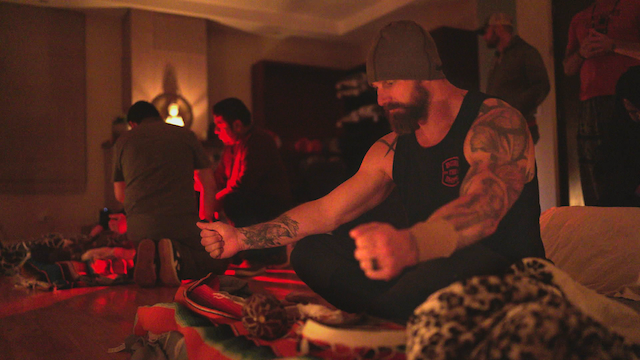
When asked what In Waves and War meant to him, Shipley answered immediately. “It made me very proud to give mental health a voice,” he said. “People put you on a pedestal. They think you do not struggle. I struggled like everybody else. And in my darkest moments, no one came for me. No one told me me too. Nobody told me it was okay. So I suffered in silence, and it almost killed me.”

His admission reflects one of the film’s central truths. Silence, not weakness, is often the most destructive burden veterans carry.

Shipley added that seeing Marcus share his experience reshaped his own sense of responsibility. “When I saw the strength Marcus showed after treatment, I said no more,” he said. “I will do everything I can. I will shout from the rooftops that it is okay not to be okay.”

For Shipley, the most difficult moment in the film was the Tall Grass sequence, which includes an AC-130 gunship audio recording connected to a traumatic event. “Tall Grass is definitely the hardest part for me,” he said. “I ugly cried. It absolutely emotionally crippled me, and I did not know why. Every time I hear it now, it does it again.”

After completing treatment himself, Shipley returned home and faced the emotional damage he had left behind. “All of my demons were unraveling around me,” he said. “I was going back to the absolute carnage that I caused. It was surreal to realize how far I had gotten away from myself.”

His honesty becomes one of the documentary’s strongest elements. It broadens the conversation and gives language to experiences that many veterans cannot yet articulate.


Matty Roberts and the Quiet Weight of Invisible Wounds

In Waves and War Offers a New Path of Healing for America’s Heroes

Image Credit: Courtesy of the In Waves and War press team

Alongside Marcus and DJ, the documentary follows former SEAL Matty Roberts. His story runs parallel to the others, marked by traumatic brain injuries, emotional detachment, and the slow erosion of stability common to high-intensity military careers.

Roberts’ scenes are understated but powerful. They reveal how trauma infiltrates daily life, complicates relationships, and reshapes identity. His choice to pursue psychedelic-assisted therapy reflects the same search for relief that led Marcus abroad. His journey emphasizes a truth threaded throughout the film. These struggles are not isolated. They exist across an entire community of veterans who bear the unseen cost of service.


From a Breakthrough to a Mission

Marcus and Amber’s experience leads to the creation of VETS, an organization dedicated to helping other special operations veterans access psychedelic treatments outside the United States. The documentary captures the urgent calls from families, the emotional weight carried by those seeking help, and the overwhelming demand for solutions that traditional systems have not yet provided.

The film also highlights research at Stanford’s Brain Stimulation Lab, where scientists study how ibogaine and 5-MeO-DMT affect the brain. These scenes link emotional testimony with scientific exploration and suggest what future treatment options might become.


Other Veterans Find Their Voices

Beyond the central stories, In Waves and War widens its lens to include brief reflections from other veterans who underwent treatment. Their remarks arrive without polish or narrative order, shaped more by recall than chronology. The effect is deliberate. These are not testimonials, but moments of recognition.

One veteran describes reaching a point he struggled to articulate, recalling a moment when he felt confronted with a simple but unsettling question: “Are you ready to be whole again?” Another speaks of seeing the battlefield from the opposing side’s perspective for the first time, and a shift in perspective that unsettled assumptions he had carried for years.

The comments are brief, but they linger. Together, they suggest how the treatments force veterans to revisit experiences long buried or avoided, not in search of tidy conclusions, but in an effort to confront what had gone unresolved.


Brotherhood and the Power of Shared Recovery

In Waves and War Offers a New Path of Healing for America’s Heroes

Image Credit: Courtesy of the In Waves and War press team

Across the documentary, one message stands out. Healing does not happen alone. Veterans rely on each other in ways civilians rarely see. Their conversations show a form of brotherhood that extends beyond service. They challenge one another, support one another, and create a safe space where vulnerability becomes possible.

For many viewers, these exchanges become the film’s most telling moments.


Why the Film Matters

The documentary offers a grounded and credible perspective on recovery, one that acknowledges the depth of trauma without reducing it to despair. The film traces the slow work of rebuilding, from families repairing strained relationships to veterans reclaiming parts of themselves that had long felt unreachable. Alongside these personal stories, it introduces emerging research that begins to align scientific inquiry with experiences many veterans have described for years.

The film’s argument is measured and consistent. Recovery is not about erasing the past or outrunning it. It is about confronting what remains, understanding its weight, and learning how to carry it forward with greater clarity and support.


A Needed Perspective at a Critical Time

The documentary does not end with an easy resolution, and it does not pretend that recovery follows a clean or predictable path. The men at its center remain in the process of rebuilding, still reflecting, still working through what they carry. What changes is not the absence of struggle, but the presence of connection. Conversations replace silence. Isolation gives way to shared understanding. Experiences once held privately are spoken aloud.

The film’s achievement lies in its restraint. It resists the impulse to simplify trauma or package recovery as a conclusion. Instead, it offers something more lasting: an honest portrayal of what healing can look like when it is grounded in truth, community, and accountability. For veterans and their families, In Waves and War makes a quiet but persuasive case that progress begins not with answers, but with the willingness to be seen.

Media.io: How to Turn a Photo into an Anime Image with AI

By: Zedx Miller

How to Turn A Photo into an Anime-Style Image with AI

I was looking through a few old photos the other day and noticed how many people around me have switched their profile pictures to some kind of anime version. Not just the unmistakable “filter style,” but the type that actually looks like someone drew it. For a while, I assumed these were commissions because that’s what people used to do, but most of them were generated with an image-to-anime AI tool.

What surprised me wasn’t the trend itself, but how little effort it actually takes now. I tried a couple of tools out of curiosity—one of them was Wondershare Media.io—and the process felt almost too simple. You upload a regular photo, write a quick note about the style you’re imagining, and the system turns it into an anime-style illustration. No software installation, nothing complicated. It’s the kind of thing you can do during a break, which probably explains why the trend spread so fast.

I’m putting the steps together below. Media.io ended up being the one I used more than once, so that’s the example I stuck with.

What Is Image-to-Anime AI & Why Is It So Popular?

Image-to-anime AI is a type of image-to-image AI that takes an existing photo—usually a portrait—and redraws it in a stylized anime style. Instead of guessing from text alone, the AI uses your uploaded photo as the visual foundation. Then, guided by your written prompt, it converts the original image to a new illustration while preserving the layout, pose, and identity.

This blend of “image + description” offers much more precision than traditional text-only AI tools. It gives you creative control while avoiding unexpected or inaccurate results. Many users rely on it to:

  •     Turn a selfie into a soft pastel anime portrait
  •     Generate manga-style black-and-white line art
  •     Create a game-like 3D anime character
  •     Convert a landscape photo into a watercolor anime scene
  •     Give product photos a creative campaign-ready look

Unlike simple filters, this method truly redraws the visual. It’s closer to having a digital artist illustrate your picture—only much faster, and accessible to everyone. Now, let’s explore why Media.io is one of the best platforms to create anime images instantly.

How Media.io Stands Out as an Image-to-Anime Tool

Media.io AI Image to Image offers a complete environment for transforming images using AI. Instead of being just another standalone anime tool, it’s part of a larger creative ecosystem powered by multimodal AI models. This makes it far more flexible and powerful than basic “photo filters.”

Here’s why creators prefer Media.io:

1. Accurate Anime Rendering With Prompt Control

Simply upload your picture, describe the anime style you want, and let the system redraw it. Media.io is good at keeping facial structure intact while enhancing details such as lighting, shading, and anime-style features. You can also experiment with prompts to convert a photo to an oil painting, generate manga line art, or turn a photo into artwork.

2. Works for Many Styles Without Manual Settings

Media.io doesn’t require complicated model selection. The prompt does all the work. You can ask for soft 2D anime, stylized digital painting, Ghibli-like scenes, chibi characters, cyberpunk themes, or anything else. The AI adapts naturally.

3. Part of a Larger Creative Toolkit

After generating your anime image, you can enhance it using other Media tools. For example:

  •     Upscale to HD using image enhancement
  •     Remove or replace the background
  •     Expand the canvas for posters
  •     Convert the anime image into pixel art
  •     Restyle it using the AI image generator 

This makes Media.io extremely useful for personal branding, design projects, and marketing.

4. Inspiration Hub

Media.io’s Explore page works like a live inspiration feed. You’ll find user-submitted videos and ready-to-use templates, all of which can be regenerated with a single click. As trends shift, new themed sections appear, making it easy to follow what’s currently gaining attention.

5. Simple, Fast, and Beginner-Friendly

The image-to-image feature runs in your browser and requires no setup. Even first-time users can turn a photo into anime in under a minute. You can also batch-upload up to nine images, making it efficient for creators who produce a series of characters or assets.

How to Turn an Image into Anime with Media.io (Step-by-Step Guide)

Feeling ready to try it? Here’s the complete tutorial.

Step 1. Upload Your Photo

Media.io: How to Turn a Photo into an Anime Image with AI

Photo Courtesy: Media.io

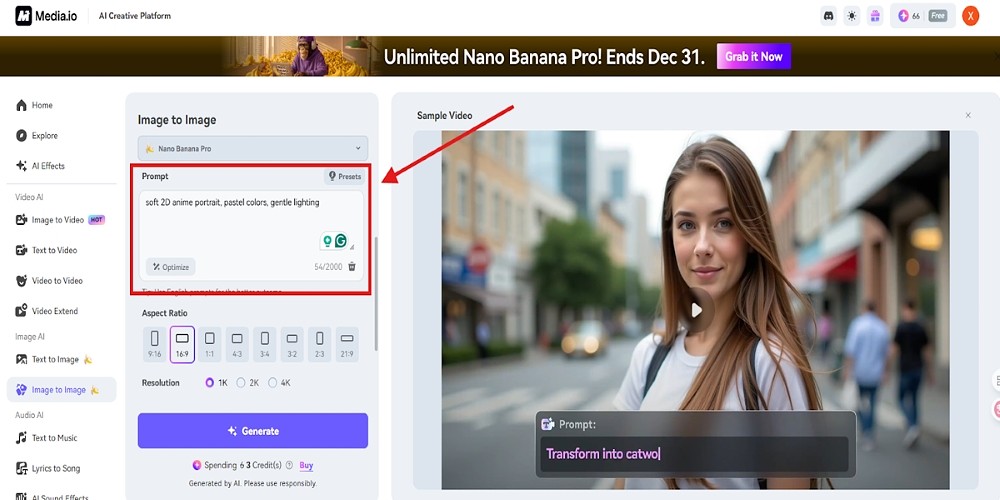
Go to Media.io’s Image to Anime tool and upload a JPG, PNG, or JPEG file. You can also bring in multiple images if you’re working on character sets or visual collections. After the upload, adjust the crop or framing so the subject is centered, which helps the AI keep proportions stable during the transformation.

Step 2. Describe the Anime Style You Want

This step controls the output. In the prompt box, describe the visual style as clearly as you can. Here are a few examples:

  •     “soft 2D anime portrait, pastel colors, gentle lighting”
  •     “manga line art with bold outlines”
  •     “3D anime character, glossy shading”
  •     “kawaii chibi, big eyes, round face”
  •     “Studio Ghibli watercolor atmosphere”

Your prompt is the only input that determines the anime style, so don’t hesitate to experiment. You can also use this method to convert an image into one in different artistic directions, not just anime.

Step 3. Generate and Download Your Anime Image

Media.io: How to Turn a Photo into an Anime Image with AI

Photo Courtesy: Media.io

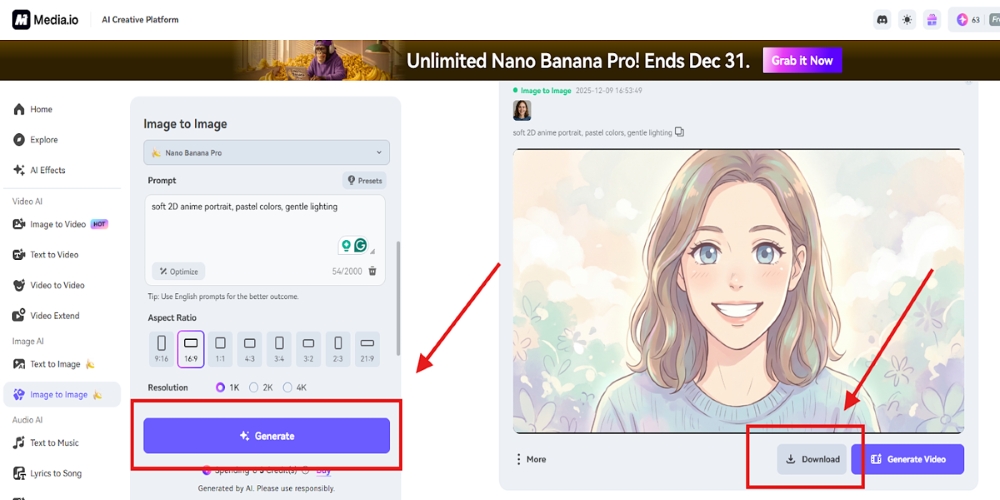
Click Generate, and the system will redraw your photo in just a few seconds. When the anime version appears, download it instantly or continue editing. If you want a more stylized result, you can try additional prompts, adjust lighting descriptions, or use Media.io’s AI change photo tools to refine the final look.

Final Thoughts — Start Turning Your Photos into Anime Today

Turning a regular photo into an anime-style image no longer requires any drawing skills. A single upload is usually enough for the AI to generate a clean, stylized version of your picture, which makes it handy for avatars or quick visual ideas.

What helps with Media.io is that you can adjust the result right after it’s generated—sharpen it, change the look slightly, or try another variation without leaving the page.

If you’re curious how your own photo would turn out, test one. Upload it, type a short note about the style you want, and let the tool create the anime version.

How Moeed Israr’s Calm & Clarity Helps Ease Emotional Weight

By: Elowen Gray

Most People Misunderstand Gratitude, and It’s Why They Stay Overwhelmed

What if the heaviness you carry isn’t stress…
but resistance?

Yesterday morning, a woman stared at her untouched coffee, already exhausted before the day even began.
Nothing was wrong, yet everything felt heavy.
You know that feeling, don’t you?

If you’ve been mentally cluttered, spiritually tired, or emotionally tight… you’re not alone.
Most women feel this at least once a day, but almost no one names it.

Here’s the part most people miss:
Resistance has one weakness, and it’s not what you think.
And there’s a moment, a single shift, that dissolves it almost instantly.
We’ll come back to that.

This article isn’t about toxic positivity.
It’s about the art of softening your energy without forcing anything.
A shift that takes less than 30 seconds, but ripples through your entire day.

Your energy has been asking for softness.
Let’s unlock it.

The Shift No One Talks About

Resistance is like fog: thick, silent, and strangely convincing, until the light hits it.
It shows up as tightness in your chest, scattered thoughts, irritability, or the quiet pressure to keep holding everything together.

Sometimes the hardest part is pretending everything is fine when your mind feels crowded.
And yet… your energy is constantly communicating, even when your mind is silent.

After years of studying emotional patterns and spiritual energy, one truth has surfaced again and again:
You don’t overcome resistance; you soften it.

Here’s where things begin to expand.
There’s a reason gratitude works so fast, and it has nothing to do with mindset lists or forced positivity.
Once you understand this energetic shift, your entire emotional landscape changes.
Most people never discover how quickly their energy can transform.
But once you unlock it, everything changes.

Why Gratitude Works Faster Than You Think

Imagine this:
You open a soft, quiet page.
Warm morning light touches the paper.
Your breath slows.
Your shoulders drop without being told.
For the first time today, you exhale.

This is the moment gratitude begins; not in your mind, but in your energy.
Gratitude isn’t a task.
It isn’t an item on a checklist.
It’s like unclenching a fist you didn’t know was tight.

Many journals force you to list gratitude.
Calm & Clarity teaches you to feel it.

And when gratitude is felt, not performed, something powerful happens internally:
Your energy expands.
Your thoughts soften.
Your reactions become gentler.
And resistance… loses its grip.

This is where the real transformation begins.

The Moment Everything Softens

There’s one sentence, a single whisper, that dissolves resistance on the spot.
We’ll get to it soon.
But first, let’s name the truth most people avoid:

Every woman knows the feeling of doing everything right…
and still feeling heavy.
Because resistance isn’t about circumstances; it’s about energy.

Think back to a moment when your day felt unbearable.
Then, without warning, something small shifted your inner world:
A warm breeze.
A smile from someone you love.
A quiet breath you finally noticed.

There’s always one gratitude moment that becomes your turning point.
Here’s the part most people miss: that moment isn’t random.
Your energy softened, and life responded.
This is only the beginning.

The Bigger Truth 

Your energy can shift in seconds.
Not through effort.
Not through discipline.
Just softness.

This energetic shift is the foundation behind Calm & Clarity, the journal built to guide you gently from resistance to ease; page by page, breath by breath.
This journal doesn’t push productivity.
It uses energy, awareness, breath, and truth.

Some of its pages…
You’re not supposed to open until you’re ready.
Most women say the shift happens by Day 3; a softness replaces the heaviness.
You begin to trust your own calm.
You begin to feel lighter.
You begin to return to yourself.

Imagine meeting the version of you who isn’t overwhelmed…
The version whose mornings begin with space, not pressure.
That version of you is closer than you think.

The Sentence That Dissolves Resistance

Here it is; the whisper that changes everything:
“I choose softness.”

Not force.
Not control.
Not perfection.
Just softness.

Say it, even silently, and feel what happens inside your body.
Your breath deepens.
Your chest loosens.
Your shoulders lower.
Your mind steadies.

This is the doorway into ease.
This is the energetic shift Calm & Clarity is built upon.

Where Your Journey Leads

This is why the journal’s prompts are designed with intention: to dissolve resistance gently:
One page brings you back to your breath.
Another invites gratitude that expands your heart.
Another helps you let go of what isn’t yours.
Another unlocks clarity you forgot you had.

Page by page, the resistance melts.
Softness replaces tension.
Your energy comes home to you.
And slowly, something beautiful happens:
You begin to meet the self you were always meant to be.

A Soft Invitation

If your heart feels ready to shift from resistance to ease…
Calm & Clarity will meet you there.

What would your life feel like if your energy softened every morning?
You are becoming.

Connect with Moeed Israr: Facebook | Instagram


Disclaimer: The information provided in this article is for general informational purposes only and is not intended as medical, therapeutic, or legal advice. The product mentioned, Calm & Clarity, is a personal journal designed for emotional and mental well-being. Individual results may vary. Please consult with a professional for advice tailored to your specific needs.

Why Christian Guzman’s Collaboration With FIT KING Makes Sense — and What It Signals for the Future of Recovery Culture

By: Matt Emma

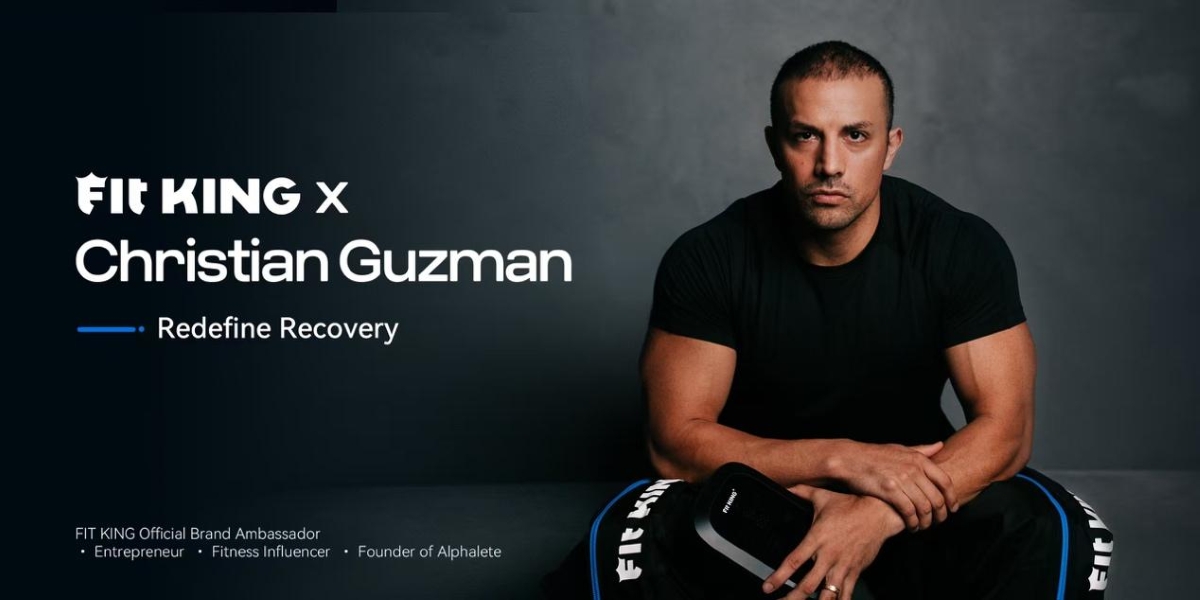
For those who have followed Christian Guzman over the years, one thing is clear: every decision he shares publicly — from his training evolution to his business ventures — seems to come from a place of intention and authenticity.

So when Christian aligned with FIT KING, this was more than “just another collaboration.”

It reflects a broader shift happening in fitness today:

Recovery is increasingly viewed as a vital part of fitness, rather than something optional. And FIT KING appears to be well-positioned to support that shift.

Christian Guzman Has Always Been Intentional — FIT KING Naturally Fits That Narrative

At the core of Christian’s public persona are three pillars:

  • Discipline
  • Consistency
  • Transparency

He has built companies, a physique, and a loyal community by sharing the real process behind the scenes — without exaggeration or artificial polish.

That’s why this partnership makes sense.

FIT KING is not a luxury “performance lab” brand and is not a trend-driven product line.

Instead, it focuses on functional recovery solutions that aim to solve real problems for people who train seriously — from elite athletes to everyday enthusiasts striving to be better.

Christian didn’t choose FIT KING for its trend appeal.

He chose it because it aligns with the lifestyle he actually lives: Train hard. Recover smarter. Stay consistent.

The Product That Makes the Collaboration Click: FIT KING 5-Zone Faster Recovery System

Air-compression recovery boots are not new — but meaningful design is.

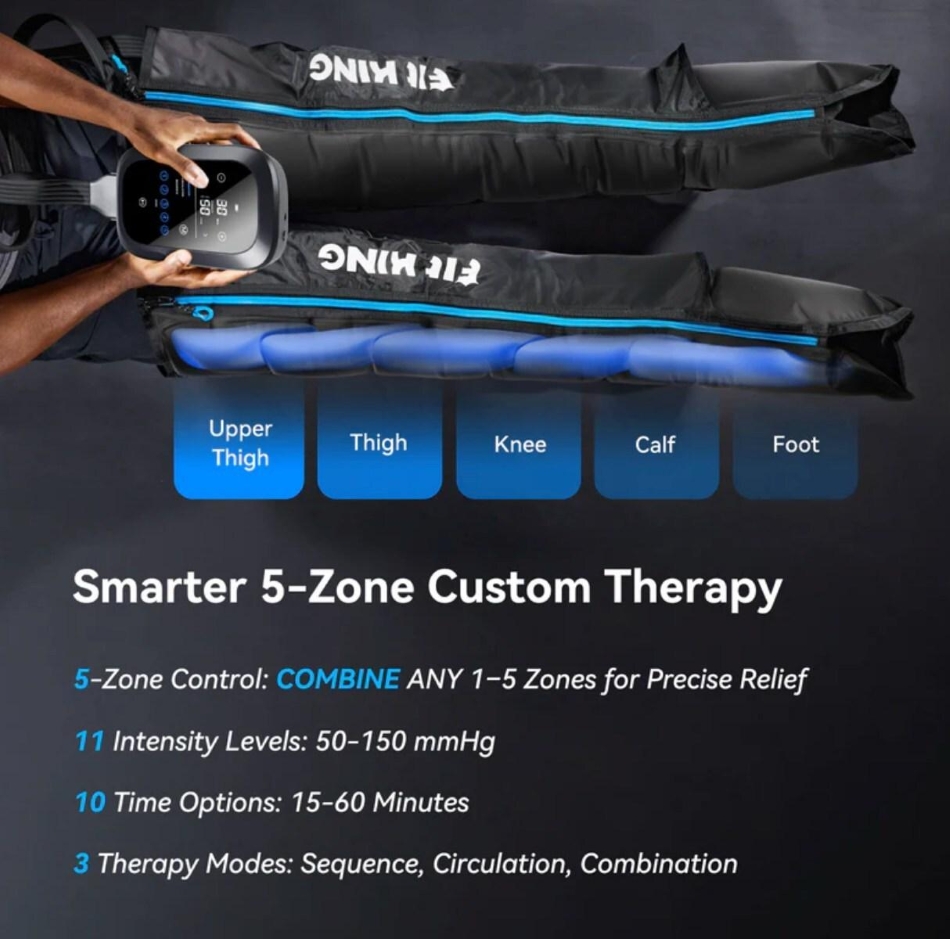
What makes the FIT KING 5-Zone Faster Recovery System stand out is not just its engineering, but how well it seems to integrate into Christian’s demanding daily rhythm.

His schedule is relentless:

Training → Filming → Meetings → Editing → Training again.

In that cycle, the recovery system becomes more than a device; it may become a useful reset.

When Christian uses the full-leg air compression boots, it’s not about luxury.

It’s about staying functional, reducing accumulated fatigue, and helping him show up tomorrow with the same level of intensity. 

And yes — the technology matters:

  • 5 independent compression zones
  • Adjustable intensity
  • Rapid inflation and deflation
  • Designed for efficient, high-impact sessions

These are not gimmicks.

Why Christian Guzman’s Collaboration With FIT KING Makes Sense — And What It Signals for the Future of Recovery Culture

Photo Courtesy: Fit King

They are functional features engineered for people whose lifestyle demands more from them — whether that’s athletes, creators, or anyone balancing high performance with a full schedule.

What This Collaboration Represents for the Industry

This partnership isn’t loud or theatrically promotional. It’s grounded, intentional, and aligned with how real athletes are thinking today.

Christian is evolving. So is his audience. And the fitness industry seems to be shifting with them.

Once, the message was: “Train harder.”

Today, the message is becoming: “Train smarter. Recover intentionally. Perform longer.”

FIT KING represents that evolution.

We design recovery tools that are:

  • Accessible
  • Effective
  • Easy to integrate into everyday life
  • Built to support longevity, not burnout

This collaboration is not about pushing a product.

It’s about communicating a new standard: Recovery is part of the training culture — not something secondary.

This Is Not a Trend — This Is a Signal

Christian Guzman partnering with FIT KING is more than an influencer-brand alignment.

It signals where modern fitness might be headed:

  • Away from “grind until collapse”
  • Toward sustainability and long-term performance
  • Toward recovery tools that may improve consistency
  • Toward smarter, more balanced training strategies

FIT KING didn’t choose Christian only for reach.

Christian didn’t choose FIT KING for hype.

This partnership works because we share the same belief:

Training well requires recovering well. And now, recovery is increasingly being recognized as part of the story — exactly where it belongs.

About Fit King

Fit King creates smart, user-friendly recovery tools designed to help people move better, feel better, and train better.

From targeted massage devices to full-leg compression systems, the brand supports millions of users worldwide seeking reliable recovery solutions.

Disclaimer: The information provided in this article is for general informational purposes only and should not be construed as medical advice. Individual results may vary. Always consult with a healthcare professional before beginning any new exercise or recovery regimen, particularly if you have any pre-existing medical conditions or concerns.