Chris Wise on PropTech: Why Class C Housing Deserves Attention

By: Natalie Johnson

When the conversation turns to real estate technology, most people picture luxury towers and high-end renters seeking the latest smart-home features. Chris Wise, founder of Wise Capital, sees the future somewhere else entirely: in Class C housing, the working-class communities that quietly support much of America.

A Career Shaped by Service and Adaptability

Wise’s path to real estate technology has been anything but traditional. He began his career as a Special Warfare Combatant Crewman in the Navy, where he gained lessons in discipline, adaptability, and teamwork under pressure. After completing his service, he entered the financial sector. By his late twenties, he had served as Chief Compliance Officer for a registered investment advisor, overseeing risk management and regulatory responsibilities.

In 2020, Wise launched his first law firm. Within just three years, it expanded into four states, a growth trajectory that demonstrated both his entrepreneurial drive and ability to build systems that scale. Along the way, he continued to experiment with new technologies. In 2023, he created a conversational technology platform designed for sales and client interaction. That early project foreshadowed the types of innovations he would later bring into the real estate sector.

Why Class C Housing Matters

Class C properties represent a significant share of the nation’s housing stock. These are older, modest buildings that provide essential homes for working families. While luxury developments dominate headlines, Class C housing remains vital for community stability.

“Everyone talks about affordability, but few people innovate where it matters most,” Wise says. “Technology can make life better for tenants and more sustainable for owners. It is not glamorous, but it is necessary.”

Building Technology, Not Just Managing Properties

Wise Capital is focused on developing proprietary technology tailored to the unique challenges of Class C housing. The company is advancing machine learning for property evaluation, conversational AI for leasing and maintenance, and predictive tools that help prevent costly repairs before they escalate. The team is also creating IoT solutions, including smart locks and sensors, designed specifically for older multifamily properties.

Unlike firms that rely on off-the-shelf systems, Wise Capital builds its technology in-house. This approach ensures the tools directly address the needs of Class C housing while also creating intellectual property that strengthens the company’s long-term foundation.

Rather than focusing on luxury amenities, Wise Capital’s approach centers on creating tools that address the day-to-day realities of managing and maintaining older housing stock. For tenants, this can translate into faster service, better communication, and improved living conditions. For property managers, it means greater operational efficiency.

Looking Ahead

Wise envisions a future where technology closes the gap between underserved housing and modern innovation. His focus is not on luxury but on building stronger communities, improving daily life for tenants, and making property operations more resilient.

“The way I see it, this is about more than real estate,” Wise says. “It is about building tools and systems that give overlooked communities the attention they deserve.”

Chris Wise and Wise Capital are showing that the next chapter of proptech may not be defined by glass towers or high-end renters. Instead, it could be written in the neighborhoods where working families live, with technology designed to support both stability and progress.

As the housing industry continues to evolve, Wise Capital is positioning itself at the intersection of technology and community impact. The company’s vision demonstrates that the next chapter of property technology may not be defined by glass towers or high-end renters. Instead, it could be written in the neighborhoods where working families live, with solutions designed to support both stability and progress.

By focusing on the needs of tenants and managers in Class C housing, Wise and his team are expanding the conversation around what real estate innovation should look like. Their work suggests that the future of housing technology is not only about making properties smarter, but about making communities stronger.


Disclaimer: This article is for informational purposes only and does not constitute financial, investment, or legal advice. Real estate investments carry inherent risks, including the potential loss of capital. Past performance is not indicative of future results. Always conduct your own research and consult with a qualified financial or legal professional before making any investment decisions.


Why Prehistoric Predators Still Capture Our Imagination Today

Few creatures in history have intrigued people like the carnivorous dinosaur. From the fierce Tyrannosaurus rex to the cunning Velociraptor, these predators have become prominent figures in popular culture for decades. Their immense size, sharp claws, and terrifying roars often make them symbols of both fear and fascination.

In modern culture, carnivorous dinosaurs aren’t just a source of entertainment—they serve as powerful educational and symbolic tools. Through museums, media, and realistic models, audiences worldwide continue to be fascinated by these ancient giants, finding new ways to connect with Earth’s prehistoric past.

Pop Culture and the Rise of the Carnivorous Dinosaur

Hollywood’s Dinosaur Obsession

Blockbuster films have played a significant role in elevating carnivorous dinosaurs to global fame. From the cinematic debut of T. rex in Jurassic Park to countless sequels, audiences have come to associate prehistoric predators with thrilling storytelling. These films emphasize spectacle and drama, ensuring that carnivores remain integral to dinosaur lore.

Television, Cartoons, and Gaming

Beyond film, carnivorous dinosaurs continue to thrive in television, animation, and gaming. Whether portrayed as ferocious villains or misunderstood creatures, they appear across genres, from children’s cartoons to survival video games and virtual reality experiences. Their adaptability across media forms demonstrates their enduring appeal.

The Role of Museums and Exhibits

Realistic Skeletons and Animatronics

Museums bring prehistoric predators to life through reconstructed skeletons and animatronic displays. Standing beneath a towering T. rex skeleton or watching a lifelike predator roar offers visitors a unique opportunity to connect with history. These experiences blend education with awe, engaging audiences of all ages.

Educational Storytelling Through Predators

Carnivorous dinosaurs also serve as gateways to broader scientific discussions. Exhibits utilize their dramatic hunting adaptations to explain topics like evolution, extinction events, and ecosystem balance. By starting with the spectacular, museums encourage audiences to dive deeper into understanding.

The Science Behind the Monsters

Fossil Discoveries and Paleontology

Paleontologists continue to uncover new carnivorous dinosaur species, expanding our knowledge of their diversity. Fossilized teeth, bones, and even soft tissue impressions provide valuable insights into predator-prey relationships and evolutionary patterns.

Understanding Behavior Through Anatomy

Anatomical studies shed light on how these creatures lived and hunted. Jaw structures offer clues about bite strength, while claw formations suggest hunting strategies. By analyzing skeletal mechanics, scientists reconstruct behaviors, fueling both academic research and cultural imagination.

Cultural Symbols and Interpretations

Carnivorous Dinosaurs as Symbols of Power

Throughout modern art and literature, carnivorous dinosaurs often represent raw strength and survival. They embody primal instincts and are frequently used in stories as metaphors for power, dominance, and resilience.

Fear, Awe, and the Sublime

The psychological impact of predators like T. rex is profound. They evoke both fear and fascination, drawing people toward the sublime—an overwhelming mix of danger and beauty that leaves lasting impressions.

Entertainment Beyond the Screen

Carnivorous Dinosaur Replicas and Attractions

Theme parks and exhibitions use realistic replicas to immerse visitors in prehistoric adventures. Standing beside a roaring animatronic predator provides a mix of excitement and education, creating memorable experiences.

Live Performances and Animatronic Shows

Live shows featuring animatronic predators continue to captivate audiences by blending technology and theater. These performances entertain both children and adults alike, proving that carnivorous dinosaurs are just as compelling off-screen as they are on it.

Dinosaurs in Education and Edutainment

Leveraging Fearsome Features for Learning

Educators use carnivorous dinosaurs to capture attention and spark curiosity. Their dramatic features make lessons memorable, whether in science classes, STEM camps, or educational documentaries.

STEM Learning with Prehistoric Giants

Programs focused on fossils and paleontology inspire the next generation of scientists. By studying the biology and behavior of predators, children develop critical thinking, research methods, and problem-solving skills.

Online Fandom and Dinosaur Communities

Social Media and Dinosaur Content

Carnivorous dinosaurs are social media stars. Viral videos of animatronics, educational clips, and fan art quickly spread across platforms, helping maintain prehistoric predators’ relevance in the digital age.

Collectors, Forums, and Online Exhibits

Global fan communities exchange ideas, models, and fossil news through online forums and exhibitions. Collectors showcase replicas, while museums host virtual tours, building thriving networks of dinosaur enthusiasts.

The Business of Prehistoric Predators

Merchandising and Licensing

Toys, collectibles, and model kits inspired by carnivorous dinosaurs fuel a thriving industry. From detailed replicas to children’s playsets, these products keep predators at the center of consumer culture.

Role of MyDinosaurs

As a leader in creating high-quality dinosaur models and experiences, MyDinosaurs plays a significant role in how audiences engage with prehistoric predators. Their lifelike replicas and custom attractions offer educational, cultural, and entertainment value for clients worldwide.

Summary

From Hollywood blockbusters to museum halls, the carnivorous dinosaur remains a powerful presence in modern culture. These predators continue to capture the imagination through spectacle, symbolism, and science, bridging education and entertainment in meaningful ways.

As innovation advances in technology, paleontology, and storytelling, prehistoric predators will likely remain icons of fascination—thrilling audiences, inspiring learners, and reminding us of Earth’s untamed past.

Rachel Ann’s Roadmap for First-Time Authors: From Idea to Published Book

By: Michael Beas

Writing your first book can feel like standing at the base of a mountain: exciting, intimidating, and full of unknown challenges. Rachel Ann, author and mentor, has helped many first-time writers through this climb. Her advice focuses on mindset, process, and accountability—showing that finishing a book is often more about strategy than luck.

1. Mindset Matters: Control Over Validation

One of the first lessons for new authors is shifting how you view publishing. Rachel Ann emphasizes that success isn’t always about securing a publisher’s stamp. “The biggest mindset shift is realizing the decision isn’t about validation—it’s about control,” she says.

Self-publishing can offer speed and autonomy, while traditional publishing tends to provide structure and credibility. But ultimately, she stresses, the book’s success is likely to depend on the effort put into marketing, audience-building, and consistency. “Stop asking ‘who’s going to let me?’ and start asking ‘what’s the path that lets me own my voice and my timeline?’”

2. Avoid Rushing to Publish

Rushing is one of the most common mistakes first-time authors make. Many confuse finishing a draft with being ready to publish, which can lead to typos, weak structure, or a lack of a solid launch strategy. Rachel Ann compares it to sprinting to 16,000 feet on Everest without oxygen: “You’re likely to crash.”

Her solution? Slow down and respect the process. Edit carefully, seek honest feedback, and build a launch runway. Publishing isn’t just about uploading a PDF; it’s about positioning your book to reach readers effectively.

3. Focused Priorities for the Next 90 Days

For authors planning to publish by the end of 2025, Rachel Ann suggests concentrating on three priorities in the next 90 days:

  • Clarify your purpose – Define who your book is for and why it matters. Clarity can help prevent stalling and provide direction.

  • Commit to a writing rhythm – Daily word counts or blocked time are often more effective than waiting for inspiration. Consistency can build momentum.

  • Build accountability early – Tell someone, join a writing group, or work with a coach. Accountability can keep you moving when motivation wanes.

“Everyone says they want to write a book. Most never finish because there’s no one pushing them past the messy middle,” she explains. Her upcoming small-group program provides reporting, 1:1 check-ins, and peer support—helping authors turn intention into tangible progress.

4. Invest in Craft and Community

Rachel Ann stresses two foundations for long-term success: craft and community. A well-structured, compelling story is critical, but building an audience before publishing can ensure the book reaches the right readers. “People don’t just buy books—they buy into authors,” she says. Sharing your process online or engaging with potential readers early may be key.

By investing in craft and community, authors not only publish a book—they create a platform that can support future projects and career growth.

5. Treat Writing as a Personal and Professional Journey

Rachel Ann also emphasizes the personal growth that comes with writing. Developing discipline, embracing vulnerability, and cultivating accountability are all part of the journey. “The mindset you adopt as a first-time author often sets the trajectory for your entire writing life,” she notes.

For her, writing isn’t just a project—it’s an exercise in self-awareness, persistence, and clarity of purpose. Each stage, from drafting to launch, offers lessons that extend beyond the book itself.

6. Key Takeaways for Aspiring Authors

For first-time writers, Rachel Ann’s guidance can be summarized into actionable steps:

  • Own your voice and your timeline.

  • Respect the process; don’t rush to publish.

  • Commit to a consistent writing practice.

  • Build accountability to stay on track.

  • Invest in craft and engage with your community.

Following these principles may transform writing a first book from a daunting leap into a structured climb. With focus, rhythm, and support, finishing a book can become an achievable goal rather than a distant dream.

Understanding the Deadline Dates to File W-2 Forms: What Employers Need to Know

Have you ever asked yourself when exactly W-2 forms need to be filed and why these dates matter for employers? 

Many business owners and managers face this question every year as tax season approaches. Filing W-2 forms on time is an important responsibility because it keeps everything smooth for both employers and employees. 

Let’s talk about these deadlines in simple terms so you can keep things stress-free and easy to manage.

Why W-2 Forms Matter for Employers

When you run a business and pay employees, the W-2 form is how you report wages, taxes withheld, and other pay details. It ensures employees have the right information for their own tax returns. At the same time, it gives the IRS and Social Security Administration accurate data to process records. 

Meeting the filing timelines is not just about following rules; it also builds trust with your employees because they know they’ll get the paperwork they need on time. Staying on top of these dates shows professionalism and care toward your team.

Filing on time is straightforward once you understand the key dates. Let’s break it down into easy parts so there’s no confusion.

1. The General Deadline for Providing W-2s to Employees

Employers must provide W-2 forms to employees by January 31 each year. This means every worker who earned wages in the previous calendar year should have their copy by the end of January. Having this date in mind helps employees prepare for their own filing without delay. It also avoids last-minute rushes in February, which makes work smoother for everyone involved.

2. Filing W-2 Forms with the Social Security Administration

The same January 31 deadline applies when submitting W-2 forms to the Social Security Administration. This can be done electronically or by mail, but electronic filing is often faster and easier to track. 

Since both employee distribution and SSA filing share the same timeline, employers have one clear date to remember. This alignment makes the process simple; there’s no need to keep track of multiple deadlines.

3. Why January 31 is a Key Date for Employers

Having a single clear date gives employers structure. By focusing on January 31, businesses can plan and complete all tasks well before the cutoff. 

Many employers start preparing documents in early January to make sure everything is ready. With payroll software and electronic filing systems, completing the task is much smoother today than it used to be. This way, you can focus on business growth while staying compliant at the same time.

Getting Ready for the Filing Deadline

Understanding the deadline is one thing, but being prepared in advance makes the entire process effortless. Employers who set up internal reminders or checklists find it easier to meet the January 31 date without any stress. 

Preparing documents early ensures accuracy and gives enough time to resolve small corrections before sending forms out. When everything is organized, filing becomes a natural part of your yearly routine.

Good planning also improves the employee experience. Staff receive their forms without delay, which helps them move forward with their tax returns smoothly. It reflects positively on the workplace culture, showing that the employer values clear communication and timeliness.

Choosing Between Electronic and Paper Filing

Understanding the Deadline Dates to File W-2 Forms: What Employers Need to Know

Photo: Unsplash.com

While employers have the option to file by paper or electronically, electronic filing is often preferred. It saves time, reduces paperwork, and confirms submissions faster. Many employers find it more reliable because there’s immediate feedback if something needs attention.

Electronic filing is also recommended for businesses with many employees since it makes record-keeping more organized.

1. Importance of Accuracy in W-2 Forms

Along with filing on time, accuracy is equally important. Double-checking employee names, addresses, and Social Security numbers avoids unnecessary issues later. Employers who maintain updated employee records throughout the year find this step much easier in January. 

By keeping everything accurate, the process flows smoothly, and employees feel confident in the information provided.

2. Using Tools and Resources to Stay on Track

Employers today have access to plenty of tools that make filing W-2s much easier. Payroll systems, online tax platforms, and even automated reminders help keep track of the filing process. These resources support efficiency and accuracy while reducing stress during tax season. When employers use technology wisely, meeting deadlines becomes a routine task instead of a challenge.

Why Timely Filing Benefits Both Employers and Employees

Meeting the W-2 deadlines creates a win-win situation. Employees get their forms promptly, which allows them to prepare tax returns early. For employers, it brings peace of mind knowing they’ve completed an important responsibility on time. It also helps keep the company’s records aligned with the IRS and SSA, which supports smooth business operations throughout the year.

Taking W-2 filing seriously also improves a company’s reputation. Employees feel valued when processes are well managed, and external stakeholders see the business as organized and dependable. In many ways, filing on time is more than compliance; it’s part of building a strong and trustworthy workplace.

1. Building a Routine Around the W-2 Deadline

Many employers benefit from creating a simple annual routine. For example, reviewing payroll details in December, preparing draft forms in early January, and finalizing everything by mid-January ensures the January 31 deadline is comfortably met. This kind of routine makes tax season easier every year, without the need for last-minute effort. Over time, it becomes a simple habit that adds structure to your business calendar.

2. Employees Appreciate Timely Filing

From the employee’s perspective, receiving a W-2 on time makes life easier. They can prepare their personal returns without waiting or worrying. This creates trust and goodwill between staff and the company. Employers who prioritize their team’s needs in this way foster stronger working relationships, which benefits the workplace in the long run.

3. Clear Communication Helps Everyone

Along with filing the forms, letting employees know when to expect them is a simple step that adds a lot of value. Clear communication reduces confusion and shows employees that the company is reliable. Sharing updates through internal emails or notices ensures that staff members are informed, which strengthens the professional bond between employer and employee.

Making the Most of the Filing Process

Understanding the deadline dates to file W-2 forms helps employers manage their responsibilities with confidence. When businesses focus on accuracy, communication, and planning, filing becomes a positive annual routine. Employers can turn this requirement into an opportunity to show care for their employees and maintain strong business practices.

1. Filing Deadlines Keep Businesses Organized

Deadlines are not just rules—they bring order to the workplace. By knowing and respecting the January 31 date, employers ensure that everything is in sync. This organization spreads to other parts of the business, creating a culture of timeliness and responsibility. Employees notice when employers are organized, and it reflects positively on the company’s overall structure.

2. Long-Term Benefits of Staying Prepared

Every year, meeting the W-2 filing deadline builds consistency. Over time, this consistency strengthens internal processes and makes tax season more predictable. Employers who treat it as part of their yearly cycle save time, avoid confusion, and enjoy smoother operations. It’s an investment in efficiency that pays off year after year.

Conclusion

For employers, understanding W-2 deadlines is about more than following a rule; it’s about creating smooth operations and showing care for employees. By focusing on the January 31 date, preparing early, and using available tools, employers can complete this task with ease. Filing on time supports accuracy, trust, and professionalism, all of which strengthen a workplace. When W-2 responsibilities are handled with attention and care, it reflects positively on both the business and its employees.


Disclaimer: The information provided in this article is for general informational purposes only and should not be construed as professional tax or legal advice. Employers should consult with tax professionals or legal advisors to ensure compliance with applicable laws and regulations regarding W-2 filings and deadlines.

Why House of Nanii’s Commitment to Zero Chemicals Makes Linen the Answer to Fashion’s Toxic Pollution Problem

By: Zen Fenrir

The fashion industry generates more carbon emissions than all international flights and maritime shipping combined. Yet, one designer in California believes the answer to sustainability lies in an ancient fiber that has clothed humanity for millennia. The fabric feels different under his fingers compared to the synthetic materials that dominate today’s fast fashion market. Each piece tells a story that bridges continents and cultures.

Nanii’s journey from his Nigerian roots to California’s design scene represents more than geographical movement. The House of Nanii founder has built his brand around a simple yet powerful premise: linen holds the key to fashion’s sustainable future. His latest Solomon Collection exemplifies this philosophy, featuring men’s clothing that marries contemporary global patterns with modern silhouettes. The collection has already attracted hundreds of customers since its Beta launch test, while its social media following has exploded from 375 total followers to over 14,000 across platforms.

When Ancient Meets Modern

Linen cultivation requires significantly less water than cotton production and utilizes every part of the flax plant, creating minimal waste. The fiber’s natural properties make it ideal for warm climates, yet its durability means garments last for decades rather than seasons. Nanii recognized these advantages early in his design career, but his Nigerian heritage provided the cultural context that makes his work distinctive and unique.

The Solomon Collection demonstrates how cultural fusion can address modern sustainability challenges. Each garment features precision-cut tailoring that sculpts the masculine frame while incorporating heritage patterns and artisanal details. The result transcends typical fashion categories, creating pieces that function equally well in boardrooms and cultural celebrations. Colors range from deep earth tones to vibrant accents that reflect both Global aesthetics and California’s diverse cultural landscape.

Nanii’s design philosophy, Be Different Together, goes above aesthetics to address practical concerns about masculine fashion. Many sustainable clothing lines sacrifice fit and style for environmental credentials, but the Solomon Collection challenges this compromise. The linen’s natural drape allows for structured yet fluid silhouettes that transition from professional to casual settings. This versatility appeals to modern consumers who demand both ethical production and sophisticated design.

Building Community Through Conscious Consumption

The House of Nanii’s growth reflects broader changes in consumer behavior toward sustainable luxury. Nanii’s customer base spans professionals who value quality construction and cultural authenticity over mass-market trends. His direct-to-consumer model through houseofnanii.com allows for closer relationships with buyers who share his values about conscious consumption. The brand’s social media growth demonstrates how authentic storytelling resonates with audiences seeking alternatives to fast fashion.

Linen’s environmental benefits extend throughout its lifecycle, from cultivation to disposal. The flax plant improves soil health and requires minimal pesticides compared to conventional cotton farming. Processing linen into fabric uses mechanical rather than chemical methods, reducing water pollution and toxic runoff. When garments reach the end of their life, linen biodegrades completely without leaving synthetic microplastics in the environment. These factors support Nanii’s argument that linen represents fashion’s sustainable future.

The designer’s Nigerian heritage provides cultural depth that distinguishes his work in California’s competitive fashion market. Traditional global textiles emphasized community connection and individual expression through clothing choices. Nanii translates these values into contemporary designs that encourage wearers to consider their relationship with clothing more than consumption. Each piece invites reflection about identity, masculinity, and global citizenship through fashion choices.

Weaving Tomorrow’s Fashion Today

Nanii’s vision for the House of Nanii rises above current success metrics. His goal of complete linen production by 2035 coincides with growing pressure on fashion brands to address environmental impact. The Solomon Collection serves as proof of concept that sustainable materials can support sophisticated design and commercial viability. 

The fashion industry’s environmental reckoning creates opportunities for designers who prioritize sustainability from inception rather than as an afterthought. Nanii’s Nigerian cultural roots provide design authenticity that mass-market brands cannot replicate, while its California base offers access to environmentally conscious consumers and sustainable supply chains. This combination of cultural depth and environmental awareness marks the House of Nanii for continued growth.

The designer’s success challenges conventional wisdom about sustainable fashion’s commercial limitations. Premium linen commands higher prices than synthetic alternatives, but customers increasingly view quality natural fibers as investments rather than expenses. Nanii’s cultural fusion method proves that sustainability and style can coexist when designers understand both their heritage and their market. The House of Nanii’s trajectory suggests that fashion’s future belongs to brands that honor both environmental stewardship and cultural authenticity, creating clothing that tells stories worth wearing.

How to Choose an ITAM Provider in 2025

Before you shortlist vendors, write down the outcomes you must deliver this year. Do you need real-time asset visibility across hybrid fleets, cleaner license positions for audits, or faster onboarding of remote endpoints? Outcomes act like your north star and prevent the “feature bingo” trap. When you lead with outcomes, you’ll evaluate tools by their ability to solve problems, not by glossy demos.

Translate each outcome into measurable success criteria and timelines. For example, “reduce ghost assets by 40% in two quarters” or “cut audit preparation time from four weeks to five days.” Tie these to business metrics—compliance risk, OPEX, MTTR, and employee productivity—so every stakeholder can see the value path from day one.

Core Capabilities That Matter in 2025

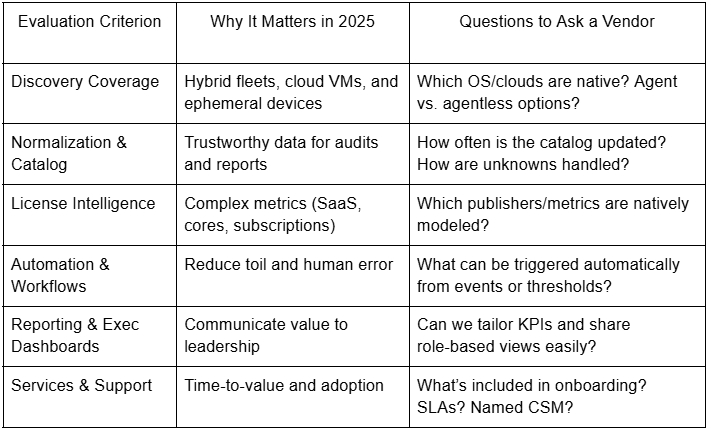
Modern ITAM spans much more than discovery and a CMDB entry. You need multi-platform discovery (Windows, macOS, Linux, mobile, cloud VMs), automated normalization, license intelligence for complex publishers, and tight integration with service workflows. Look for policy-driven lifecycle management: purchase → deploy → move → repair → retire. The platform should reconcile data from multiple sources, eliminate duplicates, and surface trustworthy records that you can audit with confidence.

Automation is no longer optional. You want event-driven updates, enforcement of ownership and location fields, and rules that trigger right-size actions (e.g., reclaim unused software). Add in robust dashboards layered with custom fields, because your executive team will ask for trends on spend, usage, risk, and sustainability (yes, e-waste and power draw now show up in board slides).

Security, Compliance, and Data Trust

Asset data is security data. Your ITAM provider should support strong access controls, encryption at rest and in transit, SSO, and detailed audit logs. If your organization operates in multiple regions, ask about data residency options and attestations (e.g., SOC 2 Type II, ISO/IEC 27001). Software recognition catalogs should be frequently updated to track publisher changes and new license metrics.

Quick security & governance checklist:

  • Role-based access with least privilege

  • Field-level history and tamper-evident logs

  • Automated PII minimization and data retention policies

  • Evidence packs for audits (publisher-specific)

  • Configurable approval workflows for high-risk changes

When your CISO asks, “Can we trust this inventory for threat remediation?” you want to answer with confidence. That requires near-real-time discovery, reconciled identity-to-device mapping, and clear lineage of data changes.

Total Cost of Ownership: Look Beyond the Sticker Price

Pricing can be per-device, per-user, tiered, or packaged with other ITSM capabilities. Don’t compare line items in isolation; model the full program cost for at least 36 months. Include services, connectors, data normalization, training, customizations, and the often-forgotten cost of manual workarounds if a feature is missing.

How to Choose an ITAM Provider in 2025

Build a TCO sheet with three vendor scenarios and a “do nothing” baseline. The right choice is often the one that removes hidden labor while elevating audit readiness and decision speed.

Integrations and Real-World Fit

A stellar ITAM platform lives where your teams already work. Confirm out-of-the-box connectors to procurement, endpoint management (e.g., MDM/EMM), directory services, identity, and your ITSM tool. Test bi-directional flows: a discovered device should automatically get an owner; a retired asset should trigger a ticket and update financial records. If your environment includes niche systems, evaluate the vendor’s low-code integration options and API maturity.

Insist on a realistic proof of value. Bring a messy slice of your environment—multiple device types, stale records, and tricky licenses. A credible vendor will normalize the data, produce reconciliation reports, and demonstrate how exceptions get handled without weeks of scripting. That’s how you separate marketing from muscle.

Vendor Reliability, Roadmap, and Support Experience

Look for transparent roadmaps, frequent releases, and a proven record of shipping customer-requested features. Community forums, knowledge bases, and enablement content matter more than you think—your admins will rely on them under deadline pressure. Talk to customer references that match your size and industry; ask about rollout time, data accuracy at scale, and how quickly support resolves critical issues.

Don’t overlook the human layer. A strong customer success manager, clear SLAs, and predictable communication rhythms can make the difference between a tool you adopt and a tool you abandon. If the vendor offers guided implementation with best-practice templates for lifecycle stages, you’ll accelerate value and reduce change risk.

Putting It All Together: A Simple Selection Plan

Create a ranked scorecard aligned to your outcomes, not just features—weight discovery accuracy, license intelligence depth, automation capability, integrations, and support quality. Run a two-step process: (1) desk evaluation to narrow to three vendors; (2) proof-of-value using your real data. Require written remediation plans for any gaps discovered during testing. Finally, negotiate success-based milestones in your contract so incentives stay aligned.

If you’re evaluating platforms that combine ITAM with service workflows and mature automation, consider exploring ITAM By Alloy Software during your shortlist phase. It’s smart to compare integrated suites with point solutions to see which approach best fits your team’s skills and timelines.


Disclaimer: The information provided in this article is for general informational purposes only. It does not constitute professional advice, and readers should conduct their own research or consult with a qualified professional before making any decisions.

Ruishu Jang’s Award-Winning Work For “The Hereafter Without You”

By: Sherry Lee

Love, obsession, and heartbreak: universal emotions that we all experience at some point in life. Life has experienced the ache of being left, of unrequited feelings, and bad luck in love. Ruishu Jang’s short film production, The Hereafter Without You, takes audiences on a remarkable journey of overwhelming emotions. In a heavily commercialized filmmaking space, she is making a name for herself with her work on content-driven projects. The Hereafter Without You stands out with its exploration of obsessive love, fading memories, and the lingering ache of heartbreak, presented in a way that is both emotionally intense and artistically distinctive.

The project has earned the producer critical acclaim from film fanatics. It won an award at the WorldFest – Houston International Film Festival in the category of Shorts-Dramatic-Original Silver Remi. It was also honored as a winner at the Latitude Film Awards and the Oniros Film Awards. It was a semi-finalist at the Los Angeles Independent Film Festival Awards and the Rome Prisma Film Awards. The Hereafter Without You also received a Best Short Film nomination at the Beverly Hills Film Festival. As the film’s success continues, it has not only garnered international recognition but also opened doors to multiple opportunities for the producer. 

For Ruishu, while international recognition and applause are something she is grateful for, the project shares a much more personal connection with her. Going through a similar phase to the storyline at the time of production and also sharing in the experience with the writer of the script, she was instantly drawn in to be part of the project. About the decision to pursue this project, she has shared on many occasions how she felt about it: “The protagonist felt like a mirror of my own heart. It was this shared ache between me and the writer that drove me to produce the film.” The producer and writer’s relatable connection to the storyline echoes throughout the film, which features many raw moments that feel palpable to the audience.

Ruishu Jang’s Award-Winning Work For “The Hereafter Without You”

Photo Courtesy: Andrii Lantukh / Ruishu Suri Jiang

The pre-production phase of the project presented a mighty challenge to overcome. To create all emotional nuances within the short format of the film. A love which turns into obsession, the blurry grey lines of characters, and the development throughout cinema had to be quick; it needed to be put together in a way that the transition seemed real, not too rushed, and that the audience had enough time to develop an emotional connection with the characters and be able to absorb the changes. For this, Ruishu had a simple exercise in mind. To bring in all the cast and crew to live the story in real time. To ensure everyone was on the same page, she took her time introducing the cast to the shooting locations, the environment to be created through the scenes, and the expectations for immaculate execution in the acting part of the scene. 

When the film came out, the casting was a particular element praised by the viewers. The performances were reviewed as strikingly raw and honest. The producer believes that realism came through from a deliberate casting process that prioritized emotional range and chemistry over fame. “We needed actors who could reach emotional breaking points—people who could live the vulnerability we were trying to portray,” Ruishu added.

For aesthetics, The Hereafter Without You is a visual masterpiece that embraces vibrant saturation, extended takes, and subtle visual dichotomies. The set backdrop, especially its warm yet haunting pink night tone, evokes the complexities of obsessive love. This distinctive visual style emerged from a truly interdisciplinary team: Ruishu’s directorial vision blended with a cinematographer steeped in lighting expertise, alongside a director with a strong background in cinematography. Each member contributed their unique perspective, augmenting the film’s emotional depth. Every visual decision was made to deepen the story; from camera movement to color grading, the emotional journey was always at the forefront. The team crafted a cinematic language that not only complemented the narrative but also encapsulated it, amplifying the film’s emotional resonance for the audience.

Ruishu Jang’s Award-Winning Work For “The Hereafter Without You”

Photo Courtesy: Andrii Lantukh / Ruishu Suri Jiang

Ruishu, when creating the film, knew that it was a project made for a universal audience, the experience of which would vary for each individual. The Hereafter Without You is not a film designed to please everyone. It doesn’t rely on exposition or resolution but instead trusts the viewer to engage with its emotional undercurrents. For those who have experienced the intensity of obsessive love, it offers a subtle yet powerful catharsis. For Ruishu, it is a reminder of the kind of films she aspires to produce—projects that leave a lasting impression by inviting viewers to feel, reflect, and ultimately, release.

This project strengthened Ruishu’s commitment to emotionally driven cinema. It also expanded her vision as a producer, affirming that great filmmaking doesn’t just inform or entertain, but resonates. As the producer continues to evolve in the industry, she aims to build a body of work that blends emotional intelligence with cinematic craft, bringing stories to life that are both deeply felt and beautifully executed.

You can follow Ruishu Jang:


Website: https://www.surijiang.com/

Instagram: https://www.instagram.com/suriiijrs

IMDb: https://www.imdb.com/name/nm9587428

DRIPBL’s Formula for Change: Curiosity, Creativity, and Community in Action

By: Jamal Hamama

Students are chasing their curiosity. Young inventors sketching prototypes at kitchen tables. Classrooms no longer boxed into lectures. That electric energy pulses through DRIPBL, a learning organization that stages education like an arena where thinking, creating, failing fast, and improving matters. What sets DRIPBL apart is not just its tools but its belief: school can be where impact begins and grows, not waits.

Dream, Research, Innovate, then Solve

DRIPBL stands for Dream, Research, Innovate, Problem/Project-Based Learning. These four pillars do not sit in some mission statement to gather dust. They drive every project, every interaction. Students are encouraged first to dream: imagine problems they want to fix. Then they research deeply: gathering data, understanding context, looking at existing solutions. Innovate comes next: finding ideas that are distinct rather than copied. Problem/project-based learning ties it together, giving real challenges or community issues as their canvas.

The emphasis is on individuality. DRIPBL does not follow a one-size-fits-all approach to learning. Instead of pushing everyone through the same mold, the model nurtures each student’s curiosity and unique talents. Hard skills and soft skills grow side by side: coding, science, engineering, yes, but also communication, teamwork, responsibility. Students are encouraged to get their hands dirty, to prototype, to test, to iterate.

Achievements extend beyond internal satisfaction. DRIPBL students have achieved notable recognition, earning patents, launching startups, and presenting at international fairs. Between 2020 and 2024, a dozen students represented DRIPBL at the International Science and Engineering Fair. Some won special awards; others launched inventions. These achievements demonstrate that the DRIPBL model can yield tangible recognition and influence.

Rachna Nath: Architect of Purpose

Founder Rachna Nath brings more than administrative firepower. She is a STEM educator, mentor, public speaker, and deeply embedded in multiple prestigious networks. Among her roles: she’s been recognized by TIME, serves as a Georgia Tech VIP Research Affiliate, works with NASA as a Solar System Ambassador, and mentors high school students for MIT’s Lemelson-MIT program.

When Rachna speaks of what education should do, her focus tends to sharpen. “We must give students permission to explore their own questions,” she says, pushing back on rigid syllabi. “By solving problems that matter to them, they become more than learners and become creators with agency.” Her own conviction that education should reflect real needs: personal, social, environmental, informs DRIPBL’s programs. Projects do not live in isolation; they reach communities, they spark discussions, they have real-world implications.

She combines vision with accountability. There are measurable outcomes: number of patents, number of students attending international fairs, scholarships won, startups formed. Under her leadership, the schoolrooms serve as labs of proof. Every contest won, every pitched idea, every product developed counts. These are part of how DRIPBL assesses its success.

Building Leaders, Not Just Learners

Among DRIPBL’s goals lies something deeper than academic excellence. Students are coached to be socially intelligent, responsible, aware that their inventions and ideas can have a broad impact. The mission emphasizes citizenship in practice. Participants work on community-based problems, discovering that even their smallest design or prototype can have meaningful benefits or unintended consequences.

Statistically, DRIPBL’s impact shows both depth and breadth. The student body includes underrepresented and low-income learners; girls and young women make up a majority in many cohorts. Patents have been filed; startups founded; scholarships earned. What counts is not just who gets left out, but who is now being included. DRIPBL’s metrics—students engaged, products produced, recognition gained—suggest that its model is working with measurable success.

The educational offerings reflect ambition but remain connected to daily life and opportunity. STEM, STEAM, research, competition—all are complemented with mentorship, exposure to real scientists, incubation for ideas. Students don’t only build robots. They develop pitches. They sketch business plans. They apply for patents. They reach across disciplines. These things sharpen minds as well as characters.

DRIPBL stands positioned as more than a school or program. It is a proving ground where dreams take form, fail, get refined, then matter. Under Rachna Nath’s leadership, the work has reached thousands: ideas have found launchpads, students have become voices, outcomes have manifested. Education serves as an active challenge, not passive absorption, but active change. And in that space, leadership is built.

Reach out to Rachna at rachna.nath@dripbl.com / linkedin.com/in/rachnanath1

Rethinking Cloud Cost Optimization: Deepak Mittal’s Vision for Developers, Startups, and Enterprises

By: Elle dela Cruz

CloudKeeper’s achievement of reaching $200 million in annualized revenue, without raising any venture capital, highlights a distinct and disciplined path to growth in the cloud cost optimization sector. Rather than relying on aggressive funding, the company has focused on building scalable, outcome-oriented solutions rooted in deep technical expertise. Leading this effort is Founder and CEO Deepak Mittal, whose background in engineering and commitment to delivering tangible value have shaped CloudKeeper’s trajectory from day one.

In this interview, Mittal shares the core principles behind the company’s product-first philosophy, detailing how it built trust with both cloud providers and customers through consistent delivery and innovation. The conversation also sheds light on CloudKeeper’s approach to developer adoption, its disruption of traditional pricing expectations, and how it maintains credibility and adaptability across a diverse client base, from early-stage startups to complex, global enterprises.

Q: CloudKeeper achieved 50% revenue growth and $200 million in annualized revenue without venture funding. What strategic decisions enabled this capital-efficient scaling while competing against well-funded FinOps rivals?

Deepak: CloudKeeper was born out of To The New, a bootstrapped company I co-founded with a strong cloud and DevOps foundation. CloudKeeper followed the same principles from the start, focusing on delivering real customer outcomes through a highly skilled engineering team and a product-first mindset. Instead of chasing growth through capital, we built scalable, innovative solutions that addressed core cloud cost challenges supported by a team of experts.

Our consistent delivery earned us trust not just from customers, but from cloud providers like AWS and GCP, who now actively recommend us. That ecosystem support, combined with disciplined execution, has helped us scale without raising a single dollar.

Q: Your AWS console-integrated Tuner platform fundamentally changes developer workflows. How did you identify this niche opportunity and convince engineers to adopt optimization tools within their existing processes?

Deepak: One of the consistent challenges highlighted by the FinOps Foundation is getting engineering teams to own cloud cost decisions. It’s understandable as engineers are measured on delivery and performance, not cost. So we knew any solution we built had to align with that reality, not fight it.

CloudKeeper Tuner has been designed with that philosophy in mind, an industry-first AWS usage optimization platform that works seamlessly within existing developer workflows. It performs real-time, non-disruptive optimization while complementing engineers with actionable, performance-safe recommendations, directly into their AWS console, through a simple browser extension.

There were no blueprints for this, we were stepping into uncharted territory. But that gave us the freedom to innovate on our own terms. It was a leap of faith, and it paid off because we put the developer experience at the heart of it.

Q: CloudKeeper offers savings without long-term commitments. How does this model challenge traditional cloud providers’ lock-in strategies, and what pushback have you encountered?

Deepak: CloudKeeper AZ aims to deliver savings without locking customers into long-term commitments. We handle commitment management through group buying and advanced rate optimization, delivering value quickly. Cloud providers have been supportive, as our model drives more predictable and efficient cloud usage. The real challenge has been educating customers, as many assume it’s too good to be true or are hesitant about routing billing through us. We reassure them with complete transparency and clarify that we only require minimal IAM access, with no visibility into their data.

Q: With 100+ AWS-certified engineers, how do you maintain technical depth while expanding into multi-cloud optimization and AI workload management?

Deepak: We have over 100 certified cloud experts across AWS and Google Cloud, many of whom also hold FinOps Foundation certifications. Their deep expertise spans cloud, DevOps, FinOps, and cost optimization. We began integrating AI well before it was mainstream, launching CloudKeeper Auto in 2022, an AI-powered RI management platform that delivers on-demand flexibility at reserved pricing.

We’ve built a strong culture of continuous learning through dedicated cloud learning paths, full certification sponsorships, and internal hackathons to foster innovation. Engineers are incentivized to experiment, upskill, and contribute to technical breakthroughs. A dedicated Center of Excellence now drives our multi-cloud and AI workload strategy forward.

Q: Your Well-Architected Reviews are funded entirely by CloudKeeper – what measurable business outcomes justify this investment compared to paid consulting models?

Deepak: Our fully-funded Well-Architected Reviews deliver immediate, tangible outcomes – unlike generic trials or passive demos. They allow us to dive deep into a customer’s actual cloud environment, identify inefficiencies, and demonstrate measurable savings and performance improvements from day one. This hands-on engagement builds trust and credibility, often converting into long-term partnerships.

Moreover, these reviews generate high-value insights that inform our roadmap and strengthen our optimization models. Even in cases where a customer doesn’t immediately convert, the goodwill and referrals we earn create a strong organic growth channel, making the ROI of these funded reviews far superior to traditional paid consulting approaches.

Q: As you expand in North America, how will CloudKeeper’s approach differ when advising cost-conscious startups versus Fortune 500 enterprises with complex cloud estates?

Deepak: Our approach remains consistent: anchored in personalized engagement – but it flexes to match the scale and needs of each business. We’ve worked with both large enterprises like FranConnect and AMI Strategies, and nimble startups like Appsmith and Chain.io, delivering tailored cost optimization outcomes across industries such as SaaS, FinTech, Healthcare, and Retail. Our team of experts performs in-depth evaluations, aligning Well-Architected Reviews with business goals to uncover savings and eliminate waste. Startups often look for quick wins, such as the immediate savings offered by CloudKeeper AZ, while enterprises tend to focus on modular services like usage optimization, EDP+ support, and multi-layered governance. This flexibility is what makes CloudKeeper a true end-to-end cloud cost optimization partner capable of adapting to diverse needs while consistently delivering measurable results.

Q: With AI infrastructure costs projected to triple, what architectural principles is CloudKeeper advocating to prevent a new wave of cloud waste in generative AI deployments?

Deepak: Generative AI workloads are extremely resource-hungry, and without the right guardrails, they can lead to massive cloud waste. At CloudKeeper, we promote building cost-aware architectures, choosing the right compute options, isolating workloads smartly, and using flexible pricing models like spot instances wherever possible. We also guide teams to streamline how AI is developed and deployed, ensuring they don’t overspend on idle infrastructure or unused models.

Our platforms like CloudKeeper Tuner and Lens are evolving to bring visibility and control to AI-specific spending, right from the start. The goal is simple: help businesses scale AI with confidence without the budget surprises.

CloudKeeper’s evolution reflects a rare mix of engineering precision, product insight, and commercial focus. Through embedding optimization within developer workflows, funding hands-on reviews, and staying ahead of multi-cloud and AI workload needs, the company has set itself apart in the FinOps space. Deepak Mittal’s perspective reveals a founder deeply rooted in technology, yet sharply attuned to business impact.

As cloud costs rise and architectures grow more complex, CloudKeeper offers more than just savings, it provides strategic guidance for companies aiming to scale with control and clarity. Its ability to adapt across startup and enterprise environments, while maintaining measurable outcomes, positions it as a trusted partner for organizations rethinking how they manage cloud efficiency and long-term growth.