Affordable Elegance at Home: How Eco-Chic Décor Elevates Your Space Sustainably

Creating a stylish home that reflects both elegance and environmental responsibility is easier than many think. Eco-chic décor combines natural, sustainable materials with thoughtful design to elevate living spaces while reducing environmental impact. Affordable elegance can be achieved by choosing well-made, eco-friendly pieces that enhance a room’s aesthetic without overspending or compromising values.

Many of these eco-conscious options, including items from CANVASDISCOUNT.com, feature products made in the USA, ensuring quality craftsmanship alongside sustainability. By incorporating natural textiles, upcycled decor, and energy-efficient elements, anyone can transform their home into a refined, eco-friendly sanctuary.

Eco-Chic Foundations: Blending Affordable Elegance with Sustainability

Creating an eco-chic home means making thoughtful choices about materials, sourcing, and design. It is possible to achieve elegance while minimizing environmental impact through natural fibers, responsible production, and transparent certifications.

What Is Eco-Chic Décor?

Eco-chic décor combines stylish design with environmentally responsible practices. It focuses on using sustainable materials and ethical production methods without compromising aesthetics. This approach includes items like a Framed photo in FSC-certified wood frames, organic cotton pillows, or bamboo accents.

Eco-chic décor means that every piece in a home serves two purposes: to look elegant and to support a sustainable lifestyle. It rejects fast furniture trends in favor of quality products that last, often handcrafted or made in the USA, reflecting a care for both design and the planet.

The Impact of Sustainable Choices in Home Decor

Choosing sustainable home decor reduces environmental harm by lowering waste and resource consumption. Items made from reclaimed wood or organic textiles limit deforestation and reduce chemical use associated with conventional fabrics.

Sustainability also involves social responsibility. Fair labor practices ensure artisans and workers receive fair wages and work in safe conditions. Ethical sourcing supports communities while elevating the standards of production globally.

Affordable elegance arises as consumers invest in versatile, timeless pieces that avoid harmful chemicals and excessive packaging. This leads to healthier indoor environments and long-term savings by reducing replacements.

Essential Sustainable Materials and Textiles

Key materials include bamboo, reclaimed wood, organic cotton, and other natural fibers. Bamboo is fast-growing and renewable, ideal for furniture and flooring. Reclaimed wood repurposes existing materials, adding character while preventing deforestation.

Organic cotton and GOTS-certified textiles are free from synthetic pesticides and harmful chemicals, ensuring safer homes. Natural fibers like wool, linen, and hemp also contribute to durability and breathability.

Using these materials helps lower a home’s environmental footprint and adds texture and warmth. Home décor items such as baskets, lampshades, and table linens often feature these materials paired with minimalist or rustic designs for cost-effective style.

Responsible Sourcing and Certifications

Transparency in sourcing is crucial to verify sustainability claims. Certifications like FSC (Forest Stewardship Council) for wood products, GOTS (Global Organic Textile Standard) for fabrics, and Fair Trade for labor practices provide assurances of ethical production.

Responsible sourcing means selecting products from suppliers who practice environmental care and social equity. It helps consumers avoid items containing harmful chemicals or produced through exploitative labor.

Consumers seeking eco-chic décor should look for labels indicating US-made or made in the USA goods or clear supply chain information. This supports local economies and reduces carbon emissions related to shipping. It also encourages brands to maintain accountability in sustainability efforts.

Elevating Your Space Sustainably: Practical Eco-Chic Décor Strategies

Sustainable home design blends natural materials, efficient technologies, and mindful purchasing to improve both aesthetics and environmental impact. Incorporating greenery, choosing durable furnishings, optimizing energy use, and seeking budget-friendly yet stylish décor are key ways to cultivate eco-chic homes.

Incorporating Natural Elements and Biophilic Design

Introducing indoor plants like snake plants, pothos, and peace lilies enhances both visual appeal and indoor air quality. These low-maintenance houseplants actively cleanse the air by reducing toxins, creating a healthier living environment.

Biophilic design extends beyond plants to include natural textures and materials like wood, stone, or driftwood, which connect interiors to nature. This connection fosters calmness and well-being while adding organic beauty.

Using natural fabrics instead of synthetic ones reduces exposure to chemicals and supports sustainable production. Elements like linen curtains or cotton throws also contribute tactile warmth without compromising eco goals.

Sustainable Furnishings and Repurposing Techniques

Opting for wood furniture made from reclaimed or responsibly harvested materials increases longevity while lowering environmental harm. These pieces often feature rich textures and craftsmanship that elevate space with authenticity.

Repurposing old furniture through sanding, repainting, or reupholstering is both cost-effective and eco-friendly. Transforming a vintage chair with new fabric or turning driftwood into shelves are practical ways to add character without new resource consumption.

Choosing timeless designs over trends ensures longer use and reduces waste. Durable furnishings save money over time and foster emotional attachment, strengthening sustainable consumption habits.

Energy Efficiency and Conscious Lighting

Installing LED bulbs drastically cuts energy use compared to incandescent lighting. Combining LEDs with motion sensors prevents unnecessary power consumption in less-used areas.

Maximizing natural light reduces the need for artificial lighting during the day. A strategic layout that places seating near windows or uses light-colored surfaces improves brightness and ambiance sustainably.

Energy-efficient lighting supports lowering carbon footprint and utility bills while maintaining elegant illumination. Layering overhead fixtures with task and accent lighting creates flexible, comfortable moods.

Affordable Finds: Thrift, Vintage, and Upcycled Decor

Thrift stores and vintage shops provide access to unique, durable home accessories and furnishings at low cost. These purchases avoid production emissions associated with new manufacturing.

Upcycling items like reusable glass jars, old textiles, or scrap wood allows homeowners to craft personalized décor with minimal waste. DIY projects inspired by these materials encourage creativity and reduce landfill contributions.

Why Choose Canvas Discount Over Other Competitors?

Canvas Discount is a great choice for consumers who want high-quality canvas prints at unbeatable prices. Backed by a Lowest Price Assurance, Canvas Discount is one of the most affordable options on the market.

Despite the low cost, customers consistently praise the vivid print quality and durable materials. Plus, production takes place solely in the United States of America, making Canvas Discount ideal for last-minute gifts or home décor. Combined with strong customer service and fast turnaround, Canvas Discount offers a rare blend of affordability, reliability, and satisfaction that makes it a smart buy.


How Scrub Caps Redefine Healthcare Style?

Healthcare is one of the most demanding professions in the world. Long hours, strict dress codes, and high-pressure environments often leave little room for self-expression. Yet in recent years, one quiet revolution has been reshaping how doctors, nurses, and medical students experience their daily routines: accessories that combine function, comfort, and personal style. From scrub caps to compression socks, the details of clinical uniforms are no longer afterthoughts—they are becoming powerful tools for confidence and identity.

Why Comfort Matters in Clinical Environments

Spending 10–12 hours in a hospital setting requires more than resilience and skill. Physical comfort plays a direct role in performance, focus, and even morale. Uniforms that don’t fit properly, fabrics that don’t breathe, or disposable head coverings that irritate the skin can make already long shifts feel unbearable.

Scrub caps are an example of this transformation. Once seen purely as a sterile necessity, they have evolved into essential pieces of functional fashion. High-quality cotton fabrics allow airflow, while designs that accommodate different hairstyles ensure that healthcare workers don’t have to sacrifice comfort for compliance. These subtle adjustments influence how professionals feel throughout their day—and that translates into better patient care.

Style and Identity in Medical Settings

Uniforms are designed to foster cohesion and professionalism, but they don’t have to sacrifice individuality. Increasingly, healthcare workers are using accessories to showcase a hint of personality while still adhering to hospital standards. A bold print on a scrub cap, a seasonal design for holidays, or even a coordinated color palette with the rest of a uniform allows professionals to feel more like themselves in a highly regulated environment.

Psychologists often note that self-expression can reduce stress and improve overall well-being. In a career as emotionally demanding as healthcare, small details that spark joy or reflect one’s personality can make a significant impact. Scrub caps, once sterile and forgettable, now act as tiny canvases for creativity.

The Rise of the Ponytail Scrub Cap

One of the most striking innovations in this space is the ponytail scrub cap. Designed with a built-in pouch or opening for long hair, this cap has rapidly gained popularity among nurses, surgeons, and medical students who prefer to keep their hair neatly secured during shifts.

Unlike traditional disposable caps, ponytail scrub caps are designed to accommodate hairstyles comfortably without flattening or damaging the hair. They also allow professionals to look polished and organized in environments where appearance can influence patient trust. Importantly, these caps aren’t exclusively for women—they work equally well for men with longer hair, reflecting the broader shift toward inclusivity in professional uniforms.

Functional Innovations Driving Change

The popularity of scrub caps isn’t only about aesthetics. Their growing demand is also fueled by practical improvements that address everyday problems in clinical environments:

  • Satin linings that protect hair from breakage and frizz.
  • Button options that ease pressure from mask straps, reducing ear discomfort during long shifts.
  • Elastic fits and adjustable ties that ensure a secure, comfortable fit for different head sizes.
  • Durable cotton fabrics that withstand frequent washing and maintain a professional look.

Each of these features addresses a specific pain point that disposable caps have ignored for years. Together, they signal a broader understanding that healthcare workers deserve the same attention to detail in their gear as athletes or first responders.

Beyond Function: A Cultural Shift

This movement is about more than fabric and stitching—it reflects a cultural shift within healthcare. Social media platforms like Instagram and TikTok are filled with posts from nurses and doctors showcasing their scrubs, caps, and personalized gear. These platforms demonstrate that style in medicine is no longer taboo; instead, it’s a means to connect with peers, inspire future professionals, and normalize individuality in clinical settings.

The rise of reusable, stylish accessories also aligns with sustainability. By replacing disposable items with durable alternatives, hospitals and clinics can reduce waste while empowering staff with products that feel better and last longer. What once seemed like a small detail—choosing a cap print or fabric—now ties into global trends of eco-consciousness and professional empowerment.

Looking Ahead: The Future of Medical Accessories

The evolution of healthcare attire shows no signs of slowing down. As younger generations enter the workforce, expectations for self-expression, inclusivity, and sustainability will continue to grow. Future accessories are likely to focus on:

  • Greater customization, including limited-edition prints and personalized embroidery.
  • Expanded designs for men, reflecting a more diverse workforce.
  • Advanced materials that balance durability with softness and eco-friendliness.
  • Community-driven trends are shaped by the content that healthcare professionals share online.

Uniforms may remain standardized, but accessories will keep pushing the boundaries of individuality and comfort.

For decades, clinical attire has been associated with sameness: the same scrubs, the same disposable caps, the same neutral tones. Today, that narrative is changing. Healthcare workers are reclaiming control over their appearance without compromising professionalism or safety. Small details, like the choice of a patterned scrub cap or the practicality of a ponytail pouch, represent a bigger idea: that the people caring for others also deserve comfort, style, and self-expression.

In the end, these accessories are more than fabric. They are symbols of pride, resilience, and individuality—qualities every healthcare professional carries into their work each day.

Disclaimer: The information provided in this article is intended for general informational purposes and reflects the evolving trends in healthcare uniforms, including scrub caps. While we strive to highlight the benefits of comfort, style, and functionality, individual preferences and needs may vary. Always consult with your healthcare institution’s guidelines regarding uniform requirements. The views expressed in this article are based on current industry trends and do not represent specific medical or professional advice.

From Global Consultant to Leadership Guide: The Past That Shaped Kara Williams

By: Matt Emma

The path to leadership often begins in quiet persistence. For Kara Williams, founder of Sprint Leadership, it started with a series of coffee chats in the late 1990s. She was a first-generation college graduate, the daughter of a mechanic and an office manager, who had earned dual degrees in accounting and finance. She had a limited network in the business world, nor had she completed internships with the “Big Six” firms, which were then the gatekeepers of consulting careers. Instead, she relied on initiative. She asked classmates who earned positions in those firms to introduce her to partners, attended happy hours where she didn’t quite belong, and made herself visible until she earned a seat at the table.

That persistence became the blueprint for a 28-year global consulting career that would take her into boardrooms across the globe, from corporate giants to family-owned enterprises. Today, it informs the mission of Sprint Leadership, her consultancy designed to serve under-$1B organizations, founders, and executives navigating high-stakes transitions. Williams has built Sprint Leadership around what she calls “wisdom for the moments that matter,” a philosophy that turns doubt into direction through storytelling, negotiation, and relationship-driven strategy.

The Foundations Of A Career In Transition

Hard lessons about access and credibility shaped Williams’ early years in consulting. Without the brand of a top MBA program, she quickly learned she had to play the game differently. A first job in corporate finance provided her with a foothold, but she viewed it as a stepping stone. Within 13 months, she had secured a position at Accenture, and shortly after, landed a client-facing role at KPMG, where she would spend the bulk of her career.

She often found herself in situations where the stakes were high and the margin for error small. Leaders in transition relied on her not only for analysis but for steadiness. “I have talked executives down from moments of panic before a board presentation,” she recalls, “and I have sat with them in devastation after a deal fell apart.” These moments taught her that technical brilliance is not enough. Influence, trust, and the ability to tell a story that brings others along are the real levers of leadership.

Bridging Theory And Practice

Alongside her career, Williams invested in her own development through executive education at top institutions, including Stanford. Academic frameworks provided her with the language for leadership, but her consulting work revealed where those frameworks fell short of action. She became adept at translating theory into practical tools that could be adapted to the cultural and relational nuances of each client.

This dual fluency, inspired by academic rigor with practical application, has become one of her hallmarks. At Sprint Leadership, she can design bespoke advisory programs tailored to the unique needs of a family office, scaling a business, the pressures of a funded startup, or the succession challenges of a multi-generational business.

The Turning Point

By the time Williams reached the top ranks of consulting, she realized she was no longer doing the work that mattered most to her. The ratio of meaning to exhaustion tilted in the wrong direction. After nearly three decades of advising, she decided to step away and create Sprint Leadership.

Her insight was profound yet straightforward: organizations with revenues under $1 billion, along with high-potential leaders, were underserved by the programs available to them. The coaching industry often relies on generic frameworks. Large consulting firms focus on multinationals. Williams saw the gap: family businesses on the verge of transition, founders scaling beyond their capacity, and executives plateauing in key career moments, and knew her experience could meet it.

The Challenges She Sees Now

The issues her clients face are pressing and deeply human. In family offices, baby boomer founders often hesitate to retire because they do not believe the next generation is ready, or because their children are not interested in taking over the business. In funded startups, visionary founders struggle to communicate effectively with investors or to delegate leadership as the company grows. In professional services, executives who have quietly excelled for years find themselves sidelined, victims of their own modesty.

Williams is drawn to these inflection points. “Once you are in the room, you cannot waste the opportunity,” she says. She notices the leaders who shrink back, the ones who doubt they belong, because she once felt the same. Sprint Leadership is designed to make those leaders visible, confident, and capable of steering their organizations through growth and uncertainty.

The Sprint Leadership Model

The consultancy is built around four pillars: storytelling, power navigation, negotiation, and relationship dynamics. Each reflects a lesson from Williams’ career. Storytelling matters because strategy without narrative rarely moves people. Power navigation matters because hierarchies, explicit or hidden, define outcomes. Negotiation matters because leadership is often about reconciling conflicting needs. And relationship dynamics matter because business is ultimately a human endeavor.

Williams delivers these pillars through executive coaching, customized workshops, and advisory engagements that honor the confidentiality her clients demand. Many of them come to her through personal referral, not public outreach. They are digitally quiet, privately owned, and wary of visibility. What they value is discretion paired with impact.

A Different Kind Of Thought Leadership

What sets Williams apart is not just her résumé but her relatability. She grew up watching her parents work for small, family-owned businesses. She saw firsthand what it means for a livelihood to depend not on corporate policy but on the judgment of a founder. That background, combined with her global consulting experience, gives her a rare vantage point. She understands both the weight of legacy and the mechanics of modern leadership.

In her words, leadership is not about title or pedigree but about choice. “Your choices are what matter in business and in life,” she says. “And the beautiful thing about a choice is you can make another one.”

Wisdom For The Future

Sprint Leadership is still in its early years, but Williams is clear about her vision. She wants to be the trusted advisor for leaders in moments of transition—whether that means guiding a founder through succession, helping a successor establish credibility, or supporting an executive who is ready to reinvent themselves.

Her past, in this sense, is not just history. It is a mirror she now offers others, a set of lived lessons that become usable tools. For organizations with revenue under $1B, and for the leaders who carry them forward, Kara Williams is positioning Sprint Leadership as a partner that turns difficult crossroads into defining moments of growth.

In a business world where legacy can be lost in a generation and leadership can falter without guidance, the need for such wisdom has never been greater. To explore how Sprint Leadership can help you navigate your next leadership transition, visit sprintleadership.com to book a complimentary consultation.

Disclaimer: The information provided in this article is for general informational purposes only and is not intended as professional advice. While we strive for accuracy, we make no representations or warranties, express or implied, about the completeness, accuracy, reliability, suitability, or availability of this information. Use of this information is at your own risk.

How New Yorkers Can Protect Their Digital Assets During Power Outages

In a city where power outages are an occasional nuisance, the risk to your digital data is significant, especially when you’re working from a high-rise office or relaxing at home. It’s important to have strategies in place to minimize the potential for data loss. This guide provides insights into preventing permanent data loss and accessing professional help when necessary.

Sudden power outages in New York City can disrupt digital activities, affecting everything from office work to personal data management. Implementing protective measures for storage devices can help reduce data loss during such events. Understanding and having access to professional recovery options is also important for restoring lost files. For more detailed information, you can refer to the FAQ on data recovery processes and solutions.

Immediate Steps to Protect Your Devices

When faced with a sudden power outage, your first priority should be to safeguard your devices and data. Unplugging sensitive equipment from power sources can prevent damage from power surges once electricity is restored. For computers and servers, using uninterruptible power supplies (UPS) can provide a critical buffer period to save work and shut down systems properly. Regular backups of important files on external drives or cloud services are also essential.

Consider implementing software solutions that automatically save progress at regular intervals. This helps minimize the potential loss of unsaved work during unexpected outages. Additionally, maintaining up-to-date antivirus software can help protect against malware that might exploit vulnerable systems during such disruptions. These initial steps play a vital role in reducing data loss and maintaining system integrity.

When to Seek Professional Data Recovery Help

If you experience substantial data loss despite taking preventive measures, seeking professional help becomes necessary. Professionals in data recovery possess the tools and knowledge required to retrieve lost information from damaged or corrupted storage media. They can handle complex scenarios involving physical damage or severe file system corruption that typical users cannot resolve alone.

Understanding when you need expert intervention can make a difference between partial recovery and total data loss. Professional services are equipped to recover data from various storage types, including SSDs, hard drives, and RAID systems. Their expertise also extends to handling sensitive situations involving confidential or valuable information.

It’s wise to research reputable data recovery professionals beforehand so that you know whom to contact in an emergency. This foresight ensures you won’t waste precious time during a crisis, increasing the chances of successful recovery.

Accessing Expert Guidance Through Informative Resources

Navigating the aftermath of a power outage requires informed decision-making. Resources like FAQs provide comprehensive answers to common queries regarding data recovery techniques. They cover diverse topics from basic troubleshooting steps to advanced recovery processes for different storage media.

The availability of such resources empowers you with the knowledge needed to address minor issues independently while recognizing when professional assistance is necessary. Accessing these guides equips you with strategies tailored for various scenarios, ensuring you’re prepared for future disruptions.

Engaging with expert-authored materials enhances your understanding of safeguarding digital assets amidst unpredictable power conditions. By leveraging these insights, you can take proactive steps toward protecting your data and minimizing disruption impacts.

Disclaimer: The information provided in this article is intended for general informational purposes only. While the article aims to offer practical advice on protecting digital assets during power outages, individual circumstances may vary. It is recommended to consult with a professional data recovery service for specific guidance or assistance. We do not guarantee any specific outcomes related to data recovery, and any actions taken are at your own risk.

From Loss to Nightlife: The Rise and Fall of Oskar

By: Kevin M. Miller

Oskar’s story doesn’t begin in the glitter of nightlife or the flash of cameras. It starts in a quiet, windswept port town. Born to a sailor father and a hotel employee mother, his early years were far from idyllic.

When his mother died of cancer at just nine years old, the loss became the first fracture in a life that would spiral through emotional isolation, betrayal, and self-destruction. With his father often at sea, Oskar was shuffled between relatives and neighbors, never feeling like he had a true home.

At thirteen, he moved to Canada under the care of an uncle, only to find himself in another hostile environment. Abuse, instability, and manipulation followed, culminating in his father renouncing legal paternity so Oskar could stay in Canada. The decision may have secured his residency, but it also severed a fundamental tie to his sense of belonging.

The Hustle Years

By his late teens, Oskar was fiercely independent, hustling to survive through odd jobs, stocking shelves, baking bread, doing whatever it took. But he was also burning bridges.

A final confrontation with his uncle led to a cruel betrayal: lured back to Poland under pretenses of his father’s illness, Oskar was stripped of his passport and trapped. That betrayal ignited something in him, a relentless need to take control, no matter the cost.

When he finally returned to Canada, his friends welcomed him back into a world of parties, performances, and provocation. Vancouver became his playground. By day, he worked in high-end restaurants, rubbing shoulders with celebrities. By night, he danced erotically at gay clubs like Odyssey, living out a hedonistic fantasy where attention came easily and consequences seemed far away.

Escapes and Addictions

From Vancouver to the Virgin Islands, the Cayman Islands to Barcelona, Oskar’s life became a carousel of temporary highs. Each destination promised a fresh start, yet the same demons followed: drugs, dysfunctional relationships, and the lure of quick success.

Modeling gigs, TV appearances, and high-profile romances placed him on the cusp of stardom. As a cast member on Sextet, a reality show likened to a Polish version of The Chippendales, his exposure catapulted him into the public eye.

But behind the glamour was chaos. Gambling consumed him, often with devastating losses. One relationship ended after he recklessly gambled away his partner Ola’s money. Every ascent seemed to bring a steeper fall.

Gatekeeper of the Elite

Oskar’s final act in the public eye was his most surreal. As the “picker” at one of Warsaw’s exclusive nightclubs, he controlled entry into the world of the elite. Celebrities, politicians, influencers, and criminals all courted his favor.

With power came intoxicating perks—drugs, alcohol, sex, and status. Yet influence didn’t bring peace. His nights blurred into excess, violence, and financial ruin. Even a move to London, meant as a reset, couldn’t free him from the grip of gambling.

Cracks in the Mirror

The striking theme of Picker’s Confession is Oskar’s own awareness of his self-sabotage. Fame was never the cure; it only amplified his insecurities. As a Polish-Canadian man, he felt rootless—belonging fully to neither culture. The harder he ran from his trauma, the closer it followed.

Despite fleeting success, Oskar’s life was shaped by instability and addiction. His memoir doesn’t glamorize the chaos—it lays it bare. With dark humor and painful vulnerability, he admits to bad choices, deep wounds, and the desperate search for meaning in a world obsessed with appearances.

A Memoir That Stings and Stays

Picker’s Confession isn’t a redemption story. It’s something rarer: a brutally honest chronicle of what happens when pain, ego, and addiction collide unchecked.

Chaotic and fragmented, the narrative mirrors Oskar’s own memories. Readers are pulled into wild parties, celebrity encounters, and the velvet-roped world of nightclub culture. But the memoir never lets us forget the cost. The line between glamour and ruin is razor-thin.

For readers seeking memoirs that go beyond surface storytelling, Picker’s Confession delivers. It’s voyeuristic yet cautionary, painful yet cathartic.

This isn’t just a story—it’s a reckoning.

Disclaimer: The following article recounts the personal experiences of Oskar, as told in his memoir. It includes descriptions of trauma, substance use, addiction, and high-risk behaviors. This content is intended for informational and literary purposes only and is not a guide, endorsement, or encouragement of any illegal or harmful activities. Readers are advised to approach the material with discretion and seek professional support if needed.

From Darkness to Dawn: The Uplifting Mission of You Are My Light Foundation & Trust

By: Thomas Jones

In a world shadowed by exploitation and suffering, there emerges a beacon of possibility: You Are My Light Foundation & Trust (YAML). Founded in 2021, this faith-based nonprofit exists not merely to rescue, but to restore—empowering survivors of human trafficking and labor slavery to reclaim their fundamental rights to life, freedom, education, and autonomy.

A Founder’s Transformation

At the heart of this organization lies the compelling journey of its founder, Orly Amor—a survivor whose life story defies the bleakness of victimhood. Once herself a victim of abuse, she emerged as a self-made entrepreneur and social influencer. Her experiences, both painful and redemptive, shape the very purpose and passion of YAML.

Her story is not one of quiet resilience, but bold advocacy. She has seen firsthand the darkest nights; now, she guides the way for others to walk out of the shadows. It is this personal conviction and clarity of mission that drives YAML, turning it from a charitable initiative into a lifeline for the broken.

Mission That Builds More Than Shelters

YAML’s vision is neither abstract nor distant. At its core, the Foundation is constructing “safe, healing, and rehabilitation centers” for rescued survivors of sex and labor slavery.

These are not merely safe houses; they are sanctuaries where transformation can take root. Here, survivors learn life skills and receive educational opportunities—each a stepping-stone toward restoring honor, dignity, and autonomy that oppression sought to erase.

A Vision of National Impact

The dream is ambitious, and by design. Over the next decade, YAML aims to become a leading force in rehabilitation in America, helping hundreds of survivors through a nationwide network of secure healing centers and educational infrastructure.

This vision signals more than scaling up services. It marks a new approach in the fight against modern-day slavery—one where survivors are not hidden or forgotten, but actively supported toward self-sufficient futures.

Three Steps Toward Wholeness

The organization’s approach is thoughtful, structured, and deeply compassionate, unfolding in three deliberate steps:

Assessment – Survivors enter a “welcome back to life” experience that includes a holistic evaluation of their physical, mental, emotional, and spiritual needs. Detox and counseling begin, and a small gift seeks to restore a sense of normalcy.

Healing – Over a period of 6 to 12 months, survivors embark on a journey of recovery. Education, arts, music, and professional training are tailored to each individual—not just for therapy, but for empowerment.

Autonomy – The final step is not just recovery, but renewal. YAML equips survivors to chart their own paths, fostering independence through the skills, support, and financial aid necessary to rebuild their lives—and help ensure they are never exploited again.

Lighting the Way

The foundation’s name—You Are My Light—is more than symbolic. It speaks of bearing light into the darkest places. From victim to advocate, innocence shattered but rebuilt, YAML serves as a testament to what healing looks like when backed by vision, dignity, and faith.

Orly Amor’s own journey—personal, precarious, purposeful—gives the Foundation its authenticity. Her leadership ensures the organization does not merely treat symptoms of trauma, but tends to its root, building lives that stand firmly on the principle of freedom.

Why It Matters

Human trafficking and labor slavery are among the most insidious crimes, thriving in the shadows and targeting the vulnerable. While legal interventions and law enforcement are vital, survivors often face years—and even lifetimes—of emotional and psychological aftershocks.

By centering rehabilitation, education, purpose, and autonomy, You Are My Light addresses these wounds with compassionate empathy. In effect, it disrupts cycles of exploitation before they can begin anew—with survivors not just healed, but hopeful.

A Call to Reflect and Act

As the Foundation unfolds its vision across America, YAML offers a charge to the rest of us: Illuminate the world where darkness presides. Whether through support, advocacy, or awareness, there is a role to be played.

In the coming years, as YAML aims to become a national force, it invites us into accountability and action. This is not a mission of distant charity, but of personal and collective relevance. And in the face of such purpose, indifference is no longer an option.

In a tapestry of broken lives, You Are My Light Foundation & Trust threads redemption through sturdy, soulful service. In the words of its founder’s journey—from survivor to advocate—YAML is itself a promise: that with care, courage, and conviction, survivors can reclaim their light—and walk unafraid into tomorrow.

Instagram: @youaremylightfountion

From Soldier to Storyteller: G.A. Sallee’s Debut Novel Channels a Life of Purpose

By: Tom White

For G.A. Sallee, storytelling is more than just a craft: it is a form of healing. His journey from soldier to author has been marked by profound personal change, with writing becoming a lifeline after military service. As he prepares to release his first novel, True Crime: Fact or Fiction, Sallee is eager to share that evolution with readers who value suspense, honesty, and emotional truth.

Finding Clarity Through Words

Like many veterans, Sallee faced the challenge of reintegrating into civilian life after serving in the Iraq War. As a proud disabled veteran, he turned to writing as a way to process his experiences and find new purpose. In that uncertain chapter, writing became something more than just a pastime. It became a guide.

“I began writing again after I got out of the Army. It wasn’t just about the story; it became something bigger than me,” he shares.

The U.S. Department of Veterans Affairs highlights that creative expression can play an important role in long-term emotional health, particularly for those managing trauma. Sallee’s return to the page offered just that: a space to reflect, reconnect, and rediscover his voice.

One of the biggest challenges he faced, he admits, was finding people in the publishing industry that he could trust. Combined with occasional bouts of writer’s block, these obstacles tested his persistence. But continuing to write remained his way through.

Emotion Woven Into Fiction

At the heart of Sallee’s work is empathy. His writing doesn’t just entertain; it delves deeper. True Crime: Fact or Fiction centers on podcaster Scott Townsend, a man who embarks on investigating a local cold case, only to find himself drawn into a more personal mystery. When a second murder mirrors the first, Scott’s mission becomes increasingly perilous, and the line between curiosity and obsession starts to blur.

The novel examines timely questions: What responsibilities do storytellers carry? When does a search for truth risk becoming a threat? Sallee’s straightforward, unadorned style, appreciated by readers for its simplicity, brings his characters’ struggles to the forefront in a way that feels immediate and relatable.

The Killer is Listening

With the unsettling tagline, “The killer is listening,” Sallee sets the tone of the book: one of constant tension. Scott Townsend’s podcast may have begun as a way to attract an audience, but it quickly escalates into something far more consequential. Themes of surveillance, trauma, and the blurry line between justice and exploitation weave an undercurrent of unease throughout the novel.

From Soldier to Storyteller G.A. Sallee’s Debut Novel Channels a Life of Purpose

Photo Courtesy: G.A. Sallee

A Story for the Whole Family

Though Sallee’s book is fictional, it is deeply rooted in personal connections. He resides in South Carolina with his wife, Sandrice, their three dogs, and an extended family that includes four children and seven grandchildren. “Life has blessed me with a big, loving family that I was fortunate enough to marry into,” he says.

“I’m a husband, a father, a grandfather… and this book is part of the legacy I hope to leave behind,” he adds.

His writing process mirrors that warmth and intimacy. He recalls writing with his dog, Jake, curled up across his lap, the rhythm of the keyboard syncing with the quiet comfort of family life. These moments ground his work in a sense of home, even as the narrative takes darker turns.

Looking Ahead

Sallee hopes that True Crime: Fact or Fiction marks the start of a long creative journey. His goals are both personal and artistic.

“This is just the beginning,” he says. “I want to invite people to join me on this creative path.”

To learn more about G.A. Sallee and his upcoming book, visit gasallee.com. If you enjoy thrillers that blend suspense with heart, this debut may be one to watch.

How Big Glasses Can Balance Your Face Shape

When carefully selected, oversized glasses can be a popular fashion accessory that enhances your facial features. Large, well-chosen frames can enhance your look by adding depth, softening or sharpening your features, and achieving a harmonious balance. This article will guide you through selecting big frame glasses that harmonize with different face shapes, offering tips for a complementary look.

How Big Glasses Balance Different Face Shapes

Round Faces

For round faces, choose angular frames to create contrast and balance the soft curves and similar width and height.. Square, rectangular, or geometric glasses are ideal because their straight lines add angles to a round face. These frames help make your face look longer and slimmer, and they provide definition that contrasts with the natural roundness.

For example, oversized rectangular frames work well because they create sharp lines that break up the softness of a round face. The key is to choose bold frames that stand out, but not too large. You want the frame to balance your features, not overwhelm them.

Square Faces

Square faces often have strong jawlines and broad foreheads, leading to an angular or severe look. To soften these features, round or oval glasses are a good choice. Oversized frames with a rounded shape will balance out the sharp angles, creating a gentler look. The roundness of the frame contrasts with the square jawline, softening the overall appearance.

Round frames, for instance, can help round off the sharper features of a square face. But, like with round faces, it’s essential to avoid frames that are too big. They should still fit perfectly and not overpower your features.

Oval Faces

Oval faces are often considered the most balanced due to their proportional features, allowing for greater versatility in choosing frame styles.. Large, wide frames are great because they can help balance the length of your face. Oversized frames can add structure to an oval face without making it look too long or narrow.

If you have an oval face, you can experiment with different styles. Geometric frames, oversized aviators, or vintage-inspired glasses all work well for this face shape. Avoid narrow or small frames, as they can elongate your face.

Heart-Shaped Faces

Heart-shaped faces have a broad forehead and a narrow chin. To balance these proportions, oversized frames should be wider at the bottom or have a bottom-heavy design. Aviators and other frames with a wider bottom can help draw attention away from the narrow chin and balance out the face shape.

Round or cat-eye frames are also excellent choices because they soften the pointed chin and create a more balanced appearance. The key is to select frames that add width where the face is narrow, which helps create a more proportionate look.

Diamond-Shaped Faces

Diamond-shaped faces have broad cheekbones and a narrow forehead and chin. To balance this, oversized cat-eye or oval frames are the best option. These frames help draw attention to the eyes and cheekbones, which are the widest part of a diamond-shaped face. They also help soften the angular features and create a more balanced look.

Cat-eye frames, for example, are perfect because their shape highlights your eyes and creates a pleasing curve that contrasts with the sharp angles of a diamond face. The rounded edges of these frames soften the face’s features, making it look more proportionate.

Key Considerations When Choosing Big Glasses

While big frame glasses can do wonders for balancing your face, it’s essential to pay attention to a few factors to make sure they fit perfectly and look good.

Size and Fit

The size of your glasses matters. Even though oversized frames can be a bold style choice, they should still fit your face correctly. Frames that are too big can overwhelm your features and make you look out of balance. The glasses must be proportional to your face size. The width of the frame should match your face, and your eyes should be centered within the lenses. This ensures your glasses complement your face and don’t overpower it.

When trying on oversized glasses, check how they fit. The frames should sit comfortably on your face, not slide down your nose or pinch your temples.

Frame Thickness

The thickness of the frames also affects how they balance with your face. Thick, bold frames are ideal for larger faces or those with more angular features. They add definition and structure. On the other hand, thinner frames are more subtle and work well on smaller or rounder faces. If you have a delicate face shape, thinner frames can give you a more balanced, understated look.

When choosing the thickness of your frames, consider the overall structure of your face. If you have more prominent features, bold frames may be the best option. But if you have softer, smaller features, thinner frames might be a better choice.

Color and Style

The color of your glasses can also make a significant difference in how they complement your face. Tortoiseshell frames, for example, can add warmth and a classic touch to your look. Clear or minimalist frames, on the other hand, offer a modern, understated vibe. The key is to choose a color and style that complements your overall aesthetic.

If you want a frame that stands out, choose a bolder color like dark blue or red. If you prefer something more subtle, clear or neutral tones are a suitable option. The style of the frames should also match your personality. Whether you prefer something retro, vintage-inspired, or modern, make sure the style feels like it suits you.

Don’t Over-Accessorize

When wearing oversized glasses, don’t overdo it with other accessories. Big glasses should be the focal point of your look, so pairing them with other large accessories like chunky necklaces, hats, or bold earrings can overwhelm your face. Maintain a minimalistic approach with your other accessories, allowing your glasses to take center stage.

For example, if you’re wearing large, statement-making glasses, pair them with a more neutral outfit and simple jewelry. This ensures your glasses are the focal point and avoids a cluttered look.

Conclusion

Big frame glasses can be a stylish and functional way to balance your facial features. By choosing the right frame shape, size, and color for your face, you can create a more harmonious and flattering look. Whether you have a round, square, oval, heart-shaped, or diamond-shaped face, there’s a pair of oversized glasses out there that can complement your features and enhance your overall appearance.

Remember, the key is to find frames that match your face’s proportions. Don’t be afraid to experiment with different shapes and styles until you find the ones that make you feel confident and comfortable.

Disclaimer: The advice and recommendations in this article are intended to provide general guidance on selecting oversized glasses based on different face shapes. Individual preferences and personal styles may vary. It is recommended to consult with an eyewear specialist or optician to find frames that suit your specific needs and preferences. The content provided is for informational purposes only and should not be considered as professional or medical advice.

Why AI Matters for the Future of Engineering and Business Growth?

Great ideas don’t fail because they’re flawed. They fail because they get stuck in long development cycles, misaligned teams, or unexpected failures during testing.

Today, that bottleneck is breaking, not with bigger budgets or more engineers, but with more innovative tools. Artificial intelligence is no longer a futuristic add-on. In engineering, it’s becoming a core part of how products are built — from electric vehicles to next-gen aerospace systems.

And for businesses, this shift isn’t just about better technology. It’s about faster time-to-market, lower risk, and a real competitive advantage.

Beyond the Hype: AI That Works in the Real World

Forget chatbots and image generators. The real impact of AI is happening behind the scenes — in labs and R&D departments, where it’s being used to solve complex engineering problems.

Take adaptive cruise control in an electric vehicle. It can’t just follow a car ahead of it. It must respond when traffic shifts, when rain hits, or when a driver suddenly brakes. No human can code for every scenario. So engineers aren’t writing rules anymore — they’re training systems to learn from experience.

They use reinforcement learning, where an AI agent improves its decisions by analyzing outcomes over time. Safety. Comfort. Efficiency. Each choice is weighted, refined, and optimized — not in a demo, but in a simulation that mirrors real-world chaos.

Or consider a high-voltage battery in an eVTOL aircraft. Overheat it, and you’re grounded. Under-engineer it, and you add weight, killing range. AI steps in by predicting thermal stress under real conditions — sudden climbs, partial sensor failure, uneven cooling. It models, adapts to, and prevents failures before they occur.

This isn’t science fiction. It’s how complex systems are being built today.

The Real Challenge? Making AI Work in Practice

Many companies want to use AI. But they struggle.

Their data is messy. Their tools don’t talk to each other. Their teams are split between design, software, and testing. They build models that look good in a presentation but fail under real load.

The problem isn’t the algorithm. It’s integration.

The most effective AI applications aren’t standalone. They’re part of a full-cycle process — embedded in design, validation, and safety compliance. Engineers use episode reward analysis to fine-tune control logic. They apply thermal modeling to derating functions so a motor doesn’t shut down under load. They simulate irregular inputs — like sensor noise or power drops — to make systems resilient.

And it only works when the team understands both the math and the machine.

Why This Changes the Game for Business

For small teams and startups, AI is a force multiplier. You don’t need a massive R&D department to compete. When you possess deep engineering knowledge — not just in software, but also in how systems behave under real-world stress — simulation becomes a powerful tool. You catch problems early. You validate designs before hardware exists. You move fast without gambling on quality.

Big companies aren’t using AI to overhaul their processes overnight. They’re using it to steady them. To ensure a new eDrive meets ASPICE requirements without a scramble. To confirm a design meets DO-160 standards before it hits the test chamber. It’s not about radical change — it’s about control, predictability, and getting it right the first time.

And for investors? It means faster validation. Fewer delays. More confidence in technical execution.

But none of this works without the right partner — one who doesn’t just deploy AI, but integrates it into the full engineering lifecycle.

The Bottom Line

AI in engineering isn’t about automation. It’s about intelligence — applied where it counts.

The companies that win won’t be those with the most data. They’ll be the ones who know how to use AI as part of a more innovative, more integrated process.

For businesses looking to bring complex products to market — faster, safer, and with fewer surprises — partnering with a team that combines deep engineering expertise with advanced AI capabilities is no longer optional. It’s essential.

For companies facing real engineering challenges — from incomplete data to integrating AI into complex systems — a specialized partner can make the difference. You can see how these problems are tackled with precision here.

It’s not just about building more intelligent systems. It’s about building them the smart way.

Disclaimer: The views and opinions expressed in this article are for informational purposes only. AI applications in engineering and business are rapidly evolving, and while the potential benefits of AI are significant, results may vary based on specific use cases, implementation methods, and available resources. Readers should seek professional advice tailored to their unique situation before making decisions based on the information presented.

Daily Habits to Cultivate Respect in Your Life

By: Deon A. Titcomb

Every day, our small choices shape the bonds we form and the communities we build. A simple smile or a moment of authentic listening can spark a genuine connection. In Basic Concept of Respect in a Simple Way by Kasimwe S. Bongerize, readers learn that respect springs from simple, everyday actions. Inspired by the book, here are a few daily habits to bring its wisdom into real life.

Respect is not just about grand gestures, but about the small, intentional acts that reflect our values. Holding the door open for someone, acknowledging their presence, or offering a kind word can create a ripple effect of goodwill. By incorporating these thoughtful actions into our daily routines, we contribute to a culture of mutual respect, fostering an environment where everyone feels valued and heard.

Warm Greetings Start the Day

A friendly smile and a clear “hello” can make a big difference when you walk into a room. The book teaches that simple greetings open hearts and show you care. This small habit builds a warm space where everyone feels welcome.

Kind Words Build Bridges

Using polite language signals that you notice others. Saying “please” and “thank you” matters, especially for teens learning to communicate with respect. A few gentle words can brighten someone’s day and turn ordinary moments into lasting memories.

Actions Speak Louder Than Words

Holding the door for a classmate or helping a neighbor carry groceries shows thoughtfulness. Basic Concept of Respect in a Simple Way reminds us that non-verbal gestures carry real weight. Listening without interrupting, for example, proves that you value another person’s perspective. Thoughtful actions turn respect into something you feel, not just something you say.

These small gestures are more than just acts of kindness; they are expressions of understanding and empathy. They show that we recognize the humanity in others and are willing to take the time to make them feel acknowledged. Basic Concept of Respect in a Simple Way teaches that when we make an effort to understand, we pave the way for deeper connections and mutual appreciation. In a world that often rushes by, taking a moment to show respect can make all the difference in someone’s day.

Caring for Shared Spaces

A neat room or a clean park reflects respect for your community. Keeping shared areas tidy makes them inviting for everyone. By picking up litter or straightening classroom chairs, you show care for those who share your space, strengthening unity and pride in your surroundings.

Daily Moments of Gratitude

Before bed, take a moment to note one thing you appreciate. Kasimwe S. Bongerize suggests keeping a short journal to record daily moments of gratitude. This habit rewires your mind to see kindness everywhere, helping respect grow naturally and reminding you of the support you receive each day.

This practice cultivates a positive mindset, allowing you to reflect on the little acts of kindness you might otherwise overlook. By acknowledging the good in your day, no matter how small, you reinforce the value of respect and gratitude. As Kasimwe S. Bongerize points out, even a few minutes of journaling can shift your perspective, making you more mindful of the respect you both give and receive. This habit encourages a deeper connection with others and nurtures a sense of community built on mutual appreciation.

Linking Words and Deeds

Respect works best when speech and action align. Calling someone by name, then asking, “May I help you?” shows genuine care. The book encourages pairing polite words with helpful deeds, deepening relationships, and proving that respect is more than a moment—it becomes a way of life.

Reflect and Grow Each Evening

Take a few quiet minutes at night to consider how you showed respect today. Celebrate small wins, learn from mistakes, and sharpen your character. With each reflection, respect becomes a skill you cultivate every day.

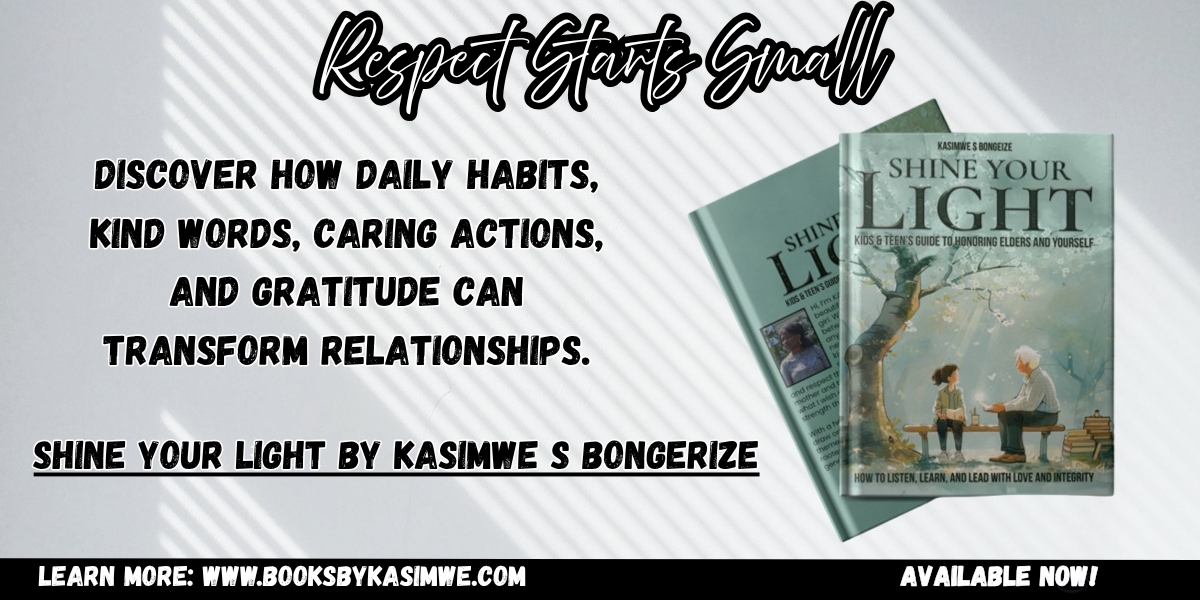
Take the next step toward building lasting respect by reading Shine Your Light by Kasimwe S. Bongerize. Its clear guidance and activities help grow kindness, awareness, and strong relationships each day.