Alina Tacmelova: How Art and Psychology Merge to Unlock Inner Healing

By: Svetlana Khachiyan

Alina Tacmelova is a contemporary artist, therapeutic coach and entrepreneur whose unique methodology combines art and psychology. Her approach is aimed at unlocking the creative potential of each individual, fostering personal growth, and achieving personal goals. Alina’s inspiring works not only impress with their craftsmanship but also encourage reflection on deep and meaningful aspects of life. Her art serves as a bridge between visual aesthetics and the inner world, opening up new horizons for self-discovery and creative expression.  

Interviewer: Alina, your work uniquely merges art and psychology. What inspired you to begin using art as a tool for healing and self-exploration?

Alina Tacmelova: My inspiration comes from both my personal experiences and the stories of my clients. As a psychologist, I’ve observed certain patterns in human behavior and emotions. I wanted to use art to help people explore these deeper layers of themselves. Art has always been a powerful means of self-expression, but it also holds immense potential for healing and understanding what’s hidden in our unconscious. I want use language of Art as tool for improve mental health. 

Interviewer: Your project “The Matrix of the Unconscious” has garnered a lot of attention. Can you explain the concept behind it and how it connects to psychological theories?

Alina Tacmelova: “The Matrix of the Unconscious” is inspired by the ideas of Carl Jung and modern psychologist Mark Wolynn. The project explores the collective unconscious, focusing on how traumas passed down through generations become embedded in our subconscious and continue to influence us. I aimed to visually represent these fragmented layers of the unconscious, highlighting how images and phrases from our ancestors can shape our beliefs, fears, and behaviors today.

Interviewer: How do these generational traumas manifest in your work, and what impact do they have on individuals or even entire communities?

Alina Tacmelova: In the project, I depict how these inherited traumas—whether they’re negative beliefs or deep-seated fears—leave an imprint on us at both the individual and societal levels. The layers I create show how our subconscious is influenced by the experiences of previous generations, whether within a family or across entire nations. These influences can subtly, yet profoundly, affect how we live, think, and interact with the world.

Interviewer: Your project “Production of Identity” has been showcased in New York and Barcelona in March 2024 and has sparked a lot of interest. Can you tell us about the central concept behind this installation?

Alina Tacmelova: “Production of Identity” explores the idea that, in today’s world, our identities can be shaped and influenced just like any other manufactured object. We often think of production in terms of goods, but what happens when the individual themselves becomes a product of external influences? My installation examines how phrases, expressions, and behavioral patterns that we encounter from childhood through adulthood affect our subconscious and, ultimately, our sense of self.

Interviewer: How do you represent these external influences in your artwork?

Alina Tacmelova: In the installation, the human subconscious is depicted as a delicate, malleable bionic form, pierced by needles connected to threads. These threads link to phrases and restrictive statements that society imposes on us. The phrases, written in a mechanical font reminiscent of On Kawara’s time fixation, are displayed on identical rectangles, forming rows that evoke minimalism. This setup symbolizes how these external influences shape our identity, often dictating our preferences, desires, and even limiting our potential.

Alina Tacmelova- How Art and Psychology Merge to Unlock Inner Healing

Photo Courtesy: Alina Tacmelova’s photo archive

Interviewer: The imagery of needles and threads piercing the subconscious is quite striking. What message are you conveying with this visual metaphor?

Alina Tacmelova: The needles and threads represent the often subtle yet pervasive way society’s expectations and judgments infiltrate our subconscious. The connections between these phrases and our inner selves are not always obvious, but they are there, forming a web that entangles our consciousness. It’s a reflection on how easily we can become ensnared by societal norms and how these influences can either support or hinder our personal growth and self-expression.

Interviewer: You’ve mentioned that “Production of Identity” includes elements of gamification. How does this interactive component fit into the overall experience of the project?

Alina Tacmelova: The gamification aspect is designed to engage visitors more deeply with the themes of the installation. In the virtual world of the project, the visitor becomes the hero of a psychological game. They must navigate a maze filled with negative beliefs and societal expectations, and when they reach the exit, they face a choice: to undergo a transformation or continue as they are. This interactive element allows participants to actively reflect on the forces shaping their identity and consider whether they want to break free from those influences.

Special thanks to my curator Marina Alvitr.

Alina Tacmelova- How Art and Psychology Merge to Unlock Inner Healing

Photo Courtesy: Alina Tacmelova’s photo archive

Interviewer: Your project “Heart of Hope,” currently in Toronto, is deeply personal. Can you share the story behind this work?

Alina Tacmelova: “Heart of Hope” is a project dedicated to my mother, Zinaida, who lived with cancer for six years. During that time, I witnessed the incredible strength and resilience she and other women battling breast cancer exhibited. The installation features an abstract anatomical heart, symbolizing all women affected by breast cancer. Surrounding the heart are plaques with supportive phrases from loved ones, friends, and even strangers. This project is about the power of support and the vital energy it provides to those facing such challenges.

Interviewer: How do the supportive phrases around the heart in “Heart of Hope” contribute to the overall experience of the installation?

Alina Tacmelova: The phrases create a sense of connection and community. Each plaque reflects the love, hope, and encouragement that can make a significant difference in someone’s journey. The mirrored plaques allow visitors to see themselves in the words, fostering a deeply personal interaction with the piece. It’s a reminder that no one has to face these challenges alone, and that collective strength is a powerful force.

Alina Tacmelova- How Art and Psychology Merge to Unlock Inner Healings

Photo Courtesy: Alina Tacmelova’s photo archive

Interviewer: You emphasize the interactive nature of your art. Why is this interactivity important to you?

Alina Tacmelova: Interactivity is crucial because it transforms visitors from passive observers into active participants. My goal is to create spaces where people can engage with the art in a way that prompts self-reflection and personal growth. By interacting with the pieces, visitors can explore their own emotions, confront fears, and begin to understand the deeper layers of their psyche. This active engagement makes the experience more meaningful and transformative.

Special thanks to my curator Liza Zhurkovskaya.

Interviewer: What are some of the psychological principles that guide your art projects?

Alina Tacmelova: My work is heavily influenced by principles of depth psychology, particularly the ideas of Carl Jung, who explored the unconscious mind and its impact on behavior. I also draw from contemporary psychological research, including trauma theory and the study of generational influences on the psyche. These principles guide my exploration of how art can help people uncover hidden aspects of themselves, heal from past traumas, and move toward a more fulfilling life.

Interviewer: Looking ahead, what are your aspirations for the future of your work?

Alina Tacmelova: Now, together with my curators Marina Alvitr and Liza Zhurkovskaya I am developing several new projects in the form of installations and performans. mY main goal make intagible (emeotions, feelings, fears) tangible.  I hope to continue creating projects that push the boundaries of traditional art and explore its therapeutic potential. My dream is to expand my work internationally, reaching more people and helping them discover the transformative power of art. I’m also passionate about supporting the next generation of artists and psychologists, and I plan to establish a foundation that fosters this integration of art and mental health. Ultimately, I want to create a lasting impact by helping people find healing, hope, and self-discovery through art. 

Interviewer: You often discuss the intersection of art, business, and psychology. How do you integrate these fields in your work?

Alina Tacmelova: I believe that art, business, and psychology can complement each other to inspire personal and social change. In my projects, I strive to create experiences that are not only artistically impactful but also psychologically enriching. Additionally, I see business as a vehicle for social responsibility. My future goal is to establish a charitable foundation that supports young artists and designers, helping them explore the therapeutic potential of art and contribute to society in meaningful ways.

Her website – https://tacmelovaalina.com/ 

Published by: Nelly Chavez

The Architectural Design Journey of Ruijing Sun

By: Anne Schulze

In the current global field of architecture, the ongoing convergence of technology and creativity spawns new design philosophies, propelling the transformation of urban and social spaces. In this continuously evolving arena, Ruijing Sun has gradually established her influence with her outstanding design talent and unique architectural philosophy. As an architect from China, Sun has been involved in several significant international projects, leveraging her diverse project experience and deep understanding of architectural aesthetics. Her design works have not only received widespread recognition but also demonstrate her innovative spirit and visionary outlook in the field of architecture.

Sun’s architectural journey began with her passion for painting and model making, interests deeply instilled by her family, which evolved into a profound passion for architectural design. From a young age, she was drawn to the discipline of architecture, which she believed uniquely integrated humanistic concerns with the exploration of formal aesthetics, necessitating rigorous scientific thinking. These elements motivated her to pursue a career in architecture. In 2015, Sun began her formal education in architecture at the North China University of Technology, where she excelled academically and actively participated in various architecture-related activities, laying a solid foundation for her future career development.

Following her graduation in 2020, Sun participated in the DigitalFUTURES WORLD workshop; here, she explored the interplay between cities, data, and technology. This experience deepened her understanding of the integration between architecture and technology, setting the stage for her subsequent career. In July of the same year, she joined MARS Studio, actively contributing to several key projects including the Tongzhou Warehouse Renovation, the Waterfront Bar & Restaurant, and the construction of Wuhan Smart City. These projects not only enriched her practical experience but also honed her ability to think globally while managing intricate project details.

The Architectural Design Journey of Ruijing Sun

Tongzhou Warehouse Renovation / Photo Courtesy: Ruijing Sun / MARS Studio

As her career progressed, Sun accumulated extensive experience and continually expanded her theoretical knowledge and international perspective. In August 2020, she began working at the Global Knowledge Lei Feng platform as an editor and translator, responsible for organizing and disseminating the latest thoughts and trends in the global architectural field. Her role involved sharing the lecture content of Professor Debora Mesa (Ensamble Studio) at Syracuse Architecture, which further broadened her international outlook and deepened her understanding of global design trends.

In September 2020, Sun was accepted into the architecture program at Columbia University, where she had the privilege of studying under the esteemed architect Steven Holl. Soon under the leadership of Steven Holl, she participated in the design of offices and exhibition spaces for the Bard Prison Initiative (BPI) project, which was praised for its innovative spatial layout and deep understanding of function. This period of hands-on experience elevated her design skills and broadened her approach to architectural challenges.

After completing her studies, Sun joined the internationally renowned OLI Architecture in October 2021. There, she became a lead designer on several major projects, including luxury residential designs in Florida, USA, and office spaces in Ningbo, China. She was responsible for all aspects, from conceptual design to the SD and DD stages of design and drawing output. Her performance in these projects not only highlighted her professional skills but also demonstrated her ability to manage complex processes and meet diverse project demands.

The Architectural Design Journey of Ruijing Sun

Modern Florida Vernacular House / Photo Courtesy: Ruijing Sun / OLI Architecture

Sun’s success at OLI Architecture is not only reflected in her project contributions but also in her growing influence within the industry. In projects such as the Forbidden City exhibition and the Stone Sculpture Museum, she contributed to design development through drawing and modeling, demonstrating her appreciation for culture and history. Her involvement in these projects allowed her to integrate modern design concepts with traditional cultural elements, helping to create spaces that provide unique and enriching experiences.

In addition to her achievements in traditional architectural design, Sun has actively explored the potential of emerging technologies, particularly in the field of artificial intelligence. In May 2024, she participated in the Artificial Nature 2 competition and received an Honorable Mention for her design that simulated natural growth processes using AI technology. This project highlighted the potential of future architecture. Moreover, she has actively addressed social issues, particularly urban affordable housing, and her award-winning design in the Buildner Under Bridge competition in July 2024 is a testament to her social responsibility and design acumen.

The Architectural Design Journey of Ruijing Sun

Photo Courtesy: Ruijing Sun / Buildner

Sun’s interest in design extends to the furniture domain, where she designed a minimalist and eco-friendly chair that won the Silver Award at the New York Product Design Awards in August 2024. This piece not only reflects her commitment to functionality and aesthetics but also embodies her dedication to sustainable design principles.

Ruijing Sun’s accomplishments are evidenced by the projects she has led and the awards she has received. From being shortlisted in the Beijing Public Space Urban Design Competition in October 2018 to earning honors in the Artificial Nature 2 competition, the Buildner Under Bridge Competition, and the New York Product Design Awards, Sun’s career has steadily advanced. Her journey demonstrates that architecture is not just a profession but a calling that deeply intertwines passion with a sense of responsibility.

Looking ahead, Ruijing Sun remains committed to pushing the boundaries of architectural design, with a focus on continuous innovation and breakthrough achievements. Her aim is to design buildings that are not only beautiful and functional but also enhance the quality of life and contribute to social progress.


Published By: Aize Perez

Where to Register Your Business: A Comprehensive Guide for Entrepreneurs

Starting a new business involves numerous decisions, and one of the crucial is where to register your business.  The location of your business registration can significantly impact your legal obligations, tax responsibilities, and overall operational strategy. This comprehensive guide will help you understand the different options available for registering your business, each with its own set of benefits and considerations. 

1. Choosing the Right Jurisdiction

The first step in registering your business is choosing the jurisdiction that aligns ideally with your needs. Jurisdictions vary from country to country, and even within countries, different states or provinces may offer different advantages. Here’s an overview of several common options:

1. Local Registration: Registering your business locally, within the city or municipality where you plan to operate, is often straightforward and may be required if you have a physical presence in that location. This choice can simplify compliance with local regulations and zoning laws. It’s ideal for small businesses that serve a local market and do not plan to expand beyond their immediate area.

2. State or Provincial Registration: For businesses operating in specific states or provinces, registering at this level can be beneficial. Each state or province has its own set of rules and regulations, and choosing the right one can impact your business’s tax rates, legal requirements, and operational flexibility. For example, some states offer more favorable tax conditions or business incentives, which can be advantageous depending on your business model.

3. National Registration: Registering your business at the national level, often through a central government agency, is essential if you plan to operate across multiple states or provinces. National registration provides a consistent framework for compliance and may be necessary for businesses engaged in international trade or those requiring federal licensing.

2. Factors to Consider

When deciding where to register your business, several factors should be considered: 

1. Tax Implications: Tax rates and incentives vary across different jurisdictions. For instance, some states or countries offer lower corporate tax rates or tax credits for certain types of businesses. Research the tax environment in potential jurisdictions to ensure it aligns with your financial strategy.

2. Legal and Regulatory Environment: Each location will have its own set of regulations regarding business operations, employee rights, and environmental compliance. Ensure you understand the legal requirements in the jurisdiction where you plan to register your business to avoid potential legal issues.

3. Business Incentives: Many jurisdictions offer incentives to attract businesses, such as grants, subsidies, or tax breaks. Investigate available incentives in your chosen location to take advantage of any opportunities that could benefit your business.

4. Market Access: Consider where your target market is located. Registering in a location that is close to your primary customer base can be advantageous for logistics and customer relationships.

5. Costs: The costs associated with business registration can vary widely. This includes registration fees, ongoing compliance costs, and any costs related to maintaining a business presence in that jurisdiction.

3. Steps to Register Your Business

Here’s a general overview of the steps involved in registering your business:

1. Choose Your Business Structure: Decide on the legal structure of your business, such as a sole proprietorship, partnership, corporation, or limited liability company (LLC). Each structure has unique implications for taxes, liability, and management.

2. Research Local Requirements: Understand the specific requirements for business registration in your chosen jurisdiction. This may include obtaining a business license, registering a trade name, or meeting zoning requirements.

3. Prepare Necessary Documentation: Gather all necessary documentation, such as proof of identity, business plan, and financial statements. Some jurisdictions may require extra documents, such as articles of incorporation or operating agreements.

4. Submit Your Application: Complete and submit your registration application to the appropriate government agency. This could include a local city office, a state agency, or a national registration body.

5. Obtain Licenses and Permits: Depending on your business type and location, you might require additional licenses or permits to ensure legal operation.

6. Set Up Business Accounts: Open a business bank account and set up any necessary accounting systems. This will help manage your finances and comply with tax obligations.

4. Considerations for International Registration

If you plan to operate internationally, you’ll need to navigate additional complexities:

1. International Business Registration: Registering your business in multiple countries requires understanding each country’s legal and regulatory environment. Consider consulting with international business experts or legal advisors to ensure compliance.

2. Cross-Border Taxation: International operations can involve complex tax considerations, including double taxation agreements between countries. Work with a tax professional experienced in international business to manage these aspects effectively.

3. Cultural and Market Differences: Be aware of cultural and market differences that could impact your business strategy. Research each market thoroughly to adapt your business practices accordingly.

5. Final Thoughts

Selecting the right location to register your business is a fundamental decision that influences various aspects of your operations. By considering factors such as tax implications, legal requirements, business incentives, and market access, you can make an informed decision that supports your long-term success.

Whether you choose local, state, national, or international registration, ensure you understand the requirements and benefits of your chosen jurisdiction. Proper planning and research will help you navigate the registration process smoothly and position your business for growth and success.

For additional resources and expert advice on business registration, consider consulting with professionals who specialize in business formation and legal compliance. They can offer valuable guidance customized to your specific needs and location.


Disclaimer: The information provided in this article is for general informational purposes only and does not constitute legal, financial, or professional advice. Business registration laws, tax implications, and regulatory requirements can vary by jurisdiction and may change over time. We recommend consulting with a qualified attorney, accountant, or business advisor to obtain guidance specific to your business needs. While every effort has been made to ensure the accuracy and reliability of the information presented, we are not liable for any decisions or actions taken based on this content. Always seek professional advice before proceeding with business registration.

Published by: Martin De Juan

Sick of Repairs? Get Compensation with Lemon Law in 2024

By: SEO Mavens

If you’re exhausted from frequent repairs and ongoing issues with your vehicle, you’re not alone. In 2024, consumers increasingly use lemon law claims to seek relief from defective cars. At Premier Legal Center, APC, our experienced San Diego lemon law attorneys are here to help you navigate this process and get the compensation you deserve. Here’s a comprehensive guide on how lemon law can work in your favor this year. 

Tired of Repeated Repairs? Lemon Law Can Help

Dealing with constant repairs can be incredibly frustrating. If you’ve faced multiple attempts to fix persistent issues with your vehicle, Lemon Law might provide the relief you need. Lemon law is designed to protect consumers whose cars have significant defects that impair their use, value, or safety. If your vehicle has been in for repairs multiple times and the issues remain unresolved, you might be eligible for compensation or a replacement. Consulting with a lemon law lawyer in San Diego can help determine your situation and guide you through the claims process. 

How to Know If Your Car Qualifies for Lemon Law Compensation

Determining whether your car qualifies for lemon law compensation involves evaluating several factors. Generally, your vehicle must have a defect that significantly affects its performance, safety, or value. Additionally, the defect must have been reported to the manufacturer or dealer, and the vehicle should have been repaired multiple times without resolving the issue. Documentation is critical—keep detailed records of all repair attempts, dealership communications, and related costs. A San Diego lemon law attorney can help you assess whether your car meets the criteria for a lemon law claim and advise you on the next steps.

The Financial Benefits of Filing a Lemon Law Claim in 2024

Filing a lemon law claim can offer significant financial benefits. If your claim is successful, you may be entitled to a replacement vehicle, a full refund, or compensation for the reduced value and related expenses. In 2024, lemon law claims can also cover additional costs such as repair fees, rental car expenses, and legal fees. Understanding the financial advantages of a lemon law claim can help you make an informed decision and ensure you receive the compensation you’re entitled to. Working with a lemon law lawyer in San Diego can maximize these benefits by ensuring your claim is filed correctly and supported. 

Avoiding Dealership Runaround: How to Enforce Your Lemon Law Rights

Dealing with dealerships can sometimes feel like a game of cat and mouse, especially when trying to enforce your lemon law rights. To avoid being misled or given the runaround, staying informed about your rights and the lemon law process is crucial. Ensure that thorough documentation is kept of all interactions with the dealership and repairs performed. If you encounter resistance or lack of cooperation from the dealership, a San Diego lemon law attorney can advocate, ensuring that your rights are enforced and you receive the compensation you deserve. 

Don’t Settle for Less: Maximizing Your Lemon Law Settlement in 2024

When pursuing a lemon law claim, you must not settle for less than what you’re entitled to. In 2024, lemon law settlements can vary significantly, and maximizing your settlement requires understanding the full scope of your claim and working with experienced professionals. A knowledgeable lemon law lawyer in San Diego can help you navigate the legal process, negotiate effectively with manufacturers, and ensure that your settlement reflects the actual value of your claim. Don’t accept a lowball offer or settle prematurely—seek expert advice to secure an ideal possible outcome.

Conclusion

If you’re fed up with repeated repairs and unresolved issues with your vehicle, Lemon Law offers a path to compensation and relief. By understanding how lemon law can work for you, knowing the criteria for compensation, and avoiding common pitfalls, you can take control of your situation and achieve a favorable resolution. Contact the San Diego lemon law attorneys at Premier Legal Center, APC, for expert guidance and support. Schedule a free initial consultation by calling (619) 235-0137 today and take the first step toward getting the compensation you deserve.


Disclaimer: The information provided in this article is for general informational purposes only and does not constitute legal advice. Lemon law regulations vary by state, and it is recommended to consult with a qualified attorney for advice tailored to your specific situation. Premier Legal Center, APC, or any other referenced legal service provider does not guarantee specific outcomes, as each lemon law case is unique. We are not responsible for any actions taken based on the information in this article. Always seek professional legal advice before proceeding with any lemon law claim.

Published by: Martin De Juan

Tavi Snoops the Ski Stadium: A Thrilling Adventure Awaits

By: Jason Gerber

In the expansive world of children’s literature, numerous stories strive to both entertain and educate young minds. However, books like Tavi Snoops the Ski Stadium” by G.C. Talan distinguish themselves by incorporating interactive elements that merge physical activities with creative play. 

These books overall change the reading experience into an active adventure, encouraging children to jump, dance, and act out scenes, which not only makes reading fun but also enhances their engagement and learning.

This book, the first in the Tavi the Playful Pup series, offers an interactive adventure that engages children aged 2-8 in physical activities and imaginative play. This kind of active participation is crucial in the early stages of child development, as it taps into their innate ability to learn through play. 

Engaging Young Minds with Interactive Fun

In this story, we are introduced to Tavi, a spirited and jovial puppy whose escapades in and around the ski stadium captivate young readers. Tavi’s delightful misadventures serve as a subtle nudge for children to engage in physical activity. As Tavi romps through the snow, dodging skiers and chasing snowflakes, children are encouraged to imitate his energetic movements. 

Each chapter integrates interactive elements, suggesting simple exercises like stretching to reach the sky like the mountaintops or bending to scoop up pretend snow. Parents will appreciate the dual benefits as they watch their children not only follow along with Tavi’s story but also partake in healthful, playful actions that mirror the puppy’s energetic zest.  

A Blend of Storytelling and Physical Activity

The unique aspect of Tavi Snoops the Ski Stadium lies in its ability to seamlessly integrate storytelling with physical movements. This innovative approach actively contributes to their physical development by enhancing motor skills and coordination. 

As children follow Tavi’s adventures through the ski stadium, they are encouraged to imitate his lively antics. Each page of the book is designed as a mini-adventure, presenting young readers with a new physical challenge that integrates seamlessly into the storyline. 

It’s an effective way to keep the energy levels high during story time, ensuring that children are entertained and physically active. 

Moreover, these activities help in refining their gross motor skills, such as balance and agility, while the mimicry and repetition involved in following Tavi’s movements aid in improving their coordination and spatial awareness. This method of learning through play and movement is not only enjoyable but also instrumental in fostering holistic development in young readers. 

Fostering Imagination and Playful Learning

The adventures of Tavi spark children’s imagination. As kids pretend to be Tavi chasing seagulls or exploring dolphin sounds, they engage in a form of play that’s both fun and educational. This imaginative play is crucial for cognitive development and creativity at this tender age.

The book encourages children to explore and be curious, which are foundational skills for lifelong learning. By embodying Tavi’s adventurous spirit, children are prompted to think creatively and explore the world around them. 

For instance, after a scene involving dolphins, the book might suggest mimicking dolphin sounds or discussing their behavior, fostering inquiry and wonder. This approach not only enriches the learning experience but also cultivates essential skills for their educational journey.

“Tavi Snoops the Ski Stadium” is an invitation to adventure and learning, wrapped in the fun and frolic of a pup’s day out at the Ski Stadium. Ideal for parents looking to instill a love for reading and active play, this book promises to be a delightful addition to any young child’s library. 

Encourage your children to leap into Tavi’s world and experience the joy of interactive reading. Grab your copy and join Tavi in his next fun-filled adventure!

Published by: Martin De Juan

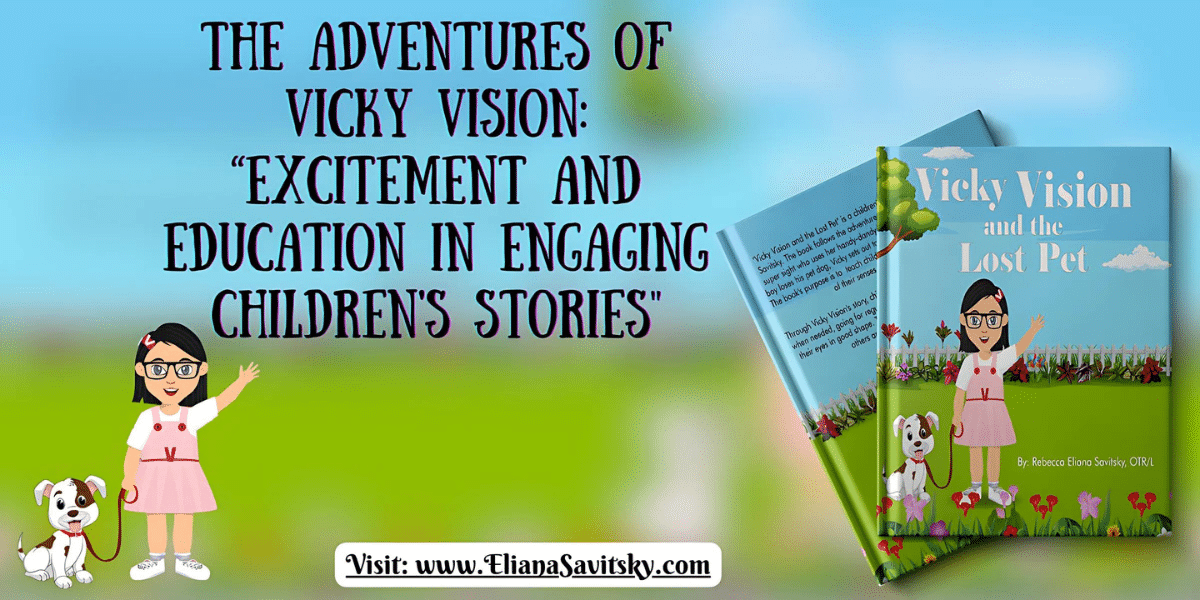
The Adventures of Vicky Vision: Merging Fun and Learning

By: Jason Gerber

Rebecca Savitsky’s creation, “Vicky Vision and the Lost Pet,” is a shining example of how children’s literature can effectively combine entertainment with educational content. 

Through the character of Vicky Vision, Savitsky introduces young readers to complex concepts related to sensory health, all wrapped in the thrill of adventurous storytelling. 

This article explores the unique elements of this book, emphasizing how it distinguishes itself by merging fun narratives with profound educational themes.

Unveiling a New Kind of Hero

Vicky Vision is a standout hero in the landscape of children’s books. Unlike traditional characters who might wield physical strength or magical powers, Vicky’s superpower is her extraordinary sight, enhanced by her glasses. This makes her relatable to children who wear glasses and serves as a stepping stone to discussing the broader topic of sensory health. Vicky’s adventures show that real heroism can come from understanding and embracing one’s unique abilities.

Crafting Engaging Stories Around Sensory Health

“Sensory health” might not sound like the most thrilling subject to a young child, but Savitsky’s storytelling prowess turns it into an enthralling theme. By integrating lessons about sight, hearing, and other senses into Vicky’s quests, the book makes these topics accessible and exciting. 

For example, Vicky’s mission to find a lost pet is not just a quest but an opportunity to illustrate how acute senses can solve real-world problems. This approach ensures that children learn important health lessons while absorbed in the story.

Emphasizing Empathy Through Narrative

A critical component of Vicky’s character is her empathy. This trait is woven throughout the narrative, teaching young readers the value of understanding and helping others. As Vicky helps a little boy find his lost pet, she demonstrates that one’s actions, driven by empathy, can positively impact those around. This storyline entertains and imparts important moral lessons about caring for others, making the story a tool for character education.

Interactive Learning: More Than Just Reading

Vicky Vision and the Lost Pet” is designed to be read and experienced. Savitsky encourages interactive engagement by posing questions and challenges based on the story’s context. This interactive element keeps young readers engaged and thinking actively about the story’s themes, such as how they would use their senses to help someone in need. It’s a dynamic way of learning that reinforces the educational content while keeping the fun alive.

A Gateway to Lifelong Curiosity

One of the most significant impacts of Savitsky’s work is its ability to spark curiosity about one’s sensory capabilities and health. Children are encouraged to think more deeply about their bodies and the care they require by framing these topics in a fun, story-driven context. This curiosity is the first step towards lifelong learning and awareness, which is essential for personal development.

Conclusion

Rebecca Savitsky’s “Vicky Vision and the Lost Pet” masterfully combines fun, adventure, and educational values, setting a new standard in children’s literature. This book is a journey that educates and inspires, especially ideal for parents and educators seeking a resource that entertains while it teaches.

Dive into the world of Vicky Vision with your young ones, and explore how fun storytelling can seamlessly integrate crucial life lessons. Get your copy of “Vicky Vision and the Lost Pet” today and join in on the adventures that make learning about sensory health exciting and memorable.

Visit: www.elianasavitsky.com


Published By: Aize Perez