Exploring the Powerful Medical Applications of Natural Substances Made With Cutting-Edge Science

By: Evexia Science

Millions of people struggle with various medical symptoms and are searching for viable solutions. Over-the-counter prescriptions have become a trusted source of relief, but many people are interested in exploring natural remedies. In a post-COVID world, society is branching away from traditional medicine and seeking support that may be less likely to cause side effects. Essential oils and other natural substances emerge as a potential panacea for these issues due to their affordability.

The wellness market is a highly lucrative sector that has become popular worldwide. In 2022, the industry was worth $5.6 trillion globally and is poised to reach $8.47 trillion in value by 2027. According to a report by McKinsey, consumers are shifting their focus away from fads and embracing the science behind natural remedies. This trend is positive as many ingredients within health and wellness products have little research showcasing their validity. In the report, McKinsey cites research from over 5,000 consumers, detailing that efficacy and scientific credibility are the two essential criteria for buyers. Additionally, millennials and Gen Z are investing more in health and wellness compared to older generations. This demonstrates the market’s capability to better provide innovative, in-demand products.

Justin Bosley, the founder of Evexia Science, is an advocate for creating products at the intersection of scientific and traditional medicine. As a chemist and nutritional scientist, he has always enjoyed finding ways to reduce pain, irritation, and other symptoms in the body. His background in chemistry and nutrition was inspired by his father, who was also a chemist, and his mother, who resonated with traditional Chinese medicine practices. 

From these roots, Justin formed a unique view of wellness that didn’t discount either side of the spectrum. In his eyes, it’s critical to equally leverage peer-reviewed scientific knowledge and age-old findings. Incorporating both of these methodologies enables companies to develop novel products that can greatly improve a client’s quality of life. 

Justin provides his opinion on the importance of balancing holistic and pharmacological principles when producing wellness products. “People are very interested in trying new things that can improve their quality of life, but companies should remember the benefits of harnessing natural ingredients and the power of scientific research,” he says. “This is a safer approach than following trends, and it will also enable more people to find products that provide maximum benefits. Evexia Science is championing this approach by embracing unique delivery methods.”

Justin founded Evexia Science, evexia meaning “wellness” in Greek, in 2021 to provide his personally developed formulas for people facing several uncomfortable symptoms. Justin was prompted to create natural products to alleviate his own medical difficulties. 

During college, Justin developed gingivitis and took an alternative route to manage his condition. Instead of using an alkalizing Waterpik, as the hygienist recommended, Justin brushed his teeth with baking soda, a natural mineral that would alkalize his mouth and protect it from tooth-eating acids. He later added various essential oils with anti-microbial studies to improve its results. At his six-month follow-up, the hygienist said his gingivitis was almost gone. When faced with an IBS diagnosis, Justin took a similar approach and created a product to improve his gut health using a combination of herbal extracts that had scientifically validated synergistic effects. 

Since making several of these natural products, Justin has perfected his strategy and released Bronchia Guard, Gut Reset, and The Honest Tooth

As society becomes more interested in proactively managing their health, the wellness market is expected to flourish. This sector can provide novel products that fill the gaps between conventional medicine while still utilizing scientific concepts. In this environment, companies like Evexia Science can have a significant impact on consumers. The company is hoping to expand its product catalog in the coming months. Overall, Justin wants to empower people to consider alternative products that may provide relief.


Published By: Aize Perez

Mastering Growth with Megan Alarid: A CEO’s Guide to TRUE Organizational Health

By: Maria Williams

In an era where companies are increasingly recognizing the importance of making a positive difference, Megan Alarid stands out as a visionary leader and strategic business guide. With over 25 years of experience in the field, Megan has dedicated her career to helping organizations unlock their full potential by aligning their strategies and operations with a meaningful, impactful mission. As Megan states, “When businesses are rooted in a positive purpose, they have the power to create incredible value not only for themselves but also for the world around them.”

The Transformative Power of Positive Impact

At the core of Megan’s philosophy is the belief that every organization has the potential to create significant value not only for its stakeholders but also for the world at large. She emphasizes that by focusing on making a positive impact, businesses can tap into a deep well of motivation, creativity, and resilience, enabling them to navigate challenges and achieve sustainable success. “When we align our work with a greater purpose, we unlock a level of energy, passion, and innovation that is truly transformative,” Megan explains.

Integrating Impact into the TRUE Organizational Health Framework

Megan’s innovative TRUE Organizational Health model, which has been successfully applied to over 55 companies, provides a comprehensive framework for embedding a positive impact mindset into every aspect of an organization’s functioning. The five key dimensions of the model -Culture, Company, Client, Category, and Cash – are all grounded in the organization’s commitment to making a meaningful difference.

By infusing this commitment into the fabric of organizational culture, Megan helps leaders cultivate workplaces where every individual feels valued, engaged, and motivated to contribute their best. “When people feel connected to a shared purpose, they are more likely to bring their whole selves to work and go above and beyond to make a difference,” Megan notes.

Operations are optimized to maximize both efficiency and positive impact. Customer relationships are deepened through shared values and a genuine desire to create value. Competitive strategies are informed by a clear understanding of the organization’s unique strengths and the difference it seeks to make. And financial management is guided by a long-term, sustainable vision of success that balances profitability with responsibility.

Empowering Leaders to Drive Positive Change

Megan’s approach to leadership coaching is rooted in the belief that leaders who are committed to making a positive impact are the key to unlocking organizational potential. “Great leaders inspire others to be their best selves and work together towards a common goal,” Megan shares. By helping leaders clarify their own values and align them with their organization’s mission, Megan enables them to become more authentic, inspiring, and effective in their roles. Through one-on-one coaching and team workshops, she guides leaders in developing the mindsets, skills, and strategies needed to create a culture of positive impact throughout their organizations.

The Ripple Effect of Impact-Driven Organizations

The influence of Megan’s impact-driven approach extends far beyond the organizations she works with directly. By helping businesses become more aligned, engaged, and responsible, she is contributing to the creation of a more sustainable and equitable business ecosystem. As more and more organizations embrace the power of positive impact, they have the potential to drive meaningful change on a global scale, addressing societal challenges and creating value for all. “When businesses lead with purpose, they have the opportunity to be a force for good in the world,” Megan reflects.

For leaders who aspire to build successful organizations that make a lasting, positive difference, Megan Alarid’s Heightened Leaders offers a proven path forward. By aligning strategies with a meaningful mission and empowering teams to create change, leaders can unlock their organizations’ full potential and leave a legacy of impact. As Megan puts it, “Embracing the power of positive impact enables leaders to create organizations that are both successful and deeply meaningful – an invitation to shape a better future for all.”

To find out more about Megan Alarid and how her TRUE Organizational Health™ model can transform your business, visit her website. Follow her journey and get insights on leadership and business growth on her social channels: LinkedIn, Instagram, and Facebook.

Stay connected with Megan to explore how she can guide your business toward sustainable success and TRUE Organizational Health™.

Published by: Nelly Chavez

Mastering the Art of Fly Selection: Wooly Buggers, Dry Flies, and More

If someone says fly fishing is easy, let them use a grasshopper fly in the middle of winter. While a grasshopper might be a tasty treat for a summer trout, it wouldn’t stand a chance against the frosted breath of a fish in February! Kidding aside, this highlights the crucial and often underestimated skill of fly selection in the art of fly fishing. 

This guide will help you master the art of fly selection and understand what type of fly to use in different fishing conditions. Should you use a wooly bugger for topwater fishing? Or would a dry fly be the better choice? Discover the answers right below.

Understanding the Different Types of Fly Fishing Flies

Mastering the Art of Fly Selection- Wooly Buggers, Dry Flies, and Mores

Photo: Unsplash.com

There are three main types of flies that fly fishers use: aquatic, terrestrial, and dry. Aquatic flies often imitate insects that live in the water. Terrestrial flies mimic land insects that might fall onto the water’s surface (a.k.a. topwater). Dry flies imitate insects that have hatched and are struggling on the water’s surface.

Aquatic flies are then split into three categories based on the life stage of insects: nymphs, emergers, and streamers. 

Nymphs: Nymph flies mimic the immature stages of aquatic insects such as mayflies, stoneflies, or caddisflies. They typically have a streamlined body with gills and leg casings, resembling natural nymphs living on the bottom of the stream or riverbed. 

Emerger: As nymphs become adults, they typically struggle on the water’s surface due to their developing wings. Emerger flies feature a nymph-like body with emerging wings, mimicking a vulnerable stage for insects that fishes usually target.

Streamer: Streamers are elongated flies that imitate baitfish or larger aquatic insects like leeches. They copy the movements of prey that fish actively hunt by sinking and swimming just below the water. A popular example of a streamer fly is the wooly bugger. Wooly buggers come in various colors and sizes, but they generally have a long marabou head and a bead head.

Next are the two types of topwater flies: Terrestrial and Dry. 

Both terrestrial and dry flies entice fish to feed on the water’s surface. Terrestrial flies imitate land insects like grasshoppers or ants that might have fallen in. Dry flies, on the other hand, mimic adult aquatic insects like mayflies or caddisflies that have just hatched and are floating on the surface. 

Matching the Hatch: Understanding What Fish Eat

Mastering the Art of Fly Selection- Wooly Buggers, Dry Flies, and More

Photo: Unsplash.com

Matching the Hatch is a crucial concept in fly selection. It means choosing flies that resemble the insects fish are actively feeding on at that specific time. Here are some tips to determine which fly you should use:

Observe the Water: Monitor the water’s surface for rising fish. This behavior often means they’re feeding on emerging insects. Use an emerger fly.

Examine the Bank: Check the banks and surrounding vegetation for recently emerged insects like mayflies or caddisflies. Once you spot them, consider using a dry fly.

Utilize Hatch Charts: Hatch charts contain a list of insects likely to be hatching on a specific body of water. Identify these spots and use a nymph fly.

Beyond the Basics: Additional Factors for Fly Selection

While understanding the hatch is crucial, other factors can influence your fly selection for specific fishing conditions. Consider checking:

  • Water Clarity: Opt for smaller, natural-looking flies in clear water. Use muted colors and subtle profiles in pressured waters.
  • Fish Size: Match the fly size to your target fish. Try to start with a smaller fly and work your way up from there.
  • Current Speed: Use heavier flies such as weighted nymphs and streamers for fast currents. For slow currents, use lighter flies with a smaller profile, such as dry flies and small nymphs.

Consider packing various fly types, sizes, and colors to maximize your fly fishing success. Always observe the water for clues, and don’t be afraid to experiment with different flies until you find what works. You may also want to track what works to refine your approach. Lastly, practice your casting to ensure flies land gently and realistically.

Mastering Fly Selection

There is no single way to master fly fishing. Experiment with different types, observe the water and seek advice from experienced anglers. Once you’re more familiar with choosing the right flies, you may want to experiment with your fly rods to see which suits your fly fishing technique best. 

Level up your fly fishing gear with Trident Fly Fishing! Aside from excellent gear, Trident also provides expert recommendations, high-quality selections, and fly-tying classes.

With this guide and Trident Fly Fishing’s support, you can cast your flies confidently and be well on your way to landing trophy catches.

Published by: Nelly Chavez

Tips for Launching a Successful Hoodie Printing Venture

In the bustling world of custom apparel, hoodies hold a special place. Not just for their comfort and versatility, but for the canvas they offer to express creativity. Whether you’re an entrepreneur eyeing the lucrative market of custom hoodies or an artist wanting to wear your art literally on your sleeve, navigating the hoodie printing business can be both exciting and daunting. This comprehensive guide will walk you through key strategies to ensure your venture not just survives but thrives in this competitive space.

Understanding Your Market

Before you dive headfirst into printing, take a step back and analyze the market. Who are you selling to? Teenagers, college students, or corporate teams? Each demographic has unique preferences, from design aesthetics to hoodie quality. Tailoring your products to your target audience’s tastes can significantly increase your appeal and sales. Remember, the more you know your audience, the better you can serve them.

Choosing Quality Material

The base of any great hoodie is the material it’s made from. A well-made hoodie that feels good to wear can transform a customer into a repeat buyer and even a brand advocate. Focus on sourcing high-quality fabrics that offer comfort and durability. While it’s tempting to cut costs here, remember that a premium product can command a higher price and foster a loyal customer base.

Mastering Printing Techniques and Equipment

The heart of hoodie customization lies in the printing technique and equipment used. Each method, from screen printing to direct-to-garment (DTG) printing and DTF printing, has its own set of advantages. Screen printing, for instance, is cost-effective for large orders and offers vibrant, long-lasting colors. DTG is ideal for complex designs with multiple colors and gradients but is more cost-effective for small orders due to its lower setup costs. DTF (direct-to-film) printing, on the other hand, offers the allure of vibrant, detailed designs on a wide array of fabrics, including the varied textures of hoodies with its unique DTF ink. It sets itself apart by its exceptional durability and quality, ensuring that each piece remains as vivid and expressive after multiple washes as it was on the first day.

The choice of printers is equally crucial. High-quality printers can be a significant upfront investment but are pivotal for producing top-notch products. Research and invest in printers known for their precision and durability. Remember, the quality of your prints can make or break your reputation in the market.

Innovating Designs

In a market flooded with generic designs, originality can set you apart. Invest time in creating unique, eye-catching designs that resonate with your target audience. Whether it’s witty quotes, artistic illustrations, or trendy patterns, captivating designs can be the difference between a hoodie that sells out and one that languishes on shelves. Collaboration with local artists or influencers can also inject fresh perspectives and increase your brand’s visibility.

Pricing Strategies

Pricing can be a delicate balancing act. Set it too high, and you risk alienating potential customers; too low, and you might undermine your brand’s perceived value. Conduct thorough market research to understand the pricing landscape. Consider factors like production costs, competitor pricing, and perceived value to your target market. Offering tiered pricing based on customization levels can also appeal to a broader audience by catering to varying budget constraints.

Marketing Your Brand

In today’s digital age, a robust online presence is non-negotiable. Utilize social media platforms to showcase your designs, share customer testimonials, and engage with your audience. Building a visually appealing and user-friendly website can also enhance your brand’s professionalism and credibility. Consider employing SEO strategies to improve your visibility online. Additionally, don’t underestimate the power of word-of-mouth; encourage satisfied customers to spread the word about your brand.

Leveraging Technology for Efficiency

As your business grows, manual processes can become a bottleneck. Implementing technology solutions for order management, inventory tracking, and customer relations can streamline operations and improve efficiency. This not only saves time but also reduces the likelihood of errors, ensuring a smoother customer experience.

Offering Exceptional Customer Service

Last but certainly not least, exceptional customer service can be your strongest differentiator. Be responsive, solve issues promptly, and go above and beyond to meet customer needs. Remember, a happy customer is not just a repeat buyer but also an ambassador for your brand.

Final Remarks

Starting a hoodie printing business presents a fertile ground for entrepreneurs and creatives alike. By understanding your market, choosing quality materials, mastering printing techniques, innovating designs, and focusing on customer satisfaction, you can build a brand that stands the test of time. Remember, success in this industry doesn’t just come from selling a product but from creating an experience that resonates with your customers. With passion, perseverance, and a focus on quality, your hoodie printing venture can grow from a budding startup to a flourishing brand.


Published by: Khy Talara

Which Is Worse for the Environment—Petrol or Diesel?

The longstanding debate between the environmental impacts of petrol and diesel vehicles continues to be a hot topic among environmental activists, policymakers, and the public, including car owners. With the urgency of climate change pressing on the world’s collective consciousness, understanding the ecological footprint of our transportation choices is more critical than ever.

Diesel’s Dilemma

Modern diesel engines have been lauded for their fuel efficiency and lower carbon dioxide (CO2) emissions compared to their petrol counterparts. Diesel, despite its efficiency, has been under severe scrutiny for emitting higher levels of certain pollutants. One of the most dangerous is nitrogen oxide (NOx), which is a significant contributor to smog and respiratory problems.

In addition to NOx, diesel engines emit more particulates, tiny soot particles that can penetrate deep into the lungs and bloodstream. The health risks and environmental impact these particulates pose are substantial, leading to adverse health effects and contributing to global warming.

The technology aimed at cleaning diesel emissions, such as particulate filters and selective catalytic reduction, helps reduce these pollutants, but these are not foolproof solutions. Complex and often expensive maintenance can lead to less efficient operation and higher emissions as cars age.

Petrol’s Predicament

While diesel engines outdo petrol engines in terms of CO2 emissions, petrol engines take the lead regarding cleaner air quality. Cars running on petrol produce fewer NOx emissions and almost no particulates when compared to diesel.

However, as highlighted by reports, the environmental edge of gasoline vehicles fades when considering their lower fuel efficiency and higher CO2 emissions per litre of fuel burned. CO2 is a significant contributor to global warming, and although petrol engines are accountable for less direct air pollution than diesel, their contribution to the planet’s increasing temperature can’t be ignored.

Furthermore, the production and refinement process of petrol also has environmental implications, often requiring more energy and resulting in more total emissions than diesel fuel production.

A Blow to Diesel’s Reputation

The Dieselgate scandal remains one of the automotive industry’s most significant controversies, where certain manufacturers were found to have installed defeat devices in diesel cars to cheat emission tests. Volkswagen, BMW, and MINI emissions exceeded legal limits. levels This malfeasance not only led to a massive loss of consumer trust but also brought to light the actual environmental cost of diesel emissions.

The scandal prompted tighter regulation and testing, resulting in a market shift as consumers and manufacturers alike became more reserved about diesel. Dieselgate resulted in billions of fines and thousands of diesel emission claims from affected car owners. Moreover, it amplified the conversation around the need for alternative fuels and the potential of electric vehicles, which further put diesel in an unfavourable light.

Despite the scandal, it is necessary to understand that modern diesel cars have made significant advancements in reducing emissions. However, for environmental activists and informed consumers, the issue of trust and the long-term environmental cost remain predominant concerns. The question is not just about the emissions, but the ethics of reporting and regulations that govern the industry. For further reading about this issue, go to Claimexperts.co.uk.

Technological Advancements and Future Prospects

Technological innovations in diesel engineering strive to address the emissions issue, with manufacturers introducing cleaner, ‘greener’ models equipped with catalytic converters and efficient exhaust treatment systems. Meanwhile, the diesel industry continues to explore alternative fuels, such as biodiesel, which produce fewer emissions. The versatility of diesel engines to adopt these fuels may give them a significant role in the transition away from fossil fuels.

The future for petrol engines also looks promising, with the development of hybrid technologies that combine internal combustion engines with electric motors to reduce fuel consumption and CO2 emissions. These advancements demonstrate a commitment to evolving the traditional petrol engine into a more environmentally friendly option.

The rise of electrically assisted turbocharging, direct fuel injection, and variable valve timing – all geared towards making petrol engines cleaner and more efficient – highlights the industry’s efforts to minimise petrol’s carbon footprint.

Making an Environmental Choice

When choosing between petrol and diesel, the decision is nuanced and depends on multiple factors, including driving habits, vehicle maintenance, and advancements in engine technology.

The distinction between which is worse for the environment is becoming less clear-cut. The debate has shifted from a simple binary to a complex discussion acknowledging advancements in both arenas. While system-wide changes are indispensable, individuals can also make impactful choices – opting for more efficient modes of transportation, holding car manufacturers accountable, and staying informed on environmentally responsible practices.

Ultimately, it is not solely about choosing between diesel or petrol; it’s about embracing the move towards more sustainable alternatives, including hybrid, electric vehicles (EVs), and alternative fuels that promise a cleaner future for transportation.

Deciding to invest in either petrol or diesel should include consideration of not just personal needs but also one’s environmental responsibility. As the discussion continues to evolve, so too should our transportation preferences, aligning closer with the health of our planet. 

Published by: Holy Minoza

The Future of Gifting: Exploring the Rise of E-Gift Cards and Virtual Shopping Experiences in 2024

Introduction

Stepping into 2024, the culture of gifting is witnessing a significant transformation, underscored by the increasing prominence of e-gift cards and virtual shopping experiences. This evolution mirrors broader social, technological, and environmental trends, highlighting the adaptability and innovation in how people celebrate and appreciate one another. From eco-conscious choices to tech-savvy solutions, the modern approach to gifting aligns with evolving lifestyles and values.

E-gift cards have become a cornerstone of contemporary gifting, offering unmatched convenience and flexibility. They cater to a diverse array of interests, from gourmet foods and wines to books and beauty products, ensuring that there’s something for everyone. The digitalization of shopping and gifting processes allows for more nuanced and personalized gift selections, driven by a growing preference for experiences over material possessions. This shift towards meaningful and memorable interactions is reshaping gifting habits.

What is a Gift Card?

Transitioning from paper certificates to the digital realm, gift cards have undergone a significant evolution. Initially popularized by leading retailers, they were prone to fraud in their early days. However, the advent of plastic and, subsequently, digital e-gift cards has changed the way people think about gift-giving. By 2018, the U.S. retail gift card market had exploded to a $160 billion industry annually, with digital gift cards topping holiday wish lists for their convenience and flexibility.

The Rise of E-Gift Cards in 2024

The digital gift card market has experienced unprecedented growth, particularly in light of the pandemic’s push towards online services. Tillo’s report of a 117% increase in Full Value Sent (FVS) between 2019 and 2021 highlights the booming “food on demand” segment, among others. E-gift cards are prized for their instant delivery and redemption, personalization capabilities, and the convenience they offer to both givers and recipients. For instance, platforms like GiftCardMall not only facilitate the purchase and sending of e-gift cards but also allow users to easily check GiftCardMall balance online, adding another layer of convenience.

Why are Gift Cards an Effective Marketing Tool in 2024?

Gift cards serve as a potent marketing tool, driving additional spending and attracting new customers. They can be strategically used in promotions, loyalty programs, and brand awareness campaigns, effectively drawing consumers into a brand’s ecosystem. The versatility of gift cards as a marketing instrument is evident in their ability to foster customer acquisition and retention, making them invaluable to businesses looking to enhance their market presence. Implementing strategies for gift card marketing, such as leveraging them in loyalty programs or targeted promotions, can significantly enhance a brand’s visibility and customer engagement.

Why Invest in Gift Card Campaigns?

The strategic deployment of gift card campaigns can significantly boost a business’s ROI, driving sales and bolstering brand awareness. For instance, 65% of consumers report being more likely to visit businesses that offer gift cards, often spending beyond the card’s value. This consumer behavior underscores the appeal of gift cards as a preferred gift choice, highlighting their potential to enhance a business’s revenue and customer engagement.

Effective Strategies for Gift Card Marketing

  • Leverage in Loyalty Programs: Incorporate gift cards as rewards to foster loyalty and encourage repeat business.
  • Targeted Promotions: Use specialized landing pages and SEO optimization to increase visibility and drive traffic.
  • Direct Communication: Employ email marketing to engage potential buyers with personalized offers.

PRO TIP: Maximize exposure by showcasing gift cards both in-store and online. This dual strategy enhances convenience and drives sales, making it easier for customers to access and purchase gift cards.

The Benefits of Gift Card Campaigns

Gift card campaigns offer numerous advantages for businesses and consumers alike. For businesses, they serve as an effective tool for boosting brand awareness and driving sales. Implementing gift cards as part of a loyalty program or as rewards for referrals can significantly enhance customer loyalty and retention. Additionally, gift cards can help manage customer returns more efficiently by offering them store credits, which can mitigate the negative impact of returns on sales.

What is an Occasion Gift Card?

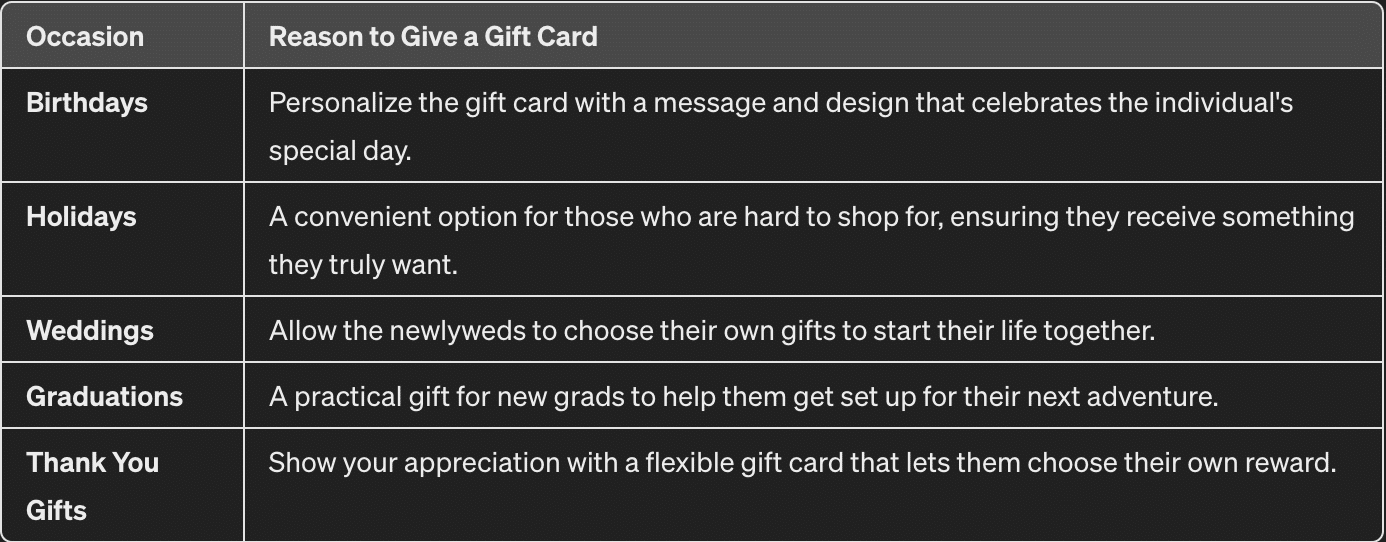
Occasion gift cards are specialized gift cards tailored to specific events or milestones, such as birthdays, holidays, or anniversaries. These cards offer a level of customization and personalization that generic gift cards do not, making them a thoughtful and convenient gift choice. Businesses can customize these cards with unique designs, messages, and themes relevant to the occasion, enhancing the gift-giving experience.

How Do Occasion Gift Cards Work?

Occasion gift cards streamline the gift-giving process by allowing the giver to select, personalize, and send e-gift cards with ease. Purchasers can choose from a variety of designs that cater to specific occasions, adding a personalized message to make the gift more meaningful. These e-gift cards can then be sent directly to the recipient’s email or phone, ensuring they receive a thoughtful present without the need for physical delivery.

The integration of e-gift cards with social media and event planning tools further simplifies the process, enabling users to share their gifts across platforms and coordinate gift-giving for events seamlessly​​​​.

The Future of Gifting: Exploring the Rise of E-Gift Cards and Virtual Shopping Experiences in 2024

Advantages of Choosing Occasion Gift Cards

Occasion gift cards offer unparalleled convenience and flexibility, making them an ideal choice for both givers and recipients. They remove the guesswork from gift-giving, ensuring recipients receive something they truly want or need. This convenience is particularly appreciated during busy holiday seasons or when time is limited. Additionally, the ability to personalize e-gift cards with messages or photos adds an emotional value that cannot be matched by traditional gifts.

For the recipient, the wide acceptance of e-gift cards means they can shop from their favorite stores or explore new ones, whether online or in-store.

Occasion Gift Cards Sent Anywhere in The World

The global reach of e-gift cards has made international gift-giving simpler and more immediate. Platforms offering a wide selection of e-gift cards in various currencies ensure that no matter where your loved ones are, you can make their special occasions memorable.

PRO TIP: For international gifting, choose e-gift cards in the recipient’s local currency to avoid exchange fees and ensure a seamless shopping experience.

Discover Gifts For Your Favorite Event Planner

Choosing the perfect e-gift card for event planners involves understanding their needs and preferences. Platforms offering a wide range of brands provide the flexibility to select a gift that aligns with the planner’s personal or professional interests, whether it’s for decor, tech, or relaxation.

Conclusion

The evolution of e-gift cards and virtual shopping experiences marks a significant shift in the landscape of gift-giving as we look toward 2024. These digital solutions offer convenience, flexibility, and a broad selection, making them a popular choice for a variety of occasions.

As the gifting industry continues to grow, the trend toward personalized, experience-based gifts is becoming increasingly pronounced, reflecting a desire for meaningful connections and sustainable practices. The future of gifting lies in innovative, environmentally conscious, and technologically integrated solutions that cater to the evolving needs and values of givers and recipients alike.


Published By: Aize Perez

David Bragg’s Journey: Revolutionizing Tech Education with FES Institute

In a world where the digital revolution has transformed every aspect of our lives, the path to success within the tech industry is often portrayed as a linear journey marked by prestigious degrees and a plethora of certifications. Yet, David Bragg’s journey tells a different story—one of resilience, self-learning, and an unwavering commitment to democratize technology education through the FES Institute, an e-learning platform that is reshaping the way individuals approach coding and tech education.

At the heart of this transformation is David Bragg, the founder of FES Institute. His story is nothing short of inspirational. At 19, Bragg found himself ensnared in the throes of video game addiction, a common plight among youth worldwide. Yet, unlike many, he chose to confront his situation head-on. Working a mundane job at a grocery store, Bragg made a pivotal decision that would set him on an unconventional path to success. He replaced gaming with coding, dedicating himself to mastering the craft. Within a year, Bragg had not only broken free from his addiction but also secured a coveted software engineering position at a billion-dollar company, all without the traditional academic credentials often deemed necessary in the tech world.

Inspired by his journey and driven by a passion to make a tangible difference, Bragg founded the FES Institute. The institute stands as a beacon of innovation in tech education, offering a radical promise: a guaranteed coding job within 12 months of enrollment. This bold pledge is underpinned by a comprehensive support system, including personalized mentorship from top tech professionals. The institute’s approach is not merely about imparting technical knowledge; it’s about fostering a supportive learning environment that prioritizes student success above all.

The uniqueness of FES Institute lies in its deeply ingrained culture of care. In an industry where educational institutions often prioritize profit over pupil success, FES Institute distinguishes itself by its commitment to student outcomes. This is exemplified by their extraordinary guarantee—if a student does not secure a tech job within a year, they not only receive a refund but are also awarded an additional $1,000. Such a policy underscores the institute’s confidence in their methodology and their unwavering belief in their students’ potential.

David Bragg’s personal achievements and his dedication to sharing his success story have garnered a significant following, with over 300,000 followers on TikTok alone. His transparency and the tangible results achieved by over 4,000 students speak volumes about the efficacy of the FES Institute’s approach. The institute has facilitated remarkable success stories, from teenagers securing lucrative coding positions to individuals transitioning from gig jobs to prestigious roles in major corporations.

What sets FES Institute apart is not just its innovative educational model or its commitment to guarantees unheard of in traditional education. It’s the underlying ethos of care, personal growth, and community. Through personalized mentorship, hands-on internship opportunities, and a curriculum designed for real-world relevance, FES Institute is not just educating; it’s empowering a new generation of tech professionals.

In examining the trajectory of David Bragg and the FES Institute, it becomes clear that their success is rooted in a genuine desire to uplift and transform lives through education. In a landscape filled with educational models, FES stands out for its ethical approach and its profound impact on individuals seeking to navigate the tech industry’s complexities. For those pondering the legitimacy and value of the FES Institute, the answer lies in the transformative journeys of its students and the visionary leadership of David Bragg. Through innovation, care, and a dedication to student success, FES Institute is indeed a pivotal force in the realm of tech education, setting a new standard for what is possible in the digital age.


Published by: Khy Talara

Innovative Product Designer Sweeps Industry Awards, Propelling Sustainable Innovation

Yang Cheng, a visionary product designer, has been making waves in the realms of EdTech, FinTech, and Generative AI with a trailblazing career marked by innovative solutions and transformative designs. With a keen eye for simplifying complexity and a knack for storytelling, Cheng has revolutionized user experiences across various platforms, leaving an indelible mark on the digital landscape.

Cheng’s most recent roles as a Funding Product Designer at CharacterStrong and a Product Designer at the United Nations Children’s Fund (UNICEF) showcases her capabilities in driving impactful change through design. At UNICEF, Cheng played a pivotal role in leading design for 10+ major features for 20M+ monthly visitors across 126 global sites in 5 languages, including navigation redesign, tag-based result experience redesign. As a result, it significantly reduced bounce and exit rates and increased visitor satisfaction, Cheng spearheaded the redesign of UNICEF’s design system, ushering in a new era of efficiency and collaboration.

Prior to her tenure at UNICEF, Cheng served as a Product Designer at OpusClip, where she leveraged her expertise in Generative AI to optimize video editing processes and enhance brand consistency. Her contributions led to streamlined workflows and improved editing efficiency, earning accolades for her meticulous attention to detail and user-centric approach.

In the realm of FinTech, Cheng’s impact is equally profound, as evidenced by her work at Ark7, a real-estate investment platform. By leading the design of innovative rewards and learning features, Cheng achieved remarkable results, including a 42% increase in conversion rates and a 24% boost in user engagement. Her agile approach to prototyping and A/B testing ensured that user feedback was integrated seamlessly into the design process, resulting in a product that resonated deeply with its audience.

Cheng’s journey towards becoming a design luminary began with a Master’s degree in User Experience Design from Pratt Institute, followed by a Masters degree in Adult Learning and Education from the University of British Columbia. Her academic achievements have been complemented by an impressive array of awards, including the European Product Design Award, Red Dot Design Award, and International Design Awards, cementing his status as a preeminent figure in the design community.

As a visionary product designer, Yang Cheng also captivate the design world with a string of prestigious recognitions, underscoring her commitment to innovation and sustainability. Cheng’s remarkable achievements include winning multiple awards, notably the 2022 European Product Design Awards, with the project “Miles Trips Page Design” she worked as one of the key design team members.

The award-winning “Miles Trips Page Design” epitomizes Cheng’s dedication to creating user-centric solutions that address pressing societal challenges. Serving as the cornerstone of the “Miles” universal reward app, the design seamlessly integrates eco-friendly commuting practices into users’ daily lives, fostering sustainability and environmental consciousness.

The design brief for “Miles” underscores its mission to incentivize greener forms of travel, offering tangible rewards for eco-conscious behavior. The Trips Page design, a standout feature of the app, showcases Cheng’s ingenuity in ‘Trip Differentiation,’ allowing users to split single journeys into multiple trips or merge various trips into one cohesive journey. Through creative interactions and intuitive visual communication, Cheng has crafted an immersive user experience that empowers city dwellers to embrace a greener lifestyle effortlessly.

Cheng’s success extends beyond the realm of sustainable mobility, with her designs earning recognition across diverse industries and platforms. His groundbreaking contributions to product design have garnered acclaim from esteemed organizations such as the European Product Design Awards, Red Dot Design Award, and International Design Awards, solidifying her reputation as a trailblazer in the field.

As Cheng’s illustrious career continues to unfold, her commitment to pushing the boundaries of design innovation remains unwavering. With each project, she seeks to redefine the possibilities of technology while advocating for sustainable practices that benefit both users and the planet.

Published by: Holy Minoza

Discovering the Benefits of Studybay for Assignment Assistance

College brings a constant onslaught of challenging writing assignments – essays, research papers, lab reports, technical documentation, and more. With the mounting academic workload, many students need expert writing support to tackle complex tasks, meet deadlines, and maintain high grades.

Studybay is a professional online assignment writing helper for university students seeking help with assignments. With a vast network of academic experts spanning various fields, it connects students with qualified professionals online who can provide expert assignment help. Here are some reasons why using Studybay’s service can be invaluable:

Broad Expertise Across Disciplines

No matter how niche or interdisciplinary your assignment topic is, Studybay has specialists who can assist. Their network includes over 50,000 writers with advanced degrees and direct subject expertise spanning thousands of academic disciplines.

From highly technical STEM fields like engineering, computer science, and data analytics to liberal arts like history, literature, and communications, you’ll find knowledgeable experts ready to help and with real-world proficiency in their areas, not just general writing abilities. This ensures your work receives appropriate context, jargon, citations, and depth.

Student-Oriented Customer Care

Studybay emphasizes a consultative experience and customer support model tailored for students. They understand the unique stresses and challenges students face in juggling academic obligations.

Their support team communicates responsively and can address concerns throughout the assistance process. Professionals walk you through services, pricing, and expert matching details and even mediate if miscommunications or roadblocks occur.

Qualified Professionals

Studybay has an intensive vetting process that ensures only highly qualified experts gain access to their platform. Each prospective employee undergoes a rigorous screening of their academic credentials, published works and teaching/research experience before approval.

Studybay allows only genuinely proficient subject-matter experts to join the team, not just people looking to make money with lackluster skills. You can be confident that the expert assigned to your project has true mastery. Their work elevates your understanding and analysis rather than cutting corners.

24/7 Support

Academic writing projects often have inflexible deadlines set by course professors. Assignment services operate around the clock, so their experts are always available to accommodate your schedule—not the other way around.

No matter if you need help with in-depth research at 3 a.m. or a last-minute citation refresh before an 8 a.m. submission deadline, there will be professionals online and ready to help instantly. The 24/7 availability prevents compromising assignment quality due to time crunches.

Customized Approach

Every student’s writing assignment has unique requirements in terms of content, structuring, analysis, arguments, formatting, and more. Studybay experts take a variety of approaches. Instead, they customize their methodology for each specific project’s parameters.

Before beginning work on your assignment, the expert will consult with you directly to understand key deliverable expectations like:

  • Your professor’s instructions and requirements
  • The assignment’s purpose, themes, and target audience
  • Your ideas, opinions, and perspectives
  • Preferred outlining, structure, and organization
  • Formatting specifics for citations, visuals, headings, etc.
  • The established voice, writing style, and tone


The expert then tailors their process accordingly, ensuring the final product aligns with your vision, not just general academic standards. You maintain control over the whole process.

Transparency and Guidance

Assignment service professionals prioritize transparency and communication throughout this process rather than working in a black box.

In the initial consultation, the expert will outline their plan and proposed workflow so you understand every step. Items like the research process, outlining, drafting schedules, revision cycles, and final output are all mapped out cooperatively.

As collaboration progresses, experts provide updates and request feedback to keep you looped in. They explain the rationales behind phrasing and content choices while remaining open to your suggestions and adjustments. You have complete visibility into the work in real time.

Time and Budget Flexibility

Studybay structures its assignment assistance services to be flexible and accommodate student situations and budgetary constraints.

You can purchase assistance as a single, affordable transaction for individuals and one-off assignments like essays or reports. Experts deliver quality help on a turnaround time that suits your deadline. For larger, long-term projects like dissertations and theses, it offers split payment methods that will be useful for students on a tight budget.

Simplified Matching

Finding the perfect expert suited for your specific academic project is accessible through the streamlined platform. Their assignment details form captures all essential information needs upfront:

  • Subject area and assignment type (essay, research paper, etc.)
  • Other requirements like length, sources, and instructions
  • Formatting guidelines for citations, visuals, and layout
  • Assignment deadline and completion timeframe


Based on your criteria, intelligent matching algorithms identify qualified professionals from their network whose specialties align. This curated selection process ensures you connect with the right person prepared to execute your project successfully while removing guesswork.

Quality Checks

It has rigorous quality control and assurance systems to deliver work meeting your academic standards every time. This multi-stage process includes:

  • Intensive proofreading, editing, and formatting reviews
  • Plagiarism screening against databases to verify 100% originality
  • Citation and referencing checkers to validate proper source use
  • Structural and logical flow analysis by senior academic editors
  • Final evaluations, ensuring all customer requirements were addressed


If any element of the completed work fails to meet your expectations, Studybay provides revisions until you are delighted – no loopholes or fine print. Their quality prioritization process upholds integrity.

From technical assignments to admission essays, research projects, lab work, exam prep, and more, Studybay provides access to verified subject-matter experts who prioritize your long-term learning growth. In the demanding higher education landscape filled with intensifying workloads, partnering with a reliable support network can be invaluable.

Resources


Published By: Aize Perez

Influence of Generative AI on the Animation Industry: An Interview with Alex Safavinia

By: Elena Mart

The animation industry is currently undergoing changes. With the rise of intelligence tools like Sora from OpenAi, there is a lot of speculation about how this technology will reshape the landscape of video production and its impact on human animators. Alex Safavinia, the CEO of Kasra Design®, an acclaimed animation studio, delves deep into the possibilities that AI brings to the field of animation in an insightful interview. This article will explore how AI influences workflows, job stability and the essence of storytelling in animation. The conversation will touch upon both the obstacles and opportunities that come with integrating AI technology into animation pipelines and how studios are adapting to this era in their creative processes.

Hey Alex, could you share a bit about how you got started in animation?

Alex Safavinia: After I finished my multimedia degree in 2009 I dived into the world of animation, just as it was gaining momentum. At that time, explainer videos were really taking off among businesses and startups in Silicon Valley. Recognizing the growing demand for animation services during this period, I decided to launch my own company. It’s been a journey to witness our growth over the years, from collaborating with Fortune 500 companies to establishing a new office in Singapore. It’s truly remarkable to see how animation has become increasingly popular across industries.

People are talking a lot about this AI tool named Sora from OpenAI. Why is that?

Alex Safavinia: Sora has definitely caught the attention of folks in the animation world, myself included. It’s like having an AI-powered video wizard at your disposal. You simply describe a scene in language, press enter, and voila! Sora brings it to life, whether as an animation or even real-life footage. This tool is a game-changer for creating content. You can churn out videos quicker and smoother than before. The best part? Sora can take your ideas and transform them into visually stunning creations. However, as with any technology, there are mixed emotions within the creative community.

What challenges did animation studios face prior to the emergence of AI video creators?

Alex Safavinia: Recruiting top-tier talent has always been a challenge, like trying to uncover a treasure! This is especially true depending on the location of your recruitment efforts. The animation industry thrives on individuals who possess a blend of creativity and technical expertise. However, let’s face it. Not everyone is naturally gifted in animation despite the increasing number of schools and courses. Only a small percentage, around 10% possess the ideal mix of talent, skills and commitment needed to truly stand out on a global level.

Furthermore, while educational institutions teach the fundamentals of animation, they often fall short in providing students with the skills required to immediately succeed in the real world. This gap between academia and industry often leaves graduates ill-prepared for their careers. As a result, animation studios invest time and resources into training and mentoring new employees. It’s not about mastering the technical aspects; it’s about nurturing creativity, problem-solving capabilities, and teamwork essential for thriving in this competitive and constantly evolving field.

Is there cause for concern among animators regarding the capabilities of Sora?

Alex Safavinia: While the demos are impressive, we’re not entirely sure of its capabilities or how much control we’ll have over our creations. Should animators be worried? It’s a bit of a bag. There are concerns regarding ownership of projects and if our work is stored in a database anyone with access could potentially replicate it hindering innovation. 

Let’s not overlook the significance of human input. Not everyone possesses the skill to create animations that truly align with a company’s requirements.

Wait, let’s not rush to conclusions. Although Sora may bring about changes, there isn’t evidence yet of it producing top-tier animations every time. Who knows, perhaps it could even streamline our concept development and production processes.

Copyright and AI-generated content have sparked discussion. What are your views on this matter?

Alex Safavinia: It’s a topic for valid reasons. The issue lies in how copyright intersects with AI-generated content, especially when AI is trained using artists’ creations. It’s an area due to the limited disclosure from AI companies regarding their training methods. Without openness, it’s challenging to determine the extent of copyrighted material utilized in training these AI models.

Another intriguing aspect is how these AI systems react to prompts mentioning artists. When an artist’s name is included in an AI prompt, the system can produce content that emulates that artist’s style. This raises queries about whether such actions constitute copyright violation even if the AI-generated output is not an exact copy of the original artwork. On the side, AI companies may argue that their creations are entirely novel and do not infringe on copyrights. However, this argument brings up considerations regarding the intricacies of copyright law and ethical dilemmas surrounding using artists’ works in AI training.

Can you identify any advantages to this evolving technology within your field?

Alex Safavinia: Absolutely! There are benefits to embracing this rapidly progressing technology within our industry.

For example, let’s consider the impact of incorporating AI tools like Sora into software such as After Effects, Blender and Cinema 4D. It’s truly a game-changer. By empowering designers and animators to create and enhance 3D models or 2D animations, we can revolutionize the content creation process like never before.

What guidance would you offer to aspiring animators who are concerned about AI potentially replacing their roles?

Alex Safavinia: It’s premature to view it as a threat at this point. However, I would suggest immersing yourself in learning about AI and embracing every chance to explore AI platforms that come your path. While AI may automate aspects of animation tasks remember that it still relies on an artist’s creative vision to truly flourish. Moreover, who’s to say? Integrating AI could become a practice in animation software sooner rather than later. Therefore, my advice is to stay curious, adapt to emerging technologies and continuously hone your abilities. It will certainly benefit you in the long term.

Published by: Martin De Juan