

By: William Jones
As organizations expand across geographies, time zones, and digital ecosystems, the mechanics of communication have grown increasingly complex. What once functioned as simple video meetings now carries the weight of enterprise alignment, global training, investor relations, and large-scale brand engagement. Yet scale has introduced friction. Participation rises, but interaction declines. Information flows, but understanding often fragments.
According to Riva Wilkins, Founder and President of VUETELLIGENCE, collaboration complexity remains one of the barriers to organizational productivity, particularly as distributed workforces expand. Research suggests that fully remote workers are the most likely to be engaged at work. Wilkins believes that employee engagement and comprehension may decline in large virtual forums where interaction is limited. She highlights a widening gap between connectivity and meaningful collaboration.
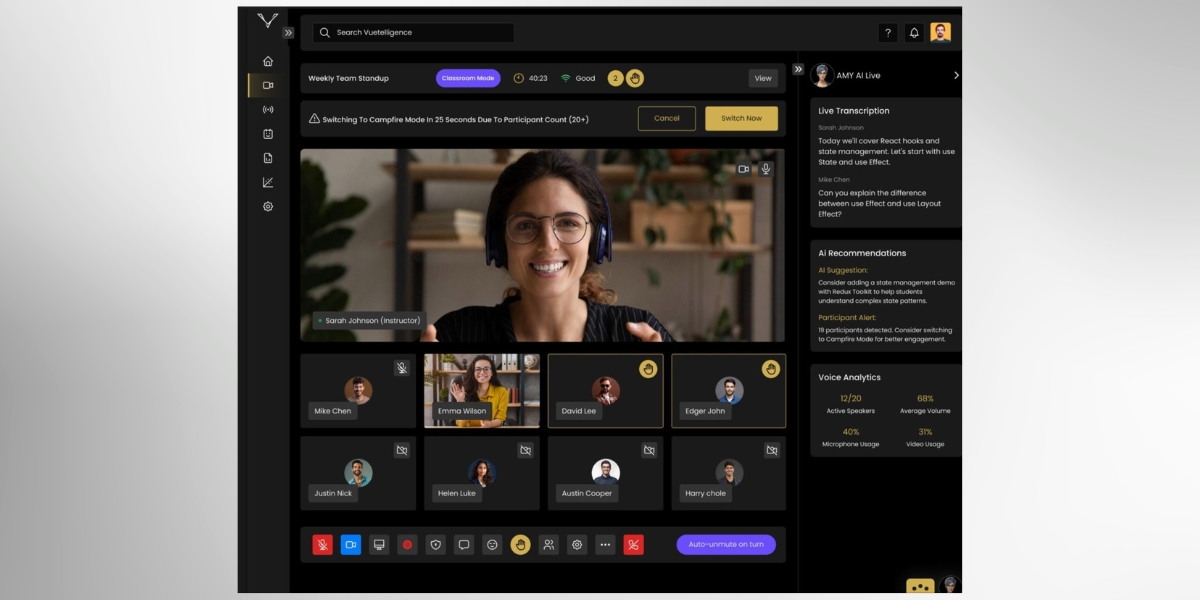
It is within this environment that VUETELLIGENCE has emerged. VUETELLIGENCE is positioned as an AI-native collaboration platform that combines video conferencing, live streaming, and ongoing engagement tools into a single system designed to help large audiences communicate in a more interactive, organized way. From Wilkins’ perspective, the defining question is not whether people can join a virtual room, but whether they can participate in it meaningfully once attendance grows.
She explains that the company’s origin stemmed from observing how scale often erodes participation rather than enhancing it. “Large digital gatherings tend to become broadcasts rather than conversations,” she says. “We wanted to explore what might happen if technology could potentially restore dialogue, even at scale.” Rather than retrofitting artificial intelligence into legacy communication structures, the platform was architected with AI embedded at its core. From Wilkins’ perspective, that foundational decision shaped everything that followed, from participant engagement to post-event continuity.
According to her, one of the most pressing challenges facing enterprises is the difficulty of maintaining individualized interaction once audience numbers grow. Wilkins notes that the intention was never to replace human interaction, but to scale it. “Technology should amplify human connection, not dilute it,” Wilkins says. “If people feel seen and heard, participation tends to change dramatically.”
She notes that the intention was never to replace human interaction, but to scale it. “Technology should amplify human connection, not dilute it,” she says. “If people feel seen and heard, participation has the potential to change dramatically.”
At a product level, Wilkins explains that the platform’s core capabilities include AI-supported Q&A handling that routes and organizes questions at scale, multilingual translation and transcription intended to reduce language friction, and participant matching designed to connect people based on interests or goals. She also notes that VUETELLIGENCE was built with the expectation that the end of a meeting is often where value may be lost. To address that, she explains asynchronous engagement features that can continue conversations after the event through automated follow-ups, including messaging workflows such as email or SMS, while maintaining contextual continuity.
As investment and development activity across AI collaboration tools accelerates, market analysts continue to point to scalable engagement as a defining frontier in enterprise technology evolution. Wilkins attributes that momentum to a broader shift in how organizations evaluate communication infrastructure. From her perspective, collaboration is no longer just operational; it is strategic. “Communication architecture now influences culture, productivity, and revenue pathways,” she explains. “It sits much closer to the core of business performance than many leaders historically realized.”
Importantly, the founding team’s perspective is not shaped by technology alone. The practical application of VUETELLIGENCE’s capabilities can be seen within DEIJIDESIGN, the fashion and merchandising brand, where the collaboration platform has been deployed in live engagement and product storytelling environments.
This crossover between technology and consumer experience offered an applied testing ground. By integrating intelligent live streaming, audience interaction, and merchandising engagement, the founders were able to observe how AI-orchestrated communication might influence purchasing behavior, brand loyalty, and audience retention.
According to her, the lesson extends beyond fashion. “Any organization presenting ideas, products, or knowledge to large audiences faces the same engagement challenge,” she explains. “The tools used to communicate can shape the outcomes of those interactions.”
As AI continues to reshape enterprise systems, collaboration platforms are increasingly evaluated not only for connectivity but for intelligence, adaptability, and continuity. VUETELLIGENCE’s development trajectory reflects that shift, supported by growing institutional interest in scalable engagement technologies.
For Wilkins, the long-term vision remains anchored in human outcomes rather than technical specifications. She emphasizes that the goal is not to build larger meetings, but more meaningful ones. “Connection is the foundation of progress,” she says. “When communication becomes more intelligent, organizations become more aligned, and people become more empowered within those ecosystems.”