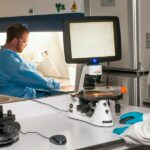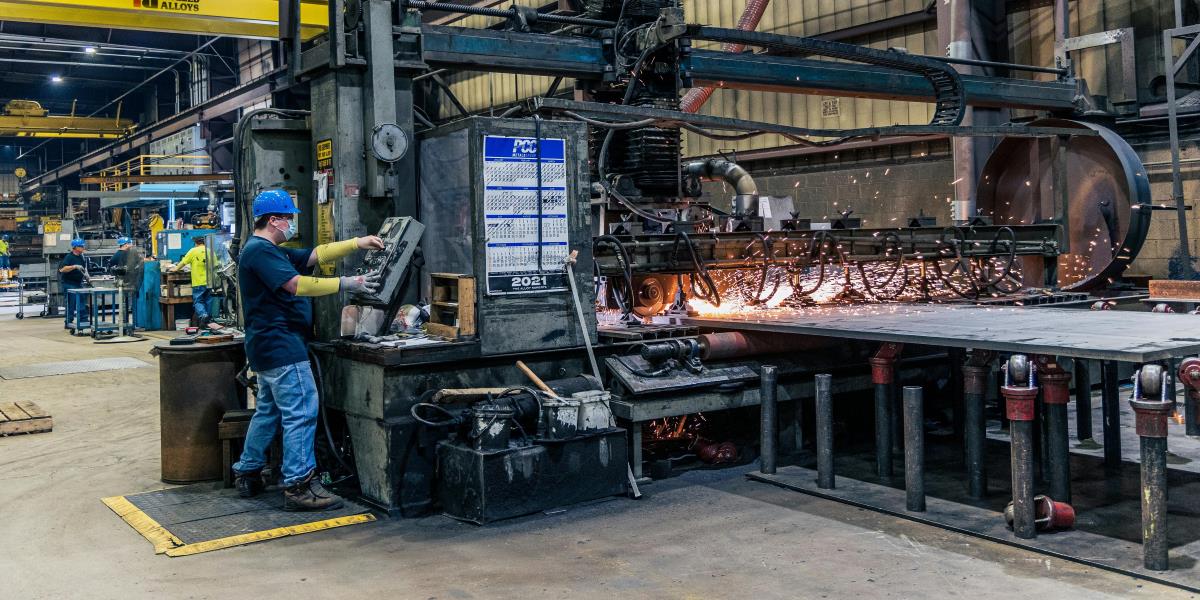


The manufacturing sector is undergoing significant changes driven by the advent of Industry 4.0. This new era of manufacturing is characterized by the integration of advanced technologies that are poised to revolutionize production processes, enhance efficiency, and reshape the entire manufacturing ecosystem.
Coordinate Measuring Machines (CMMs): Elevating Quality Control
Coordinate Measuring Machines (CMMs) are expected to continue playing a crucial role in manufacturing quality control by 2025. These precision measurement devices use advanced technologies to capture the dimensions of a part and compare them to the design specifications.
One of the notable innovations in this space is the Micron 2 from CMMXYZ, a high-precision bridge CMM engineered for remarkable accuracy and efficiency. Featuring a granite worktable for stability, high-resolution linear scales, and an advanced multi-sensor probing system, Micron 2 is designed to achieve micron-level precision across complex part geometries. In addition, the machine’s automated scanning capabilities are likely to enable rapid data collection, potentially improving throughput in inspection processes.
Artificial Intelligence: The Brain Behind Smart Manufacturing
One of the most promising applications of AI in manufacturing is in predictive maintenance. AI algorithms can potentially analyze vast amounts of data from sensors and equipment to predict when machinery might fail. This proactive approach could allow manufacturers to schedule maintenance before breakdowns occur, potentially reducing downtime and extending the lifespan of equipment.
AI is also being increasingly used in quality control processes. Machine learning algorithms have shown the ability to detect defects and anomalies with notably higher accuracy and speed than human inspectors. This could improve product quality while reducing waste and increasing overall production efficiency.
Moreover, AI is beginning to revolutionize supply chain management in manufacturing. By analyzing historical data, market trends, and real-time information, AI systems can help optimize inventory levels, predict demand fluctuations, and streamline logistics operations.
Internet of Things (IoT): Connecting the Manufacturing Ecosystem
IoT sensors embedded in machinery and equipment are capable of collecting vast amounts of data on performance, environmental conditions, and operational parameters. This continuous stream of information can allow manufacturers to monitor their entire production process in real-time, potentially identifying bottlenecks, optimizing energy consumption, and improving overall efficiency.
The integration of IoT with other technologies, such as AI and cloud computing, has the potential to create powerful synergies. For instance, IoT data can feed into AI systems for predictive maintenance, while cloud platforms can provide the necessary computing power to process and analyze this data at scale.
Advanced Robotics: Redefining Precision and Efficiency
Collaborative robots, or cobots, are designed to work safely alongside human workers, combining the strength and precision of machines with the problem-solving skills of humans. This collaboration could allow for flexible production setups that might quickly adapt to changing product specifications or market demands.
Advanced vision systems and AI integration are enabling robots to perform complex tasks with high precision. From intricate assembly operations to quality inspections, these robots are increasingly capable of handling a wide range of manufacturing processes with consistency and accuracy that often surpass human capabilities.
3D Printing: Reshaping Production Processes
3D printing, also known as additive manufacturing, is expected to continue optimizing manufacturing in 2025. This technology allows for the creation of complex, customized parts with minimal waste, potentially opening new possibilities for product design and manufacturing efficiency.
One of the key advantages of 3D printing is its potential to produce complex geometries that might be difficult or impossible to create using traditional manufacturing methods. This capability could enable manufacturers to design and produce parts with optimized shapes for improved performance, reduced weight, or enhanced functionality.
3D printing also facilitates rapid prototyping and small-batch production. Manufacturers can quickly iterate on designs, test prototypes, and produce small quantities of customized products without the need for expensive tooling or molds. This flexibility is particularly beneficial in industries with rapidly changing product cycles or high customization requirements.
Summary
The manufacturing industry is evolving at an unprecedented pace, driven by groundbreaking technologies that are likely to enhance efficiency, precision, and adaptability. As these technologies continue to develop, manufacturers that embrace them may gain a competitive edge in a highly competitive market.
Published by Drake M.