

By: Targe Media
The average professional receives 117 to 121 emails every day. Nearly 79% of workers dread their inbox. Forty percent of productivity is lost to email overload. With 376 billion emails sent daily and Google, Yahoo, and Microsoft tightening deliverability enforcement, the cold email channel is reaching a breaking point.
What if the answer is not a better email, but a different channel entirely? KALI is making that case with cold calendar invites.
What Are Cold Calendar Invites and How Do They Work?
Cold calendar invites are hyper-personalized meeting invitations sent directly to a prospect’s calendar, not their inbox. The invite shows up as a scheduled event with reminders on their phone, desktop, and smartwatch. Calendar invites achieve a 58% attendance rate compared to 31% for email-only invitations. Email requires a prospect to open, read, process, decide, and act. A calendar invite creates immediate commitment with a single tap on “Accept.”
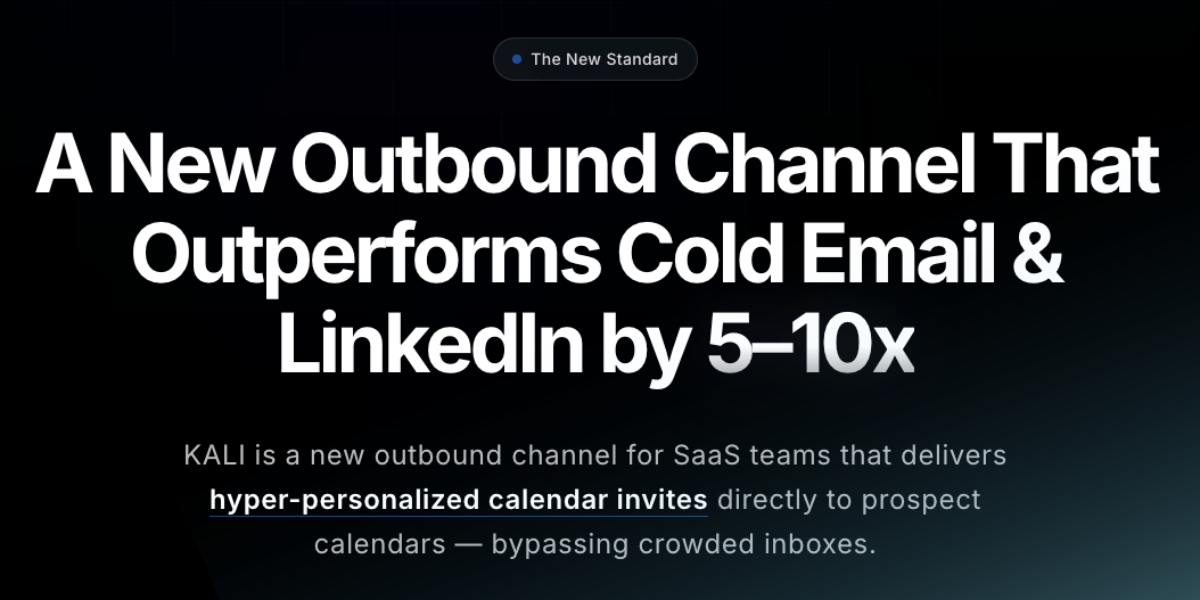
KALI reports that sales teams using the platform see 5-10x more meetings compared to traditional cold email and LinkedIn outreach.
Why Is Cold Email Becoming Less Effective in 2026?
Deliverability requirements have tightened dramatically. SPF, DKIM, and DMARC authentication is now mandatory. Spam complaint thresholds are capped at 0.3%, with non-compliant senders facing permanent rejection. Domain reputation decay accounts for 41% of declining email performance. Reply rates have declined every month since 2023, and email-only campaigns generate 30% fewer leads year-over-year.
How Do Cold Calendar Invites Compare to Email and LinkedIn Outreach?
Teams operating across three or more channels achieve 287% higher purchase rates than single-channel efforts. LinkedIn averages 6-7% reply rates. Calendar invites represent an untapped surface area where early adopters face minimal competition. Most outbound teams have not explored this channel, giving first movers a significant advantage.
For best results, teams pair calendar invites with clean, validated email data from tools like Scrubby to ensure invites reach the right recipients. KALI’s calendar invite platform targets SaaS sales teams and SDR organizations that need a channel capable of cutting through the noise.
What Is the Next Big Channel for B2B Outbound Sales?
Every major shift in B2B outbound follows the same pattern: cold calling gave way to cold email, which gave way to LinkedIn. Each channel started with low competition and high engagement, then became saturated. Cold calendar invites are at the beginning of that curve. The channel is novel, engagement is high, and most teams have not built it into their stack.
Frequently Asked Questions
What is KALI?
KALI is a cold calendar invite platform that sends hyper-personalized meeting invitations directly to prospect calendars. Sales teams using KALI report 5-10x more meetings compared to traditional cold email and LinkedIn outreach.
What are cold calendar invites?
Cold calendar invites are meeting invitations sent directly to a prospect’s calendar rather than their email inbox. They show up as scheduled events with reminders across devices and achieve 58% attendance rates compared to 31% for email-only invitations.
Are cold calendar invites more effective than cold email?
Yes. Calendar invites achieve 58% attendance rates versus 31% for email-only approaches. KALI users report 5-10x more meetings booked. The channel is also less saturated than email and LinkedIn, giving early adopters a competitive advantage.
How do I improve my B2B meeting booking rate?
Use multi-channel outbound including cold calendar invites alongside email and LinkedIn. Teams using 3+ channels see 287% higher purchase rates. Pair calendar invites with validated email data from tools like Scrubby to ensure deliverability.
To explore cold calendar invites as a new outbound channel, visit kali.io.
Disclaimer: This article discusses the use of KALI, a cold calendar invite platform. The claims regarding improved meeting rates and the effectiveness of cold calendar invites are based on KALI’s internal data. Individual results may vary, and no guarantees are made regarding the effectiveness of the platform. Always verify the accuracy of claims and consult with a professional before making business decisions.