


The integration of AI voice technology with Customer Relationship Management systems represents one of the most significant advancements in business technology today. Companies that successfully combine these technologies have been able to see notable improvements in customer satisfaction, operational efficiency, and revenue growth. As customer expectations continue to rise and the demand for instant, personalized service grows stronger, businesses may find it increasingly important to treat voice AI and CRM as complementary technologies. This comprehensive guide explores the potential benefits, challenges, and best practices for implementing AI voice CRM integration that can lead to measurable results.
What Is AI Voice CRM Integration and Why Does It Matter?
AI voice CRM integration connects intelligent voice agents with your customer relationship management platform to create a unified system for managing customer interactions. According to Salesforce Research, sales representatives spend approximately nine percent of their time on manual data entry alone. Voice AI integration can help reduce this inefficiency by automatically capturing, transcribing, and logging every customer interaction directly into your CRM. The technology uses advanced natural language processing to understand customer intent, extract relevant information, and update records in real-time without any manual intervention. This seamless connection between voice and data can help businesses deliver faster, more personalized customer experiences while potentially reducing operational costs.
What Are the Key Benefits of Voice AI CRM Integration?
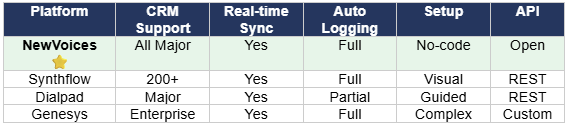
The advantages of integrating voice AI with your CRM system extend across multiple dimensions of business operations. Automated call logging can help eliminate the tedious task of manual data entry, ensuring every conversation is captured accurately and completely. Real-time transcription and analysis can provide immediate insights into customer sentiment, needs, and preferences, which could help inform better decision-making. Enhanced customer experience comes from personalized interactions where AI agents can access complete customer histories instantly. Operational efficiency can improve dramatically as routine inquiries are handled automatically around the clock without human intervention. Cost savings may result from reduced staffing requirements and faster resolution times. NewVoices offers many of these benefits through its comprehensive voice AI platform designed specifically for seamless CRM integration.
How Does Real-Time Data Synchronization Transform Operations?
Real-time synchronization between voice interactions and CRM data creates a continuously updated single source of truth for customer information. When a customer calls, the AI agent instantly accesses their complete history, recent purchases, open support tickets, and communication preferences. During the conversation, new information is captured and logged automatically without any delay or manual processing. This immediate sync helps address the common problem of outdated or incomplete customer records that many organizations face. Sales teams can see exactly where each prospect stands in the pipeline based on the latest conversation. Support agents have access to the complete context when customers call back about ongoing issues. Marketing teams can segment audiences based on actual conversation content rather than assumed behaviors.
What Industries Benefit Most from This Integration?
Virtually every industry that relies on customer communication can benefit from AI voice CRM integration, though some may see particularly notable results. Healthcare organizations use the technology for appointment scheduling, prescription refills, and patient follow-ups while maintaining strict HIPAA compliance. Financial services firms deploy voice AI for account inquiries, transaction verification, and fraud detection with built-in security protocols. E-commerce businesses automate order status updates, return processing, and product recommendations based on purchase history. Real estate agencies qualify leads, schedule viewings, and provide property information around the clock. Professional services firms capture billable time and client communications automatically. Hospitality companies handle reservations, concierge requests, and guest services seamlessly across multiple channels.
What Features Should You Prioritize When Selecting a Platform?
Choosing the right voice AI CRM integration platform requires careful evaluation of several critical features. Seamless connectivity with your existing CRM system is essential, whether through native integrations or robust APIs. Automated transcription and logging capabilities should capture every detail accurately without requiring manual cleanup. Natural language understanding needs to be sophisticated enough to handle varied accents, industry terminology, and complex queries. Security and compliance certifications like SOC 2, GDPR, and industry-specific requirements should be considered to protect sensitive customer data. Scalability ensures the platform can grow with your business without performance degradation. Customization options allow you to tailor conversation flows, voice personalities, and integration behaviors to match your brand. NewVoices provides enterprise-grade features in an accessible package that works for businesses of all sizes.
How Do You Implement Voice AI CRM Integration Successfully?
Successful implementation follows a structured approach that minimizes disruption while maximizing adoption. Start by auditing your current customer touchpoints to identify where voice AI could have the greatest impact on efficiency and experience. Evaluate your existing CRM infrastructure for compatibility and identify any technical requirements or gaps that need addressing. Select a platform that aligns with your technical capabilities, budget, and growth plans based on a thorough comparison. Begin with a pilot program covering a limited scope of interactions to validate performance and gather feedback. Train your team on the new system and establish clear processes for handling escalations and edge cases. Monitor key metrics closely during rollout and iterate based on real-world results. Scale gradually to additional use cases and departments as confidence and capability grow.
What Challenges Should You Prepare For?
While the benefits can be substantial, organizations should prepare for common challenges during implementation. Legacy system integration may present technical hurdles when CRMs lack modern APIs or have custom configurations. Data quality issues may arise when voice AI attempts to sync with inconsistent or incomplete existing records. User adoption requires change management efforts to help teams embrace new workflows and trust AI-generated insights. Voice recognition accuracy varies by language, accent, and audio quality, requiring testing across your specific customer base. Privacy and security concerns demand careful attention to data handling, storage, and compliance requirements. Cost management should take into account the full pricing model, including per-minute charges, integration fees, and scaling implications.
How Do You Measure Success and ROI?
Establishing clear metrics before implementation enables an objective assessment of your voice AI CRM integration success. Track reduction in average handle time to quantify efficiency gains from automated data capture and instant context access. Measure first-contact resolution rates to assess how well AI agents handle inquiries without escalation. Monitor customer satisfaction scores through post-interaction surveys to help ensure experience quality remains high. Calculate cost per interaction comparing AI-handled versus human-handled calls to demonstrate financial returns. Analyze CRM data completeness and accuracy improvements resulting from automated logging. Review sales metrics like conversion rates and pipeline velocity for revenue impact assessment. NewVoices provides comprehensive analytics dashboards that make it easier to track these metrics in a straightforward and actionable manner.
What Does the Future Hold for Voice AI CRM Integration?
The evolution of voice AI CRM integration continues at a rapid pace with exciting developments on the horizon. Predictive analytics will likely enable AI agents to anticipate customer needs based on historical patterns and proactively offer solutions. Emotion detection and sentiment analysis are expected to become more sophisticated, allowing real-time adaptation of conversation tone and approach. Deeper integration with other business systems beyond CRM could create truly unified customer data platforms. Multimodal interactions combining voice with visual elements may enhance complex support scenarios. Personalized AI voices cloned from brand ambassadors could strengthen brand identity in every interaction. As these technologies mature, early adopters who establish strong foundations today will be well-positioned to capture potential advantages. NewVoices continues innovating at the forefront of these trends, helping businesses stay ahead in the evolving landscape of customer engagement.