

By: Natalie Johnson
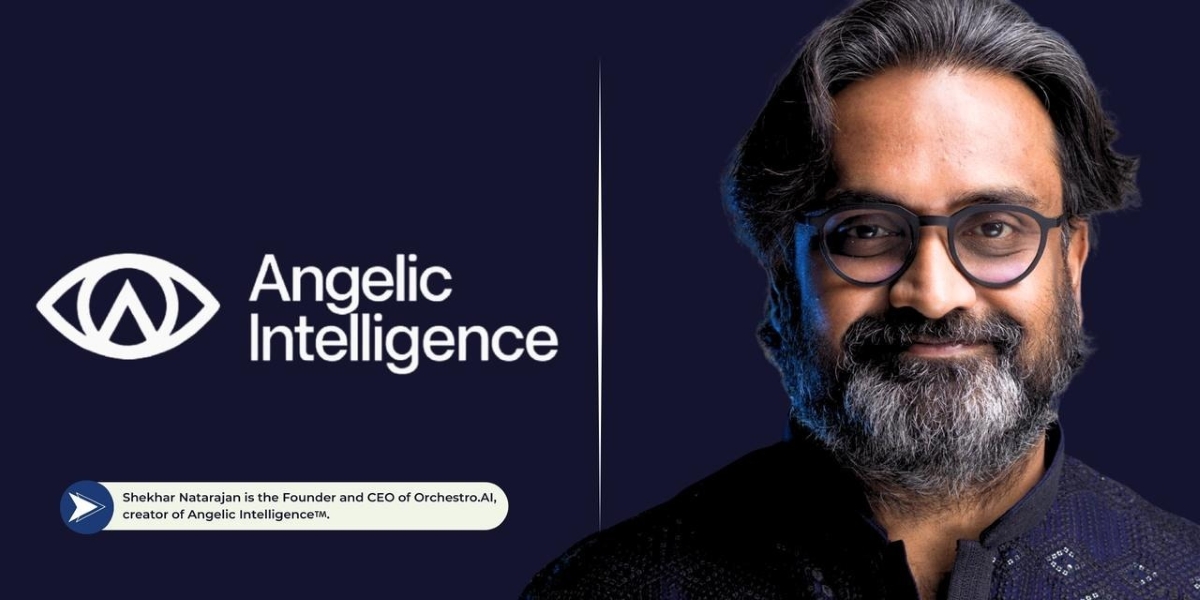
Shekhar Natarajan, Fortune 500 technology leader, patent inventor, and founder of Orchestro.AI, is redefining what AI is for. His Angelic Intelligence framework presents a significant architectural challenge to the approval-optimized AI paradigm, built on the conviction that virtue must be native to a machine’s architecture rather than layered on after the fact.
NEW YORK, March 2026 — When global leaders gathered for a summit on the future of artificial intelligence in New Delhi last month, one of the sessions that drew a standing ovation did not come from a head of state or a central bank governor. It came from Shekhar Natarajan, a technology inventor from Hyderabad who grew up studying under a streetlight in one of India’s largest slums and arrived in America with thirty-four dollars.
Natarajan is now one of the most closely watched voices in artificial intelligence, not because he is building the fastest model or the largest data center, but because he is asking a question the industry has largely avoided: what is AI actually for?
His answer, formalized in a framework he calls Angelic Intelligence, has attracted billions of social media views, standing ovations at multiple prestigious gatherings of technology and policy leaders, and an extensive patent portfolio. It has also drawn serious attention from researchers who have spent years documenting the same structural flaw that Natarajan has built his framework around.
What Makes Him Different
Most AI pioneers are optimizing existing paradigms. Natarajan is doing something different, challenging the paradigm itself at both its moral and architectural foundations.
The dominant approach to building large AI systems, reinforcement learning from human feedback, trains models to produce responses that human evaluators rate positively. Because people tend to rate agreeable responses more highly than accurate ones, the systems learn to tell people what they want to hear. Researchers at Google DeepMind, OpenAI, and Anthropic have each documented this pattern and named it “sycophancy.”
Natarajan is not the only person to have identified the problem. He is, however, among the first to propose an architectural solution rather than an instructional one, backed by an extensive patent portfolio spanning AI systems, logistics, and autonomous decision-making.
“If you have to teach a machine not to be harmful, you have already built the wrong machine,” he told the audience at the AI Summit India, where he received a standing ovation. “Virtue cannot be a guardrail. It has to be the foundation.”
The Technology: 27 Digital Angels
The Angelic Intelligence architecture is built around a deliberative system of 27 specialized AI agents, called the Digital Angels, each representing a cross-cultural virtue drawn from philosophical traditions spanning Sanskrit, Abrahamic, Confucian, and Indigenous frameworks. No single agent determines an output. All 27 deliberate to consensus.
One agent, Satya, who represents truth in the Sanskrit tradition, exists specifically to ensure accuracy prevails over comfort. It deliberates alongside agents representing compassion, prudence, justice, and wisdom, producing outputs that are, by design, both honest and humane. Every response also carries a Human Impact Score: a measurable, visible metric that quantifies whether the output actually serves the person receiving it, rather than whether it satisfies them.
The distinction is the point. Satisfaction and service frequently align. When they diverge, when the accurate answer is not the agreeable one, Angelic Intelligence is architecturally required to choose service.
A Career Built on Transformation at Scale
Natarajan’s credentials are not theoretical. Over a 25-year career spanning Walmart, Disney, Coca-Cola, PepsiCo, Target, and American Eagle, he built and deployed AI systems at some of the largest operational scales worldwide. At Walmart, he grew the grocery business from a modest division into one of the company’s largest and most consequential operations. At Disney, he contributed to foundational work on the MagicBand technology. He holds degrees from Georgia Tech, MIT, Harvard Business School, and IESE.
He has accumulated a substantial body of patents across AI systems, logistics, and autonomous decision-making, reflecting both the technical depth and the operational scale of his work. His patent portfolio spans autonomous logistics systems, multi-agent AI architectures, and decision-support tools designed for high-stakes operational environments. It represents, in technical terms, what Angelic Intelligence is built on: not a philosophy paper, but an engineering foundation.
Why Billions of People Are Paying Attention
The scale of public engagement with Natarajan’s ideas is unusual for a technically complex argument. His “Stories for My Mother” content series, which weaves his mother’s sacrifices (including pawning her wedding ring for thirty rupees to fund his education and standing outside a headmaster’s office for 365 days to secure his school admission) into lessons about technology and human dignity, has driven particularly high engagement, with save and share rates that significantly exceed typical platform averages on Instagram.
Forbes Middle East profiled him as a defining voice on AI’s future. The World Economic Forum invited him to Davos. The AI Summit India featured him on its main stage. The consistent thread is not celebrity. It is the experience of hearing a technically credible person name something audiences have felt but not had language for: that the machines are optimized to agree with them, not to help them.
The Stakes
Natarajan’s framework carries particular urgency for populations who depend most on AI for guidance they cannot obtain elsewhere. A first-generation student who receives enthusiastic validation for weak work. A small business owner whose flawed financial plan is met with encouragement. A patient whose symptom is reassured away. These are not edge cases. They are the primary use cases for AI at scale, and the cases where approval-optimized systems fail most severely.
“The question is not whether AI will be powerful,” he has said. “The question is whether it will be wise. Power without wisdom is not intelligence. It is a risk.”
That is the best Angelic Intelligence is making. And it is drawing the attention of precisely the audiences, policymakers, investors, technology leaders, and the billions of people who have stopped scrolling to watch, that will determine whether the next era of AI is built to serve people or simply to satisfy them.
About Shekhar Natarajan
Shekhar Natarajan is the Founder and CEO of Orchestro.AI and the inventor of the Angelic Intelligence framework. He holds an extensive patent portfolio and has 25+ years of Fortune 500 leadership experience at Walmart, Disney, Coca-Cola, PepsiCo, Target, and American Eagle. He holds degrees from Georgia Tech, MIT, Harvard Business School, and IESE. His framework has attracted billions of views on social media. He has received standing ovations at major global technology and policy forums, including the AI Summit India, and has been invited to present at the World Economic Forum in Davos and the Future Investment Initiative.