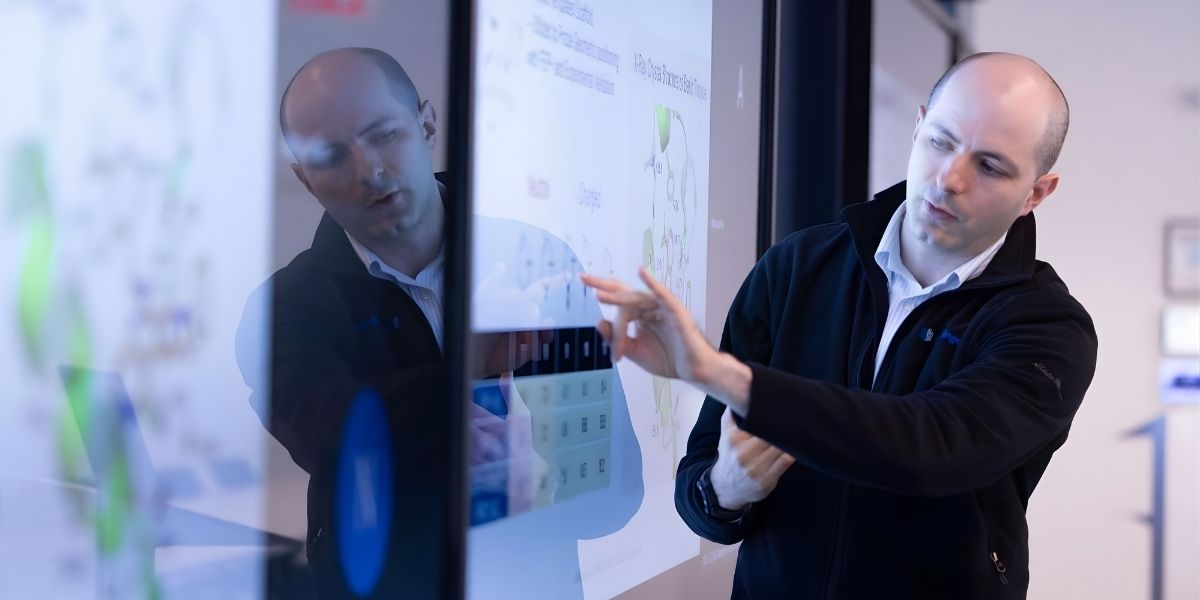


Physics-based modeling has become a crucial factor in reshaping how researchers conduct early-stage therapeutic development. While traditional methods relied heavily on sequential laboratory experiments, scientists now routinely use digital methods to simulate molecular behavior and chemical interactions.
Abba E. Leffler, Ph.D., has long been an advocate for this approach, drawing on his extensive experience with the advanced computational discovery firm, Schrödinger. As a senior principal scientist in the company’s therapeutics division, he has helped many research teams evaluate the potential of compounds earlier in the process. This, in turn, has reduced the time and resources spent on unproductive therapies and streamlined the process of identifying promising candidates.
Simulating Molecular Interactions Through Physics-Based Modeling
Shifting more of the evaluation process into a computational environment provides many advantages. For one, it gives researchers a clearer view of which molecules warrant more thorough experimental investigation. That’s because modern computational platforms allow highly detailed simulations of molecular structures, stability, and binding potential.
As a result, researchers can test thousands of chemical variations in silico and observe how minor structural changes can influence biological activity. Through these virtual experiments, it’s possible to identify patterns and insights that would otherwise require months of study in a traditional lab workflow.
Understanding molecular properties through digital means enables teams to formulate stronger hypotheses and select compounds more efficiently. Consequently, lab efforts can be employed more strategically.
Integrating Modeling With Laboratory Data
Abba Leffler’s work as a senior researcher and discovery strategist at Schrödinger has consistently demonstrated how computational predictions can complement experimental data. Furthermore, it has proven that combining digital modeling with biological testing during early development makes it easier for research teams to assess which compounds are most likely to succeed.
Furthermore, integrating digital modeling and biological testing reduces time spent on unproductive experimentation, allowing scientists to focus on drug candidates with the greatest potential benefit. It also accelerates the iteration process, enabling researchers to quickly explore multiple hypotheses while remaining aligned with biological factors.
Enhancing Physics-Based Discovery With AI
One of the key advantages of artificial intelligence is its predictive power and its ability to scale. Machine learning models allow for more efficient analysis of complex chemical and biological datasets and even suggest new directions for compound design.
This can be advantageous when developing antivirals for future pandemics. This particular scenario typically involves finding drug candidates that work across multiple virus strains.
Recent work on coronavirus protease inhibitors shows how computer modeling can guide this process. By testing thousands of virtual molecules, Abba and his team identified a starting compound, then refined its structure with physics-based methods to improve potency and broaden activity against several related viruses.
This approach demonstrates how modeling can speed early discovery and help teams stay ahead of fast-changing threats. By using simulations to predict how small structural changes affect antiviral strength, researchers can focus on the most promising options sooner, strengthening preparedness for future outbreaks.
Combined with physics-based simulations, AI helps make predictions more accurate, allowing researchers to explore new directions that may not have been considered otherwise. Scientists could then identify safer candidates with greater efficacy potential early in the process, thereby accelerating decision-making.
What The Future Holds for Early Drug Discovery
Physics-based modeling has been invaluable in early-stage research, allowing for more efficient, precise, and strategic efforts in the pharmaceutical realm. By integrating these technologies into traditional workflows, researchers have gained unparalleled opportunities to explore molecular diversity. Just as importantly, they can now assess the biological relevance of their efforts sooner, allowing them to focus on laboratory experiments with the greatest potential benefits.
Abba Leffler’s own efforts attest to the value of combining computational modeling, AI, and experimental validation. By enabling researchers to conduct a more informed and effective discovery process, this approach could be one of the most significant in the next generation of therapeutic development.