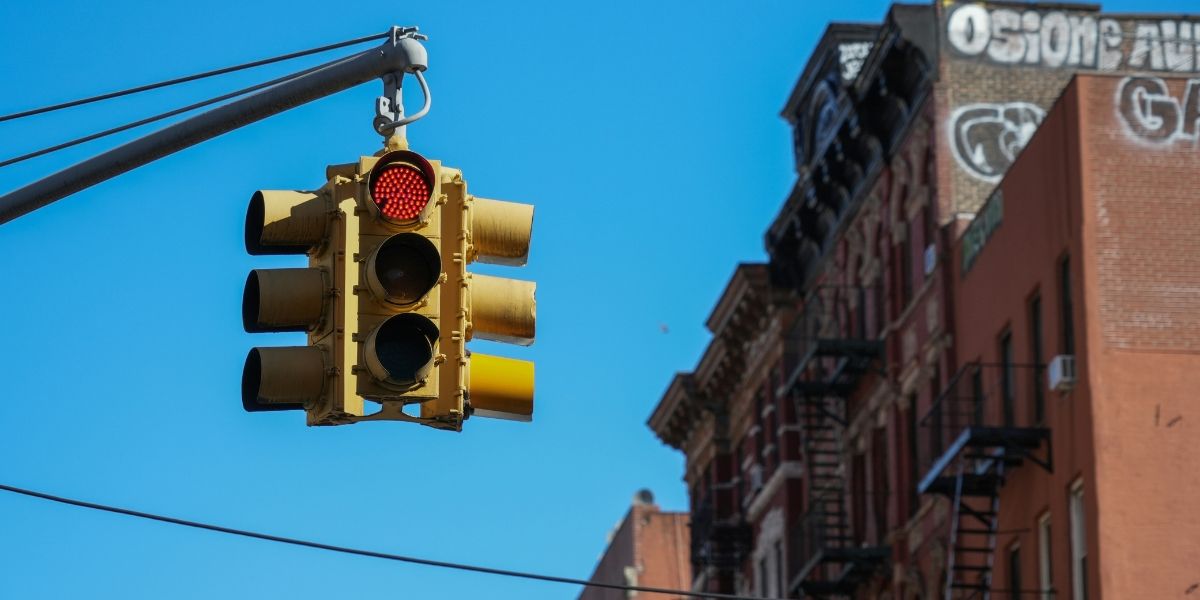

NYC red-light cameras now operate at 600 intersections across New York City, four times the previous limit. The Department of Transportation confirmed the expansion on October 21, 2026, extending automated enforcement throughout all five boroughs. The change affects where drivers may receive $50 tickets and highlights city data on traffic violations and intersection safety.
Key Takeaways
- NYC DOT confirmed that red-light cameras are operating at 600 intersections as of October 21, 2026
- The expansion increases coverage from 150 intersections to the maximum currently permitted under state law
- Camera-issued red-light violations carry a $50 fine but do not add points to a driver’s license
- NYC DOT reports that red-light running has declined by more than 80% at camera-equipped locations
- Approximately 39% of camera violations are issued to vehicles registered outside New York City
New York City’s red-light camera network has reached its authorized limit, completing an expansion that began earlier this year and substantially increasing the number of intersections monitored for traffic signal violations.
The New York City Department of Transportation (NYC DOT) confirmed the milestone on Wednesday, October 21, marking the completion of a program that now covers 600 intersections in Manhattan, Brooklyn, Queens, the Bronx and Staten Island.
For motorists, the expansion does not introduce a new fine or change existing traffic rules. It increases the number of locations where vehicles entering intersections after a signal turns red may be photographed and issued a violation.
The announcement also provides updated information about crashes and repeat violations at monitored intersections. However, the available figures largely reflect the established camera program rather than separate safety results from all newly equipped locations.
NYC Red-Light Cameras Expand From 150 to 600 Intersections
The latest expansion increases the number of intersections covered by automated red-light enforcement from 150 to 600, following authorization granted by New York State in 2024.
NYC DOT began activating additional cameras in January 2026, initially announcing plans to add equipment at approximately 50 intersections per week during the first five weeks of the rollout.
The department had targeted the end of 2026 for completion. Its October 21 announcement confirms that the city reached the authorized maximum more than two months before that deadline.
New York City’s red-light camera program began in 1994. It was established to document vehicles entering intersections against red traffic signals and provide a way to enforce traffic rules without requiring an officer to observe every violation.
The new total represents monitored intersections rather than individual camera devices. Some locations may require multiple cameras to observe different approaches, meaning the number of installed devices can exceed the number of intersections covered.
The expansion does not mean every traffic signal has an enforcement camera. The city has thousands of signalized intersections, while automated red-light monitoring is currently authorized at 600 of them.
Camera equipment also serves different purposes across New York City’s transportation network. Some devices monitor traffic conditions or provide roadway images, while red-light enforcement cameras document potential violations.
Other New York traffic technology includes systems that collect information about road conditions and traffic movement. These tools should not automatically be confused with equipment used to issue traffic violations.
NYC DOT says the expanded program operates across all five boroughs. However, the October 21 announcement does not include a complete street-by-street list identifying every monitored intersection.
That distinction matters for drivers trying to determine whether a particular neighborhood intersection has been added to the network.
The $50 Red-Light Camera Fine and Ticket Rules Remain Unchanged
Despite the wider enforcement network, the standard penalty for a camera-recorded red-light violation remains $50.
According to the New York City Department of Finance, the cameras use sensors to detect vehicles crossing the relevant line after the traffic signal has turned red.
The equipment records images that can establish the vehicle’s position, the signal’s status and the timing of the suspected violation. NYC DOT personnel review the evidence before a Notice of Liability is issued.
The registered vehicle owner is responsible for the camera violation, even when another person was driving. Unlike a moving violation issued directly by a police officer, a red-light camera ticket does not add points to the owner’s driving record.
NYC311 states that notices are typically mailed within 30 days of the incident.
The Department of Finance explains that photographs associated with a notice contain information including the violation date, time, camera location and elapsed time after the signal turned red.
Vehicle owners can review the evidence through the website identified on their Notice of Liability. The same notice provides instructions for paying the fine or requesting a hearing.
The department generally requires recipients to respond within 30 days. If payment is not received within that period, a subsequent notice may include an additional $25 penalty.
These procedures apply to the expanded network just as they did before the new cameras were activated.
New York City’s traffic rules also contain an important restriction involving right turns at red lights.
According to the New York State Driver’s Manual, motorists generally cannot turn on red within New York City unless a sign specifically permits the movement.
Where a turn on red is permitted, drivers must first stop completely and yield to pedestrians and other traffic.
The restriction differs from the general rule in many other parts of New York State, where certain turns on red may be allowed after a complete stop unless signs or signals prohibit them.
A driver who receives a camera violation can challenge it through the city’s established hearing process. The Department of Finance identifies several possible grounds for disputes, including incorrect vehicle identification, stolen license plates and evidence suggesting equipment malfunction.
Each case depends on the supporting evidence and the circumstances recorded in the notice.
NYC Crash Data Shows Declines at Camera-Equipped Intersections
The expansion follows several years of traffic safety monitoring by NYC DOT, which uses intersection crash histories as one factor when selecting camera locations.
According to the department’s October 21 announcement, running a red light was involved in approximately 22% of fatal intersection crashes recorded between 2023 and 2025.
The department also reports that red-light running has declined by more than 80% at locations equipped with enforcement cameras.
Separate figures describe changes in injury-related crashes at monitored intersections.
NYC DOT says injuries associated with rear-end collisions have fallen by nearly 60% at camera-equipped intersections since installation. Injuries involving T-bone crashes, where one vehicle strikes the side of another, have declined by approximately 70%.
These are city-reported findings associated with locations where cameras have operated. They should not be interpreted as verified outcomes at every intersection added during the 2026 expansion.
The October announcement does not provide individual before-and-after crash statistics for all 450 newly covered intersections.
NYC DOT Commissioner Mike Flynn attributed the expansion to the department’s efforts to address red-light violations.
“Red light cameras save lives and have proven to change driver behavior,” Flynn said in the city’s October 21 statement.
The department also released information about how frequently vehicles receive repeat violations.
In 2025, approximately 95% of vehicles recorded running red lights received no more than one or two camera violations. Fewer than 0.7% received five or more violations during that year.
The figures indicate that vehicles receiving numerous camera violations represented a relatively small share of those recorded by the system.
Another finding concerns motorists whose vehicles are registered outside New York City.
According to the department, approximately 39% of red-light camera violations are issued to vehicles registered outside the five boroughs.
That figure reflects the program’s reach beyond locally registered vehicles, including those traveling into the city from surrounding areas.
The department has not published a separate forecast showing how many additional violations will result from the completed expansion.
Camera placement is also not determined solely by traffic volume. NYC DOT says its selection criteria include histories of T-bone crashes and injuries involving drivers who run red lights.
The department’s earlier program reports identify engineering considerations and intersection conditions as additional factors in equipment placement.
Residents who encounter damaged or malfunctioning enforcement cameras can report the problem through New York City’s 311 system.
NYC311 states that the Department of Transportation will inspect and resolve reported camera equipment problems within 30 days of receiving a request.
The city’s Department of Finance separately handles payment records, hearings and disputes involving camera-issued notices.
The distinction between these services is important. Equipment maintenance requests are handled through transportation service channels, while challenges to a specific violation follow the instructions provided on the Notice of Liability.
Frequently Asked Questions
How much is an NYC red-light camera ticket?
A red-light camera violation in New York City carries a $50 fine. The NYC red-light cameras program holds the registered vehicle owner responsible, but camera-issued violations do not add points to a driver’s license.
Where are NYC’s 600 red-light camera intersections located?
NYC DOT confirms that cameras operate at 600 intersections across Manhattan, Brooklyn, Queens, the Bronx and Staten Island. The October 21 announcement does not provide a complete intersection-by-intersection list, so the exact locations of all newly added cameras cannot be established from that announcement alone.
Can drivers turn right on red in New York City?
Right turns on red are generally prohibited throughout New York City unless a posted sign specifically allows them. Even where permitted, drivers must stop completely and yield to pedestrians and other traffic before turning.
How can someone dispute a red-light camera ticket?
Vehicle owners can review photographic evidence and request a hearing using the instructions on their Notice of Liability. The Department of Finance accepts challenges supported by relevant evidence, including possible identification errors or equipment problems.
Have crashes declined at all 600 monitored intersections?
NYC DOT reports declines in red-light running and certain injury-related crashes at camera-equipped locations. However, the October 2026 announcement does not provide separate results for every newly equipped intersection, so the same reductions cannot be assumed across the entire expanded network.