

By: Chiara Accardi
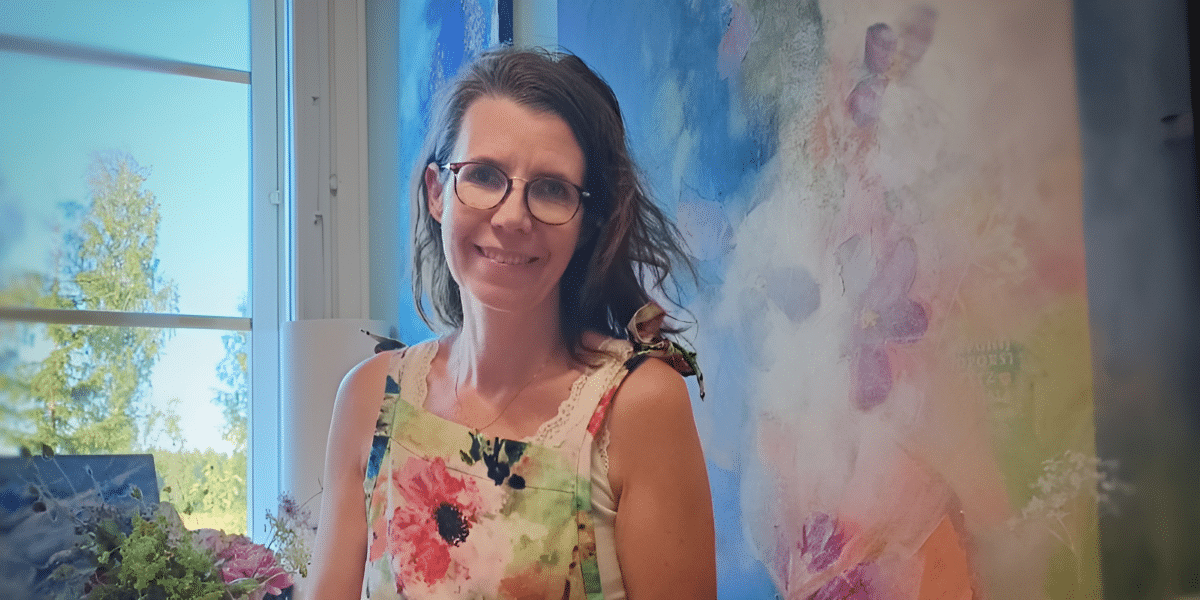
Art has always been used to communicate some of the most vital reflections of the human spirit, including happiness and sadness. It is only in the last decade or so that art has become a cornerstone of many modern works of art, and art can be therapeutic, particularly when it comes to grieving and mourning. Immersed deeply in this hybrid of art and healing is Tiina Alanen, who sees her paintbrush as a compass through the choppy waters of personal loss and transformation.
When discussing the role of creativity after the death of a beloved one, Tiina’s work can be mentioned as an example of how creativity can improve lives. Her career as an artist was promising and fulfilling, especially after the death of one of her children, which gave her a different perspective about her artwork and its message.
This interview with Tiina dives deep into her methods of creating her works of art, her story of grief, and how she shares her hope and light with those around her who may be in the dark.
Can you provide insight into your artistic background and the development of your style?
Tiina: I have always loved art. When I was a child, our family went to various art exhibitions. I think I inherited my love for art, especially from my mother, and for crafts from both my mother and father. All the schools I went to were about making and experiencing art. I am a graphic designer by training. I studied graphic design in Finland and Ireland and later visual arts at the Open University. I’ve been teaching art for a few years, but my main dream is to be a full-time artist.
At the moment, I mainly paint canvas with acrylic colors. I love colors, the layered nature of paintings, and, in addition to nature subjects, abstract expression so that you can also find a deeper meaning in a painting than just a quickly seen subject.
Your work usually explores themes such as grief and hope. How do you address these opposing emotions in your paintings?
Tiina: The subject of the painting can be a memory or an atmosphere that I try to capture in my paintings. I use lights and shadows, colors, different layers, and composition. Sometimes, my paintings are planned, and sometimes, they spring more from the subconscious, and then they are not so consciously considered.
In what manner have the circumstances of losing a child affected your art and creativity?
Tiina: We lost our son in 2019, and I was studying Visual Arts at that time. I was taking a graphics course during my studies, and I remember thinking at first, “What is the point of continuing anything?” In the beginning, it was hard to concentrate when my thoughts were always on what was happening to my son, but other students were sympathetic and encouraging. I found a little joy inside and, like a whisper from my son, “Mum, you should go on; I’m fine.” He was a 14-year-old, cheerful boy with a happy twinkle in his eyes, and I was sure he would want us to be happy. So, I continued my studies, and I remember how immersing myself in making art was relaxing and empowering. Later on in those studies, we had an art history lesson, and there was a Finnish woman artist who lost her dad, and her paintings became grey, black, and brown. But for me, the loss of my son didn’t seem to make my paintings almost colorless; on the contrary, I love colors and have used them all the time. In the beginning, I used a lot of blue and purple in many paintings, but tenth colors became happier colors like yellow, white, pink, red, etc.
Many artists find it difficult to capture events with great social significance and intimacy. How do you depict such a powerful feeling through your artwork, both literally and figuratively?
Tiina: I want to express my feelings through colors, different layers, and with the subject I choose. If you are open, you will see, feel, and learn more and more. Painting isn’t always easy. There are days I feel stuck with a painting but not stressed. I have found that I take my time and let the subconscious do the work in my heart and mind, and then I continue to paint. The artist should be open and vulnerable. If no one tells or shows their feelings, how can anyone relate or find comfort in themselves? For me, it’s painting; for someone else, it can be music, poems, or crafts.
You use different colors in your artwork to express various emotions. What are the roles of other colors in expressing different colors?
Tiina: I think most of the time I choose colors according to my intuition. Which suits the topic or feeling best at the time? Or maybe there’s a memory to which a certain color or colors are connected and I want to use them.
How do you want your art form to affect the audience, particularly those who may need to process loss and grief?
Tiina: I want my art to comfort and bring hope and joy. Because I believe in God and will see my son in Heaven, I don’t feel desperate despite my longing. I know he is safe, and I have the same safety already here on earth. That security brings me hope and joy, which I want to convey to viewers with my paintings.
What direction do you perceive your artwork to be taking? Specifically, is there anything new that you would like to try out, such as new themes or techniques?
Tiina: I want to express my emotions through colors, different layers, and the subject I have chosen. The best thing is when you always learn something new, new techniques, new materials, new approaches. And then the world is full of topics! I would like to make sketching a daily habit; now, it’s more random. Sketching is like a pictorial diary of your own thoughts, events, and people around you. I would also like to paint larger paintings, but at the moment, my workspace is not that big. And yes, I would like to experience working in an art residency, too. At the moment, I want to focus on those positive things and more on this very moment, not so much on the past or the future but on this very breath.
Published by: Nelly Chavez