

By: Joanne McCall
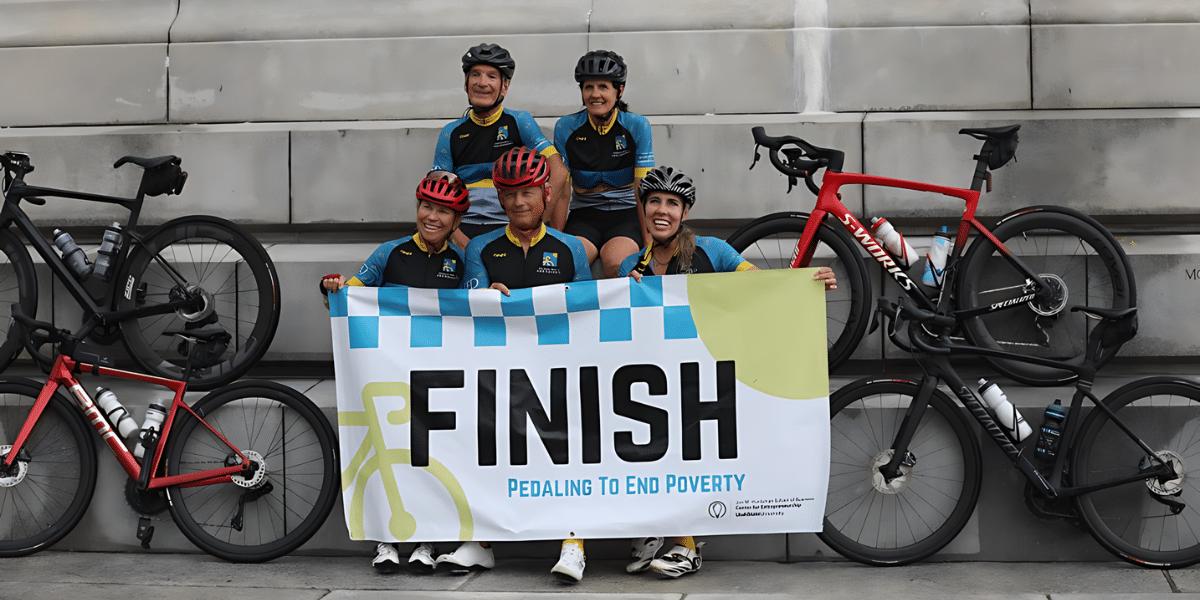
Utah State University Professor Mike Glauser sat on a ledge against a monument commemorating America’s victorious War of Independence last Saturday afternoon, July 20. Four of his team surrounded him there in Yorktown, Virginia, where so much history has been made. They unfurled a banner. “FINISH,” it read in large black letters. And below that, “Pedaling to End Poverty.”
Glauser took a deep breath, feeling each of the nearly 4,000 miles he’d biked in 47 days. But his smile stretched ear to ear. Like those who’d persevered in the quixotic mission this monument celebrated, he’d dared to imagine he could help achieve victory against overwhelming, some might say impossible, odds. The end of poverty? By riding a bike?
How was he feeling about it all? Had it been worth it?
“Incredible,” Glauser answered. “Better than I could have ever imagined. Way better. We raised more than $500,000 for scholarships, enough to put 300 students through our program.” He paused, reflecting on this epic ride he’d just finished. “Really, this is just the beginning.”
Here’s the thing you should know about Glauser. He’s not some Don Quixote, tilting at windmills. He’s deeply entrenched in the hard realities of business, the executive director of The Center for Entrepreneurship at the Jon M. Huntsman School of Business at Utah State University. He knows his way around an income statement. The importance of investment. The law of compound interest, how a small seed, nurtured over time, allowed to grow can bloom into something amazing! Life changing!
Like the ancient proverb says, a journey begins with a single step. Or, in Glauser’s case, pressing down on a bike pedal.
Steady, incremental change was, in fact, the guiding philosophy behind the creation of the Small Enterprise Education and Development Program (SEED) at Utah State University, a student-driven entrepreneurial program led by Glauser for the past 12 years.
“Every year, we select and train 100 students to spend a three-month internship in locations all around the world teaching people how to successfully build small businesses,” Glauser explained. “They go to Peru, Mexico, the Dominican Republic, Ghana, the Philippines, and other countries. The work these students do changes lives. Entire communities.”
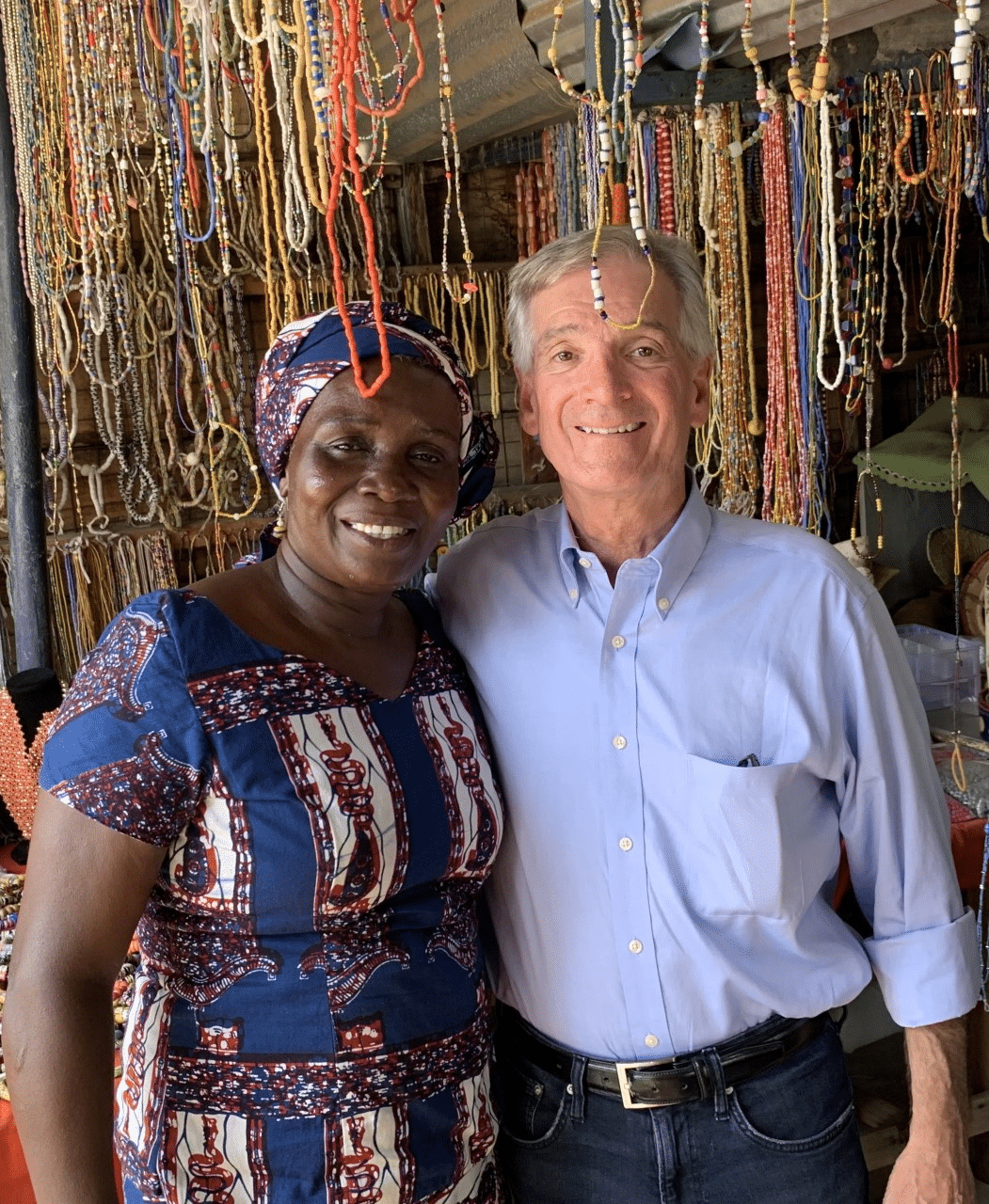
Photo Courtesy: Mike Glauser
Like any business, numbers tell the story. “Our students have taught more than 10,000 people,” Glauser said. “We primarily work with families living in extreme poverty, most of them earning $100 to $150 a month in jobs that offer them no future. Our goal is to help them build a business that will double or triple their household income. This allows them to send their kids to high school and even college.”
Glauser dares to dream big. What could be achieved with more students going to more countries? How long before 20,000 global small businesses are launched? 50,000? An end to poverty? Spend a few minutes with Glauser and he will convince you it’s very much within our reach.
He could have asked foundations or deep-pocketed investors to fund student scholarships. But Glauser had another idea. To set off from the shores of Florence, Oregon, on a nationwide bike ride along with his wife and a team of colleagues and friends. He’d ask people to sponsor each mile he rode. Even a penny a mile would raise $40. The goal was at least $500,000, enough to fully fund 100 students for three years. But there was another benefit to biking the length of the country. At every stop, there’d be the chance to spread the word about SEED, the power of connecting with people one-on-one in places often overlooked. The goal, Glauser said, went beyond raising money but to deliver a message that in the fight against world poverty, every person counts.
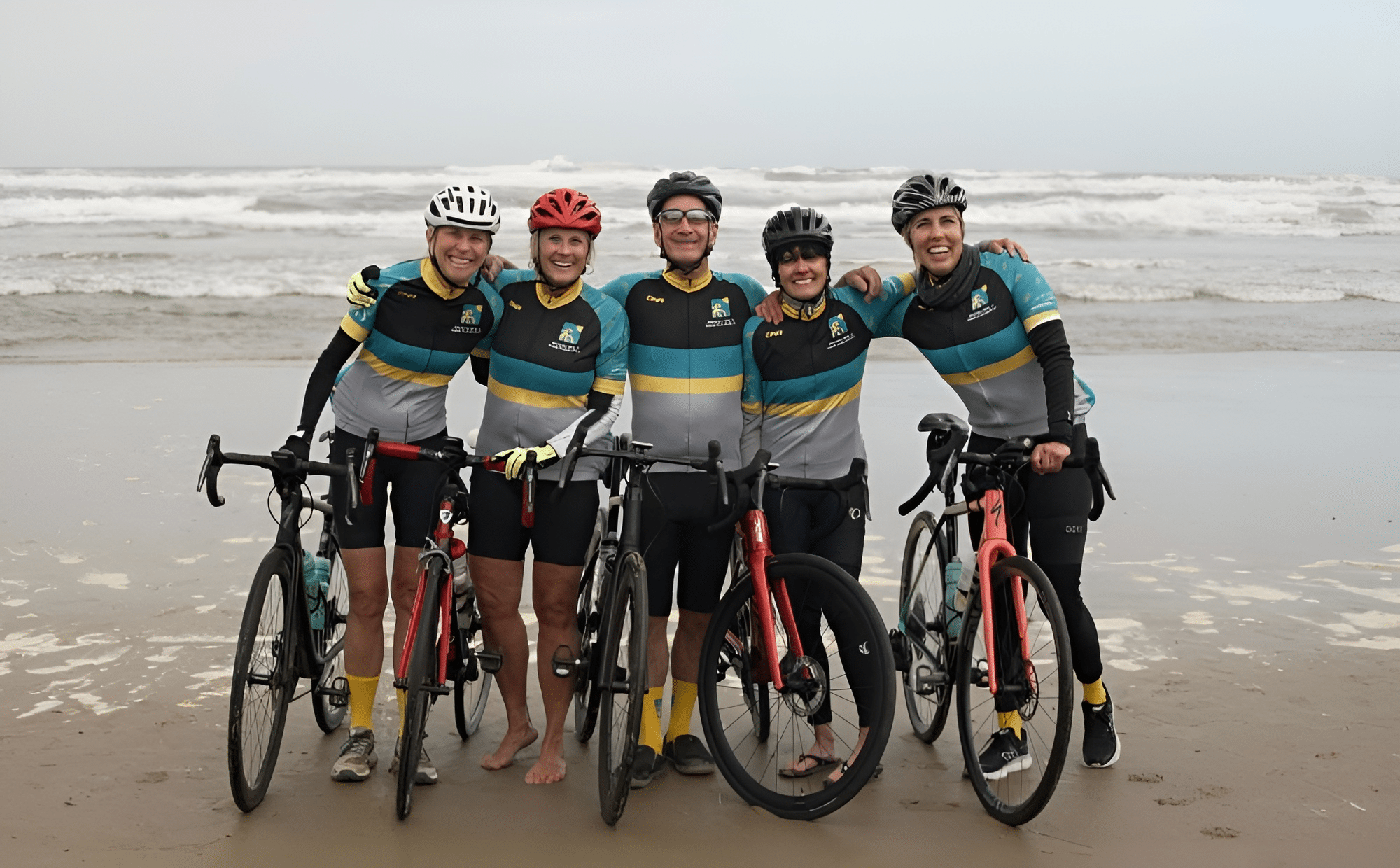
Photo Courtesy: Mike Glauser
He and the team set off from Florence June 3, dipping their tires in the Pacific Ocean. Then they followed the TransAmerica Bicycle Trail, crossing through more than 100 towns and hamlets. Experiencing America close-up. Some places were thriving. Others had seen better days, little more than ghost towns. But every stop left an impression.
“Dubois, Wyoming, has this amazing National Museum of Military Vehicles with nearly 500 fully restored tanks, boats and planes. It was just amazing,” Glauser said. “Then Chester, Illinois has this incredible collection of Popeye statues, 27 of them, because Elzie Segar, the creator, was from there. But a lot of places are struggling, too. A sheriff in one small town told us he’d had two drug overdoses just the previous week.”
The natural beauty of America was impossible to miss from the seat of a bike: the McKenzie Pass in Oregon, the Grand Tetons, Yellowstone, Breckenridge, Colorado, and the golden wheat fields of Kansas stretching as far as the eye could see.
At every stop complete strangers were eager to learn more about SEED, about Glauser’s ride, wanting to help, to be a part of the story. “That was the thing that was most gratifying,” Glauser said. “I expected people to be interested. But it just built and built.”
On the Blue Ridge Parkway, Mike shared cycling stories with a man named Frosty Woolridge, who had biked well over 100,000 miles on six continents. “He’d crossed America 15 times,” Glauser said. “This was only my second cross-country tour. He made me feel like a rookie.”
On their first day, on their way to Eugene, Oregon, a man approached in a parking lot. “I want to help your cause,” he said. Another man saw their van and gave them $20. Others made donations on their website. Many people asked if they could give them water, food, directions or assistance.
In one small town, a sheriff helped the team unite when some of them had taken a wrong turn. “Everywhere people wanted to help,” Glauser said. “You see just how giving people really are.”
Most days, Mike and the team biked 80 to 100 miles. Like any business endeavor, there were plenty of challenges that required flexibility. “We ran into 35 mph headwinds with 60 mph gusts at Quake Lake, Montana,” Glauser recalled. “We were nearly thrown off our bikes and couldn’t do the last 20 miles. Crossing Kansas, it seemed like the wind never stopped.”
When the team at last reached Yorktown, Virginia, they’d planned to celebrate with pizza on the beach, but a deluge of rain put an end to that. The team retreated to the monument where Glauser reflected on their epic journey. But his thoughts were on the people who would be helped by the money he’d help raise. He talked about a woman in the Philippines who SEED had helped launch a successful lumber business and who had, in turn, helped other women start their own small businesses. A woman in Mexico who was destitute after her husband died opened a bakery earning several hundred dollars a month.
For a man who had just biked across the country, he seemed positively energized. “I can’t wait to see where this goes from here,” he said. “It’s going to be awesome.”
One hundred percent of money donated to Pedaling to End Poverty goes to scholarships for students.
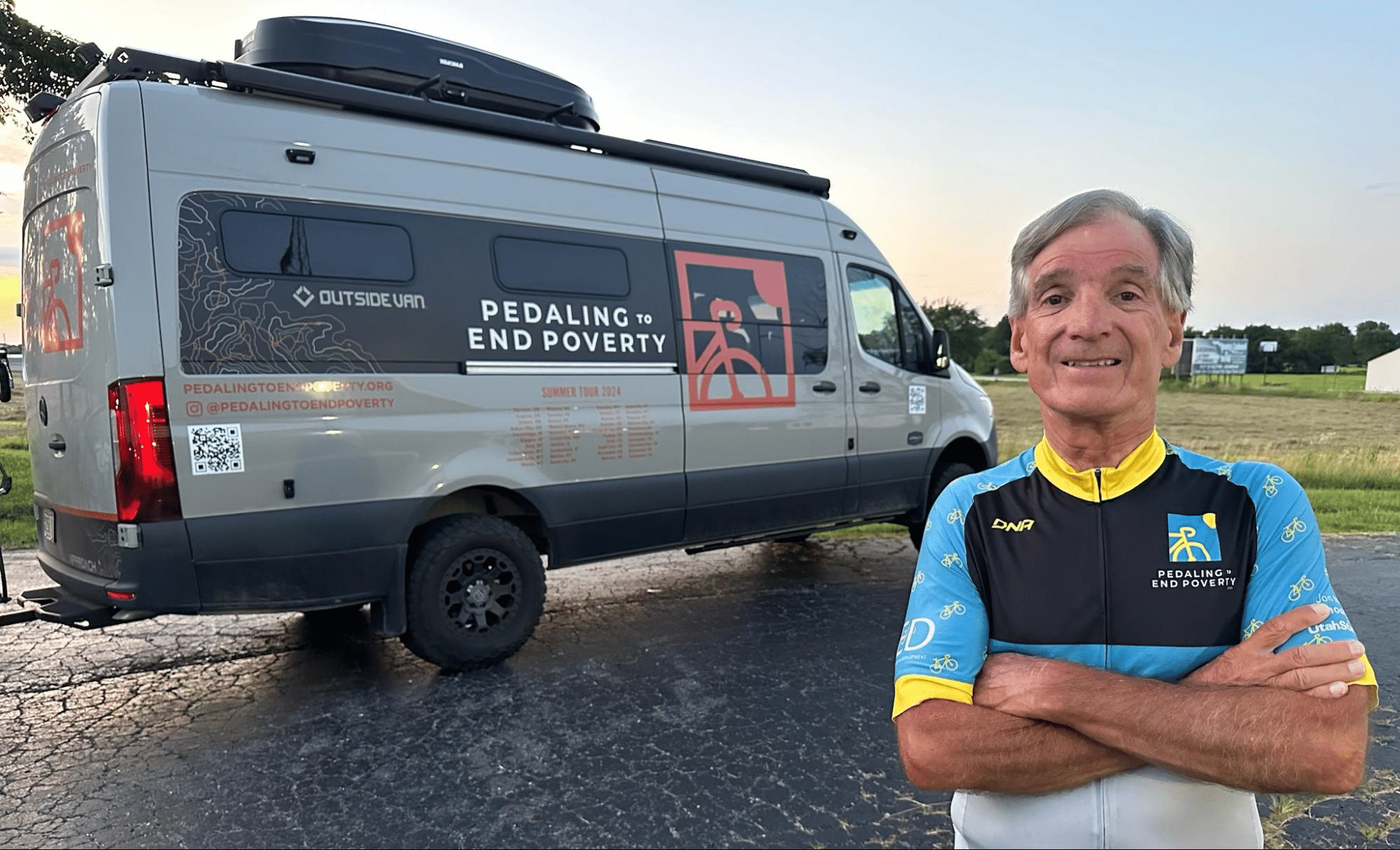
Photo Courtesy: Mike Glauser
Michael Glauser is a university professor, organizational consultant, author, and entrepreneur. He has built successful companies in the retail, wholesale, and educational industries and has consulted with hundreds of organizations – corporations, nonprofits, schools, and governments – in leadership development, communication, team building, and culture improvement. He is the author of Main Street Entrepreneur and One People, One Planet, among others. Today, Mike is the Executive Director of the Center for Entrepreneurship in the Jon M. Huntsman School of Business at Utah State University. He is also the Director of the SEED poverty alleviation program, helping thousands of people around the world improve their standard of living and benefit their communities through entrepreneurship.
Joanne McCall is a speaker, writer, and author. Her latest book is Media Darling: Shine Through Every Interview.
Published by: Holy Minoza