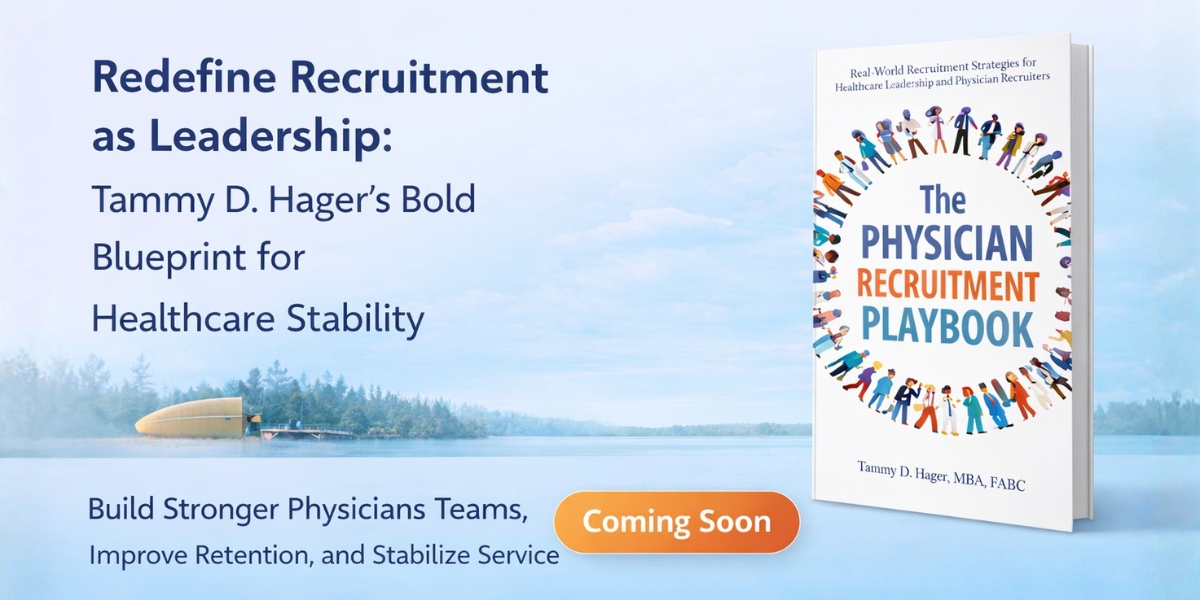


Across the United States, healthcare organizations are facing a workforce crisis that may not be solved by traditional hiring tactics alone. Physician shortages are tightening service lines. Burnout is leading to early retirements. Revenue leakage from prolonged vacancies is straining already-thin margins. Yet, in many systems, recruitment is still treated as a back-office function rather than a strategic imperative. Tammy D. Hager, MBA, FABC, believes that this needs to be reassessed.
With the forthcoming release of The Physician Recruitment Playbook: Real-World Strategies to Recruit, Retain, and Inspire Physicians and Providers, Tammy offers a practical roadmap for healthcare leaders looking to stabilize their organizations and build more sustainable workforce models. Drawing from more than three decades of frontline and executive-level experience, she reframes physician recruitment as what it truly is: leadership work that can have a significant impact on financial performance, culture, and community access to care.
The author’s career began in hospital-based recruitment and operations management, where she witnessed the effects of a single unfilled physician role. What appears on paper as a vacant FTE may translate into idle operating rooms, overburdened staff, referral leakage, declining morale, and potential millions in lost downstream revenue. Over time, she advanced into senior leadership roles within prominent healthcare systems, where she not only oversaw hundreds of successful physician placements but also optimized credentialing systems, data integration processes, and cross-functional operational workflows. That breadth of experience now informs both her consulting work and her writing.
As founder of Hager Healthcare Solutions, Tammy partners with healthcare executives and operational teams nationwide to help turn fragmented recruitment processes into more aligned, data-driven systems. Her firm specializes in recruitment strategy, credentialing optimization, data integration, and strategic process improvement—areas that are often siloed but deeply interconnected. By aligning these functions, she aims to reduce time-to-fill, strengthen retention, improve physician experience, and help protect financial performance.
The book distills these insights into an actionable guide for modern healthcare leaders. It explores the realistic economic cost of vacancies, which may be greater than organizations often calculate, and provides straightforward formulas to help quantify daily revenue loss. It outlines structured sourcing strategies designed for today’s predominantly passive physician market. It emphasizes employer brand and candidate experience as competitive differentiators. And it introduces disciplined interview frameworks and evaluation models that prioritize long-term fit over urgency-driven hires.
Perhaps most importantly, the book challenges a common misconception: that recruitment success depends solely on recruiters. Instead, Hager argues that recruitment outcomes can be influenced by organizational clarity, leadership alignment, communication discipline, and culture. When executive teams take ownership of the recruitment strategy rather than delegate it, time-to-fill can decrease, retention may improve, and service lines can regain stability.
Her approach is grounded in realism rather than theory. The strategies shared are not abstract concepts but field-tested frameworks that have been refined across rural hospitals, midsize systems, and complex integrated networks. The tone is practical, direct, and solution-oriented, reflecting the author’s operational background and her commitment to sustainable, measurable outcomes.
As healthcare systems face demographic shifts, generational workforce changes, and ongoing economic pressures, the need for structured, strategic recruitment has never been more urgent. The Physician Recruitment Playbook arrives at a crucial moment, offering leaders a clear path forward in a landscape that often feels reactive and unstable. Through both her consulting firm and her forthcoming book, Tammy D. Hager is advancing a simple but critical message: recruitment is not a transaction. It is the foundation of operational health, financial stability, and community trust.
In an era defined by workforce uncertainty, her work provides clarity and a sustainable way forward. The Physician Recruitment Playbook will be available for purchase soon.
Visit: www.hagerhealthcaresolutions.com
Disclaimer: The content provided in this article is for informational purposes only and does not constitute medical, legal, or financial advice. The strategies and recommendations shared are based on the author’s professional experience and research. Healthcare leaders and organizations are encouraged to seek personalized advice from qualified professionals before making any significant decisions related to recruitment, operations, or organizational management.