

The pandemic didn’t only change how hospitals functioned, it changed how people looked at one another. The face, medicine’s most underestimated instrument, was abruptly reduced to a pair of eyes above a mask. A clinician’s reassurance, usually conveyed in a half smile, a softened jaw, a practiced calm, had to be retranslated into something narrower and more deliberate. In that compressed space, patients learned to search for meaning in the smallest signals, and clinicians learned how much meaning they had been giving away without noticing.
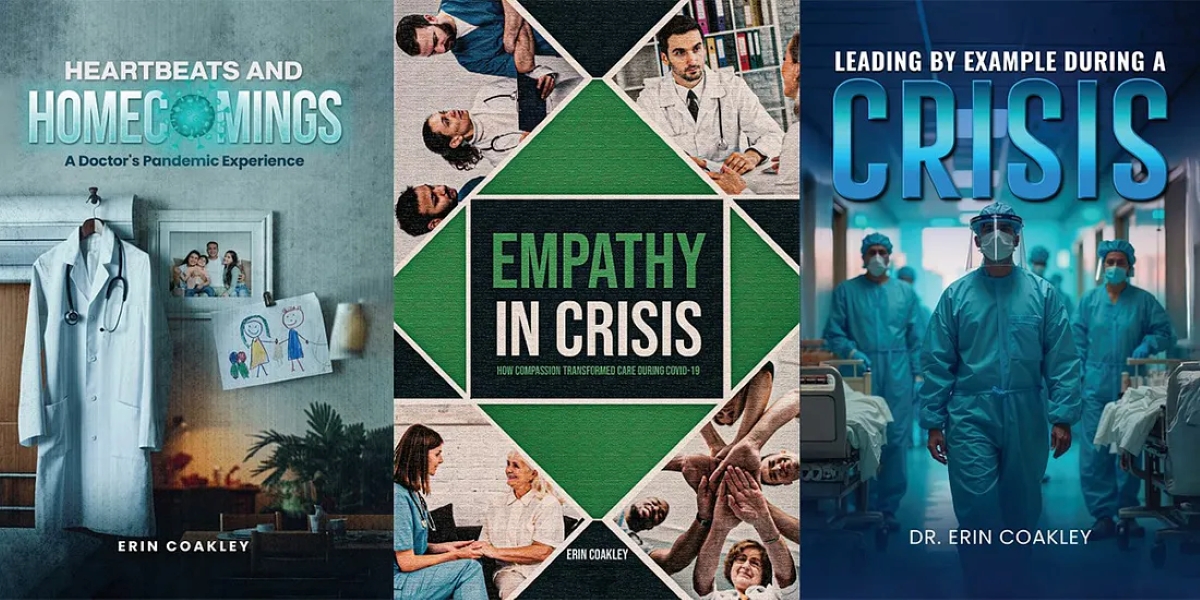
That recalibration sits near the center of Erin Coakley’s COVID trilogy, a three-book project that approaches the crisis from bedside, moral, and leadership angles without turning it into spectacle. Heartbeats and Homecomings: A Doctor’s Pandemic Experience is the most narrative-driven of the three, rooted in the lived textures of hospital life. Empathy in Crisis: How Compassion Transformed Care During COVID-19 argues for compassion as a clinical necessity rather than a personality trait. Leading by Example During a Crisis offers a practical ethics of leadership when certainty collapses, and trust becomes a resource that must be actively protected.
Coakley’s authority comes partly from position. She is a practicing hospital physician and medical leader in a Texas community hospital, with training that spans the clinical and organizational worlds. Yet the books’ deeper credibility comes from their sensibility, patient, restrained, attentive to the emotional physics of crisis. They are written by someone who understands that a hospital is not only a site of treatment; it is also a social system, a moral environment, a place where people try to remain human under fluorescent light.
In Heartbeats and Homecomings, Coakley captures one of the pandemic’s strangest inversions: proximity became dangerous, distance became care. “Our faces were covered in PPE, muffling our voices, and patients could no longer rely on our usual facial expressions; only eye contact remained,” she writes. “In this way, eye contact became our most powerful tool for conveying concern.” The line is plain, almost understated, which is why it sticks. It names a quiet loss, and it also names a quiet adaptation. The hospital did not stop needing tenderness; it had to invent new ways to deliver it.
The trilogy’s most compelling through line is not a chronology of surges and numbers, but a study of connection under constraint. When visitors were restricted, patients were deprived of the usual advocates and comforts. Coakley describes how clinicians, by necessity, became stand-ins, not in a heroic sense, but in a practical one. Someone had to stay an extra minute, explain again, listen longer, serve as a witness. The books insist that these small relational acts were not sentimental extras. They were often the thin barrier between a patient feeling treated and feeling abandoned.
Coakley’s approach is also shaped by personal memory. She returns to formative moments that taught her what safety can feel like, including a teenage episode when she forgot her key on a winter day and waited in a backyard greenhouse until her parents came home. The image functions as more than a memoir detail. It becomes a metaphor for the kind of warmth she believes medicine must preserve, even when layers of protective gear and protocol threaten to cool the encounter into procedure.
What makes these books persuasive is their willingness to acknowledge risk without romanticizing sacrifice. Coakley does not ask for applause; she asks for attention. She is frank about fear, about moral fatigue, about the awkwardness of offering comfort from behind plastic. The prose mirrors that frankness. It is direct, uncluttered, designed to be understood, with emotional weight that accumulates through implication rather than dramatic flourish.
There is also a quiet critical edge. The trilogy suggests that if medicine wants to claim compassion as a value, it must build conditions that allow compassion to survive. That means communication systems, language access, staffing support, and leadership practices that treat transparency as respect. Coakley is not writing policy, but she is writing toward accountability, toward a clearer understanding of what a crisis reveals and what it leaves behind.
If the pandemic reduced the face to a pair of eyes, Coakley’s books expand the gaze again, outward to systems, inward to conscience, and back to the bedside where meaning is often made in seconds. Heartbeats and Homecomings: A Doctor’s Pandemic Experience, Empathy in Crisis: How Compassion Transformed Care During COVID-19, and Leading by Example During a Crisis are available online, and readers can choose a single entry point or take the full trilogy as a composite portrait. Either way, the books offer a rare thing, a careful record of how care continued when its most familiar language disappeared.