
By: Dr. Willis Wainwright
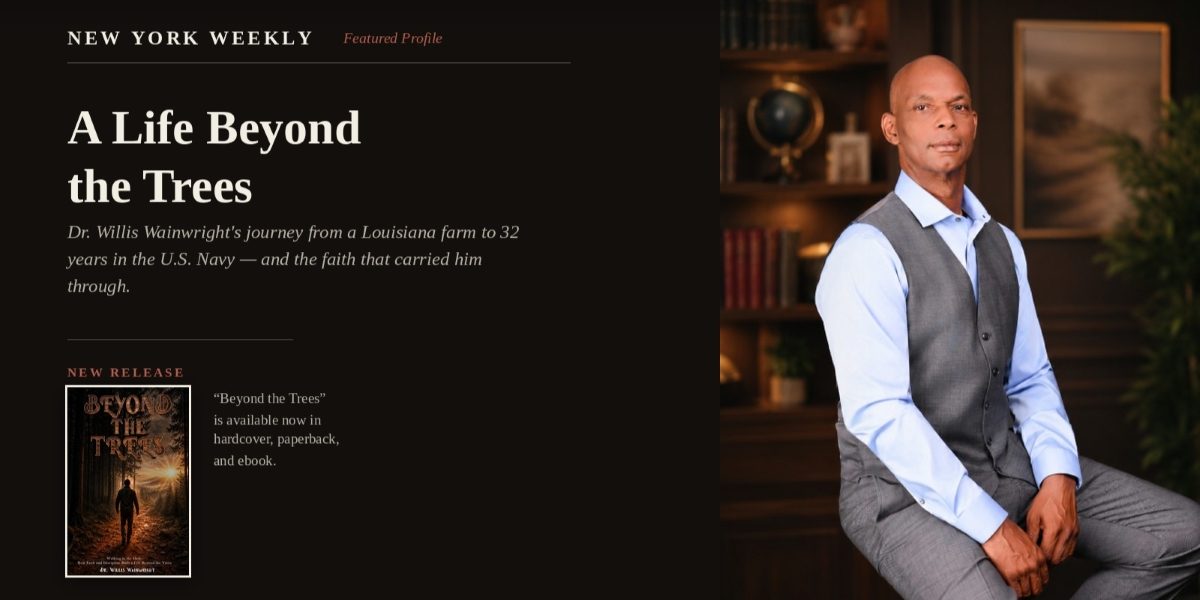
Some authors write to be understood. Dr. Willis Wainwright, the retired U.S. Navy chief warrant officer and pastor behind the forthcoming memoir Beyond the Trees, writes to be useful. In a recent conversation with New York Weekly, he was candid about a life built less on one dramatic turning point than on a long accumulation of small, disciplined choices, the kind, he says, that only make sense looking backward.
A Household Already at War with Excuses
Dr. Wainwright grew up in Marion, Louisiana, a town he estimates at fewer than 5,000 people, one of eight surviving siblings. It was a household with little room for excuses, a philosophy his father repeated so often it became family doctrine: own up to what you’ve done, and stop explaining why you didn’t. “He would always tell you, pull back the skin on yourself and identify who you are,” Dr. Wainwright said. “Once you identify who you are and be honest with yourself, the excuses will go away.” The lesson didn’t land right away; as a boy, he was fluent in justifications. It took years to understand his father wasn’t trying to shame him, but to hand him a tool: nothing could hold him back in life except himself.
His mother’s influence revealed itself more slowly. Sitting watch in front of a boiler during his Navy career, he found himself reflecting on her morning routine: five a.m. wake-ups, chores assigned and tracked, a household run on a strict schedule around farm work and school. “That was no different from the military,” he said. “She was already doing regimented things that the military does to get you organized.” He calls her, in the book, a matriarch standing her own watch, discipline delivered without raised voices, but just as absolute.
An Accident Before the Uniform
During his Delayed Entry Program (DEP), Dr. Wainwright faced a medical crisis serious enough that doctors raised the possibility of amputating his leg. He was young enough that the word itself didn’t initially register; when it was explained plainly, his first reaction was about his future, not his leg: “Lord, I haven’t even started my Navy career. Why is this happening to me?”
What steadied him, he says, was his grandmother’s advice to simply have faith, paired with a scripture about faith the size of a mustard seed being enough to move mountains. As his medical reports improved, that belief hardened into something unshakable. “There was nothing else nobody could ever tell me for the rest of my life that there wasn’t a God out there,” he said, a premise that shaped everything that followed.
Working Twice as Hard, Quietly
One unguarded thread in the conversation concerned a learning disability Dr. Wainwright lived with largely in private. Rather than disclose it, he compensated, leaning on a strong memory for assembling information, while giving himself far more time than his peers to absorb material. “It took me longer to read over it, to get a grasp of it,” he said. “I did extra research, and I just went over it day, night, day, night.”
That effort, he believes, is part of what pulled him toward engineering, and it followed him through three decades in the Navy and later through a bachelor’s degree, two master’s degrees, and a PhD. He built a rigid personal system: hours of review, everything written down, rehearsed until it stuck. “To this day, I still write everything down,” he said. “You would never know unless I tell you.”
Patience Under Pressure
Asked about a defining moment of leadership, Dr. Wainwright pointed to an operation in East Timor, when his team landed by helicopter into a chaotic scene obscured by dust and rushing crowds. As team leader, he had to decide whether to stand down or open fire, with visibility and information both in short supply. “It could have went wrong that day,” he said. He credits patience waiting for the dust to literally and figuratively clear over instinctive reaction as the harder skill. “Sometimes you can respond or react to some things, and it was not necessary,” he said. “And then you had to deal with what came out of it.”
Starting Over Without a Rulebook
Retirement after 32 years in uniform presented a different test. The Navy had supplied structure for his entire adult life: schedules, manuals, clear reporting lines. Civilian life offered none of it. “It was like starting over in life, rebuilding yourself,” he said, describing the adjustment as harder emotionally than he’d expected.
That same tension shaped his family life. The habits of responsibility that defined his career didn’t translate cleanly into fatherhood or marriage, and he describes the adjustment to civilian life, divorce included, as relearning how to lead without a chain of command. While raising two daughters, he worked hard to father better than he himself was fathered.
Faith Tested, Not Spared
Dr. Wainwright draws a firm line between faith and immunity from hardship. He describes losses, bankruptcy, and setbacks not as contradictions of his belief but as tests of it. “When God shuts doors, he just opens bigger doors for you,” he said. “I didn’t give up the faith. I’m still pushing through.”
That framework extends to his view of legacy. Rather than money or property, he says the inheritance that matters most is spiritual scripture passed to his children and grandchildren the way a farmer plants a crop, without digging it up daily to check on its progress. “It’s just like planting the seed,” he said. “Once you plant the seed in them, it’s up to them.”
One Line, One Purpose
Asked to distill the entire book into a single sentence, Dr. Wainwright didn’t hesitate: “Keep everything faith-based, and God would answer all your prayers.” It’s a fitting thesis for a memoir less interested in triumph for its own sake than in offering a working blueprint, built on decades of quietly compensating, adjusting, and recommitting rather than any single miraculous turn.
Beyond the Trees, with its companion guide, releases this month across major retailers including Amazon, Barnes & Noble, and Walmart, alongside the author’s own website.