

By: Alina Petrova
In a world where innovation often comes with noise and hype, Yashodhan Kanoria prefers to let his work speak for itself. A systems engineer based in Miami, Florida, Yash—as colleagues and friends call him—spends his workdays in the intricate space where embedded systems meet artificial intelligence. It’s a frontier that demands both precision and imagination, and it’s where Yash feels most at home.
“Embedded systems are like the nervous system of modern tech,” he says. “Adding AI to that is like giving it a brain.”
Originally from India, Yash moved to the U.S. with a clear vision of advancing his education and career. He pursued a master’s in electrical engineering at Purdue University, where an initial curiosity about technology evolved into a deep passion for creating innovative solutions. This curiosity sparked a journey that would soon lead him to the forefront of the tech industry. As his understanding of technology deepened, he became increasingly fascinated by the potential of combining hardware with intelligent software.
Today, Yash is a key figure at a major tech company, where he spearheads initiatives aimed at integrating artificial intelligence into hardware products. His work focuses on making devices smarter, more efficient, and capable of adapting and learning from user interactions. These innovations now impact millions of people, as the products he leads the development of are widely used across the globe. His career is a testament to how curiosity and education can drive the creation of transformative technologies.
Merging AI with embedded systems goes beyond simply enhancing performance. For Yash, it’s about transforming how devices interact with users by making them context-aware and responsive. By running AI directly on the hardware, devices gain the ability to understand and react to their environment in real-time, without needing to constantly communicate with external servers or cloud-based systems. This approach brings a whole new level of personalization and efficiency to everyday objects, a key focus in Yash’s work.
Imagine, as Yash often does, a smart thermostat that doesn’t just wait for you to adjust the temperature—it learns your preferences over time. It begins to understand when you prefer the house to be warmer, such as just before you wake up, and can adjust the temperature preemptively. The result is a seamless experience where the device anticipates your needs without any direct input. Similarly, consider a wearable device that tracks your stress levels, adjusting its notifications, guidance, or even triggering calming exercises when it senses you’re feeling overwhelmed—innovations Yash is dedicated to making a reality.
These are not just simple conveniences; they represent intelligent interactions tailored to each user. The technology’s ability to learn from and adapt to individual behavior creates a personalized experience that feels intuitive, as if the devices understand your habits and needs before you even have to express them. By embedding AI within these systems, Yash and his team are moving closer to a world where our devices truly enhance our lives in a way that feels natural and effortless.
“The challenge,” Yash notes, “is getting AI to run efficiently on limited hardware. You can’t just throw cloud computing at every problem. You have to think smarter, optimize better.”
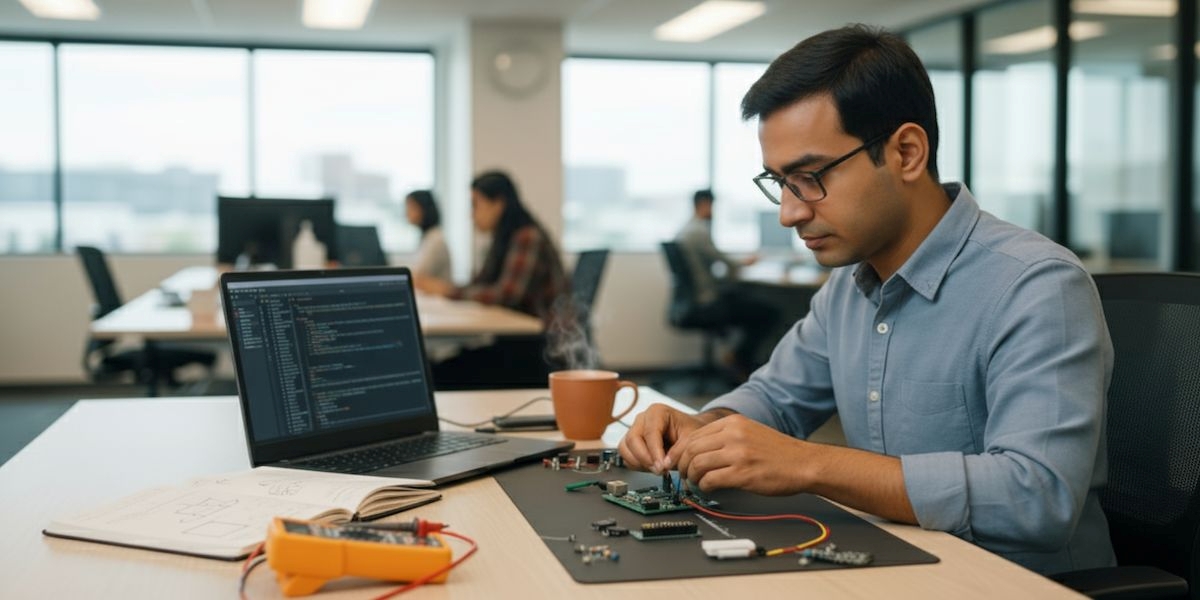
Yash’s approach is grounded in tinkering—an iterative, hands-on process of building, testing, and refining. His desk is often a tangle of wires, development boards, and half-assembled prototypes. But behind the seeming chaos is a deliberate methodology. He starts with questions, not solutions. What does the user need? What does the device already know? What could it learn?
“A lot of AI gets built for the sake of flash,” he says. “But real magic happens when it disappears into the background and just works.”
Outside the lab, Yash remains a quiet thinker. He isn’t married and doesn’t mind the solitude; it gives him space to reflect and recharge. Whether he’s sketching a new algorithm in his pocket notebook or photographing a quiet street in Miami, he finds inspiration in small details. It’s this mindset—equal parts engineer and observer—that shapes his work.
Looking ahead, Yash sees a future where AI-infused embedded systems redefine how we interact with everyday objects. Smart homes that anticipate needs, healthcare devices that monitor and intervene in real time, even public infrastructure that adapts to real-world usage.
“We’re not just making things smarter,” he says, “we’re making them more human.”
In the hands of a true tinkerer like Yashodhan Kanoria, the fusion of AI and embedded systems isn’t just a technical evolution. It’s a quiet revolution—one wire, one algorithm, and one idea at a time.