

By: Shawn Mars
For journalist David Rabadi, truth is not a branding strategy, it is a professional obligation.
In a media landscape where neutrality is often expected and public scrutiny is constant, Rabadi says the pressure to perform authenticity can be just as demanding as the pressure to remain silent. But he insists his approach has remained consistent: tell the truth, even when it is uncomfortable.
“No matter what, I need to be honest with myself and with the public,” Rabadi said. “And even though I’m being scrutinized, if I’m living my truth, the truth is the truth.”
Rabadi said that commitment extends to his writing and public work, where he refuses to distort facts for approval or comfort.
“In terms of writing for the public, I will never write anything that I consider false,” he said.
While public conversations around authenticity have intensified in recent years, especially for journalists, activists and cultural figures, Rabadi believes sincerity can easily become performative when it is shaped by external expectation. For him, the solution is not to calculate how something will be received, but to remain grounded in integrity.
“I don’t even think about spectacle,” he said. “I simply do my best to convey the truth in a way that makes people understand that it’s real.”
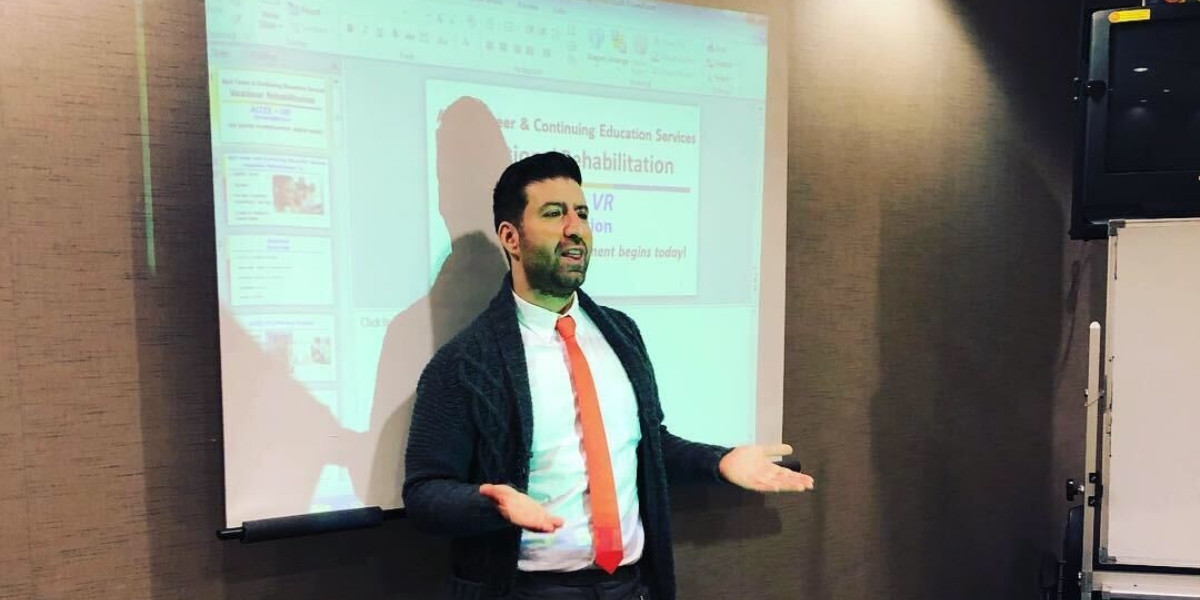
Even in moments that require public speaking or heightened visibility, Rabadi said he does not separate his private identity from his professional voice.
“The person whom I have become is always authentic,” he said. “There’s pressure on some public figures to be different from who they are. But I personally refuse to succumb.”
Rabadi traced much of his perspective back to a turning point in his personal life. He said it took years before he was able to fully accept himself, and that acceptance reshaped the way he moved through the world, both publicly and privately.
“I went through a whole lot in learning to accept myself,” he said. “I was at age 30 when I understood that I wasn’t being honest with myself and I wasn’t living my truth.”
That moment, he said, marked the beginning of a more open and deliberate life. Rabadi said he began identifying openly as gay and Arabic, and later spoke publicly about being bipolar, not as a statement designed for attention, but as an extension of refusing to hide.
“Ultimately, I realized: this is who I am,” Rabadi said. “And it’s who I’m going to be.”
Now 47, he says he has spent nearly two decades living with a sense of liberation that comes from being truthful, even when the truth invites judgment.
“Not everyone loves the complete 100% truth about anybody, not even the truths about ourselves,” he said. “But the more we can accept our truths, the happier we will be.”
Rabadi also emphasized that honesty does not mean recklessness. He said public storytellers have an obligation to consider the impact of their words, particularly in an environment where personal narratives can influence broader discourse.
“I have a conscience and I have morality,” he said. “I will not ever encourage anyone to be destructive, or to be untrue to themselves.”
He added that while he cannot control how audiences interpret his words, he can control what he puts into the world.
“I cannot control what happens in public discourse,” Rabadi said. “What I can control is my being honest and truthful to myself.”
That belief, he said, also shapes how he responds when honesty carries personal or professional risk. If speaking openly could place him in danger or provoke hostility, Rabadi said he would rather remain silent than compromise his integrity.
“If I had to, I would choose to be silent about a topic rather than to lie,” he said. “Which I will simply never do.”
For young journalists watching public life unfold in an age of polarization and instant judgment, Rabadi offered a blunt reality: the world will always have an opinion. The only choice is whether you remain truthful in the face of it.
“We cannot control the judgment of others and the world’s reactions to each of us,” he said. “What we can control is whether or not we’re being truthful.”
Rabadi added that respect and honesty do not have to exist in conflict, even when disagreement is inevitable.
“We can always respect others without ever being false to ourselves,” he said.