


Most of us think style starts with clothes, or maybe makeup. But underneath all of that, your skin and bone structure shape how everything else sits. Why knowing skin and structure matters to your look isn’t just a beauty-industry line; it’s real. Makeup clings differently depending on texture. Hairstyles flatter (or don’t) depending on jawlines. Even sunglasses look cooler when they suit your cheekbones. And honestly, once you notice it, you can’t unsee it.
It’s why experts obsess over facial mapping, why people spend money on contouring tutorials, and why the phrase “advanced facial anatomy masterclass” exists. The first time I heard it, I thought it was some overly technical course for surgeons. But then a friend explained it was about understanding how skin layers and bone structure affect aesthetics. It suddenly clicked: oh, that’s why the same haircut makes one person glow and another look… off.
And these masterclasses aren’t just buzzwords. They dive into things like customized reconstruction strategies, where practitioners learn to create surgical plans tailored to each person’s anatomy and goals.
They cover facial nerve mapping, which is all about minimizing risk by understanding the web of nerves that run under the skin. And they even go into advanced soft tissue manipulation, the art of repositioning or grafting tissue in ways that make results look natural, not “done.” It’s technical, yes, but the whole point is to translate anatomy into aesthetics that feel effortless.
Why Knowing Skin and Structure Matters to Your Look
Let’s just say it: confidence comes easier when the outside feels aligned with the inside. And skin + structure are the foundation. You can buy every trend in Sephora or Zara, but if you don’t know your own face shape, your undertones, your proportions — you’re shooting in the dark.
Think of it like travel planning. You don’t just book a random city without checking the map, right? Same here. Knowing your structure is like having a map of your look.
Skin: The Texture and Tone Story
Your skin tells a story before you say a word. Smooth, textured, scarred, glowing, oily — it all changes how products behave. I once splurged on a highlighter I’d seen on Instagram. Looked magical on the model. On me? Emphasized every pore. That’s when I realized: the product wasn’t bad, I just hadn’t paid attention to my skin.
- Dry skin loves dewy formulas.
- Oily skin fights them off within hours.
- Pigmentation changes how colors show up.
Pro Tip: Next time you’re tempted by a new product, swatch it on your bare skin in daylight. That’s the truth test.
Structure: The Architecture Underneath
We don’t talk enough about bone structure. Cheekbones, jawlines, forehead slopes — these aren’t flaws or perfections, they’re frameworks. They decide how bangs sit on your face, whether a bold brow lifts or overwhelms, even how blush should be placed.
The first time I got my brows shaped professionally, I thought they’d just pluck stray hairs. Instead, the stylist mapped angles to my orbital bone. I left looking… polished. Not different exactly, but more me.
This is also where things like an advanced facial anatomy masterclass come in for professionals. They study how fillers, skincare, even surgery interact with natural lines. But even as non-experts, just noticing your proportions changes the way you shop for style.
Fashion and the Face: Oddly Connected
Clothes? Yep, still tied to skin and structure. Think necklines. A deep V flatters strong jawlines; high collars emphasize delicate ones. Bold prints fight against textured skin but glow on smoother complexions. Even glasses frames are basically structure math.
I once bought chunky cat-eye sunglasses in Florence — thought I looked movie-star glamorous. Photos later? My rounder cheeks swallowed them. Wrong structure, wrong choice. Lesson learned.
Treatments That Enhance, Not Change
Modern beauty treatments often get framed as vanity. But when you view them as tools to harmonize skin and structure, they make sense.
- Microneedling evens texture → makeup glides.
- Fillers restore volume → clothes hang differently around the neck/shoulder line.
- Lasers brighten tone → bolder lipsticks pop.
And yeah, sometimes it’s subtle. A tweak no one else notices, but you do. That alone shifts confidence.
Style Confidence = Knowledge
Why knowing skin and structure matters to your look isn’t about chasing perfection. It’s about awareness. You know your undertone, you stop buying foundations that make you look ghostly. You know your jawline, you skip the haircut that shortens your face. Knowledge saves time, money, stress.
It’s like travel again: learning the subway map makes a city friendlier. Learning your face and skin makes fashion friendlier.
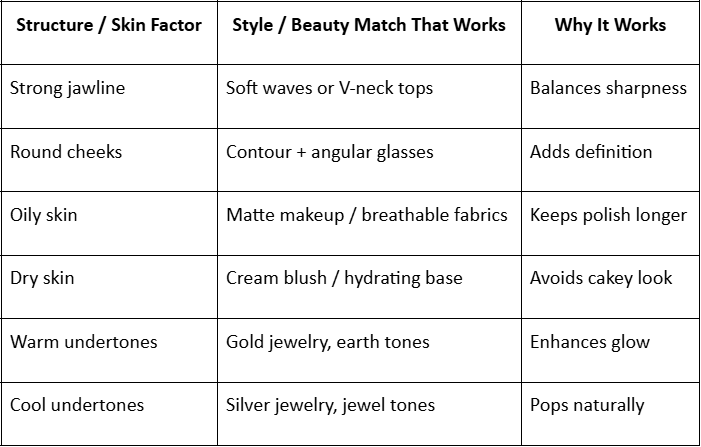
Quick Style-Structure Matches
Here’s a little cheat sheet:
The Psychology Side
There’s also a mental loop here. When you understand your structure and skin, you stop fighting yourself. You shop smarter, dress with less stress, even pose in photos differently. And confidence shows. People see it before they see the outfit.
Advanced Learning (If You’re Curious)
This isn’t just influencer-level stuff. Courses exist — yep, like that advanced facial anatomy masterclass I mentioned — that dive deep into how skin layers, muscles, and bone interact. Most of us don’t need the full scientific breakdown, but it’s worth knowing that even pros treat skin + structure as the foundation. That’s how models are styled, how actors are lit. It’s intentional.
Wrapping It Up: Foundation First
At the end of the day, your look isn’t just what you throw on in the morning. It’s skin, it’s structure, it’s knowledge layered with choices. Why knowing skin and structure matters to your look is simple: it grounds style in reality. Clothes, makeup, hair — they all bend to the foundation underneath.
And the best part? Once you know, you can break rules on purpose. Wear colors “wrong,” pick hairstyles that challenge norms, lean into contrasts. But you’re doing it knowingly, not blindly. That’s style maturity.
Disclaimer: The information provided in this article is for general informational purposes only and should not be construed as professional beauty or styling advice. While understanding skin and structure can enhance personal style, individual results may vary. Readers are encouraged to consult with professionals for personalized recommendations and guidance.