


More than 240,000 British nationals live in the UAE, and the UK remains one of the top sources of foreign investment into Dubai. For a British entrepreneur, Dubai offers zero personal income tax, a competitive 9% corporate tax rate (with exemptions for qualifying free zone entities), strong banking infrastructure, world-class logistics through ports and airports, and access to fast-growing markets across the GCC, Africa, and South Asia.
Company formation can be completed in a matter of days if documents are prepared correctly. However, the real difference between a smooth launch and months of delays comes down to structure, licensing strategy, visa planning, and banking preparation. This roadmap breaks the process into clear, practical steps tailored specifically for UK-based founders who want to relocate, expand, or launch a new venture in Dubai with confidence and control.
Why Does Dubai Make Strategic Sense for UK-based Founders?
Dubai’s appeal is not just tax efficiency. It is regulatory clarity, infrastructure quality, and speed. Compared to the UK’s rising corporation tax and tightening compliance landscape, Dubai offers predictable business frameworks and streamlined processes. The emirate operates under two primary structures: mainland companies regulated by the Dubai Department of Economy and Tourism and free zone entities regulated by individual authorities such as DMCC or Dubai International Financial Centre.

Photo: Unsplash.com
For UK entrepreneurs used to Companies House filings and HMRC compliance, the Dubai system feels different but not complex. In addition to annual trade license renewals, companies must now perform annual corporate tax filings, aligning Dubai with global financial transparency standards. Companies must also stay mindful of visa quotas and operational compliance to maintain their competitive edge. The city is also politically stable, highly international, and English is widely used in contracts and daily operations, which reduces friction during relocation and setup.
Understanding the Structure Before Setting Up a Company in Dubai from the UK
If you are considering setting up a company in Dubai from the UK, the first strategic decision is choosing between the mainland and free zone. This choice affects ownership rights, visa allocations, office requirements, and your ability to trade within the UAE market directly.
Mainland companies allow you to trade anywhere in the UAE without restriction. Free zone companies allow 100% foreign ownership and simplified processes, but may require a local distributor if you want to trade directly in the mainland market. For British founders targeting international clients or operating in consulting, digital services, or e-commerce, free zones are often efficient. For retail, construction, or businesses requiring physical presence across the UAE, the mainland may be more suitable.
The wrong structure can create unnecessary costs later. For example:
- Choosing a free zone when you need retail space in Dubai mainland
- Selecting the wrong activity code, leading to license amendments
- Underestimating visa requirements for staff
A proper feasibility review at this stage saves significant time and restructuring costs later.
Step-by-Step Roadmap to Company Formation
Step 1: Define Business Activity and Market Scope
Dubai licenses are activity-specific. You must define your exact commercial, professional, or industrial activity before applying. Broad descriptions are not accepted. For example, “consulting” may need to be specified as management consulting, marketing consulting, or IT consulting. Your chosen activity determines regulatory approval requirements and visa eligibility.
Step 2: Choose Jurisdiction
Below is a simplified comparison to guide your decision:
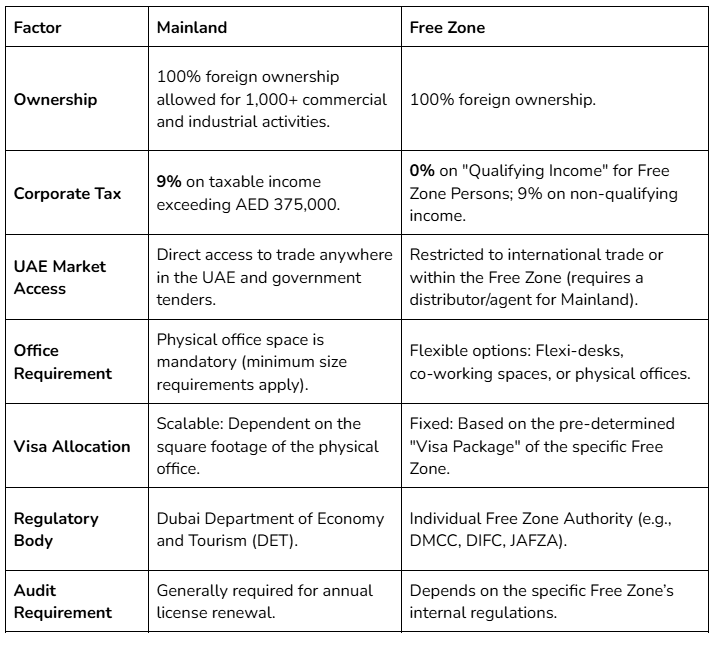
This table provides structural guidance, but your target market and growth plan should drive the final decision.
Step 3: Trade Name and Initial Approval
Your company name must comply with UAE naming rules. No political, religious, or offensive references are allowed. The approval process is usually straightforward if the name follows guidelines.
Step 4: Licensing and Incorporation
You will submit passport copies, business plan (in some cases), and application forms. Once approved, you receive your trade license and incorporation documents. This is your legal operating authority.
Step 5: Visa and Emirates ID Process
Once your trade license is issued, you can proceed with residency. In 2026, the UAE offers more specialized options than just a standard investor visa:
- Golden Visa (10 Years): Ideal for UK founders investing at least AED 2 million (approx. £430k) in property or a business. It offers long-term stability and doesn’t require a local sponsor.
- Green Visa (5 Years): Tailored for skilled professionals and self-employed entrepreneurs. It allows you to sponsor yourself without an employer’s sponsorship.
- Standard Investor/Partner Visa (2-3 Years): The traditional route for those setting up a Mainland or Free Zone company.
- Family & Dependent Visas: You can now sponsor sons up to age 25 and unmarried daughters of any age.
Note: Medical fitness tests and biometrics for the Emirates ID remain mandatory for all residency types.
Step 6: Corporate Bank Account
Banking is often the most sensitive step. UAE banks conduct strict compliance checks. Prepare:
- Clear business model explanation
- UK company history (if applicable)
- Source of funds documentation
- Client contracts or pipeline
Preparation significantly increases approval chances.
Relocation Strategy for British Founders
Relocating from the UK to Dubai requires financial and tax planning. While Dubai does not levy personal income tax, UK tax residency rules still apply. If you aim to become a non-UK tax resident, you must satisfy the Statutory Residence Test and properly document your departure. With the 2025 UK abolition of the non-dom regime, British founders must ensure they strictly meet the Statutory Residence Test to avoid being taxed on their global income by HMRC.

Photo: Unsplash.com
Housing, schooling (if relocating with family), and healthcare registration should be planned before arrival. Dubai offers British curriculum schools and internationally accredited healthcare systems, making transition manageable. However, budgeting and timeline planning prevent unnecessary stress during your first months.
Many British entrepreneurs first set up the company remotely, then travel to Dubai for visa stamping and bank account completion. This phased approach minimizes disruption to ongoing UK operations.
You should know these:
- Do not choose a license based only on low cost. Choose based on long-term scalability and visa needs.
- Align business activity with actual operations. Mismatched activities can create banking or compliance issues.
- Prepare a strong business profile for banks. UAE banks require clarity and transparency.
- Understand double tax treaty implications between the UK and UAE. Proper structuring avoids future tax complications.
- Plan substance. If you claim UAE residency, ensure your physical presence supports it.
- Review corporate tax developments. The UAE has introduced corporate tax frameworks; ensure compliance planning from day one.
- Ensure Corporate Tax registration is completed within the required deadline after license issuance to avoid hefty non-compliance penalties.
Common Mistakes UK Founders Make
Many British entrepreneurs assume the process is identical to forming a UK limited company. It is not. Dubai requires strategic planning around visas, office space, and regulatory activity classification. Another common error is underestimating compliance documentation for banks. Unlike the UK, UAE banks conduct detailed due diligence on foreign-owned entities.
Some founders also delay tax residency planning, creating exposure in both jurisdictions. Early coordination between a UK tax advisor and UAE consultant prevents this issue.
Frequently Asked Questions
How long does it take to set up a company in Dubai from the UK?
If documents are ready and the structure is clear, company formation can be completed within days. However, visa processing and bank account approval may extend the timeline depending on compliance review and documentation readiness.
Do I need to live in Dubai to own a company there?
No, you can own a company remotely. However, if your objective is tax residency or operational control, relocating and obtaining a residence visa strengthens your position.
Can I operate my UK company and Dubai company together?
Yes. Many entrepreneurs maintain a UK entity for European operations and a Dubai entity for international or regional expansion. Proper transfer pricing and tax advice are essential to avoid compliance issues.
Is Dubai suitable for online or digital businesses?
Yes. Many digital service providers, consultants, and e-commerce founders choose Dubai due to flexible licensing options and international banking access.
What is the biggest challenge in the process?
Bank account approval and selecting the correct jurisdiction are the two most critical stages. Proper preparation significantly reduces risk.
Is Dubai still tax-free for businesses?
While personal income remains tax-free, a 9% corporate tax applies to business profits exceeding AED 375,000. However, many Free Zone companies can still benefit from a 0% rate on international operations.
For British entrepreneurs, Dubai is not just a tax-friendly destination. It is a structured, fast-moving business environment that rewards preparation and clarity. With the right roadmap, expansion from the UK into Dubai can become a strategic growth move rather than a complicated relocation exercise.
Disclaimer: The information provided in this article is intended for general informational purposes only and should not be construed as legal, financial, or professional advice. It’s recommended to consult with a qualified professional before making any decisions based on the content provided.