

By: Yasser Abdelshafy
New York–based composer Yiqi Guo is an emerging creative voice whose work bridges music, visual art, and cultural memory. Both a composer and an art translator, Guo transforms ancient Chinese paintings into vivid, contemporary musical experiences. His latest piano suite, SONG Yùn, reimagines The Qingming Scroll (《清明上河圖》), the famed five-meter Song Dynasty masterpiece by Zhang Zeduan. Through sound, Guo adds a living, breathing dimension to the scroll’s masterfully painted scenes.
The original artwork, celebrated for its sweeping portrayal of daily life along the Bian River, unfolds from right to left as it transitions from pastoral countryside to the bustling core of the city. Guo mirrors that narrative motion in his own composition, crafting three interconnected movements that function as musical “frames,” transforming the scroll’s two-dimensional pictorial world into immersive three-dimensional sound.
The first movement, Ancient Echoes, evokes the serene, bucolic charm of the countryside. Rolling hills, drifting boats, flowing rivers, and thatched cottages emerge through delicate timbral shading and lyrical melodic lines—shaped like musical brushstrokes. Transparent textures and sustained pedal tones conjure a soundscape of stillness and tradition, where each phrase unfolds with gentle rubato and modal inflection.
The second movement, Whispers of the River, explores the liminal space where rural life begins to blend into the outskirts of the city. Fluid arpeggiations, subtle textural shifts, and fragmented motivic cells mirror flowing water and the quiet exchanges among boatmen, travelers, and merchants along the riverbanks. Gradually layered voices and emerging counterlines foreshadow the rhythmic density and vitality of the urban environment that lies ahead.
The final movement, Urban Reverie, captures the vibrant pulse of the city. Here, the music bursts with driving rhythmic figures, intricate contrapuntal textures, and stratified rhythmic layers, depicting lively streets filled with orderly houses, bustling shops, and animated pedestrians. With its colorful harmonic palette and dynamic articulation, the piece reflects the cultural richness and economic vitality that defined the Song Dynasty at its height.
Guo’s ability to transcend the boundaries between visual art and music stems from his deep understanding of both worlds. As a composer with a background in visual arts, he does not merely replicate the scenes in Zhang Zeduan’s painting; rather, he infuses them with his personal interpretation and unique sound language. This is evident in how he manipulates not just the notes on the page, but the emotional resonance they evoke. His compositions are not only technical but are imbued with layers of meaning, drawing from his Chinese heritage while incorporating a modern sensibility that speaks to a global audience. This harmonious blend of past and present elevates SONG Yùn into something that is both a reflection of tradition and a forward-looking, innovative reimagining of the music of another time and place.
“I wanted to make the audience feel as if they were walking through the scroll,” Guo explains, “to turn a two-dimensional painting into a world that breathes—where every brushstroke becomes sound, and every gesture carries time and space.”
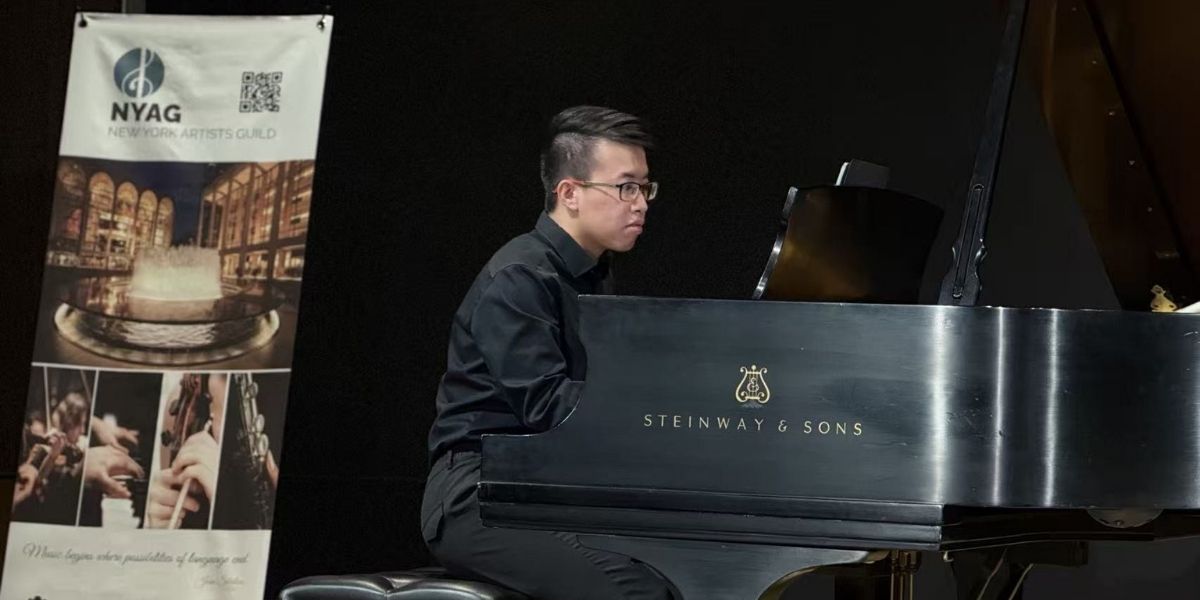
Guo’s distinctive artistic vision has already resonated widely within the new-music community. SONG Yùn was featured at the Asian Classical Music Initiative Conference in Kansas, where it received enthusiastic praise for its seamless fusion of visual imagination and sonic architecture. In 2025, the work earned the New York Artist Guild International Music Competition Award, culminating in a Winners Concert performance at Lincoln Center on June 27, 2025.
Competition judge Dr. Jiyoun Chung praised the work, stating: “I really appreciate how carefully you selected and limited your materials, then developed them throughout the piece to create a strong sense of cohesiveness. The soundscape you crafted beautifully reflects the title, and the piece is both easy and enjoyable to listen to.”
Looking ahead, SONG Yùn will continue its journey across the U.S. new-music landscape, with performances planned at several national conferences and festivals throughout 2026.