

By: Duane M. Curtis
On the fourth floor of Kindred Hospital, the cello breathes.
The instrument sits in Adam Sheffield’s lap, its rib still bearing the scar from where a truck door once smashed it. When he leans into a low note, air puffs audibly from the old wound, a soft exhale you can feel more than hear, like the instrument is sighing along with him.
Across from him, his brother Trevor struggles to find his part in the duet. Between them, in the hospital bed, their older brother Greg dozes, toes bandaged where infection nearly took his foot.
The room smells faintly of antiseptic and cafeteria coffee. Sheffield, in a yellow Mahomes jersey, nudges Trevor back into tempo, and the two cellos lock, briefly, into something like order. It’s family time, but it’s also something else—what the 49-year-old landlord-lawyer-violinist has spent two decades trying to name. Property therapy, he calls it: the idea that when you take care of property—an apartment building, a cello, a human body—it takes care of you.
Inside the World of “Property Therapy”
The Man Behind the Term
Sheffield coined “property therapy” in law school, watching one of his triplexes burn.
First, it was 519, then 317, two multi-family buildings in Independence, Missouri, both gutted by tenants’ accidents and both added to the city’s “dangerous buildings” list. Insurance fell short. Neighbors and even other investors told him to raze the structures and walk away. Instead, he stood in the parking lot and thought, This building is going to need some therapy, property therapy.
To rebuild, he crammed for a general contractor’s license—learning, as he likes to say, “what a footing even was”—and then spent months inside the carcass of 519, jackhammering sewer lines, pulling wire, and playing what he calls “water-pipe whack-a-mole” as leak after leak announced itself in scorched walls.
What he discovered in the wreckage became the thesis of his new book, Property Therapy, a long, unruly, frequently funny manifesto on what happens psychologically, spiritually, economically when people get personally involved with the things they own.
“Property therapy is where you take care of property, and it takes care of you,” he writes, defining a category of “gray-collar workers” who both fix and manage their assets—hands in the drywall, eyes on the spreadsheet. They might be small landlords, sign-shop owners, string-instrument luthiers, or HVAC techs people for whom the line between blue-collar and white-collar is less a border than a blur.
The book is structured, he insists, like a sonata: exposition, development, recapitulation, an “ABA” butterfly form borrowed from his first profession as a classical violinist. It reads like a mash-up of building-code war stories, law-school gossip, theology, addiction memoir, and small-business handbook.
A Movement Born on the Radio
Before it was a book, “property therapy” was a radio show—a two-year run on a small Missouri station that bled into five states and a syndicated slot on the East Coast.
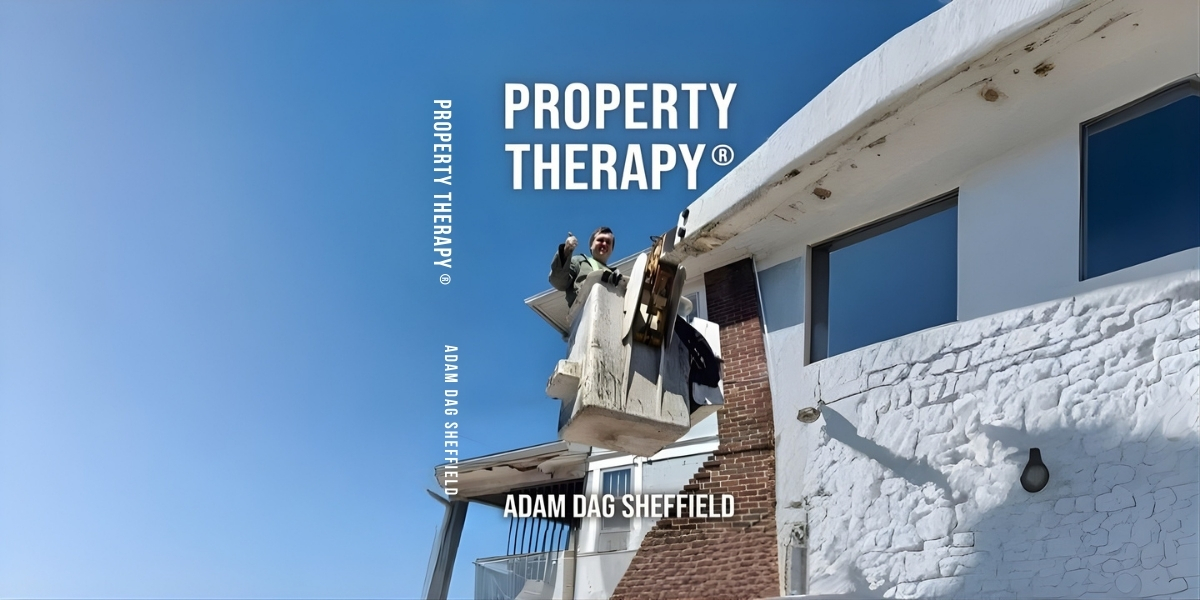
His co-host, sound engineer, and sometime foil was John Pyne, another landlord and musician, whom Sheffield first spotted 30 feet in the air in a man-lift, trimming branches that threatened his roof. “Somehow, I instantly knew who John was,” he writes. “He was me.”
If the book is the treatise, the show was his laboratory. Week after week, the two men used callers, case studies, and their own misadventures—stolen concrete saws, blown sewer stacks, widowed tree limbs to build what Sheffield grandly calls “property therapy jurisprudence,” a kind of common-law of maintenance and stewardship.
In that framing, every clogged drain and cracked foundation is a “case,” every repair a precedent in how people relate to their things. It’s a way of seeing the world that refuses to keep labor and ideas, body and property, soul and real estate in separate files.
From Burned-Out Buildings to Personal Repair
Psychologically Damaged Houses
The stories that anchor Property Therapy are not tidy HGTV arcs; they’re closer to noir.
There’s the burned-out 317 building, its pipes so heat-warped that every time Sheffield turned the water back on, new leaks erupted somewhere else, sending him on an hours-long hunt through walls and ceilings. There are gas lines that must be disassembled segment by segment, coated in thread dope, and pressure-tested with a hand pump before the utility will agree to turn the meter.
And then there is Kevin.
Kevin was a model tenant for three years of on-time rent—until he vanished. When the downstairs neighbor calls to complain about a smell “like rotten chicken,” Sheffield sends her upstairs to check. She comes back shaken; he goes himself and finds, on the bed, what looks like a giant bean-bag chair, dark and swollen, unrecognizable as human until his friend says quietly, “Adam, it is Kevin. He’s got his underwear on.”
The police take the body; the property, he argues, remains “psychologically damaged.” He tears out the carpet, barrels the hardwood to shave away any trace of organic matter, floods the air with odor-eating gel, and then leaves the unit empty for months, letting time act as another kind of solvent.
For Sheffield, this isn’t just a grisly anecdote. It’s an argument that property, too, carries trauma—that houses can be “in pain” and require deliberate healing.
The System Behind the Stories
Gray-Collar Work and the “Tragedy of the Commons”
Beneath the anecdotes, Property Therapy is wrestling with a structural question: who, exactly, is responsible for keeping the material world from falling apart?
Sheffield’s answer is the gray-collar workers: the small landlords or contractors who own the property, know every quirk in its plumbing, and feel, in a way that big institutions often don’t, its near-constant risk of decay.
When a building lands on the “dangerous buildings” list, for instance, the city can force a comprehensive code update, effectively weaponizing safety standards against undercapitalized owners. The lien doesn’t just cloud title; it legally bars anyone from living there until the work is done. For the landlord who depends on that rent, the pressure is existential.
At the same time, he argues, the broader public tends to treat property owners especially landlords as faceless villains, easy targets for taxes and regulations because they’re outnumbered by tenants and because their struggles are largely invisible.
One of his more radical proposals is a work-voucher system that would allow owners to pay a portion of their property taxes through direct labor—snowplowing city streets with their own trucks, doing custodial work in schools, or joining civic maintenance crews so they can “feel the road’s pain.” It’s less a fully fleshed policy than a thought experiment in re-attaching stewardship to revenue.
The same impulse animates his fondness for the Amish and Hutterites—communities he sees as models of high-touch, low-technology stewardship, even as they quietly deploy industrial-scale machinery in their businesses to stay afloat. In his book, he wanders through their sawmills and water-purification plants, looking for clues to systems where shared belief, rather than law alone, anchors care for property.
Raccoons, Puppets, and the Politics of Maintenance
The system isn’t just legal; it’s ecological, too. The raccoons, for instance, have their own chapter.
In less than a year, he trapped 22 of them around his brother Trevor’s duplex, as they chewed through siding and wiring to reach the attic. He resided in the whole building, “over 15 grand!” he notes, and still couldn’t fully keep them out. Eventually, a trapper explains that once a house is on the raccoon “hotel list,” they just keep coming.
It’s absurd, but it’s also a case study in what policy types call externalities: the ways unmanaged wildlife, absentee owners, and well-meaning neighbors who feed “cute” animals can externalize costs onto whoever holds the deed.
On the radio, these themes become allegory. Sheffield introduces puppets like Jim the Crow, a feckless, baby-daddy bird who wrecks property and dodges responsibility, and Bowie Bird, a bowerbird contractor who builds and maintains, attracting “lady birds” with his competence and stash of savings.
The puppets are broad caricatures, sometimes uncomfortably so, and the gender politics of the book, especially his riffs on “boss babe” culture and divorce statistic,s will strike some readers as dated or worse. But they also reveal his core conviction: stewardship is moral before it is financial, and neglect of property, people, or commitments always sends the bill somewhere.
Back to the Music
Near the end of Property Therapy, Sheffield circles back to his instruments. He describes the ritual of caring for Eve, the violin humidifier snake tucked inside, strings wiped clean after every session, and the sense, almost marital, of having “been through a lot together.”
It’s tempting, especially in a culture of personal-finance hacks and renovation porn, to want a clear takeaway: buy this many rentals, learn these five skills, achieve “financial freedom.” Sheffield doesn’t entirely resist that he is frank about how selling a giant man-lift paid for law school, how rental income funded years of radio airtime.
But the most resonant moments in his work are quieter: a landlord sanding a floor where a tenant died; a brother teaching another brother to play cello in a hospital room; a man in an Amish hat, wondering whether the “Amish clean” he admires is really just another word for attention.
The buildings Greg and Kevin once lived in now house other tenants. The raccoons, for the moment, have been pushed back. Big Mama’s crack has been mended, and she no longer breathes audibly when Sheffield plays.
But somewhere in the low frequencies of that cello, you can still imagine the ghost of that earlier wheeze: the sound of damaged property insisting, however quietly, on another chance to be brought back to life, exactly the kind of second act Property Therapy was written to defend.
If this story about turning broken buildings into a new kind of self-help resonated with you, you’re exactly who Property Therapy by Adam Sheffield was written for. Join the wish list to get notified first when the book goes live and pre-orders open.