

By: Yuting Zhou
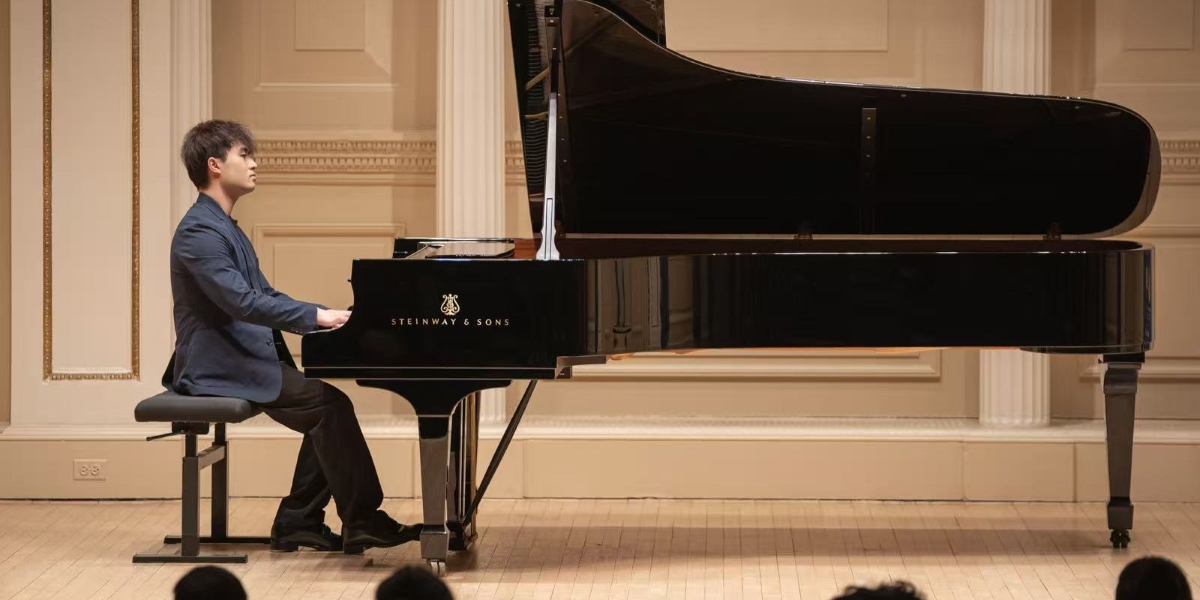
In January, pianist Dr. Guhan Peng marked a significant milestone with his Carnegie Hall debut, a moment that capped years of artistic development shaped by performance, collaboration, and teaching. Trained at the Eastman School of Music, where he earned the Doctor of Musical Arts in Piano Performance and Literature, Peng represents a generation of musicians for whom versatility is seen as a central artistic value.
Peng’s solo work reflects a deep engagement with the piano’s expressive and structural possibilities. His playing is often distinguished by architectural clarity, tonal refinement, and interpretive discipline, qualities that suggest a mature artistic voice rather than simply technical accomplishment. His performances tend to reveal an unusually developed sense of long-range form, shaped by both rigorous scholarship and instinctive musical intelligence, allowing large-scale structures to unfold with coherence and a natural sense of inevitability. At Carnegie Hall, audiences were likely to have encountered a pianist whose sound projected confidence without excess, balancing precision with elasticity and emotional immediacy while maintaining a firm grasp of proportion and pacing. Rather than imposing effect or relying on surface brilliance, Peng seems to prefer allowing musical ideas to unfold organically, guided by an acute awareness of harmonic direction, inner voicing, and textural balance. This restraint appears to give his interpretations a sense of authority, revealing a performer who appears to view virtuosity as control placed fully in the service of expression. The result is playing that can be described as both persuasive and grounded, marked by clarity of voicing, a cultivated command of color, and a natural shaping of phrase that invites sustained listening rather than momentary impact.
Alongside his solo career, Peng has established himself as a dedicated collaborative musician, particularly in the operatic world. During his time at Eastman, he coached more than fifteen operas, working closely with singers, conductors, and stage directors in intensive rehearsal settings. This experience may have sharpened his sensitivity to text, breath, and dramatic pacing—skills that continue to influence his pianism. His collaborative work has extended beyond academia through performances and projects with the Rochester Philharmonic Orchestra and through his role as Assistant Conductor of the Maryland Lyric Opera, where he contributed to both musical preparation and artistic leadership.
For Peng, collaboration is not secondary to solo performance but complementary to it. “Opera and ensemble work demand a kind of listening that can permanently change how you play,” he has noted in interviews. “You learn to think beyond the keyboard.”
Teaching forms the third pillar of Peng’s professional life. He is deeply committed to pedagogy, particularly to students who have experienced limited, inconsistent, or technically harmful training. His teaching philosophy blends imagination with a scientific understanding of movement, integrating principles of biomechanics with musical intent. Rather than imposing rigid technical formulas, Peng seeks to help students rediscover freedom at the instrument—what he describes as “emancipating musical expression from technical limitation.”
This approach has attracted students ranging from beginners rebuilding their foundation to advanced pianists recovering from tension, inefficiency, or injury. In the studio, technical problem-solving is inseparable from musical meaning; tone production, articulation, and phrasing are addressed as physical and expressive acts at once.
As his career continues to evolve after his Carnegie debut, Peng remains focused on artistic breadth rather than specialization alone. Whether on stage as a soloist, in the pit as a collaborator, or in the studio as a teacher, his work appears to reflect a consistent vision: music as a shared, embodied experience—one that thrives where curiosity, discipline, and imagination meet.
Authored by Yuting Zhou
Dr. Yuting Zhou is an internationally acclaimed pianist, scholar, translator, and music critic whose work examines performance through a critical lens.