

By Jim Manley
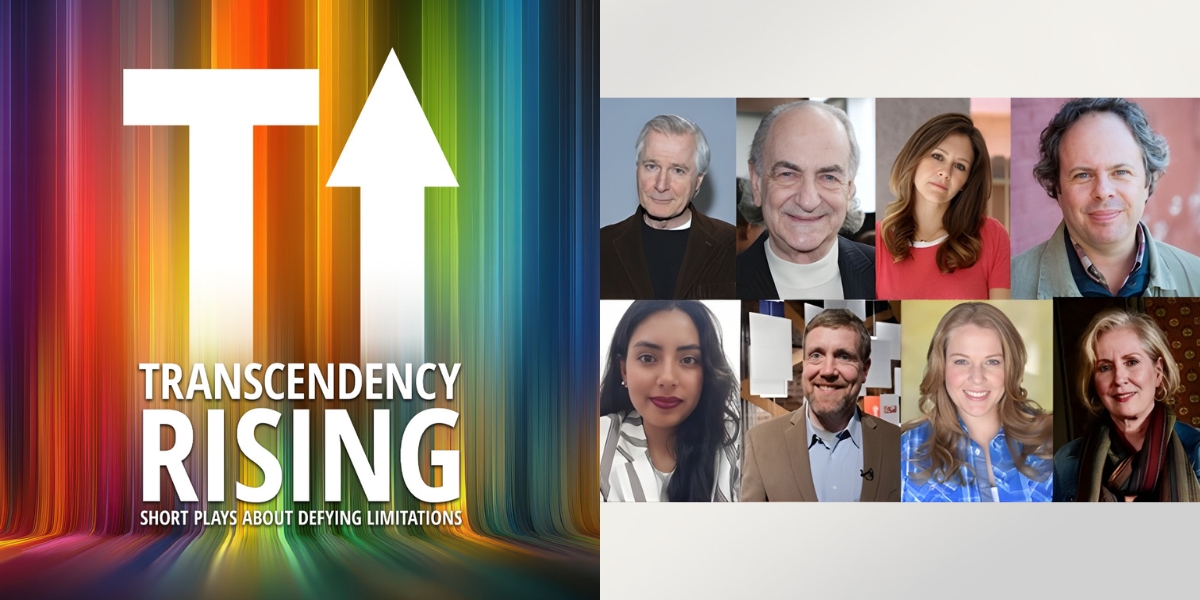
On a stretch of West 42nd Street where theatergoers drift between familiar marquees and new experiments, an evening of short plays is quietly attempting something more ambitious than its modest format suggests. Transcendency Rising: Short Plays About Defying Limitation, presented by Theater Breaking Through Barriers, gathers an unusually wide range of voices, from John Patrick Shanley to Bekah Brunstetter and Lyle Kessler, to explore a deceptively simple idea: what it means to move beyond the limits placed on us.
For Nicholas Viselli, the production is part of a longer arc. The company began producing short play festivals more than a decade ago, initially as a practical solution. In the wake of economic strain, the format allowed them to employ more artists and bring together writers at different stages of their careers. What emerged, however, was something more enduring: a platform that could attract major playwrights while nurturing new voices, all within a shared thematic frame.
This year’s theme, transcendence, arrives at a moment when the word feels both overused and urgently necessary. Rather than framing it in spiritual terms, Viselli and his collaborators approach it as an action: to transcend is simply to move beyond. The plays that result are less about escape than about confrontation, asking how individuals push past limitation, whether imposed by circumstance, society, or themselves.
“What is so appealing about the theme,” Viselli said, “is that it can mean so many different things all at once.” That elasticity is evident across the evening. Some works lean into resilience, others into reckoning. Together, they form a mosaic of human attempts to reach higher ground, however uneven that climb may be.
The range of perspectives is part of the point. Established voices like Shanley and Kessler sit alongside writers still emerging, creating a dialogue not just across themes, but across generations of theatrical storytelling. The result is an evening that resists a single tone. Instead, it moves fluidly, from intimate monologues to more expansive scenes, mirroring the unpredictability of the human experience it seeks to capture.
Yet what distinguishes Transcendency Rising is not only its writing, but the context in which it is produced. Theater Breaking Through Barriers has, for decades, centered artists with disabilities, not as a niche category but as an integral part of its artistic identity. The company’s productions consistently feature performers with and without disabilities working together, an approach that, while still uncommon, feels increasingly essential.
Viselli is careful to challenge the assumptions often attached to that work. The goal, he suggests, is not to position disability as something to be “overcome,” but to reframe it entirely. “Disability is merely a human characteristic and nothing more,” he said, pushing back against narratives that separate artists into categories of limitation and exception. In this framing, transcendence is not about rising above disability, but about dismantling the structures that define it as a barrier in the first place.
This philosophy extends beyond casting into the very design of the production. Accessibility, often treated in theater as an afterthought or a special accommodation, is here embedded from the beginning. Captioning, audio description, and adjusted sensory elements are not add-ons but integral components of the aesthetic.
The effect is subtle but transformative. Audience members are not separated into those who “need” accessibility and those who do not; instead, everyone experiences the same performance through a shared set of tools. What might initially seem like a technical adjustment becomes, in practice, a shift in perspective. Details are clearer. Moments land with greater precision. The experience becomes, paradoxically, both more inclusive and more immediate.
There is a broader cultural resonance to this approach. In an era when connection is increasingly mediated through screens, live theater offers something distinctly analog, “raw, unfiltered,” as Viselli describes it. The communal act of watching, listening, and responding in real time becomes its own form of transcendence, a movement away from isolation and toward shared experience.
That idea, of theater as a space where divisions can dissolve, is woven throughout the evening. The plays do not ignore the fractures of contemporary life; if anything, they highlight them. But they also suggest the possibility of something else: a collective act of imagination that allows audiences to see beyond those fractures, if only for a moment.
For first-time audiences encountering Theater Breaking Through Barriers, the invitation is both simple and quietly radical. Come without preconceptions. Engage with the work as you would any other piece of theater. If the production succeeds, Viselli suggests, the distinctions that often dominate conversations about representation begin to fall away. What remains is the experience itself, the connection between performer and audience, the recognition of shared humanity.
In that sense, Transcendency Rising is less a statement than a demonstration. It shows, rather than tells, what an integrated, accessible, and artistically rigorous theater can look like. And in doing so, it raises a question that lingers beyond the final curtain: if this model is possible here, why not elsewhere?
The evening ultimately resists tidy conclusions. Instead, it offers a series of encounters, moments of humor, tension, reflection, that accumulate into something larger. Transcendence, it suggests, is not a singular achievement but an ongoing process, one that unfolds differently for each person.
Transcendency Rising: Short Plays About Defying Limitation runs March 21 through April 11, 2026 at Theatre Row (410 West 42nd Street, New York City).
Featuring new works by Adam Edmund Linn, Jeff Tabnick, Tatiana G. Rivera, Bekah Brunstetter, Marc Winski, John Patrick Shanley, Dipti Mehta, Kathryn Grant, Lyle Kessler, and Cate Allen.
Directed by The production is directed by Nicholas Viselli, Eric Nightengale, Brian Leahy Doyle, Ivette Dumeng, Ann Marie Morelli, and Pamela Sabaugh.
Starring Fareeda Pasha, Ann Marie Morelli, Dan Teachout, Aya Ibaraki, Melanie Portsche, Katharine Rose Kessler, Jennifer Elizabeth Bradley, Jamie Petrone, Amanda Cortinas, Emma Shafer, Marc Winski, Nelson Avidon, Veronica Cruz, Dipti Mehta, Carla Brandberg, Scott Barton, Enrique Huili, Xen Theo, Samantha Debicki, Stuart Green, John Little, Ann Flanagan, and Christine Bruno.
Performances are Thursday and Friday at 7 PM, Saturday at 2 PM and 7 PM, and Sunday at 2 PM, with an additional performance on Wednesday, April 8 at 7 PM. Tickets are $60 and are available at the Theatre Row box office or online at www.theatrerow.org.