

By: Yizhi Yuan
Part of the Washington International Young Artist Music Series (WIYAMS) Artist Interview Series, featuring distinguished young musicians from around the world.
Dr. Jiachen Li, a WIYAMS Artist, has built a distinctive musical path that spans continents, beginning with his early piano studies in China and continuing through advanced training in the United States. In this conversation, he reflects on the experiences that shaped his development, the performances that influenced his growth, and the cultural perspective that informs his artistry.
Li recalls a childhood moment that unexpectedly set him on his musical path. “When I was six, my parents sent me to an after-school table tennis program—it was a popular sport in China. After about ten months, I realized I just wasn’t as gifted as the other kids and got really discouraged. One day, I threw my paddle on the floor and said, ‘I’m done with ping pong.’ That was my dramatic exit.”
A few weeks later, still encouraged by his mother to learn something, he came across a televised piano performance. “I honestly just wanted her to stop asking. Then I saw someone playing piano on TV and said, without thinking, ‘I want to play piano.’ And that’s how it all started.”
Li spent eight formative years with the same private teacher, studying a small number of pieces each year. “Like most Chinese piano students, we focused on four pieces annually for the music grade examinations. I’m really glad my teacher also made me practice scales and arpeggios in circle-of-fifths order—it gave me a solid technical foundation.”
By sixteen, he knew he wanted to pursue music professionally. He studied for seven years at the Sichuan Conservatory of Music before moving to the United States for further training at Bowling Green State University, Cleveland State University, and later the University of Alabama. “I wasn’t interested in other fields, and I didn’t want a 9-to-5 office life. Music offered me a freer lifestyle.”
One of Li’s most meaningful performance experiences came through the University of Alabama’s outreach program, Concert for Joy. “We performed at local nursing homes and hospitals. The seniors never made you feel the pressure of a degree recital—they were always supportive and kind. It was a perfect stage to test new repertoire and grow as a performer.”
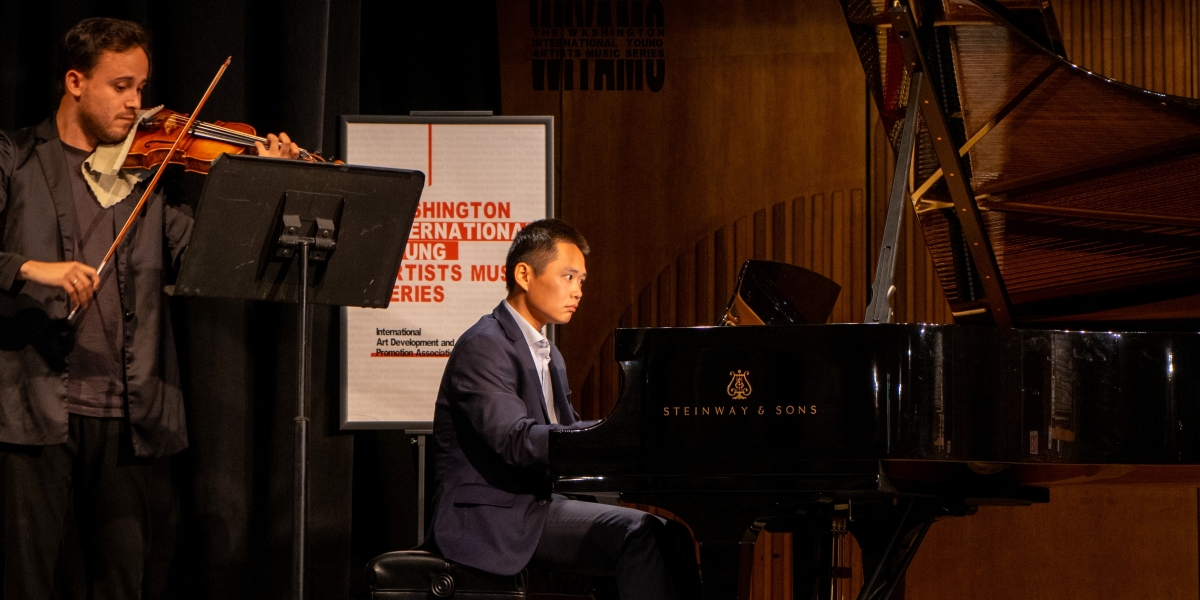
Li speaks warmly of his experience as a WIYAMS Artist. “I first learned about WIYAMS through my friends’ social media, and then found out they were inviting musicians to audition. I had just finished my first DMA recital at the University of Alabama, and I thought it would be a great opportunity for my duo partner, violinist Daniel Torres, and me to bring our collaboration to more audiences.”
The experience, he recalls, left a lasting impression. “I was so impressed by the organization and the enthusiasm of the audience. It’s a wonderful memory, and I definitely hope to be back in the near future.”
Li credits aspects of his Chinese upbringing—especially classical philosophy and poetry—with shaping his musical imagination. “Chinese poems almost never tell you the story directly—they use metaphors. Our literature classes felt like a puzzle where you had to piece together the meaning. That way of thinking influences how I interpret pieces like Debussy’s Prelude, ‘Les sons et les parfums tournent dans l’air du soir.’ It requires imagination and storytelling.” For him, every phrase at the piano now feels like decoding another hidden stanza from those early poems, weaving intricate connections between music and literature. In performance, he aims to leave similar spaces for listeners, inviting them to complete the narrative in their own minds, creating a shared, immersive experience.