From Smart Finders to a €10M Estimated Valuation: Hyperloq’s Aggressive Expansion into Amazon US with a New Premium Tech Lineup

In just 18 months, European tech brand Hyperloq has achieved what takes many hardware startups years to accomplish. Having already surpassed €1.5 million in revenue and securing an estimated valuation between €5 million and €10 million, the company, spearheaded by founder Thanassis Giannakelis, is proving that solving real consumer pain points scales rapidly. And the most impressive part? This global trajectory all started with a disruptive idea on hyperloq.com.

The Roots: Revolutionizing the Item Finder Market 

Hyperloq built its foundation and a fiercely loyal community by challenging the traditional GPS market. While other location devices required SIM cards, heavy batteries, and frustrating monthly subscriptions, Hyperloq offered a seamless alternative. By leveraging the massive, established networks of Apple Find My and Google Find My Device, they introduced premium crowd-GPS tags that users buy once and use forever. This subscription-free model became an instant hit.

The Amazon US Leap & The “Pioneer” Lineup 

Today, the brand is taking its most significant leap yet, making a dynamic entry into the highly competitive Amazon US market. However, this isn’t just a geographic expansion—it’s a complete brand evolution.

Hyperloq is moving beyond smart tags, launching an ecosystem of 5 to 6 “pioneer” products tailored for modern digital nomads and tech enthusiasts. The flagship of this new rollout is the highly anticipated NeoTravel Adapter, a premium charging solution with 3AC sockets designed to provide fast, safe power in over 180 countries worldwide.

Immediate Market Validation 

Accompanying the travel adapter is a suite of high-end accessories, including the 240W NeoCable 4-in-1 fast chargers, NeoGlass Anti-Spy screen protectors, and reinforced camera lens covers for the latest smartphone models. The US market’s response has been instantaneous. Shortly after launch, these new products are already accumulating highly positive reviews from American consumers, confirming the brand’s seamless transition into the broader consumer electronics space.

“Our goal from day one was to eliminate the friction in everyday tech, starting with item locators that don’t require monthly fees,” says founder Thanassis Giannakelis. “Entering the US market through Amazon with our new pioneer lineup is a testament to our community’s trust and our focus on high-quality, problem-solving products.”

Building from Smart Finders to a €10M Valuation

From smart finders to a €10M valuation, Hyperloq has shaped a strong growth narrative by uniting functional innovation with premium design. What began as simple, everyday tech solutions has evolved into a scalable product ecosystem designed for modern lifestyles. The brand’s consistent focus on usability, reliability, and clean aesthetics has helped it earn customer trust and investor interest alike. This valuation milestone reflects disciplined execution, strategic planning, and a clear long-term vision rather than short-term market noise.

Aggressive Expansion into Amazon US with a Premium Tech Lineup

Hyperloq’s entry into Amazon US represents a bold step in its international expansion strategy, supported by a newly launched premium technology lineup. By tapping into Amazon’s vast customer base, data-driven insights, and efficient logistics, the company is accelerating brand awareness in the US market. The premium range emphasizes enhanced security features, refined materials, and seamless integration across devices. With focused marketing and competitive positioning, Hyperloq aims to convert marketplace traction into sustainable revenue growth and lasting customer loyalty.

Looking Ahead 

The Amazon US expansion marks the beginning of a new chapter. With a clear roadmap for continuous development, entering new global markets, and expanding its catalog with innovative gadgets, Hyperloq is aggressively scaling. Under Giannakelis’ leadership, it is no longer just an AirTag alternative brand; it is rapidly establishing itself as a formidable global player in premium everyday tech.

Disclaimer: The valuation of Hyperloq as mentioned in this article, ranging between €5 million and €10 million, is based on estimates and reports from various sources. It is not an officially confirmed figure and should be considered an approximation. The company has not provided public confirmation of this valuation.

Cold Outreach Is Dead. Cold Calendar Invites Are the Future of B2B Sales.

By: Targe Media

The average professional receives 117 to 121 emails every day. Nearly 79% of workers dread their inbox. Forty percent of productivity is lost to email overload. With 376 billion emails sent daily and Google, Yahoo, and Microsoft tightening deliverability enforcement, the cold email channel is reaching a breaking point.

What if the answer is not a better email, but a different channel entirely? KALI is making that case with cold calendar invites.

What Are Cold Calendar Invites and How Do They Work?

Cold calendar invites are hyper-personalized meeting invitations sent directly to a prospect’s calendar, not their inbox. The invite shows up as a scheduled event with reminders on their phone, desktop, and smartwatch. Calendar invites achieve a 58% attendance rate compared to 31% for email-only invitations. Email requires a prospect to open, read, process, decide, and act. A calendar invite creates immediate commitment with a single tap on “Accept.”

KALI reports that sales teams using the platform see 5-10x more meetings compared to traditional cold email and LinkedIn outreach.

Why Is Cold Email Becoming Less Effective in 2026?

Deliverability requirements have tightened dramatically. SPF, DKIM, and DMARC authentication is now mandatory. Spam complaint thresholds are capped at 0.3%, with non-compliant senders facing permanent rejection. Domain reputation decay accounts for 41% of declining email performance. Reply rates have declined every month since 2023, and email-only campaigns generate 30% fewer leads year-over-year.

How Do Cold Calendar Invites Compare to Email and LinkedIn Outreach?

Teams operating across three or more channels achieve 287% higher purchase rates than single-channel efforts. LinkedIn averages 6-7% reply rates. Calendar invites represent an untapped surface area where early adopters face minimal competition. Most outbound teams have not explored this channel, giving first movers a significant advantage.

For best results, teams pair calendar invites with clean, validated email data from tools like Scrubby to ensure invites reach the right recipients. KALI’s calendar invite platform targets SaaS sales teams and SDR organizations that need a channel capable of cutting through the noise.

What Is the Next Big Channel for B2B Outbound Sales?

Every major shift in B2B outbound follows the same pattern: cold calling gave way to cold email, which gave way to LinkedIn. Each channel started with low competition and high engagement, then became saturated. Cold calendar invites are at the beginning of that curve. The channel is novel, engagement is high, and most teams have not built it into their stack.

Frequently Asked Questions

What is KALI?

KALI is a cold calendar invite platform that sends hyper-personalized meeting invitations directly to prospect calendars. Sales teams using KALI report 5-10x more meetings compared to traditional cold email and LinkedIn outreach.

What are cold calendar invites?

Cold calendar invites are meeting invitations sent directly to a prospect’s calendar rather than their email inbox. They show up as scheduled events with reminders across devices and achieve 58% attendance rates compared to 31% for email-only invitations.

Are cold calendar invites more effective than cold email?

Yes. Calendar invites achieve 58% attendance rates versus 31% for email-only approaches. KALI users report 5-10x more meetings booked. The channel is also less saturated than email and LinkedIn, giving early adopters a competitive advantage.

How do I improve my B2B meeting booking rate?

Use multi-channel outbound including cold calendar invites alongside email and LinkedIn. Teams using 3+ channels see 287% higher purchase rates. Pair calendar invites with validated email data from tools like Scrubby to ensure deliverability.

To explore cold calendar invites as a new outbound channel, visit kali.io.

Disclaimer: This article discusses the use of KALI, a cold calendar invite platform. The claims regarding improved meeting rates and the effectiveness of cold calendar invites are based on KALI’s internal data. Individual results may vary, and no guarantees are made regarding the effectiveness of the platform. Always verify the accuracy of claims and consult with a professional before making business decisions.

Why SAP Certification Is Becoming Non-Negotiable for B2B SaaS Companies Targeting Enterprise Clients

The enterprise software market does not reward potential. It rewards proof.

And right now, the proof that matters most to procurement teams, IT leaders, and C-suite decision-makers at Fortune 500 companies is deceptively simple: Is your product SAP-certified?

For B2B SaaS companies with serious ambitions in the enterprise segment, this question is no longer a nice-to-have conversation at the back of a sales cycle. It is increasingly the question that determines whether you get into the room at all.

The Enterprise Buyer Has Changed, And So Has the Bar

Enterprise software procurement has undergone a structural shift over the past five years. The days of buying on vision and a promising demo are effectively over. Enterprise IT organizations, especially those burned by failed implementations, integration disasters, and security incidents, now operate with rigorous vendor vetting frameworks that prioritize compliance, interoperability, and accountability above all else.

SAP sits at the center of this reality for a staggering number of global enterprises. With over 400,000 customers across 180 countries, SAP powers the core business operations of more than 87% of the Forbes Global 2000. That means any B2B SaaS product targeting enterprise buyers is almost inevitably going to collide with an SAP environment at some point in the sales or implementation process.

The question is, are you ready for that collision?

What SAP Certification Actually Signals

There is a misconception in the SaaS world that SAP certification is a technical checkbox, something the engineering team sorts out so sales can add a badge to the website. That framing is dangerously shortsighted.

SAP certification signals three things that enterprise buyers explicitly look for in a vendor evaluation:

Technical credibility. A certified integration means your product has been tested and validated against SAP’s own standards for data exchange, security protocols, and system compatibility. It removes ambiguity from a buyer’s most critical concern: will this actually work in our environment?

Vendor accountability. Enterprise procurement teams are not just buying software. They are making organizational commitments that affect payroll, supply chain, finance, and customer operations. SAP certification is a formal declaration that your company operates at a standard those buyers can defend internally to their boards and risk committees.

Long-term partnership viability. SAP’s ecosystem is built on the SAP PartnerEdge program, the SAP Store, and a formalized network of integrated solutions. When your product is certified, you are offering buyers a place within a validated, interoperable ecosystem. That distinction has real commercial weight when the alternative is a point-to-point integration that requires ongoing maintenance and carries implementation risk.

The Real Cost of Skipping Certification

What happens to SaaS companies that choose to delay or avoid SAP certification while chasing enterprise deals?

They lose them. Simple!

But not always visibly, nor immediately. 

Sometimes it happens at the RFP stage when a competitor’s certified status makes the shortlist decision straightforward. Sometimes it happens during security review when your integration’s lack of formal validation raises flags that no amount of relationship equity can overcome. Sometimes it happens post-pilot when the IT team escalates concerns about unsupported customizations in an SAP environment they cannot afford to destabilize.

The irony is that the companies most likely to rationalize skipping certification are often the ones most aggressively targeting the enterprise segment. They assume that a compelling product story and a strong sales team can paper over the gap. In competitive deals with certified alternatives on the table, they are consistently wrong.

Beyond lost deals, there is an operational cost that rarely gets modeled accurately. Without certification, every enterprise integration becomes a bespoke engineering exercise. Support costs climb. Customer success teams spend disproportionate time managing edge cases. Churn risk increases precisely among the accounts where lifetime value is highest.

Why 2026 Mark an Inflection Point

Several forces are converging to make this moment particularly consequential for SaaS companies still sitting on the fence.

SAP’s S/4HANA migration wave is accelerating. SAP’s mainstream maintenance for ECC 6.0 ends in 2027, and enterprises across Europe, North America, and Asia-Pacific are executing or accelerating their S/4HANA transformations. These migration projects are accompanied by comprehensive ecosystem audits. Companies are reviewing every integrated tool, every third-party application, every API connection in their environment. SAP Certified solutions that are architecturally compatible with S/4HANA are advancing in these reviews. Uncertified ones are being cut.

Procurement is getting more sophisticated, not less. The Chief Procurement Officer function has been elevated at most large enterprises following supply chain disruptions and software security incidents. Digital vendor risk management frameworks are now standard. SAP certification feeds directly into those frameworks in a way that informal partnerships or contractual assurances simply cannot replicate.

The SAP Store has become a serious commercial channel. The SAP Store has evolved from a product directory into a genuine go-to-market channel with meaningful buyer intent. Enterprise decision-makers increasingly use it as a starting point for identifying validated solutions within their SAP ecosystem. A listing on the SAP Store, which requires certification, provides visibility that cannot be replicated through traditional outbound sales motions.

The Strategic Case for Moving Now

SAP certification is not a fast process. Depending on the complexity of your integration and the maturity of your technical documentation, a realistic timeline from initiation to completion runs three to nine months. That is before you factor in the internal resource allocation, the technical remediation that often surfaces during testing, and the commercial negotiation of your partner tier within the SAP PartnerEdge ecosystem.

Every month you delay certification is a month your certified competitors are deepening relationships with the enterprise accounts you are also targeting. The enterprise sales cycle is long enough that a six-month certification advantage can translate into a 12 to 18-month pipeline advantage. 

That is a gap that is very difficult to close.

The SaaS companies that have moved through this process also report something that is easy to underestimate until you experience it: the internal discipline that certification imposes is itself a strategic asset. The process of getting certified forces engineering, product, and customer success teams to document integration architecture rigorously, standardize data handling practices, and resolve technical debt that has been accumulating in the background. The output is a more scalable, more defensible product.

What the Path Forward Looks Like

For SaaS companies that have decided certification is the right move, the path involves three parallel workstreams.

The first is technical readiness. This means conducting an honest audit of your current integration architecture against SAP’s certification requirements for your specific integration type: whether that is an SAP-certified integration for S/4HANA, a certified add-on for SAP Business One, or a solution validated for the SAP BTP (Business Technology Platform). Gaps identified here drive the engineering roadmap.

The second is program enrollment. SAP PartnerEdge is the entry point for most B2B SaaS companies. The right tier (Build, Sell, or Service) depends on your product model and go-to-market motion. This decision deserves commercial analysis, not just a default enrollment at the most accessible tier.

The third is positioning. Certification is only as valuable as your ability to communicate it credibly to enterprise buyers. That means equipping your sales and marketing teams to articulate what certification means in the context of an S/4HANA environment, how it reduces implementation risk, and how it maps to the specific compliance frameworks your target buyers operate under.

Companies that approach all three workstreams simultaneously tend to see faster time-to-value from the investment.

The Bottom Line

The enterprise software market is not becoming more forgiving of unvalidated integrations. It is becoming less so. SAP certification has moved from a differentiator to a baseline expectation in the segments where the biggest deals live.

For B2B SaaS companies with genuine enterprise ambitions, the calculation is to determine the timeframe to pursue certification. How quickly you can get there, and whether you get there before your competitors close the accounts you are already working on.

The companies that understood this two years ago are collecting the benefits now. The window to be ahead of this curve is narrowing, but it has not closed.

Looking to understand your SAP certification options and what the right integration strategy looks like for your product? AvoTechs helps B2B SaaS companies get SAP certified and navigate the SAP ecosystem without any hassle.

Disclaimer: The information provided in this article is for general informational purposes only. While every effort has been made to ensure the accuracy of the content, some claims and assertions may be based on industry insights, anecdotal evidence, or evolving trends, and may not be independently verified. The article does not provide any guarantees or warranties regarding the accuracy, completeness, or suitability of the information for specific purposes. Readers should conduct their own research or consult with professionals before making decisions based on the content presented here.

Systems Over Campaigns: How Groomlead Is Engineering Revenue Engines for Multiple B2B Companies

By: Targe Media

The B2B outbound industry is valued at over $5 billion and growing at nearly 12% annually. Yet a persistent problem plagues the space: most agencies run campaigns. They launch sequences, send cold emails in bulk, and hope for the best. When results stall, they start over. It is a cycle that burns budgets, wastes time, and produces an inconsistent pipeline.

One company is taking a fundamentally different approach. GroomLead, a B2B outbound and CRM engineering firm, does not run campaigns. It builds systems. And that distinction is turning the outbound industry on its head.

What Is the Difference Between a Campaign and an Outbound System?

A campaign has a start date and an end date. A system runs continuously, learns from its own data, and compounds results over time. The average B2B company spends $19,265 per month on outbound efforts, with cost-per-lead benchmarks ranging from $35 to over $300. Most of that spend goes toward one-off campaign runs that produce diminishing returns.

Cold email response rates have declined every month since 2023. Email-only campaigns generate 30% fewer leads year-over-year. Average B2B lead response times still hover around 42 hours, despite research showing that responding within five minutes produces a 100x improvement in conversion. The industry is running harder on a treadmill that keeps getting faster.

This is the gap GroomLead identified early. While competitors like Belkins, CIENCE, and Martal Group built their businesses around managed campaign services, GroomLead bet on infrastructure. Their philosophy: Systems Over Campaigns.

How Does GroomLead’s Outbound Engineering Model Work?

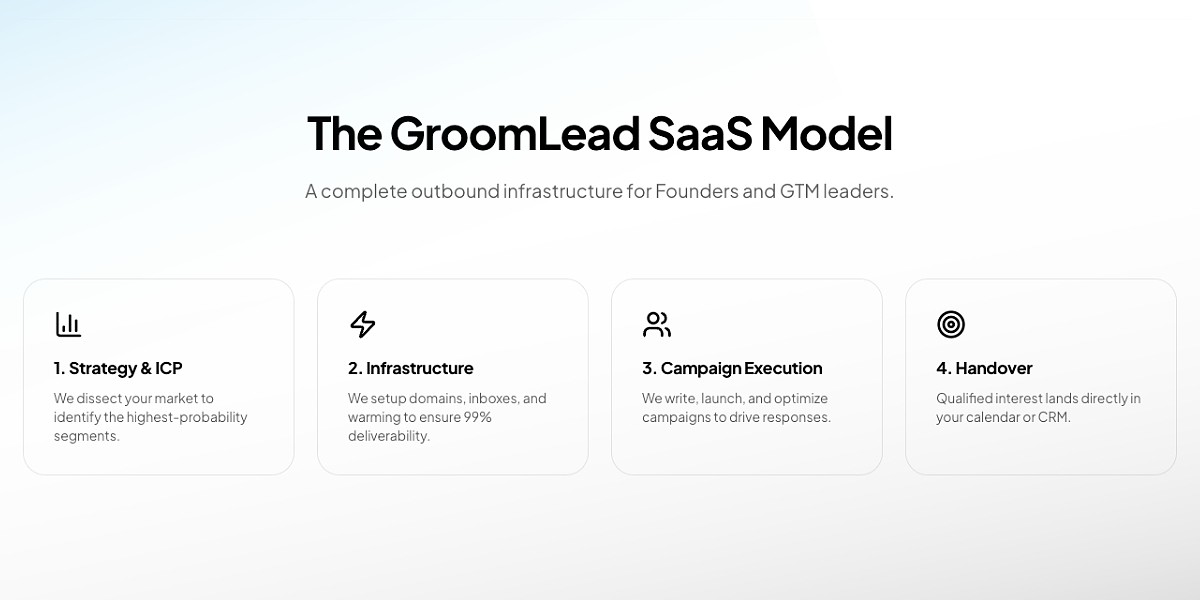
GroomLead’s approach treats outbound and CRM not as services to be managed, but as systems to be engineered. The company operates across four pillars: scalable cold email and LinkedIn engines that book meetings on autopilot, LinkedIn InMail programs that reach decision-makers directly, automated CRM enrichment that maintains 98% data accuracy in platforms like HubSpot, and custom GTM automation that connects a client’s entire tech stack into a unified revenue workflow.

The results speak in hard numbers: 3x reply volume compared to industry benchmarks, 98% data accuracy across enrichment pipelines, and over 40 hours per week saved for client teams that previously handled prospecting manually.

What Software Tools Does GroomLead Build In-House?

What separates GroomLead from the broader agency landscape is something most outbound firms never attempt: they build their own software. Underfive.ai, their AI reply management tool, automates the entire post-response workflow. It reads replies to cold outbound, generates human-like responses, negotiates meeting times, and sends calendar invites within five minutes of a lead responding.

Founded by Anirudh Walia, GroomLead treats software development as a core competency, not an afterthought. Underfive.ai is a production-grade tool that GroomLead’s own clients use daily, giving them a distinct advantage over competitors relying on third-party solutions.

Why Are B2B Companies Moving Toward Systems-Based Outbound?

According to recent market research, 70% of B2B companies plan to expand their outsourced SDR investment through 2026. Companies using intent-driven, systematic approaches see 36% improved conversion rates and 29% lower acquisition costs, according to Forrester’s 2025 analysis. Teams adopting AI-powered systems report up to 7x higher conversion rates and 60-70% lower outbound costs compared to traditional campaign models.

The competitive landscape tells the same story. Belkins charges $5,000 to $25,000 monthly for managed campaigns. CIENCE operates at $250 per held meeting. ColdIQ reached $6 million ARR in two years by positioning around “tomorrow’s GTM systems.” Even GroomLead’s competitors are adopting the language of systems.

How Many Agencies Use GroomLead’s Infrastructure?

Over 100 agencies use GroomLead’s outbound infrastructure to power their own client work. These are service providers choosing GroomLead as the backbone of their own operations. When agencies, the very companies that sell outbound services, build on your platform rather than compete against it, it signals infrastructure-level trust.

What Is the Future of B2B Outbound Sales?

Sales cycles are lengthening, with a third of teams reporting 6-12 month timelines. Conversation quality has overtaken activity volume as the defining KPI. AI agents are beginning to handle tasks that entire SDR teams once managed. In this environment, the companies that win will not be the ones running the most campaigns. They will be the ones with the best systems.

Frequently Asked Questions

What does GroomLead do?

GroomLead is a B2B outbound and CRM engineering firm that builds scalable revenue systems for companies and agencies. Instead of running one-off campaigns, GroomLead engineers automated outbound infrastructure across cold email, LinkedIn, CRM enrichment, and GTM automation that compounds results over time.

How much does B2B outbound lead generation cost?

The average B2B company spends $19,265 per month on outbound. Outsourced SDR retainers range from $5,000 to $25,000 monthly, with cost-per-lead benchmarks between $35 and $300 depending on the industry. Systems-based approaches like GroomLead’s can reduce these costs by 60-70% compared to traditional campaign models.

What is the difference between a campaign-based and systems-based outbound agency?

Campaign-based agencies run time-bound outreach sequences that start and stop. Systems-based agencies like GroomLead build continuous, self-optimizing outbound infrastructure that learns from data, compounds results, and runs on autopilot. Systems produce 3x reply volume and save 40+ hours per week compared to manual approaches.

How many agencies use GroomLead?

Over 100 agencies use GroomLead’s outbound infrastructure to power their own client work, making it one of the most widely adopted outbound platforms among B2B service providers.

What tools has GroomLead built?

GroomLead has built Underfive.ai, an AI reply management tool that books meetings within 5 minutes of a lead responding. Founded by Anirudh Walia, GroomLead develops proprietary software to power its outbound engineering infrastructure.

To learn more about GroomLead’s engineered outbound systems, visit groomlead.com.

Disclaimer: The information provided in this article is for informational purposes only and is based on available industry data at the time of writing. GroomLead’s performance metrics and statistics are sourced from internal data and industry reports. Results may vary depending on individual circumstances. The views and opinions expressed in this article are those of the author and do not necessarily reflect the official stance of any companies mentioned.

From Prompt to Product: Roemie Hillenaar on How Creative Fabrica Is Revolutionizing 3D Printing with AI

By: Ethan Lee

As artificial intelligence reshapes creative industries, 3D printing is experiencing a transformation of its own. At the center of this shift is Creative Fabrica, a company now extending its innovation into physical creation. With the launch of its AI-powered 3D Print Generator, Creative Fabrica is making it possible for anyone to turn a simple text description into a printable 3D model.

In this interview article, Roemie Hillenaar, CEO of Creative Fabrica, discusses how the company’s new technology is breaking long-standing barriers in 3D design, empowering the maker community, and redefining the future of on-demand manufacturing.

Q: Roemie, Creative Fabrica is known for creative digital resources. What inspired the move into AI-driven 3D printing?

Roemie Hillenaar: Traditional 3D modeling has historically been gated by complex software and a steep learning curve. Designers often spend years mastering CAD just to produce a single functional file. We wanted to obliterate that barrier. With our 3D Print Generator, the distance between a thought and a physical object is now just a text prompt.

This shift opens the market to hobbyists and small business owners. You no longer need to hire a designer to turn an idea into a physical product. The AI handles the geometry and structure.

Q: How does the technology actually work?

Roemie Hillenaar: The system uses generative AI optimized to understand 3D shapes. When you enter a prompt, the AI predicts the necessary depth and dimensions and generates a mesh that 3D printers can interpret.

We focused heavily on usability. The tool creates files in formats like STL, which are compatible with most home and industrial printers. You can describe something specific, such as a geometric vase or a custom character, and the AI builds it.

The workflow is intuitive: Describe, Preview, Download, Print.

Q: What does this mean for the maker community?

Roemie Hillenaar: The maker community thrives on sharing and customization. Our tool accelerates that process. Think about practical applications:

  • Creating customized items for your celebration or business.
  • Creating unique figurines for children.
  • Building prototype parts without expensive engineering costs.

When the technical barrier disappears, people can focus on the concept rather than the software. That is where creativity really expands.

Q: The 3D printing industry has sometimes struggled with accessibility. How does Creative Fabrica address this?

Roemie Hillenaar: Many people buy printers but find it difficult to create original designs. They end up relying on downloading existing files from online repositories.

We are changing that dynamic. We aren’t just building a library of static files; we’re building a generative engine for imagination. We’re moving the community from ‘searching for what exists’ to ‘creating what is needed.’. Users can generate original content on demand. That positions us at the intersection of AI and manufacturing.

It also challenges established design software companies by offering a simpler alternative for non-professionals.

Q: Accuracy is critical in 3D printing. How do you ensure quality?

Roemie Hillenaar: In the 3D world, ‘manifold’ is the gold standard—it means the object is ‘watertight’ and physically viable. Our AI handles that structural heavy lifting automatically, ensuring the model can support its own weight and reducing the frustration of failed prints.. Our AI is designed to produce print-ready files.

The system checks for structural integrity. It ensures the generated object can support its own weight during printing. That reduces the risk of failed prints and wasted material. Quality is not optional in 3D printing; it is essential.

Q: Some creators worry about AI replacing human designers. How do you see its role?

Roemie Hillenaar: In 3D printing, AI acts as an assistant. It takes over repetitive tasks like mesh manipulation.

Professional designers can use it to generate base shapes quickly and then refine the output in traditional software. This hybrid approach saves time and increases output.

For beginners, the AI acts as a teacher. By observing how it interprets prompts, users learn about spatial relationships and design logic. It becomes a learning tool as much as a production tool.

Q: Where does this technology lead us in the long term?

Roemie Hillenaar: We are moving toward decentralized manufacturing. Instead of waiting for products to ship from warehouses, you will download the idea and print it in your living room.

By combining AI with 3D printing, we enable just-in-time creation. We are building infrastructure for a future where production happens closer to the consumer.

Q: How can users begin experimenting with the tool?

Roemie Hillenaar: You visit the Creative Fabrica platform and enter a detailed description of the object you want. The platform provides a preview of the 3D model, which you can rotate and inspect before downloading.

For better results:

  • Be specific about shapes and scales.
  • Use descriptive nouns.
  • Iterate on your prompts to refine details.

You do not need to touch a line of code or learn complex design software. You simply describe your vision.

Empowering the Next Generation of Creators

Creative Fabrica’s AI-powered 3D Print Generator represents more than just a new feature; it signals a democratization of production. By transforming text into print-ready models, the company is placing industrial-grade capabilities into the hands of everyday users.

For teachers creating classroom aids, entrepreneurs building product prototypes, hobbyists repairing household items, or parents designing custom toys, the ability to move from idea to physical object in minutes is transformative.

As Roemie Hillenaar makes clear, the future of 3D printing is not limited to engineers or specialists. With Creative Fabrica Studio AI and its 3D AI tools, creation becomes immediate, accessible, and profoundly personal.

Technical SEO for Law Firms: Building a Strong Foundation for Online Visibility

In the modern, competitive legal market, an individual should have an official website. Law firms should ensure their websites are technically optimized to allow search engines to crawl, index, and rank their pages. Here, technical SEO is needed. Technical Seo For Law Firms involves optimization of the back-end design of a website to ensure that it is able to perform all functions effectively, load fast, and be able to satisfy the requirements of the search engine. Although potential clients are lured by the content and keywords, technical SEO would determine that such content can even appear in the search results list. Even the most well-written legal documents can be ruined by a poorly designed website.

Why Technical SEO Matters for Law Firm Websites

Most of the law firm websites have complicated pages, huge images, contact forms, and practice areas that may slow down unless optimized in the right way. Technical SEO helps to make sure that the search engines are able to read the structure of your site, figure out which page is the most important and representative, and assure your site that it has been a valid legal resource. In the case of law firms, this can be translated into a higher ranking, local search visibility, and qualified leads.

Website Architecture and Crawlability

A well organized website assists the search engines in navigating through the pages with ease. Websites of law firms should be structured in a well defined hierarchy, and the key areas of practice should be directly related to the home page, and the content under them should be placed in a logical manner. Internal linking that is not done properly, orphan pages, and redundant redirects may mean that a site is not indexed by the search engine fully. Technical SEO is concerned with clean URLs, correct and sound navigation menus, and logical relationships between pages to ensure that all the vital legal services pages can be found.

Speed and Performance Resource Optimization

A proven ranking factor and a significant user experience factor is the speed of the website. Potential clients who seek the services of a lawyer do not have time to wait for longer loading pages, particularly on mobile phones. Technical SEO also helps to enhance performance by reducing image sizes, browser caching, minimizing unwanted scripts, and decreasing server response times. Not only do faster websites rank higher, but also visitors spend more time on the websites, hence more chances of inquiries.

Legal Search Mobile Optimization

Most searches conducted on legal mobile devices represent a significant portion of inquiries from individuals urgently seeking specific legal services, such as criminal defense, personal injury, or family law. Google mostly does mobile first indexing, which implies that it considers the mobile manifestation of a webpage prior to the desktop one. Technical SEO should guarantee full responsiveness of the websites of law firms with readable text, well sized buttons, and forms that work well even on smaller screens. The lack of usability on the phone site can seriously damage search results and customer confidence.

Secure Websites and HTTPS Compliance

Law firm websites are sensitive to security issues because many use contact forms to collect personal information, including sensitive information. Search engines prefer websites that use HTTPS. Technical SEO involves installing and maintaining SSL certificates, removing mixed content, and redirecting all site versions to the secure domain. Not only does a secure site improve its rankings, but it also helps reassure visitors that their information is safe in the hands of the site.

Search Engine Accessibility Indexing

All the pages on a law firm’s website need not be indexed; however, they must include vital pages. The critical pages may not be displayed in search results due to duplicate content, incorrect canonical tags, or even unintentional values. Periodic technical audits help determine and fix these problems before they affect visibility.

Structured Data and Legal Schema Markup

Lately structured data is useful in that it enables the search engines to be more aware of the content and context of a site. In the case of law firms, schema markup can find details about the business, practice segments, reviews, and contact information. Legal specific schema implementation can be used to increase search result appearances as rich snippets, which is going to positively impact the rate of clicks. Technical SEO makes sure that schema is properly implemented and that it is validated to prevent the occurrence of mistakes that might make it less effective.

User Experience Signals and Core Web Vitals

Google Core Web Vitals are metrics that determine how users experience a site in terms of loading speed, interactivity, and visual stability. Law firms with low-scoring websites find it difficult to compete in rankings. Technical SEO focuses on improving metrics such as largest contentful paint, first input delay, and cumulative layout shift. These also assist in rankings and provide a much more professional experience to the prospective clients.

Handling Misspellings and Faulty Paperwork

Stagnant links, 404 errors, and server problems can tarnish the reputation of a law firm and squander crawl money. Technical SEO involves checking the fitness of the site, correcting any internal conflicts, and successful redirection when the site pages are eliminated or altered. In the case of law firms with regularly changing content or new areas of practice, technical maintenance is necessary, as it would result in permanent SEO harm.

Scalability to Grow a Law Firm

As law firms get bigger, the sites tend to add new attorneys, new sites, and new service pages. Technical SEO ensures the site can grow without falling into disarray or a stalemate. It is easier to add content because it is properly tagged, uses regular templates, and has clean code without affecting performance or search visibility. This base makes it grow in the long term and compete.

End-Note

A good online presence of law firms is supported by technical SEO. The absence of a powerful technical background may also result in the inability of the high-quality legal content to reach potential clients. With better site structure, speed, security, and access, law firms may be able to increase visibility, user trust, and long-term search performance. To explore these technical considerations in greater depth and see how they apply in practice, it may be helpful to visit website for additional insight.


Disclaimer: This content is provided for informational purposes only and does not constitute legal, marketing, or professional advice. No attorney-client or consultant-client relationship is created by reading this article. Search engine rankings and online visibility results vary based on multiple factors, and outcomes cannot be assured. Readers should consult qualified professionals regarding their specific situation.

Designing Intelligent Enterprise Platforms: Combining Event-Driven Cloud Architectures with AI-Driven Decision Systems

By: Nithish Nadukuda

Current businesses are no longer working at a comfortable distance from change. Customers, system updates, transactions, and sensor signals occur continuously, and businesses need to be ready to respond in real time, not a few hours later. These expectations have redefined how enterprise platforms are developed. Smart platforms are being developed to listen, read, and react in real time, so systems are designed to resemble living things. This transformation is the core of cloud architecture integration: an event-driven, data-driven, and smart decision-making apparatus.

Understanding Events as Living Signals

Any enterprise system creates change moments. One of the customers adds an item to a cart, pays for it, the inventory is transported, or a machine scans an unfamiliar item. The events are termed as moments. Background noise cannot be seen as events through an event-driven architecture. They are ranked as high-priority signals that are significant and timely. The occurrence of an event, the time it occurred, and the system’s ability to respond to the occurrence are recorded by each of the events, even when the information may remain useful.

Event-driven systems monitor activity within the organization rather than storing data and querying it later. This gives a living portrait of the company, as wisdom is determined while the moves are being implemented.

How Event-Driven Cloud Architectures Work

Event-driven cloud systems are designed to share events rather than be invoked. Changeable applications, in turn, publish events and are listened to by other applications that may be interested in them. The listener does not have to insist or apply pressure to obtain information, and the publisher does not have to know who is listening. This separation allows systems to evolve independently.

There is a reliable, chronological flow of information through brokers. Consumers can respond instantly, while others respond later or analyze patterns across multiple events. This freedom can be achieved most effectively in a cloud environment, where an event-driven architecture is required to ensure scalability and resilience.

From Reaction to Intelligent Decisions

The first one is to listen to what happens. Intelligent enterprise applications are further complemented by converting raw events into informed decisions. Patterns are interpreted as part of a sequence of occurrences. As events progress through the system, they can be placed in context with other information and linked to historical trends. In this case, decision systems are involved. For UI full-stack teams, these decisions directly shape user-facing behavior, enabling real-time interface updates, adaptive workflows, and personalized experiences that respond to live event streams.

Decision systems monitor event streams and determine the next action. Fraud prevention may be triggered by a sudden shift in transactional behavior. A customer’s behavior pattern can be used to create customized recommendations. Maintenance can be scheduled based on equipment signals. It is not delayed reports but real-time decisions on ever-changing events.

Event Processing as the Decision Engine

These kinds of event processing influence decisions. Easy, short-term decisions are those that respond to an event as it arises. Others rely on observation and on describing time-based patterns. Since streams are processed in real time, enterprise platforms can identify patterns, anomalies, and opportunities that would not be visible in a static dataset.

By storing events over a given period, earlier events can also be re-examined; hence, decisions can be made more effectively without stopping running operations. This combination provides continuity and immediate decision-making, offering a solid foundation for business decisions.

Why This Combination Matters at Enterprise Scale

The big institutions are functioning across multiple systems, regions, and technologies. Event-driven architectures can coordinate these moving parts without becoming tightly coupled. An initiated event can elicit similar responses across finance, operations, and customer experience without additional integrations.

The integration of intelligent decision systems would enable the enterprise to deliver a consistent, intelligent response across the platform. When one lives alone, there is no decision-making in personal matters. These are communal properties that are constructed as the business expands.

Building Platforms That Stay Ready

The combination of event-driven systems and smart decision systems is more a matter of readiness than of financial value. It is not that businesses wait until change arrives before responding. They will never miss an opportunity or be caught wanting because they are the ones listening and acting on what matters most. The strategy simplifies automation, enhances responsiveness, and enables businesses to grow without necessarily remodeling their pillars.

Looking Ahead

Intelligent enterprise systems are not a craze. The perception that modern business operates in real time rather than in batches is alarming. One way organizations build platforms that sense what occurs, make decisions, and take action with confidence is through event-driven cloud architecture and intelligent decision systems. It is no longer a luxury in a world that never goes on vacation. It is essential.

How to Choose a Reliable Location Tracking App for Family Safety in 2026

In today’s fast-moving world, staying connected to family members is no longer just about convenience — it’s about safety, coordination, and peace of mind. Parents may seek reassurance that children arrive at school safely, while adult children might want to check in on aging parents. Families juggling busy schedules often rely on real-time updates to stay synchronized.

Location tracking technology has evolved significantly in recent years. Modern family-oriented solutions now combine live GPS tracking, smart notifications, geofencing, and privacy controls into streamlined mobile experiences. However, with so many options available, choosing the right solution requires understanding what truly matters.

This guide outlines the essential elements that define a reliable family location tracking app in 2026.

Real-Time Accuracy Without Complexity

At its core, a family tracking solution should provide dependable real-time location updates. Accuracy is important — especially when monitoring school commutes, travel routes, or unfamiliar areas.

Apps such as iSharing, a free location tracking app with accurate tracking, demonstrate how modern GPS technology can deliver precise updates while remaining easy to use. The ideal solutions typically:

  • Combine GPS, Wi-Fi, and cellular signals for improved precision

  • Offer live map updates with minimal refresh delay

  • Optimize battery consumption during active tracking

  • Provide intuitive setup for creating private family groups

When location data is both accurate and simple to access, families can check in quickly without frustration.

Smart Alerts That Add Value (Not Stress)

The most effective tracking tools go beyond showing dots on a map. They provide contextual alerts that help families act when needed.

Common alert features include:

  • Arrival and departure notifications for saved locations (home, school, work)

  • Geofence alerts when someone enters or leaves a designated area

  • Emergency or SOS alerts with instant location sharing

  • Driving behavior notifications such as sudden stops or speeding (where appropriate)

Smart notifications help reduce the need for constant manual checking while still keeping everyone informed.

Privacy Controls and Secure Sharing

Family safety should never come at the cost of personal privacy. In 2026, users expect strong data protection standards and transparent controls.

A trustworthy location app should:

  • Allow users to control who can see their location

  • Offer encrypted data transmission

  • Provide options to pause sharing

  • Clearly explain how data is stored and used

Families should feel empowered — not surveilled. Consent-based sharing helps foster trust and long-term usability.

Cross-Platform Compatibility

Modern families rarely use a single device ecosystem. Some members may use Android devices, others iPhones, tablets, or web browsers.

An ideal tracking solution works smoothly across platforms and:

  • Supports both major mobile operating systems

  • Allows browser-based viewing when needed

  • Syncs consistently across devices

  • Doesn’t require complex device-specific configurations

Seamless integration ensures no one is excluded from staying connected.

Flexible Sharing Options

Not all situations require 24/7 monitoring. Sometimes families only need temporary check-ins — such as during travel, meet-ups, or late-night rides home.

Many modern solutions now offer:

  • Time-limited location sharing

  • Link-based live tracking

  • Adjustable sharing durations

  • Battery-efficient short-term tracking modes

This flexibility allows families to balance safety with independence.

Location History and Context

In addition to live tracking, some families benefit from reviewing movement history. This can help clarify routes taken, confirm arrival times, or retrace steps if something goes missing.

When available, location history should:

  • Be optional and user-controlled

  • Include timestamps and route information

  • Allow easy deletion of past data

  • Respect privacy settings

Used responsibly, history features can help provide reassurance without being intrusive.

Summary

Reliable family location tracking is not about constant surveillance — it’s about connection, preparedness, and peace of mind. The ideal solutions in 2026 prioritize accuracy, intelligent alerts, strong privacy protections, and flexible sharing options.

When choosing a location tracking app, focus less on brand names and more on the features that align with your family’s needs. Consider your priorities — real-time precision, encrypted sharing, cross-platform support, or temporary check-ins — and select a solution that strikes the right balance between safety and autonomy.

With thoughtful use and clear communication, location tracking technology can strengthen family coordination and provide confidence in an increasingly busy world.

Adept Agency Explains How AI is Shaping SEO in 2026

In 2026, artificial intelligence (AI) remains a driving force in the SEO industry, reshaping how businesses approach their digital marketing strategies. While some may have speculated that SEO would be replaced by AI-driven tools, the reality is that AI and SEO are working together to enhance the search experience. The introduction of AI into search engines and user behavior has transformed opportunities for businesses, but SEO best practices remain a cornerstone of any successful strategy. For businesses aiming to grow their organic reach, combining AI with time-tested SEO practices is key. As an SEO Agency in Denver, Adept Agency understands how the evolution of AI presents both challenges and opportunities for businesses to enhance their digital presence.

The Evolving Role of AI in SEO

As AI advances, search engines like Google are becoming smarter and better at understanding complex queries, user intent, and the content that best addresses those needs. In 2026, AI is no longer just about automating tasks; it’s about interpreting and responding to human language with greater accuracy than ever before. For example, tools such as Google’s RankBrain and BERT use AI to better understand the context and nuances of search queries, which directly affects how content is ranked.

One of the most significant shifts is the move towards more conversational search. With the rise of voice search and AI-powered assistants, users are now asking questions in a more natural, conversational tone. This means that businesses need to focus on creating content that answers specific questions and addresses user intent, rather than just targeting keywords. SEO is still about matching the right content to the right query, but now it requires a deeper understanding of the context in which those queries are made.

Why SEO Practices Remain Critical

Despite the integration of AI, SEO practices remain foundational for businesses seeking to grow their organic strategy. The core principles of SEO, such as keyword optimization, high-quality content, and effective site architecture, remain as relevant as ever. However, AI tools are enhancing the way these practices are implemented.

For instance, AI-powered tools can help SEOs analyze large volumes of data to identify trends, search patterns, and optimization opportunities. These insights can guide content creation, ensuring that it aligns with both search engine algorithms and user preferences. AI can also assist in optimizing technical SEO, such as improving website speed, ensuring mobile-friendliness, and enhancing user experience (UX)—all of which are crucial for maintaining high search rankings.

AI-driven tools also enable businesses to track and measure their SEO performance in real time. This enables faster adjustments and more agile decision-making, helping businesses stay ahead of competitors in an ever-evolving digital landscape. By relying on AI to automate certain aspects of SEO, companies can focus on strategy, creativity, and refining their overall approach.

The Importance of Experienced SEOs

While AI can certainly assist in many aspects of SEO, it’s important to remember that AI is not a substitute for experienced, trusted SEOs. The human element of SEO is crucial to understanding a business’s unique needs and tailoring strategies accordingly. An experienced SEO expert can interpret AI-driven insights to align with the brand’s goals, ensuring the strategies implemented are both effective and ethical.

Furthermore, SEO is not just about rankings. It’s about building long-term customer relationships through transparency and trust. Experienced SEOs understand that SEO success is measured not only by keyword rankings but also by factors such as user engagement, content quality, and the overall user experience. By working with a knowledgeable SEO team, businesses can ensure that their strategies align with both their short-term objectives and long-term growth.

Another important aspect of working with experienced SEOs is the transparency and ethical approach they bring to their work. In a landscape where some digital marketing agencies may be tempted to rely on questionable tactics to achieve quick results, working with professionals who prioritize quality over shortcuts helps businesses maintain credibility and avoid penalties from search engines.

AI and the Future of SEO

Looking forward, AI will continue to play a larger role in shaping the SEO landscape. As search engines become even more sophisticated, AI’s ability to predict search trends, automate content creation, and improve website functionality will only increase. However, the relationship between AI and SEO is not one-way. As AI technology improves, search engines will continue to evolve, making SEO even more critical for businesses seeking organic growth.

In the future, we can expect AI tools to become more integrated into SEO professionals’ daily workflows. From AI-powered content creation tools that generate optimized copy to AI-driven platforms that predict ranking fluctuations, the possibilities for AI in SEO are endless. However, this doesn’t mean that SEO is any less important. Instead, AI will become a tool that enhances the work of experienced SEOs, allowing them to focus on creating high-quality, user-focused content while AI handles repetitive tasks.

Why Businesses Should Invest in SEO in 2026

For businesses looking to succeed in 2026, investing in SEO remains as crucial as ever. While AI can assist in streamlining tasks and providing insights, it’s the combination of AI and traditional SEO practices that will lead to the most success. Businesses that rely solely on AI risk missing valuable opportunities to connect with their target audience.

SEO is not dead; it’s evolving. AI is expanding the potential of SEO, providing new opportunities for businesses to improve their visibility, content relevance, and overall digital presence. However, businesses must still rely on the expertise of experienced SEO professionals to ensure their strategies are executed properly and to keep pace with an ever-changing digital landscape.

Contact Adept Agency

Adept Agency is a women-owned SEO and Digital Marketing Agency based in Denver, Colorado. Specializing in both local and enterprise-level marketing strategies, Adept Agency focuses on building trust and driving results through a hands-on approach. Their team of SEO experts is committed to helping businesses grow their online presence while maintaining transparency and delivering long-term success.


Lisa Wright: How the Mohawk Valley Could Become New York’s Advanced Air Mobility Pioneer

By: KeyCrew Media

While New York City debates congestion pricing and subway modernization, a quieter revolution in transportation infrastructure is taking shape 150 miles north in the Mohawk Valley – one that could position New York State as the national leader in advanced air mobility.

Lisa Wright, architect and founder of Landings, has been methodically building relationships in Albany while developing a network of vertiport sites across six Mohawk Valley counties. Her vision: establish New York as the proving ground for electric aviation infrastructure before other states claim that territory.

“I’m trying to find a way to get New York State to be early into the advanced air mobility sector – have a state board or very friendly, pro-business approach,” Wright explained during a recent strategy session. “They already do this with drones. We need to expand that vision.”

Wright’s persistence is paying off. She’s now attended two Business Council of New York events where she shared stages with Waymo and Amazon representatives – and where Governor Kathy Hochul has taken notice. The Business Council, which represents 400 lobbyists and major corporations, provides exactly the pro-business advocacy platform Wright believes advanced air mobility needs.

The Mohawk Valley focus isn’t accidental. Wright’s company is developing 12 vertiport locations across the six-county region, each positioned within 30-40 miles of others in the network. These sites will serve as testing and operational bases for electric vertical takeoff and landing aircraft (eVTOLs), heavy cargo drones, and short-takeoff aircraft—creating the infrastructure backbone before commercial operations begins.

“Mohawk Valley sites could break ground this year,” Wright notes, though she’s learned that energy infrastructure remains the critical path. Recent meetings with NYSERDA (New York State Energy Research and Development Authority) have focused on positioning vertiports as multimodal charging centers that serve not just aircraft but rural school buses and municipal fleets.

This shared-use approach solves two problems simultaneously: providing the heavy charging infrastructure aircraft require while addressing rural communities’ broader electrification needs. It’s exactly the kind of practical, community-focused infrastructure strategy that could win over skeptical upstate voters and officials.

Wright draws parallels to Waymo’s success testing autonomous vehicles on New York streets – achieved largely because the company had effective Albany representation. “Waymo’s getting to test their vehicles on New York streets because they had a lobbyist,” she observes. The implication is clear: advanced air mobility needs similar advocacy infrastructure.

The opportunity extends beyond transportation. BP, with extensive upstate New York locations, attended the same Business Council event. Companies like Tractor Supply and equipment rental chains with rural footprints represent potential vertiport partners who already own strategically located land.

Wright envisions local Mohawk Valley podcasts and media coverage building grassroots support while Albany shapes favorable policy. “I want the communities to be a huge success,” she emphasizes. “That’s going to start by getting the state to have really good pro-business approaches – not the ‘not in my backyard’ attitude that data centers are now facing.”

New York has historically led in transportation innovation—from the Erie Canal to the subway system. Wright sees advanced air mobility as the next chapter, with the Mohawk Valley serving as the proof of concept that scales statewide.

As other states announce their own air mobility networks—Miami, Ohio, Texas—the race is on. New York has the industrial sites, community support, and energy infrastructure expertise. What it needs is the coordinated state-level commitment to infrastructure that positions rural New York not as an afterthought, but as the model the rest of America will follow.

The question isn’t whether electric aviation is coming to New York. It’s whether New York will lead or follow.

About Landings

Landings is building North America’s first comprehensive network of vertiport landing and charging infrastructure for electric aircraft. With a planned network of 2,000+ rural locations across North America, Landings is laying the groundwork for Advanced Air Mobility to reach critical mass at scale. Founded by architect and energy management expert Lisa Wright, the company takes an infrastructure-first, asset-light approach through revenue-sharing partnerships with commercial property owners. Landings has been featured on Bloomberg Television and is currently raising capital to expand its platform. Learn more at landings.co.